




Hello Heart Hero.
The first time your heart does something odd, it can feel like your body has handed you a mystery with no instructions. Maybe it was a flutter in the shower, a hard thud while you were sitting still, or a racing burst that vanished before you could even check your pulse. Then the questions start. Was that nothing, a skipped beat, or something your doctor should see?
That's where continuous rhythm monitoring earns its place. Instead of relying on one rushed office reading, it gives you a longer record of what your heart is doing across normal life, sleep, stress, errands, and those random moments when symptoms show up and disappear just as fast. If you're comparing device types, an affordable health smartwatch for iPad users can be a useful starting point for understanding what a consumer wearable can and can't do, especially if you're trying to decide whether to keep things simple or move toward a medical-style monitor.
The calm truth is that a single odd sensation doesn't need to send you spiraling. It does mean you may need better evidence. This guide walks through what continuous rhythm monitoring is, why timing matters so much, what the main device types feel like in daily life, how results are usually read, and how to share what you learn with your clinician without getting lost in jargon.
A Heart That Skipped a Beat
You feel it, then it's gone. A flutter in your chest on the stairs, a thump while you're half-asleep, a quick burst of racing that leaves you staring at the ceiling and wondering if you should have checked your pulse faster. The part that makes it hard is that the moment has already passed, but the worry stays.
That's the exact kind of problem continuous rhythm monitoring is built to solve. It doesn't ask you to remember a single heartbeat from memory. It gathers a longer trail of evidence so you and your clinician can look at what your heart was doing over time, not just what it happened to do in one office visit.
Why this matters when symptoms come and go
Many rhythm issues are intermittent. They may show up at night, after caffeine, during recovery, or on a day that otherwise feels ordinary. A brief check can look normal even when something meaningful happened earlier or later in the day.
A monitor is most helpful when it matches the rhythm problem you're trying to catch.
That's why people often feel relieved once they understand the goal. It's not about proving that every flutter is dangerous. It's about giving your care team a better shot at separating a harmless blip from a pattern worth acting on.
If you've already worn a device once and felt disappointed by a “normal” result, that doesn't automatically mean you imagined the symptoms. It may mean the event didn't happen during the recording window. The next sections break down how the technology works, which device fits which situation, and how to make sense of the report when it lands in your inbox.
What Continuous Rhythm Monitoring Really Means
Your heart runs on electricity. An ECG is just a snapshot of that electrical activity at one moment. That snapshot can be useful, but it's still only one frame in the movie. Continuous rhythm monitoring turns on the camera for a much longer stretch, so the parts that happen between appointments have a chance to show up.
A snapshot versus a running record
A single ECG in a clinic is like taking one photo of a moving car. It tells you where the car was right then, but not where it drove before or after. Continuous monitoring is closer to leaving a camera running all day and night. It records more of the road, more of the turns, and more of the moments when the car briefly speeds up or slows down.
That matters because intermittent symptoms are easy to miss. A person can feel palpitations only once or twice a week, or not feel them at all even when the rhythm changes. A short recording window may look normal only because the event didn't happen during that tiny slice of time.
The firefly analogy helps here. Catching one with a flashlight is hard if you only flash the light for a second. Leave the porch light on all evening, and the odds go up. Rhythm monitoring works the same way. More time means more chances to see the flash.
Why this isn't just about “more data”
Longer monitoring is helpful because it changes what can be seen, not because bigger numbers are automatically better. A longer window can catch atrial fibrillation, supraventricular tachycardia, pauses, or ectopy that a brief snapshot would miss. It can also show when symptoms are not tied to a dangerous rhythm, which is reassuring in its own way.
That said, more monitoring does not mean more certainty about every feeling you have. It means a better chance of matching symptoms to actual rhythm data. That's the primary goal, and it's why people who feel dismissed by quick answers often find longer monitoring easier to trust.
For a practical look at patch-style monitoring, the overview at Qaly's heart patch monitor guide is helpful if you want to understand how a longer wear period changes the kind of information you get.
Wearables, Patches, and Implantable Recorders
Different monitoring tools solve different versions of the same problem. Some people mainly want reassurance after a strange flutter. Others need a longer record because symptoms are rare, unpredictable, or connected to a recent cardiac event. The best fit usually depends less on the device itself and more on the worry it needs to relieve.
The smartwatch that answers the question in the moment
A smartwatch or fitness band feels like a pocket-sized porch light. You can check it when you feel off, do a spot reading, or review trends after the fact. That makes it useful for people who want quick feedback, especially when the main anxiety is, “Did that just happen, or am I overthinking it?”
It's also the least disruptive option for many users. You already wear it, you can glance at it easily, and it can help turn vague sensations into something more concrete. Still, it's not the same as a full medical monitor. It's a tool for observation and early clue-gathering, not a final verdict.
The patch that stays out of your way
A Holter-style patch is closer to a dedicated watch post. You put it on, then let it keep track while you go about normal life. People often prefer it when their symptoms are happening often enough that a longer stretch of recording should catch something, or when their clinician wants a more complete rhythm picture without asking them to do anything complicated.
The feeling it tends to relieve is uncertainty. You don't have to keep remembering to press a button or wonder whether you missed the “right” moment. The monitor is there, collecting data.
The implantable recorder for rare events
An implantable loop recorder is the long-game option. It's used when events are rare enough that shorter monitoring keeps coming up empty, or when the clinical question is serious enough that a long-running record is worth the added commitment. People usually think about it when the question is not “Did I feel something yesterday?” but “Can we capture the rhythm if this happens again months from now?”
The right device is the one that matches your symptom pattern, not the one with the most features.
For a patient-facing comparison of patch workflows, the Qaly ECG app for Apple Watch overview gives a useful sense of how a wearable-based workflow can fit into daily life without turning monitoring into a full-time job.
How Well Continuous Monitoring Actually Detects Things
Longer monitoring usually finds more. That's the core idea, and the data back it up. In a pooled analysis of 22 studies, detection rates kept rising beyond 48 hours and continued increasing beyond 7 days, with mean detection rates of 12.2% for atrial fibrillation, 45.5% for supraventricular tachycardia or supraventricular ectopy, and 17.3% for ventricular tachycardia. The same review found chronic or sustained AF at 5.6%, while paroxysmal AF was 23.3% PubMed review. That gap is why short snapshots can miss intermittent rhythm problems.
Why the first 48 hours are not the whole story
Large monitoring datasets point in the same direction. In an analysis of 1,100,337 ambulatory ECG devices, the actionable arrhythmia yield was 35.8%, and most arrhythmias showed up after 48 hours, including 64.0% in daily-symptom patients and 59.9% in non-daily-symptom patients large ambulatory ECG analysis. The median time to detection was 3.52 days for daily symptoms and 3.00 days for non-daily symptoms same source. In plain language, the useful signal often arrives after the first couple of days.
A separate real-world cohort reported 838 patients, or 31.9% of the monitored population, with clinically actionable arrhythmias during monitoring, and the final detection yield reached 80.3% by the end of wear Circulation report. The mean time to first notification ranged from 2.4 days for AF to 5.2 days for pauses same source. That's the practical reason many people are advised to keep wearing the monitor even after the first day feels uneventful.

What a short “normal” result can and can't tell you
A clean report after limited wear can be reassuring, but it doesn't always close the case. If your symptoms happen less often than the recording window, the monitor may have missed them. That's why a result needs to be read in context, not treated like a universal yes-or-no answer.
The older comparison data make this even clearer. After a nondiagnostic 24-hour Holter, real-time telemetry detected clinically significant arrhythmias in 41.4% of patients versus 14.6% with external loop recorders in one high-suspicion population Circulation comparison cited in the review. The lesson isn't that one tool is always superior. It's that duration and method need to fit the pattern you're chasing.
If you want a clearer sense of how wearable ECG review can fit into that process, Qaly's ECG app overview shows how recordings are often turned into readable interpretations instead of raw traces.
Get your ECG checked by certified experts within minutes on the Qaly app.


What a Week of Continuous Monitoring Feels Like
Maya put on her monitor on a Monday morning and immediately worried she'd touch it wrong, sleep badly, or somehow ruin the whole recording. That reaction is common. The first week feels strange because you're suddenly aware of your heartbeat, your skin, your sleep position, and every little wobble in the device.
Day 1 through day 3
The first part is mostly adjustment. Maya learned where the device sat comfortably, what movements she could ignore, and which sensations were just normal awareness rather than something to panic over. She stopped trying to “make” symptoms happen, because that only made her more tense.
If your device is a wearable, battery life and overnight wear matter. If it's a patch, skin irritation can show up around the edges. Neither one means you're doing it wrong. It just means you're noticing the human side of the process, which is exactly what happens in real life.
If a device feels a little annoying, that doesn't mean it's failing. It often means it's doing the quiet work of staying in place long enough to catch something useful.
The moment a notification appears
Maya's first flagged reading didn't arrive with a dramatic siren. It showed up as a possible rhythm issue that needed review. That part matters. A flagged alert is usually a conversation starter, not a diagnosis. Motion, loose contact, or a noisy signal can all confuse a device, which is why human review can help separate a real event from a technical blip.
Many people feel relief. Not because they now have an answer, but because the situation has become specific. Instead of “something feels wrong,” they now have a time stamp, a recording, and something concrete to discuss.
For people who like a human-reviewed workflow, Qaly is one option that connects wearable ECG recordings to certified cardiographic technicians and returns a narrative report alongside interval measurements. It's not the only route, but it's a clear example of how raw data can become something easier to understand.
Reading Your Results and Sharing Them With Your Doctor
ECG reports can look like they were written in another language. PR, QRS, QTc, rhythm labels, rate trends, and a few bolded warnings can make a person feel like they need a medical degree just to open the file. They don't. They need a guide that turns symbols into meaning.
What the labels are trying to tell you
A human-reviewed report usually does something a raw algorithm can't. It places the waveform in context, notes whether the pattern looks normal or suspicious, and explains what deserves attention. That matters because two reports can both contain the same-looking rhythm strip, yet one may be a reassuring normal finding while the other suggests follow-up.
Qaly's certified cardiographic technicians review wearable ECGs and provide interval readings like PR, QRS, and QTc alongside a narrative explanation. That kind of report can help a patient come to an appointment with clearer questions, especially if they've been trying to track palpitations, rhythm trends, or medication changes over time.
For readers who want a deeper look at how to think about episode counts and burden, Qaly's AFib burden guide is a useful companion because it helps frame a report as part of a bigger rhythm picture, not a one-off event.
How to make the appointment more useful
Bring the report, the date and time of your symptoms, and a short note about what you felt. If you can, write down whether you were resting, walking, stressed, dehydrated, or asleep. Those details help your clinician decide whether the rhythm finding lines up with the symptoms.
A few questions are worth asking out loud:
- Does this rhythm fit the symptom I felt? That keeps the conversation tied to the event, not just the label.
- Do I need more monitoring, or is this enough information? That can prevent unnecessary guesswork.
- What would change my care plan? That helps you leave with a next step instead of a vague shrug.
The goal isn't to walk in with a perfect interpretation. It's to walk in with enough context that the visit feels productive instead of rushed.
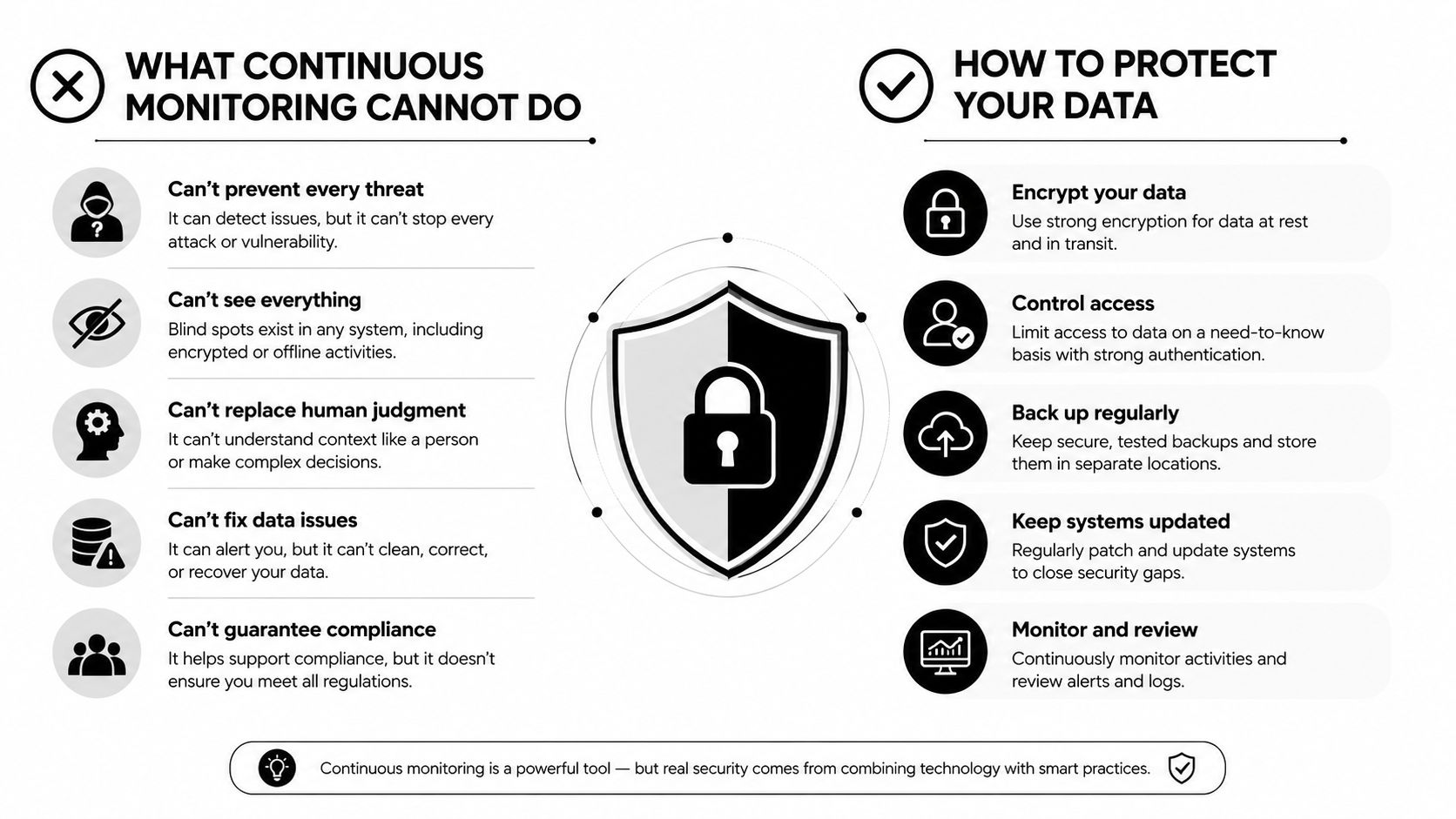
What Continuous Monitoring Cannot Do and How to Protect Your Data
Continuous rhythm monitoring gives you a strong window into your heart, but it doesn't turn a wearable into a final diagnosis. A single-lead consumer device can miss some rhythms, and even a good recording can't replace urgent care when symptoms are severe or changing fast. New chest pain, fainting, shortness of breath that's unusual for you, or a major shift in how you feel should be treated as a separate conversation, not something to sit on while you wait for a report.
The honest limit of a good monitor
A flagged rhythm is a lead, not a verdict. A “nothing detected” result can be useful, but only within the limits of the wear time and the device's design. Symptom-based and intermittent approaches can also miss atrial fibrillation, with sensitivity reported as low as 31% to 71% and negative predictive value from 21% to 39% in one review of continuous monitoring in AF AF monitoring review. That's a reminder to treat results carefully, especially if your symptoms keep returning.
Your data should stay yours
Privacy matters because rhythm data is personal health data, not a casual screenshot. Before sharing anything, check what the app collects, who can see your recordings, and whether you control export or deletion. If you're using a service that offers human review, decide in advance who you want to share reports with and whether you want them forwarded directly to your care team.
The strongest stance is simple. Use the monitor to learn, not to surrender control. When you understand the limits, you're less likely to overreact to every alert and more likely to use the data in a way that helps.
Your Next Step With Continuous Rhythm Monitoring
Start with the question that matches your situation. If you're a curious smartwatch user, keep a symptom log and use the device to spot patterns. If you're recovering after a cardiac event, ask whether a longer recording window makes sense while your heart is still settling. If you're adjusting a rhythm-affecting medication, ask how often your clinician wants to see the tracing and what changes should trigger a call. For a practical recovery-focused resource, the Pain and Sleep Therapy Center ablation recovery guide can help frame what a post-procedure monitoring period may feel like in everyday life.
A good first two weeks usually look simple. Wear the device consistently, note the time when symptoms happen, and save the report for your next appointment instead of trying to decode every line alone. If you want a workflow that fits into that routine, Qaly's remote patient monitoring overview shows how wearable recordings can be reviewed and organized before a visit.
What you're really doing is building confidence from evidence. Not every blip needs a conclusion, and not every quiet day needs a celebration. The goal is steadier information, so you can feel less at the mercy of random symptoms and more in control of your heart health.
Take the next step today, choose the device that matches your symptom pattern, start recording when it makes sense for your life, and bring the first clear report to your clinician so you can decide together what matters and what doesn't.
Unsure what your wearable ECG shows? Certified experts review it within minutes.


