





Hello Heart Hero. You're probably staring at a health decision that doesn't feel simple at all. Maybe you're deciding whether a wearable ECG service is worth paying for, whether to wait for an appointment, or whether the stress you're feeling is “enough” to justify another test. That kind of uncertainty is exhausting, especially when the healthcare system makes costs feel blurry and the benefits hard to judge.
Cost Effectiveness Analysis gives you a calmer way to think. It doesn't tell you what to feel, and it doesn't pretend every health decision can be reduced to a single number. It does help you ask a better question, which is, “If I spend more here, do I get enough more health benefit to make it worthwhile?”
For patients, that question matters more than is often understood. A tool can be cheap and still not be worth it if it creates confusion, false reassurance, or more worry. A tool can also cost more and still be a smart choice if it helps you act sooner, understand your body more clearly, or avoid a worse outcome later.
Welcome to a Clearer Way of Thinking About Health
You've probably had this experience. One option sounds medically sensible, another sounds more convenient, and a third sounds expensive but reassuring. Nobody gives you a clean answer, and the bill or subscription page doesn't tell you whether the choice is good for you.
That's where cost effectiveness analysis becomes useful. It's a way of comparing health options by looking at what they cost and what they achieve, instead of judging them only by price or only by hope. The CDC describes cost-effectiveness analysis as comparing interventions by estimating how much it costs to gain one unit of health outcome, like a life-year gained or a death prevented, and notes that positive net-cost interventions are reported as a cost-effectiveness ratio (CDC overview of cost-effectiveness analysis).
For a patient, that's a lot less cold than it sounds. It's really just the same logic you use when you decide whether a slightly pricier pair of shoes will last, or whether a better phone camera matters to you enough to justify the upgrade. Health decisions are just heavier because the “feature” might be peace of mind, symptom tracking, or earlier care.
Practical rule: don't ask only, “What does this cost?” Ask, “What does this change for me?”
That framing also fits personal tools like wearable ECG services. If you're trying to understand palpitations, the key question isn't whether a service exists, it's whether it gives you more clarity, less anxiety, or better information for your clinician than doing nothing and hoping the symptoms fade. If you want a patient-friendly example of remote tracking in action, the guide on remote patient monitoring benefits shows how monitoring can support day-to-day decisions without replacing medical care.
A different way to think about health value is to ask what problem you're trying to solve. If the issue is unexplained symptoms, the best option may be the one that helps you interpret them faster and more reliably, not the one with the lowest sticker price. For readers comparing broader wellness costs, Empire Medical Wellness on obesity costs is a useful reminder that the true expense of a health issue is often bigger than the first number you see.
What Are We Really Measuring in a Health Decision
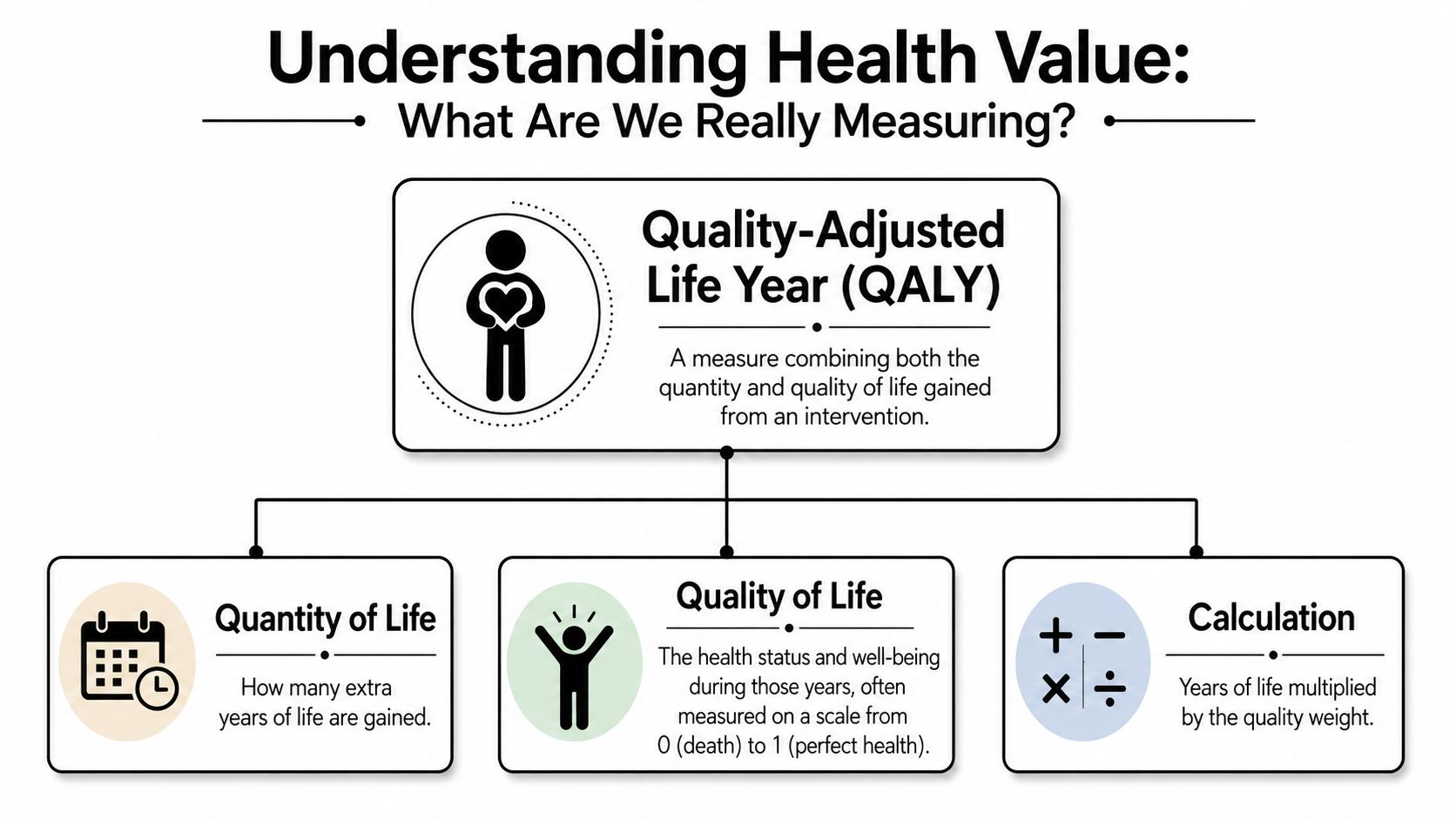
A good health decision isn't only about spending less. It's about understanding what kind of health gain you're buying, and whether that gain matters enough to you. That's why quality-adjusted life year, or QALY, sits at the center of many cost-effectiveness discussions.
QALY in plain language
A QALY combines how long you live with how well you live during that time. If one option helps you live longer but leaves you feeling unwell, and another gives you fewer years but better day-to-day health, QALY is one way to compare those trade-offs on the same scale. NICE has long used a benchmark range of about £20,000 to £30,000 per QALY as a practical reference point in appraisals (ICER on the QALY and value thresholds).
That doesn't mean every person should think in threshold terms at home. It means health systems use QALY as a common language for value, especially when treatments differ in both cost and clinical effect. The method is broad enough to capture direct medical costs and other consequences too, which is why it's used for drugs, devices, screening, and public-health programs.
ICER is the comparison tool
The other core term is incremental cost-effectiveness ratio, or ICER. In simple terms, it's the difference in costs between two strategies divided by the difference in outcomes. A technical methods summary defines it that way and notes that ICER is the standard metric for comparing a new intervention against usual care or another alternative (NCBI Bookshelf on ICER).
Think about it like comparing two phones. If the pricier one has a better camera, you don't ask whether the phone is “expensive” in general. You ask whether the extra money buys enough improvement in the feature you care about. ICER does the same thing for health. It asks how much extra you're paying for one extra unit of health benefit.
Simple translation: QALY helps define the benefit, ICER helps compare the price of that benefit.
This is why CEA can feel surprisingly practical from a patient's point of view. If a wearable ECG service helps you spot a rhythm issue sooner, or gives you enough reassurance to stop spiraling over every flutter, the question becomes whether that extra clarity is worth the cost to you. Different people will answer differently, and that's okay.
For a related patient-facing use case, the article on health data analytics helps show how measurement becomes useful only when it changes real decisions. The same logic applies here, because health value only matters when it changes what you do next.
A Look Under the Hood of the Analysis
The part often overlooked is how much the answer depends on the setup. Two analyses can look similar on the surface and still produce different conclusions because they count different costs or look over different time periods. That's why perspective matters so much.
Whose costs count
HERC recommends looking at cost-effectiveness from at least two reference-case perspectives, the health care sector perspective and society's perspective (HERC cost-effectiveness guidance). The health care sector view includes medical spending. The societal view is broader, and it includes patient costs, unpaid caregiver time, and other costs outside the health sector.
That difference matters in real life. If a wearable ECG service saves you time, reduces unnecessary visits, or helps a caregiver feel less burdened, a narrow medical-bill lens might miss part of the picture. A broader lens sees more of the actual experience.
How analysts keep the process organized
The 3ie training handbook lays out four practical tasks for building a cost-effectiveness framework, defining the intervention and scope, designing a cost collection template, collecting and adjusting cost data during implementation, and reporting costs and impact (3ie CEA training handbook). That sounds technical, but the idea is simple. Good analysis starts with clear boundaries, then follows the money and the outcome through the whole lifecycle, not just at the point of purchase.
The AIR economic evaluation standards add another useful discipline. They say cost analyses should be planned in advance whenever possible and recorded concurrently with implementation, with resource categories that are mutually exclusive and exhaustive, including personnel, materials and equipment, facilities, and other inputs (AIR standards for economic evaluation).
If you track costs only after the fact, you miss what actually made the intervention work, or made it expensive.
Models are just structured stories
Analysts often use models because real life branches. A decision tree is like a choose-your-own-adventure book, one choice leads to another, and each branch has a different result. A Markov model is more like a repeated cycle, where someone can move between health states over time.
For a patient, the point isn't to memorize model names. It's to understand that the result depends on the story being told, the costs counted, and the time window chosen. If you'd like a health-data example that keeps the focus on real-world tracking rather than abstract math, understanding body composition for wellness offers a similar lesson about why measurement only helps when it matches the question.
Common Pitfalls and Important Limitations
A lot of people lose trust in healthcare numbers because the numbers can look more certain than they really are. That skepticism is reasonable. Cost effectiveness analysis helps organize a decision, but it does not hand down a final verdict.

Averages can hide people
A major limitation is that standard CEAs often report average outcomes and can hide who gains and who loses. A 2017 guide on equity in cost-effectiveness analysis says routine CEAs “rarely provide information about who gains and who loses,” and warns that this can hide trade-offs between cost-effectiveness and equity. That matters because an intervention that looks fine on average can still miss the people who need it most.
A patient feels this gap quickly. A wearable ECG service may look efficient in a model, yet the experience can still differ if one person gets clear answers and another gets confusion, extra worry, or delayed follow-up. The average tells only part of the story.
Not everything important is easy to price
Peace of mind is real, even when it is hard to put into a formula. So are frustration, uncertainty, and the stress of waiting for symptoms to be “enough” to justify care. Standard economic models usually struggle to capture those human details.
The same issue can show up with a holter monitor, where the cost is not just the device or the test, but also the time, effort, and uncertainty around using it. A practical example is the cost of a Holter monitor, which reminds patients that the price of monitoring is rarely just one line on a bill. If a service helps you track symptoms and share clearer information with a clinician, the benefit may be partly emotional and partly practical. Those gains do not always appear neatly in a ratio, but they still matter to the person living with the symptoms.
Low coverage can change the answer
Another blind spot is implementation reality. Some interventions can look attractive on paper and still fail if coverage is low, access is limited, or the service is hard to deliver in practice. The NCBI methods chapter on cost-effectiveness says analysis should be complemented by disease burden, existing coverage, and health-system capacity, because some interventions can be highly cost-effective but still have low coverage.
That is why a careful reader should ask more than “Is it cost-effective?” Ask whether it works for people like you, in the setting you are in, with the follow-up you can realistically use. If an analysis ignores those questions, it leaves out part of the decision.
Putting It All Together with a Wearable ECG Service
Let's make this concrete. You've been getting palpitations, and you are choosing between waiting for a routine visit or using a wearable ECG service to capture what happens when symptoms appear. From a patient's point of view, this is exactly the kind of choice where cost effectiveness analysis helps organize the trade-offs without pretending to choose for you.
Consider All Costs, Not Just the Obvious Ones
The service fee is the most visible cost, but it is only one part of the picture. A patient-centered view also includes the time spent worrying, the strain of not knowing, and the chance of an unnecessary urgent visit when symptoms feel alarming and unexplained. A broader perspective matters because patient costs and unpaid caregiver time belong in the conversation too.
The service itself also needs to be defined clearly. A monitoring option is not only an app or a device, it is the full process of recording, reviewing, interpreting, and acting on the result. If that process is left vague, the comparison can miss what you are paying for.
Then look at the outcomes
The value side is more than “Did it catch something?” It can also include better symptom understanding, less worry, and information that is easier for a clinician to use. For some people, that drop in uncertainty is the main benefit. For others, the value comes from getting earlier direction about whether symptoms seem worth following up.
A wearable ECG service like Qaly fits this kind of decision because it offers human-reviewed analysis of wearable and at-home ECG recordings, which can turn vague symptoms into more organized information. That does not replace medical care, and it should not be treated as a diagnosis on its own, but it can improve the quality of the information you bring to your next appointment.
If you want to compare that option with other monitoring routes, the service details on Qaly pricing are one place to start. Use the price as one input, not the whole answer.
A patient's version of ICER
From the patient side, the ICER question becomes, “What extra cost am I taking on for each extra bit of clarity, reassurance, or earlier warning?” That is not always something you can calculate at home, but it is a useful way to think. If one choice is inexpensive but leaves you stuck in fear, and another costs a little more but helps you act sooner with better information, the second option may be the better value for you.
A simple rule helps here. If a tool lowers uncertainty and improves the quality of the next medical conversation, that benefit belongs in the decision.
That is the heart of patient-centered value. An expensive choice is not always worth it, and a cheap choice is not always a good deal. The right option is the one that best fits your symptoms, your tolerance for uncertainty, and the kind of help you need.
Get your ECG checked by certified experts within minutes on the Qaly app.


Using This Knowledge for Your Health Journey
You don't need to become a health economist to use cost effectiveness analysis well. You just need to stop treating price as the only signal and start asking a better question about value. That shift is powerful because it turns a confusing choice into a structured one.
The most useful ideas are simple. QALY helps describe what kind of health gain you're getting. ICER helps compare the extra cost of that gain. Perspective reminds you that a decision can look different depending on whether you count only medical spending or also your time, stress, and caregiver burden.
For patients, especially those dealing with palpitations or other hard-to-interpret symptoms, this way of thinking can reduce panic. It helps you separate “cheap” from “worth it,” and “expensive” from “bad.” It also gives you better language for talking with clinicians, because you can ask about outcomes that matter to you, not just whether something is available.
The main takeaway is simple. Cost-effectiveness analysis is a decision tool, not a command. It can't tell you what your peace of mind is worth, but it can help you notice when peace of mind is part of the value equation.
If you're weighing a wearable ECG service, a follow-up visit, or another monitoring option, use this framework to compare the actual trade-offs. Then choose the path that gives you the clearest next step, and bring that information to your clinician with confidence.
Weighing a wearable ECG service? Certified experts review your ECG within minutes.


