





Hello Heart Hero. You check your smartwatch, see a strange spike or a skipped beat, and then spend the next hour wondering whether it was a harmless blip or something worth worrying about. That mix of curiosity and doubt is exactly where health data analytics becomes useful, because it helps turn raw heart readings into something you can understand.
A lot of people feel underinformed by the healthcare system, especially when symptoms come and go. If you've ever wished for a calmer way to make sense of ECG data from your watch or home device, you're not being dramatic, you're looking for clarity. A helpful overview of how data-driven care is expanding across medicine is the AI analytics in healthcare industry discussion from Wonderment Apps, and if you want a practical example of wearable ECG interpretation, Qaly's guide on ECG for Apple Watch fits naturally into that conversation.
Starting Your Health Data Analytics Journey
Your heart can feel mysterious when it acts up in brief, scattered moments. One second you're fine, the next you feel a flutter, your watch vibrates, and you're left trying to decide whether the reading matters or just happened to catch a noisy signal.
Health data analytics gives those moments a structure. Instead of treating every reading like a separate mystery, it looks for patterns across time, devices, and context. That's why the field has moved so quickly from simple recordkeeping into predictive workflows, with machine learning reported in 40% of healthcare data analytics platforms for early disease detection, according to the market overview in the verified data set (WorldMetrics).
Why this matters when your heart feels unpredictable
Wearable ECG data is especially easy to misread when you're anxious. A single odd tracing can feel louder than it really is, which is why human judgment still matters so much in heart data review.
Practical rule: a single reading should rarely carry the whole story. Trend, timing, and review all matter.
That's also why people often look beyond traditional appointment-only care. Services built around human-reviewed ECG interpretation can help turn uncertainty into a more usable summary, especially when your symptoms don't line up neatly with clinic hours. If you've ever wondered how that kind of interpretation works in practice, the broader problem is the same one seen across healthcare data: lots of information, but not enough useful action.
The challenge isn't only technical, it's emotional too. Patients want reassurance without being dismissed, and they want data without drowning in jargon. That's the lens for everything that follows.
What Health Data Analytics Means for Your Heart
Think of your heart data like a weather report that starts out as scattered clouds, wind shifts, and tiny changes in pressure. On their own, those signals don't tell you much. Once they're organized, though, they can suggest whether the day is calm, unstable, or worth watching more carefully.
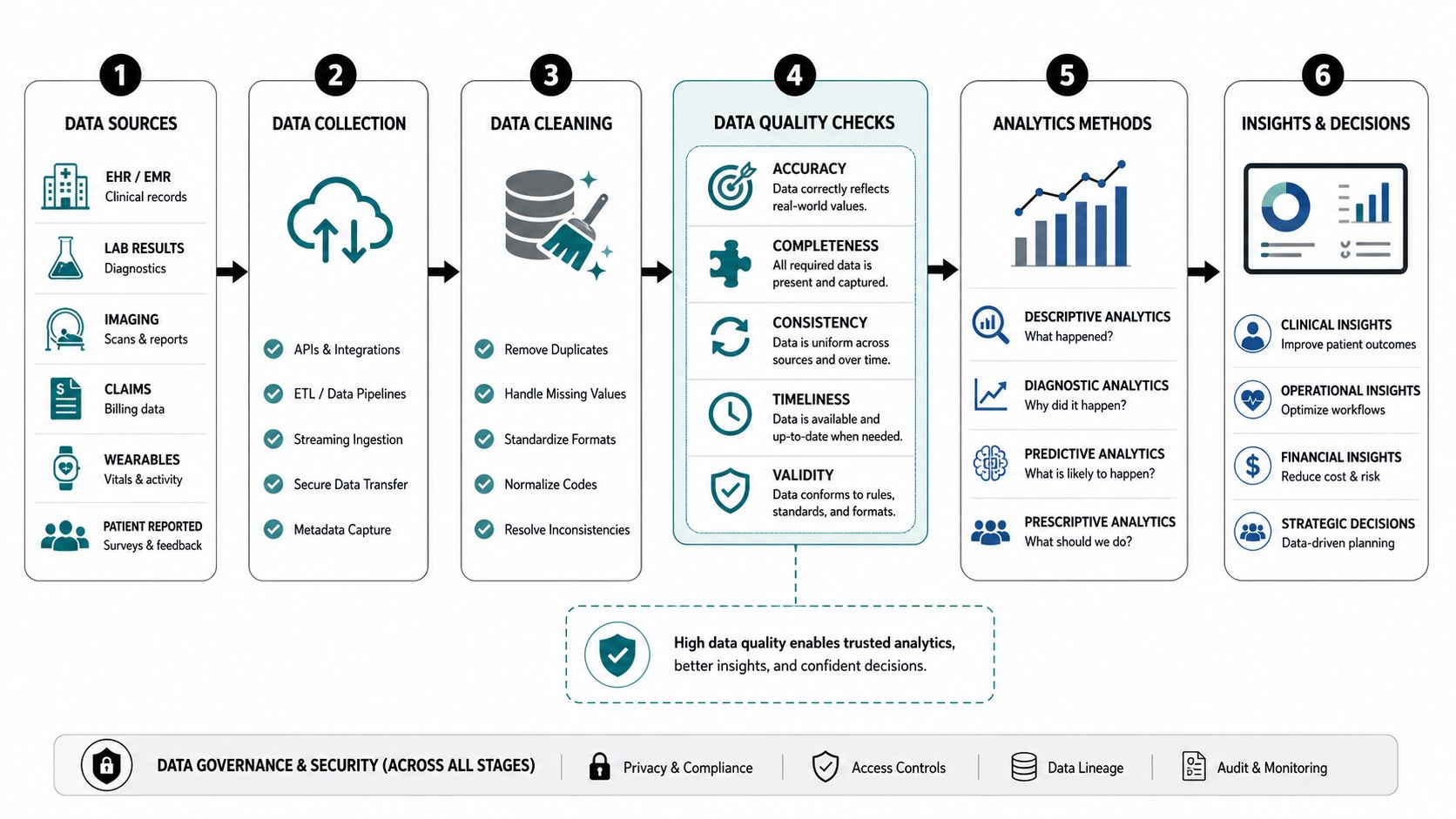
That's the practical meaning of health data analytics for heart data. It takes raw ECG traces, rhythm notes, symptom reports, and device readings, then turns them into a clearer story you can act on. Modern healthcare analytics is built for that kind of mixed-data work, combining EHR records, claims, imaging, genomics, patient-reported data, and wearable-device streams into one pipeline, with the quality of the output depending on normalization, entity resolution, and interoperability across sources (NCBI Bookshelf).
From squiggles to a readable story
A smartwatch ECG can look like a line of squiggles to many individuals. Analytics tries to answer a simpler question, what happened, what might happen next, and what should I do about it.
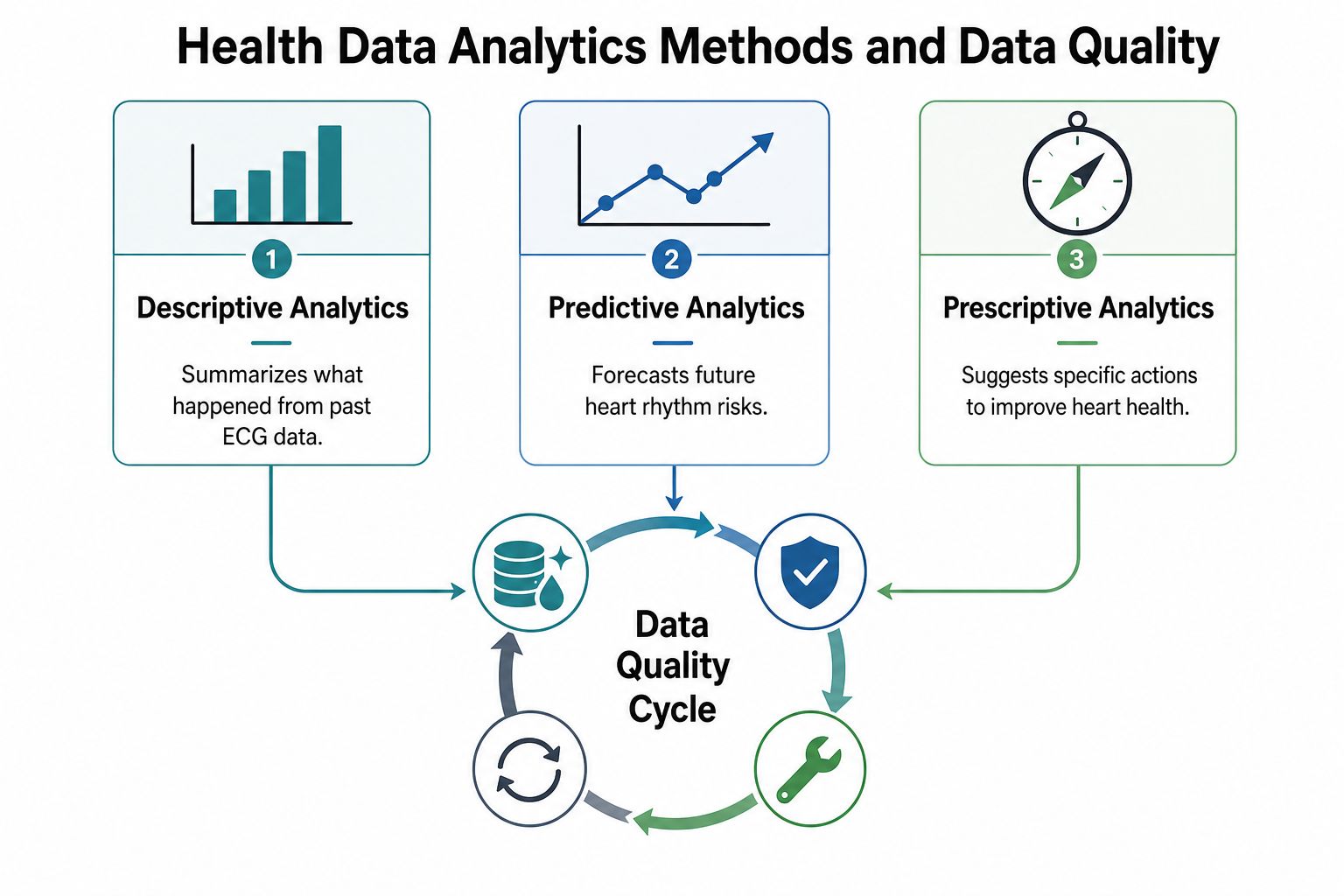
That's why the field usually gets grouped into three broad methods. Descriptive analytics summarizes what happened, predictive analytics estimates what might happen, and prescriptive analytics suggests what to do next. For heart users, that can mean moving from “I felt something weird” to “this pattern keeps recurring after exercise” to “this is worth sharing with a clinician.”
Why mixed data needs careful handling
The useful part of analytics isn't just the model. It's the pipeline. Healthcare data is messy because it comes from many places, and each source uses its own language, timing, and format. When a rhythm strip, symptom note, and device timestamp don't line up, the story can get distorted.
A clean interpretation starts long before the final report. The data has to be organized so the right signal can survive the noise.
That's also why analytics in heart care feels more like translation than magic. The goal isn't to replace your experience. It's to make your experience easier to trust.
Health Data Analytics Methods and Data Quality
A useful way to think about analytics is to separate the method from the input. The method tells you how the data is being read, while data quality tells you whether the reading can be trusted in the first place. If the input is messy, even a smart method can point in the wrong direction.
The three methods in plain English
Descriptive analytics answers, “What happened?” For wearable ECG users, that might mean counting how often an irregular rhythm appeared or noticing whether a symptom happened at rest or after activity.
Predictive analytics asks, “What might happen next?” In heart data, that can help flag patterns that deserve attention before they become a bigger problem.
Prescriptive analytics asks, “What should happen now?” That might mean suggesting a repeat recording, a review by a human technician, or a conversation with a clinician before the next appointment.
These methods are useful because they move you from raw information toward decisions. But they only work well when the underlying data is clean enough to support them. A guide for health information professionals describes the workflow as collecting raw data, processing it by organizing and cleaning it to remove errors, corruptions, inconsistencies, or outliers, then analyzing and visualizing it before turning the results into action (USF Health Online).
Why wearable ECG data is especially sensitive to cleanup
Intermittent recordings can be noisy. A wrist shift, a loose strap, motion, or a partial recording can make a trace harder to interpret. That's why the cleaning stage matters so much when a person is trying to understand heart rhythm data from a watch rather than a hospital monitor.
Good workflow: collect, clean, analyze, then act. Skipping the middle step is how people end up trusting bad readings.
If you like seeing the technical logic behind heart-rate and rhythm analysis, Qaly's explanation of how to calculate HRV from ECG is a useful companion read, because it shows how one ECG recording can support more than one kind of insight.
A practical check before you trust a reading
- Look for consistency: If the signal looks odd only once, don't rush to conclusions.
- Check the context: Motion, stress, caffeine, and poor contact can all muddy a trace.
- Ask whether the data was reviewed: Human review helps separate a noisy moment from a meaningful pattern.
- Prefer reports that explain the result: A useful summary tells you what was seen and why it matters.
- Treat trends as more reliable than one-off spikes: Repetition is often more informative than drama.
Healthcare teams that work well with analytics usually treat data quality as part of the job, not an afterthought. That mindset shows up in other digital healthcare workflows too, including the healthcare test automation success stories from Faberwork LLC, where reliability is the point, not the bonus.
Health Data Analytics in Arrhythmia Detection
A smartwatch buzzes during a meeting. You check it later and see an irregular tracing. One part of you wants to ignore it, while another wants a clear answer right away.
That is the point where analytics stops feeling abstract. A systematic review in healthcare found that big data analytics can support real-time analysis of large and varied datasets, with low-to-moderate quality evidence showing moderate-to-high accuracy for several tasks, including diagnosing and predicting complications of diabetes, diagnosing mental diseases, predicting suicidal behaviors, and diagnosing chronic diseases (PMC). For heart users, the useful idea is simpler, analytics can surface patterns that routine care may miss because the signal is intermittent or hard to capture.
A wearable reading becomes a reviewable event
Arrhythmias often appear at inconvenient times. If your heart rhythm looks normal by the time you reach a clinic, the question is no longer whether the symptoms were real, it is whether enough evidence remains to interpret them.
Human-reviewed ECG services help bridge that gap. Qaly, for example, reviews wearable ECGs with technician input so a patient gets a narrative report instead of only a line on a screen. That kind of review matters because people do not just want a label, they want help deciding whether the rhythm is something to monitor, share, or bring to a doctor. Services that combine wearable capture with review also fit the broader idea of continuous rhythm monitoring, where repeated readings matter more than a single snapshot.
The clearest insight is the one you can explain to another human without losing the meaning.
Why pattern detection changes the experience
Pattern detection helps because it lowers the chance that you will overreact to one noisy trace or underreact to repeated symptoms. A patient may notice that palpitations cluster at certain times of day, after exertion, or during stress. Analytics does not replace the patient's observation, it organizes it.
The broader healthcare literature also shows that analytics can identify risk factors, support early disease detection, and help with more personalized treatment planning. For wearable users, that often turns the next step into something practical. Not a dramatic headline, just a clearer decision about what to watch, share, or discuss with a clinician.
A calmer path for the patient
A wearable ECG can feel uncertain in the moment, especially when the tracing looks messy or the symptoms are brief. Human review helps turn that uncertainty into something usable, because a trained reviewer can separate a noisy moment from a rhythm that deserves attention.
That matters for patients outside traditional care too. A person who is not sitting in a clinic can still get a reading that is reviewed, explained, and framed in plain language. That shift from raw signal to interpreted event is what makes health data analytics useful in arrhythmia detection, it gives patients a clearer way to respond without treating every skipped beat like an emergency.
Get your ECG checked by certified experts within minutes on the Qaly app.


Privacy and Interoperability in Health Data Analytics
People are right to ask who sees their heart data. That concern isn't paranoia, it's basic common sense. Health data is personal, and a useful service should treat it that way.
The bigger system problem is interoperability. Brookings describes the health-data environment as splintered, with interoperability still a foundational barrier, and the same concern appears in review work noting fragmented systems and representativeness bias as major obstacles to turning analytics into better outcomes (Brookings). In plain language, if your watch, app, and clinician can't share information cleanly, the story gets chopped into pieces.
What fragmentation does to heart insights
When data stays locked in separate systems, people lose context. A clinician may see a symptom note without the matching ECG. An app may show a trend without the human interpretation that gives it meaning. That makes it harder to turn a possible signal into a responsible decision.
A simple rule helps here. If the workflow only stores data, it's not enough. If it turns the data into a shareable, understandable summary, it's doing something useful.
Questions worth asking before you share your readings
- Who can access the ECG recordings? You want a clear answer, not vague reassurance.
- Can you export your data? Portability matters when you need a second opinion.
- Is there human review, or only automated labeling? The difference is important when a tracing is borderline.
- How are results explained? Good reports should make the finding easier to discuss with a clinician.
- Does the service support device data from your watch or monitor? Compatibility saves frustration later.
If you use Fitbit-based recordings, Qaly's guide on exporting your ECGs from Google Health (formerly Fitbit) is a practical example of the kind of data movement people often need when they want their information to travel with them.
The reassuring part is that privacy and usefulness don't have to be enemies. A careful workflow can respect your information while still making it actionable.
Best Practices for Health Data Analytics Users
The safest way to use heart data is to build steady habits, not chase every blip. The people who get the most value from analytics usually do a few ordinary things well, and ordinary is good here.
Health reviews point out that analytics can support early detection, treatment planning, and public health monitoring. The larger lesson is simple. Data matters most when it helps people make better decisions, not when it just piles up in an app or dashboard. For individuals and clinicians, that means the workflow should stay simple enough to repeat and clear enough to trust.
Five habits that make readings more useful
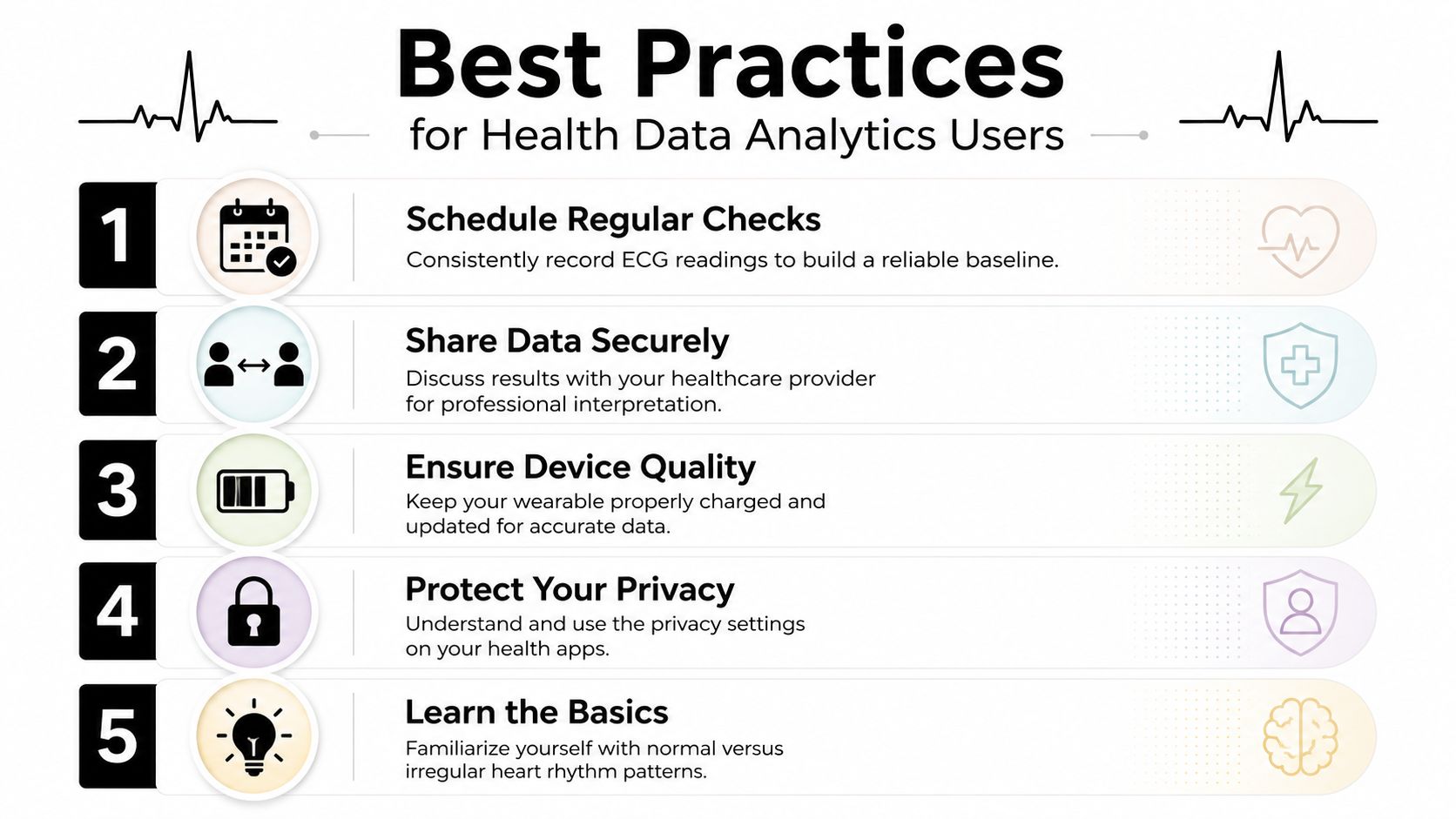
- Schedule regular checks. A steady baseline makes unusual readings easier to notice, the same way a familiar heartbeat pattern helps you spot a skipped beat.
- Share data securely. If a clinician can review the same rhythm history you saw, the conversation usually becomes more focused and less confusing.
- Keep the device in good shape. A charged, updated wearable is more likely to capture cleaner readings, and clean readings are easier to interpret.
- Protect your privacy. Review app settings before symptoms make you rush, because hurried choices are where people often miss permissions they care about.
- Learn the basics. Knowing the difference between a noisy trace and a meaningful one helps you stay calm and ask better questions.
These habits do not require special training. They just make the data easier to trust, like keeping notes in one notebook instead of scattering them across a desk.
What clinicians should look for
Clinicians get more value when the patient brings more than a screenshot. A trend report, symptom timing, and human-reviewed interpretation can reduce guesswork during the visit. That matters because a tracing that looks unclear on a watch screen can become easier to understand once someone trained in ECG review has looked at it.
Qaly fits into that kind of routine by providing human-reviewed ECG interpretation for wearable recordings. For patients who are unsure whether an alert means trouble or noise, that extra review can turn an uncertain signal into information they can discuss.
Good practice for both sides: do not ask whether the device found something scary. Ask whether the data is good enough to support a decision.
The more repeatable the process, the less stressful it becomes. That matters for people who are already worried about their heart and do not want every alert to feel like an emergency.
Moving Forward with Health Data Analytics
If your heart has been sending mixed signals, you do not have to keep guessing. Health data analytics, cleaner workflows, and human review can turn uncertain readings into something easier to trust and discuss.
A useful next step is to prepare your data before a clinician visit. Bring the rhythm trace, the symptom timing, and any notes about what you were doing when the alert appeared. That combination gives the clinician a clearer picture, the way a few well-labeled photos make a messy story easier to follow. A single screenshot can leave too many gaps, while a short log can show whether the reading lines up with exercise, stress, rest, or an alert that needs more attention.
The value lies not in collecting more data for its own sake. It is in sorting fragmented information into something the right person can use at the right moment. Wearable ECG services help with that by taking a confusing signal and turning it into a report that is easier to review, share, and talk through. For people who feel uneasy about an alert, a human-reviewed interpretation can separate signal from noise and make the next conversation more concrete.
Qaly fits into that kind of workflow by providing human-reviewed ECG interpretation for wearable recordings. If a watch tracing looks unclear, that extra review can help patients decide whether they are seeing a true rhythm issue or a reading that needs context. It also gives patients something more useful than a raw alert, since they can bring a plain-language report to their clinician instead of trying to explain a blurry strip from memory.
From there, a calmer routine helps. Check readings regularly, keep the device reliable, protect your privacy settings, and ask for human review when the result does not make sense. If you want to understand wearable ECGs better, choose a process that explains the result plainly and gives you a record you can use later, not just a notification that disappears after a few minutes.
If your smartwatch keeps catching rhythms you do not understand, do not sit with the uncertainty alone. Use a human-reviewed ECG service, bring the report to your clinician, and keep a simple log of when symptoms happen so patterns are easier to spot and less frightening to revisit.
Unsure about a smartwatch ECG? Certified experts review it within minutes.


