





Hello Heart Hero. You may be reading this after seeing the words “heart cancer” on a report, hearing them during an appointment, or searching late at night for a survival percentage that can tell you what happens next. That fear makes sense. But the phrase heart cancer survival rate doesn't point to one disease, so one number can't accurately describe every person's outlook.
A benign growth, a malignant tumor that began in the heart, and cancer that spread to the heart are medically different situations. Their treatments and expected outcomes can differ sharply. The most useful first step isn't finding the highest or lowest percentage online. It's identifying what kind of tumor is present, where it began, whether it can be removed, and how it responds to treatment.
Understanding What You Are Really Searching For
A person might search for survival information after an imaging scan reveals a mass near the heart. Another might already have a pathology report naming a sarcoma, lymphoma, or metastatic cancer. Someone else may have been told about a benign tumor and find frightening statistics while looking for reassurance. These readers are using the same search phrase, but they aren't asking about the same medical condition.
That explains why online answers can feel contradictory. One page may combine all heart tumors, while another discusses only primary malignant cardiac tumors. A third may describe cancer that reached the heart from another organ. The label matters because the biology matters.
A percentage is a group estimate
Survival statistics describe what happened to groups of patients diagnosed in particular circumstances. They don't predict the exact future of one individual. The estimate may include people with different tumor locations, stages, treatments, ages, and overall health.
Median survival can also be misunderstood. If a study reports a median survival of several months, that doesn't mean every patient will live exactly that long. It means half the patients in that study lived longer and half lived for less time. It also may not reflect newer diagnostic tools or a treatment plan customized for one person's tumor.
A useful question: “Which group of patients does this statistic describe, and does that group match my diagnosis?”
The honest message is serious. Primary malignant tumors that begin in the heart often have a poor prognosis. Yet a general statistic shouldn't replace an individualized discussion with a cardiac oncology team. A tumor that can be completely removed is a different clinical problem from one that has invaded vital structures or cannot be safely resected.
You deserve clear explanations, not vague reassurance or a single alarming number. Ask your clinicians to translate the diagnosis into plain language, explain what is known, and identify what remains uncertain. That conversation gives the statistics context and helps you focus on decisions that may still be available.
The Three Types of Heart Tumors and Why They Matter
A mass found near the heart can represent very different diseases. A harmless growth arising in the heart, an aggressive cancer that starts there, and a cancer that has traveled from another organ may look similar on an initial scan. Their treatment and outlook can be very different, so the first useful step is identifying which category fits.
Benign heart tumors
A benign tumor is not cancer, yet its position can still create serious problems. It may obstruct blood flow, interfere with a valve, press on the heart's electrical pathways, or trigger abnormal rhythms. If surgeons remove it successfully, long-term outcomes may be close to normal in appropriate cases. Follow-up still depends on the tumor type and the person's overall health.
“Benign” describes how the growth behaves, not how little it matters. It generally does not invade and spread like a malignant cancer. Doctors still need to assess its size, location, attachments, and effect on heart function. A small mass in a difficult location may cause more trouble than a larger one that does not affect circulation.
Primary malignant cardiac tumors
A primary malignant cardiac tumor begins in the heart or nearby structures. This group includes different cell types, and each can grow, spread, and respond to treatment differently. Some extend into surrounding tissue, some travel to distant organs, and some remain difficult to identify until they affect heart function.
This is the category most often meant when sources discuss a poor heart cancer survival rate. A large U.S. analysis reported a median survival of 7 months, with survival at 40.7% after 1 year, 15.6% after 3 years, and 9.8% after 5 years (PubMed analysis of primary malignant cardiac tumors). Another multi-institutional study reported survival of 81.2% at 30 days, 45.3% at 1 year, and 11.5% at 5 years (National Cancer Database study). These figures differ because the studies included different patients, treatment settings, and methods.
Metastatic tumors involving the heart
A metastatic cardiac tumor started in another part of the body and later reached the heart. Its outlook depends largely on the original cancer, how far it has spread, available treatments, and the extent of cardiac involvement. The heart may be one affected site within a wider illness rather than the starting point.
A review associated cardiac metastases with 12-month survival around 38% after the metastasis is diagnosed and distinguished metastatic, benign, and primary malignant tumors (review of cardiac tumors and survival outcomes). That figure cannot predict one person's outcome because the original cancers and treatment plans vary.
Testing helps clarify which category is present. An echocardiogram may identify a suspected mass, while other scans and pathology add information about its structure and origin. You can learn more about the role of a transthoracic echocardiogram. If symptoms or care needs make travel difficult, families may ask clinicians whether in-home heart failure treatment could support related heart-care needs. It does not replace cancer evaluation, but coordinated care can help when heart function is affected.
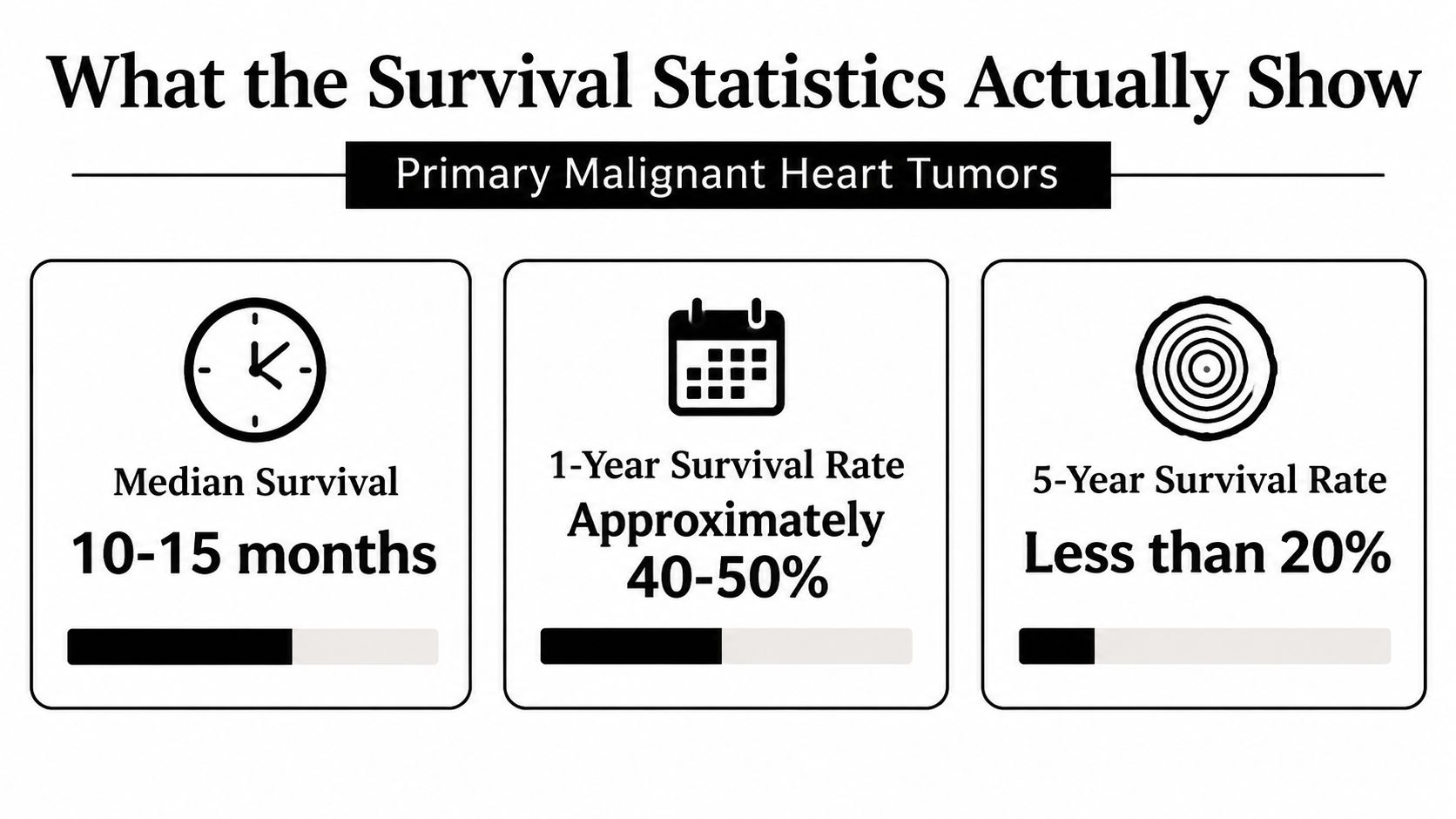
What the Survival Statistics Show
A survival percentage is a map of group outcomes, not a personal countdown. Median survival marks the midpoint of a study group. One-year, three-year, and five-year rates show how many people in that group were alive at each interval, based on when the study began counting, such as diagnosis, treatment, or surgery.
For primary malignant cardiac tumors, historical data suggest improvement, although the disease remains difficult to treat. A Circulation study found one-year survival increased from 32% in 1973 to 1989 to 50% in 2000 to 2011. Three-year survival rose from 17% to 24%, while five-year survival increased from 14% to 19% across those periods (Circulation study of malignant cardiac tumors).
The same analysis reported overall median survival of 10 months, with more than 80% of patients dying within 20 months of diagnosis. These figures describe primary malignant tumors in historical study populations. They should not be applied automatically to benign growths or tumors that spread to the heart from another cancer.
Why study results differ
A study reporting a seven-month median and another reporting a ten-month median may both be accurate. Their groups can differ in tumor type, treatment period, referral center, disease stage, and the definition of survival. Some studies count from diagnosis, while others count from surgery or identification of a metastatic lesion.
Recent data summarized in a review reported one-year, three-year, and five-year survival around 45.6%, 18.8%, and 11.2% for primary malignant cardiac tumors. Older SEER analyses reported 46%, 22%, and 17%, showing how estimates shift between datasets and eras. These figures come from populations with different mixes of primary tumors and clinical circumstances, so they are useful for context rather than prediction.
Tumor cell type also changes the comparison. Cardiac sarcomas and mesotheliomas have been reported at about 47% at 1 year, 16% at 3 years, and 11% at 5 years, while cardiac lymphomas showed 59%, 41%, and 34% at the same time points (Journal of the American Heart Association analysis).
Heart function can affect the outlook and may require separate discussion, including information about cardiomyopathy life expectancy.
Survival statistics describe a population. Your pathology, scans, treatment response, and surgical options make your situation more specific than the headline number.
A tumor that responds well to therapy may not resemble the average case in an older dataset. The statistics still provide a frame for discussion, while your medical team supplies the details that make the picture personal.
Get your ECG checked by certified experts within minutes on the Qaly app.


Factors That Change the Outlook Significantly
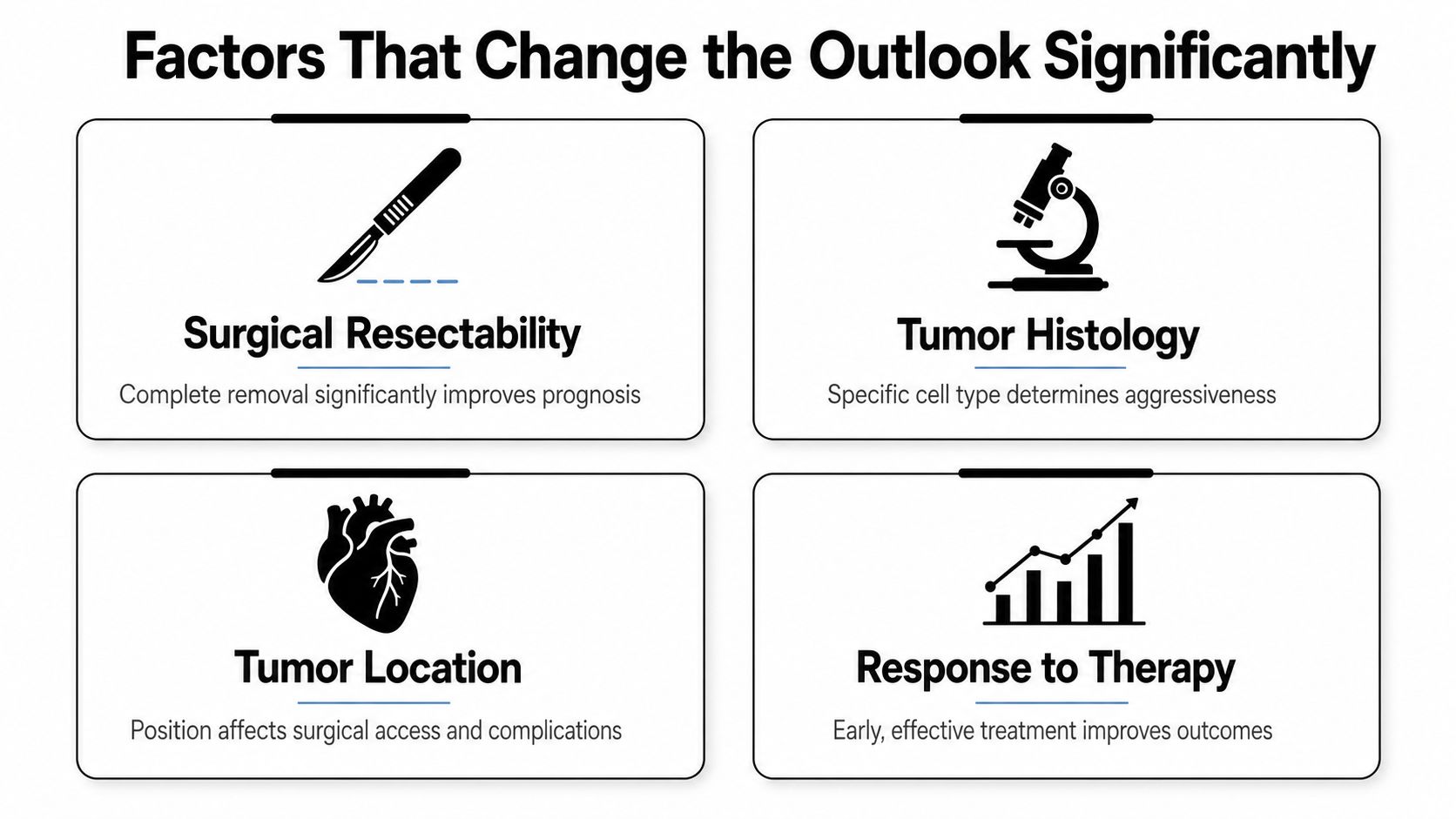
Two people may both hear “heart cancer” yet face very different situations. The outlook depends on whether the growth is a primary malignant tumor, cancer that has spread to the heart, or a benign mass, as well as its pathology, location, removability, and response to treatment. A single survival figure cannot represent all three conditions.
Complete removal can change the trajectory
Whether a primary malignant tumor can be removed safely often affects the outlook. One review found median overall survival of 38 months for completely resected disease, compared with 11 months for unresectable disease (review of primary cardiac malignancies). These figures describe selected patient groups, not a promise for an individual. The heart contains muscle, valves, coronary vessels, and electrical pathways, so surgeons must balance possible cancer control with the risk of damaging heart function.
Cleveland Clinic reports survival for primary heart tumors of 50% at 1 year, 24% at 3 years, and 19% at 5 years. It also reports average life expectancy of about 6 months without surgical treatment, while surgery may extend survival beyond 1 year and, after complete removal, sometimes several years (Cleveland Clinic overview of heart cancer).
Pathology gives the tumor a medical identity
Histology, the study of tumor cells, helps clinicians judge aggressiveness and select treatment. A lymphoma may respond to systemic therapy, while a sarcoma may require difficult local surgery. Cancer that reached the heart from another organ follows the behavior and treatment needs of its original cancer, so its outlook should not be combined with that of a primary cardiac malignancy.
Location adds another layer. A mass near a valve may obstruct blood flow. One embedded in the heart wall may be harder to remove completely, while a tumor near the conduction system can cause rhythm problems. Proximity to major vessels may also limit surgical options.
The extent of disease, overall health, and response to therapy can move an individual above or below a population average. Your treating team can connect those details to a more personal estimate.
Treatment Pathways and Ongoing Monitoring
Treatment usually begins with a careful effort to define the tumor. Imaging may include echocardiography, cardiac MRI, CT, or other scans. A tissue diagnosis may be needed, although the safest method depends on location and the risk of bleeding, obstruction, or other complications.
A plan built around the tumor
Surgery may be considered when the tumor can be removed safely and completely. Chemotherapy, radiation, immunotherapy, or other systemic approaches may be used according to the pathology and extent of disease. Some people receive treatment before surgery to shrink or control a tumor, while others need therapy afterward to address the risk of recurrence.
A multidisciplinary team may include cardiology, cardiac surgery, oncology, radiology, pathology, and specialists in rhythm disorders. Ask how these clinicians reached their recommendation and whether the plan aims to remove disease, control growth, relieve symptoms, protect heart function, or combine several goals.
Researchers and clinicians also discuss possible roles for repurposed cardiovascular drugs for cancer, but any such approach needs careful review for evidence, interactions, and suitability with your prescribed treatment. A discussion of this topic is available from Hirschfeld Oncology's review of repurposed cardiovascular drugs.
Monitoring protects both heart function and treatment options
Follow-up commonly uses repeat imaging and clinical assessments. ECGs can help identify rhythm changes, while echocardiography can evaluate pumping function and valves. Cardiac MRI may provide detailed tissue and structural information, and patients can review an explanation of cardiac MRI before discussing the test with their clinician.
Wearable ECG devices can record episodes of palpitations or irregular rhythm between appointments. They don't diagnose a tumor or replace a clinical ECG, but recordings may give the care team useful information about timing and symptoms. Seek urgent care for severe chest pain, fainting, sudden severe breathlessness, or other emergency symptoms rather than waiting for a wearable reading.

Questions to Ask Your Medical Team and Next Steps
The most helpful appointment turns a frightening label into a defined plan. Bring the pathology report, scan reports, medication list, and a written record of symptoms. If possible, take someone with you who can listen and help remember the answers.
Ask direct questions:
- Diagnosis: Is this benign, a primary malignant cardiac tumor, or a metastasis from another cancer?
- Pathology: What exact tumor type and grade did the pathology identify?
- Extent: Where is the tumor, and has it spread beyond the heart?
- Surgery: Can the tumor be removed completely, and what would make surgery unsafe?
- Treatment: Is chemotherapy, radiation, immunotherapy, or another approach recommended before or after surgery?
- Outlook: Which survival data best match this diagnosis, and what features place me above or below that estimate?
- Monitoring: Which scans, ECGs, and heart-function tests will I need, and what symptoms should prompt an urgent call?
- Support: Would a second opinion at a specialist cardiac oncology center change the available options?
A second opinion isn't a rejection of your current team. It can help confirm the diagnosis, clarify resectability, and identify treatment alternatives. Services such as Qaly's second-opinion resource may help you understand how to prepare for that discussion.
Don't leave with only a percentage. Leave with the tumor's name, its location, the treatment goal, the next test, and the date of the next decision. Those details are more useful than a generic search result because they connect the statistics to your actual care.
If you're dealing with a new diagnosis, suspected tumor, or unexplained palpitations, write down your questions today and schedule a conversation with a qualified medical team. If you use a wearable ECG, Qaly can connect recordings from devices such as Apple Watch, Fitbit, Samsung, Kardia, or Withings to human-reviewed rhythm analysis that you can discuss with your clinician. It isn't a substitute for emergency care or cancer treatment, but it may help you organize rhythm information between appointments.
Noticing rhythm changes? Certified experts review your ECG within minutes for clarity.


