





Hello Heart Hero. You're sitting there after a rough day, trying to unwind, and your chest suddenly gives a little flutter. Maybe your watch lights up with an ECG prompt. Maybe you check your pulse more than once. Maybe you're telling yourself it's “just stress,” but your body doesn't feel easy enough to ignore.
That uneasy moment is exactly why how to reduce stress naturally matters in a real-world way, not as a vague wellness slogan. Stress can show up in the heart, breathing, sleep, digestion, and even the way every skipped beat feels louder than it should. Natural stress relief won't replace medical care when something needs attention, but it can lower the background strain that makes symptoms feel bigger and more frequent.
What Stress Does to Your Heart and Body
A sudden flutter in the chest can make everything else feel louder. You might be in a meeting, sitting on the couch, or halfway to sleep, and then your pulse feels jumpy enough to pull your attention straight to your heart. In that moment, the question usually comes fast: stress, rhythm, or both?
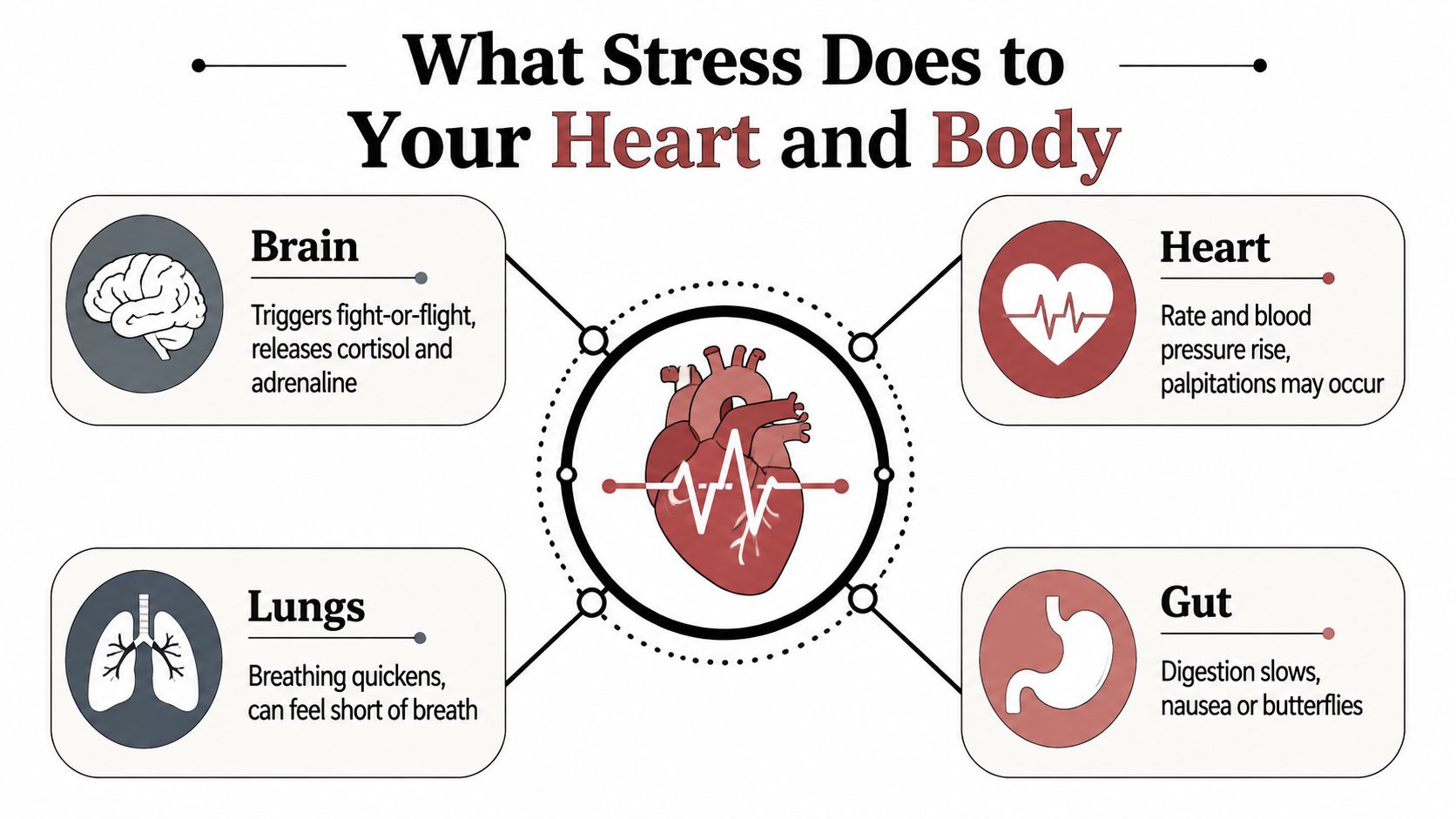
Stress is a full-body response, not just a feeling in your mind. It can raise heart rate, change breathing, and leave digestion feeling unsettled. Natural stress tools make sense here because they work with the body's recovery systems instead of asking the body to calm down by force.
The body reacts before the mind catches up
When stress switches on, the body moves into a ready-for-action state before your thoughts have fully named what is happening. The heart may beat faster, breathing can get shallow, and the gut may feel tight, uneasy, or fluttery. That pattern can feel scary, especially if you already notice palpitations, but the body is responding to a real physical signal.
If you want a simple overview of the different kinds of stress, the Qaly article on the 4 types of stress is a useful companion read. It helps separate everyday strain from more persistent overload without turning the topic into a clinical lecture.
Practical rule: if symptoms get louder when your day gets louder, stress may be part of the picture, but that still does not explain everything on its own.
A helpful way to think about it is that the nervous system can press the gas pedal before your mind has time to check the dashboard. That is why a racing heart can feel so confusing at home, especially if you wear an ECG device and keep seeing changes that look similar from one episode to the next. A fast pulse, an extra beat, and a stress surge can overlap, so tracking the pattern matters as much as noticing the sensation.
Why natural approaches can help
Natural methods matter because they can quiet some of the background noise in your system. A calmer nervous system often means less muscle tension, steadier breathing, and less of the spiral where one skipped beat turns into ten minutes of worry. The Cedar Hill Behavioral Health stress guide is a useful reminder that stress management works best as part of daily life, not only during a crisis.
That also keeps the picture honest. You do not have to choose between wellness habits and medical care. Movement, breathing, sleep, and mindfulness can support your body, while symptoms that feel new, severe, or different still deserve a clinician's eye. If you have ever felt brushed off because “it is probably anxiety,” that reaction makes sense, and a clearer framework can help you watch your heart more confidently at home.
Breathing Techniques You Can Use in the Moment
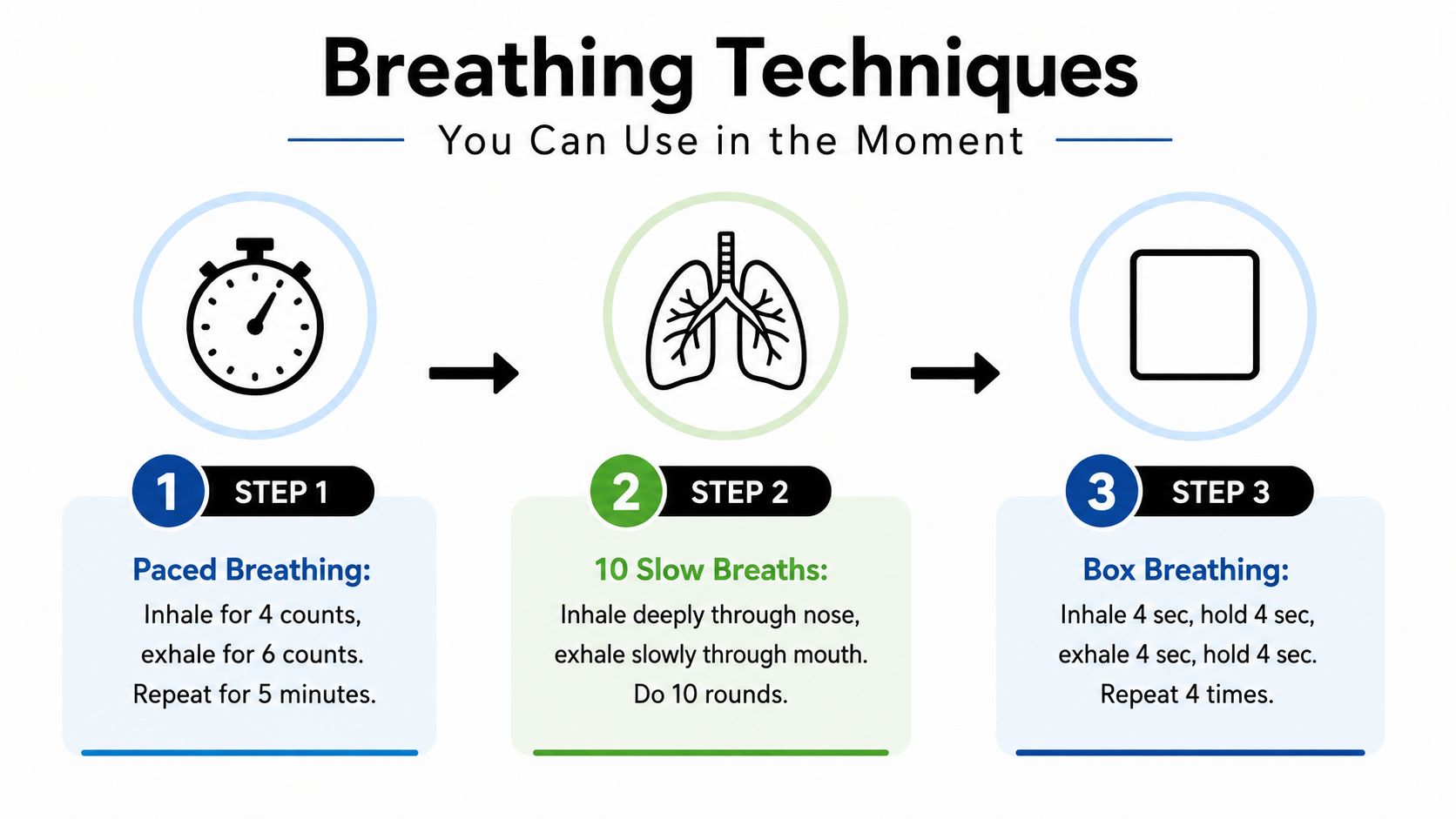
A gentle paced breath is often the fastest way to interrupt a stress surge. Inhale for 4 counts, exhale for 6, and let the exhale carry a little more of the effort. That slower out-breath gives your body a clear cue to settle, which can help when your heart feels jumpy or you are watching a wearable ECG and trying to tell whether the pattern looks like stress, rhythm, or both.
Start with a gentle paced breath
Keep your shoulders soft, unclench your jaw, and breathe low and easy. If counting helps, use your watch or trace the rhythm with your fingers. If counting feels like too much work, just lengthen the exhale a little and keep the breaths smooth.
The goal is a calmer rhythm, not a bigger breath. Filling the lungs hard can make you feel more keyed up, especially when you are already noticing every beat.
Use the 10 slow-breath reset
Harvard Health recommends a basic breathing exercise that uses 10 very slow breaths in and out and can trigger the relaxation response (Harvard Health). Breathe in through the nose, then out slowly through the mouth. Let your face soften on each exhale, and keep your chest from rising too high.
If you feel lightheaded, scale it back. Make the breaths smaller and slower instead of deeper, because too much air can make the sensation worse rather than better.
Try box breathing when your mind is spinning
Box breathing is easy to remember, which helps when your thoughts are racing. Inhale for 4 seconds, hold for 4, exhale for 4, hold for 4. Repeat four times if that feels comfortable.
A common mistake is making the breaths too forceful, as if calm has to be earned through effort. Gentle breathing is easier to repeat at a desk, in a car, or right before a stressful conversation, and that makes it more useful when symptoms feel unpredictable.
A reader in a tense meeting might feel a flutter, glance at a watch, and see the heart rate ease after a short reset. That kind of small observation matters. Once the body gets a steadier signal, the mind usually stops scanning for danger quite so aggressively.
Sleep, Movement, and Food That Lower Stress
The short techniques help in the moment, but daily habits change the baseline. If your body spends all day tense, a five-minute breathing drill can only do so much. The bigger effect comes from sleep, movement, and the food and drink choices that keep your system from staying on edge.
Sleep is a foundational stress treatment
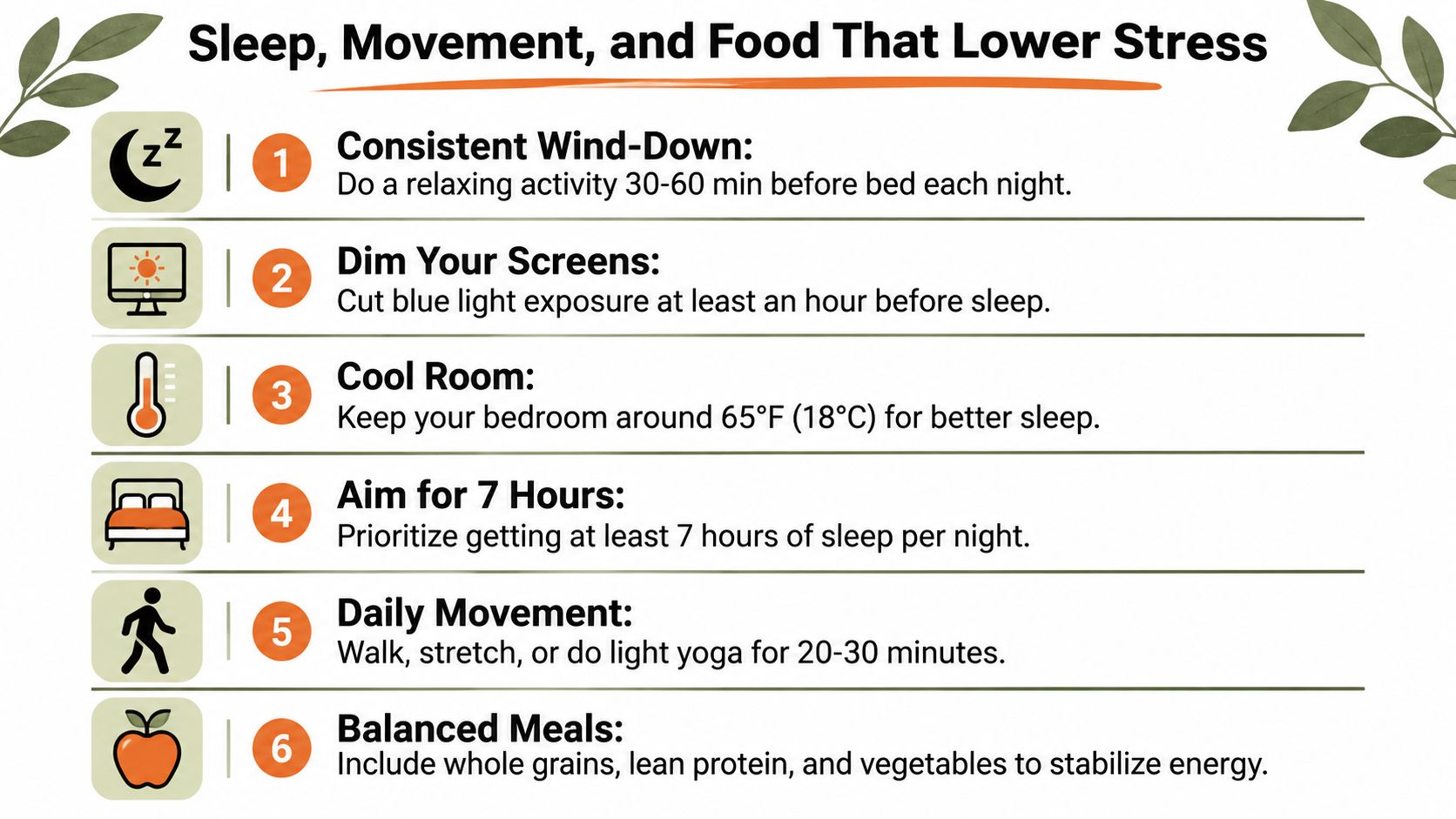
Sleep gives the heart and nervous system a chance to settle. The CDC notes that adults need 7 or more hours of sleep per night for better sleep health and recommends consistent habits that support recovery before bed (CDC). In plain language, your body does better when sleep is protected, scheduled intentionally before other tasks take priority.
A quiet wind-down matters more than a perfect routine. Dim the lights, put the phone down a little earlier, and keep your room cool enough to sleep comfortably. If your heart tends to race at night, predictability helps because the body learns what “safe and sleepy” feels like.
For someone wearing an ECG device, this can also make the reading easier to interpret. A heart rate that drifts down as you settle for bed points in one direction, while a sudden jump after scrolling, worrying, or a late caffeine hit points in another. That difference can help you and your clinician sort out stress from a rhythm issue, or see when both may be involved.
Movement lowers the baseline
The CDC guidance says adults should work up to 2.5 hours per week of activity, broken into smaller sessions like 20 to 30 minutes a day (CDC). Harvard Medical School also highlights 150 minutes per week of moderate-intensity exercise, such as brisk walking, as part of stress management (Harvard Medical School). You do not need a gym identity to benefit from that.
A brisk walk after lunch, a few flights of stairs, or a gentle stretch between tasks can all count. The point is consistency. Your nervous system learns from repeated calm inputs, not heroic bursts once a week.
Movement can also help you learn your own pattern. If your pulse settles gradually during an easy walk, that is different from a racing heart that starts with little exertion, feels irregular, or shows up with dizziness. That kind of note is useful when you review ECG traces at home, because it gives context instead of leaving you to guess.
Food and drink can amplify or soften stress
Regular meals help keep energy steadier, which makes stress easier to handle. Hydration matters too, because dehydration can make you feel more keyed up than you really are. If caffeine or alcohol makes your heart feel louder, that is useful information, not a failure.
Small swaps often work better than strict rules. Some people do better with a lighter dinner, others need more protein earlier in the day, and some notice that a late snack keeps them from waking with palpitations. The goal is to learn which habits steady you and which ones make your body feel jumpy.
Good enough beats perfect: choose meals that keep you steady, not meals that make you crash, skip, and then overcorrect later.
If you want a broader look at how daily habits tie into stress, the SleepHabits guide on how to improve sleep naturally is a helpful companion for the nighttime side of the routine. Better sleep and calmer stress responses tend to reinforce each other.
Get your ECG checked by certified experts within minutes on the Qaly app.


Mindfulness, Nature, and Calming the Nervous System
A walk under trees can do more than give your legs a break. For someone who notices a racing heart and wonders, “Is this stress, or something else?”, a calmer setting can make the body's signals easier to read. The point is not to force calm. It is to give your nervous system fewer reasons to stay on high alert.
The American Heart Association says spending 120 minutes per week in nature improves health and well-being (American Heart Association). That does not have to mean a long hike. It can be a walk under trees, a quiet park bench, or even a lunch break outdoors with your phone in your pocket.
Make mindfulness small enough to repeat
Mindfulness works better when it fits real life. A few quiet minutes of breathing, a body scan, or brief journaling can help interrupt the stress spiral before it builds. If your attention keeps jumping to your heartbeat, start with something easier to tolerate, then add stillness later.
The CDC recommends simple habits like deep breathing, meditation, journaling, and time outdoors. If sitting still makes you more aware of your heartbeat, begin with a short walk. Once your body loosens a little, a minute of quiet sitting may feel more manageable.
Use body-based calming tools
Mayo Clinic lists deep breathing, meditation, guided imagery, massage, progressive muscle relaxation, tai chi, and yoga as concrete stress relievers, and says they tend to work best when practiced regularly (Mayo Clinic). That regular practice matters because the nervous system learns through repetition. A single calm moment can help, but repeated calm inputs teach the body a new default.
You can also think about this as supporting the parasympathetic system, the part of the body that helps with rest and digestion. Gentle movement, slow breathing, and time outdoors all nudge that system in the right direction. If a 10-minute walk outside makes your chest feel less tight and your breathing less choppy, that is useful feedback from your own body.
For readers who want to connect mindfulness with heart symptoms more directly, the Qaly article on meditation and heart palpitations gives a useful heart-focused lens without making the topic overly technical.
For a broader look at how daily habits support the nighttime side of stress, the guide on how to improve sleep naturally is a helpful companion. Better sleep and calmer stress responses tend to reinforce each other.
Tracking Your Heart and Stress With a Wearable ECG
If you already wear an ECG-capable device, you have a useful way to catch the moment as it happens instead of trying to reconstruct it later. That can make a real difference, because palpitations often fade before you can describe them clearly at an appointment. For people who feel a racing heart and wonder whether it is stress, a rhythm issue, or both, the device gives you something concrete to compare with how the episode felt in real life.
Use the device to capture the reading, then write down the context in a plain note. Record the time, what was happening, how it felt, and what you did next. A stressful meeting, a walk, a disagreement, a cup of coffee, or a quiet moment lying still before bed can all matter, because the same sensation can mean different things in different settings.
Keep the note simple and repeatable
The goal is pattern recognition, logging episodes so you and your clinician can see what's happening over time. A short note after each episode makes the record easier to use later. Over a few entries, questions start to get clearer, such as whether the palpitations cluster after poor sleep or whether they settle after breathing and sitting down.
Devices such as Apple Watch, Fitbit, Kardia, Samsung, and Withings can all fit into that routine. If you want help turning those readings into something easier to read over time, one option is Qaly, which provides human-reviewed ECG interpretation and interval tracking alongside wearable recordings. The point is to give you a clearer record to bring with you, while keeping your clinician in the loop.
Best use case: one reading without context can feel scary, but a handful of logged episodes can reveal a pattern.
What makes a useful entry
A good entry does not need to be polished. It just needs to be consistent.
- Time and date: write down when the episode started and when it settled.
- Trigger or context: note stress, exercise, caffeine, poor sleep, or a quiet rest period.
- What you felt: flutter, pounding, skipped beats, dizziness, shortness of breath, or chest pressure.
- What helped: sitting, breathing, walking, hydration, or nothing at all.
If your device gives you repeated irregular-looking readings, save the strip and keep your note. That gives the clinician a clearer story to review later, especially when stress and rhythm symptoms seem to overlap. For readers who want a heart-rate-variability angle alongside ECG tracking, the Qaly article on heart rate variability apps can help connect the dots without overcomplicating the process.
When Stress Is Not the Whole Story
A fluttering heart after a hard day can fit stress. Fluttering isn't always stress-driven, though, especially when the feeling is new, keeps returning, or shows up in a way that doesn't match your usual pattern. A simple framework is more useful than speculation.
Watch for patterns that deserve attention
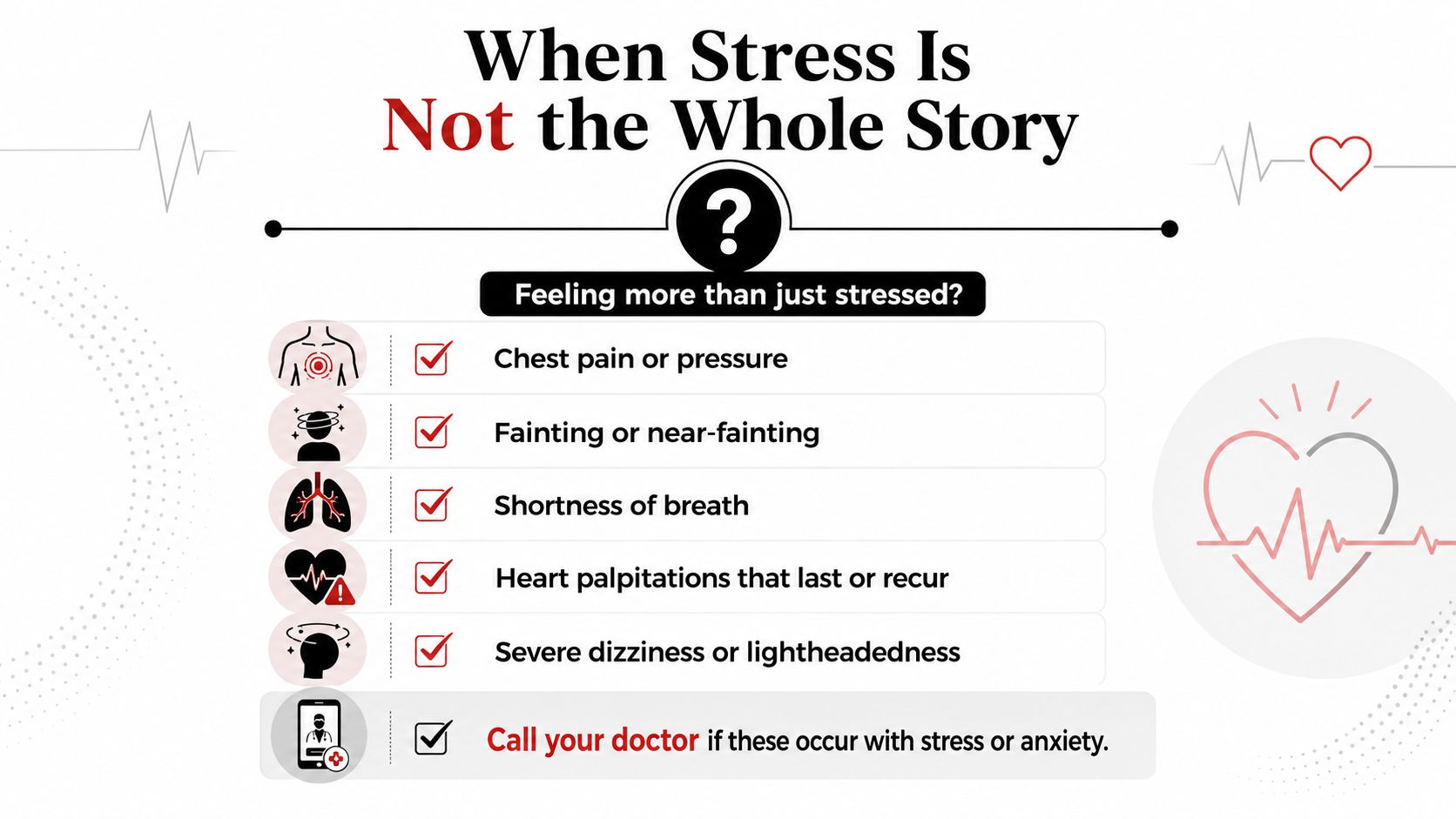
Chest pain or pressure, fainting or near-fainting, shortness of breath at rest, palpitations that do not settle, and wearable readings that keep looking irregular deserve medical evaluation. The same is true for severe dizziness or a sense that your heart rate is staying unusually fast. These signs do not mean something serious is definitely happening, but they do mean the episode should not be brushed aside.
A helpful comparison is the difference between a smoke alarm that chirps once and one that keeps going off. One brief episode can happen with stress, caffeine, or poor sleep. Repeated episodes, or symptoms that come with chest discomfort, breathing trouble, or fainting, deserve more attention because the body is giving you a broader signal. If you want a closer look at how anxiety and rhythm symptoms can overlap, the Qaly article on Afib and stress is a useful starting point.
Bring something useful to the appointment
If you do seek care, bring the ECG strip, a brief symptom note, and a screenshot of the heart-rate trend if you have one. That is often more useful than trying to remember how it felt days later. Organized data helps the conversation move faster and keeps the focus on what happened, when it happened, and what your wearable recorded.
Seeking evaluation does not cancel out natural care. It fits alongside it. Your instincts matter, and if something feels off in a way that does not match your usual stress pattern, that is reason enough to take it seriously.
Your Simple Daily Plan for Calmer Days
A calmer day comes from repeatable habits you can stick with, not a perfect routine you abandon after a week. If you want a starting point, choose the smallest version you'll do tomorrow and build from there. That is how natural stress reduction becomes part of real life instead of a short-lived experiment.
If you want another practical perspective on the whole-body side of stress, the Axelrad Clinic guide on reducing stress naturally for hormonal balance is a useful companion read. It fits well with the idea that sleep, movement, and recovery work together.
A simple day might look like this. Start with two minutes of slow breathing when you wake up. Take a 20-minute walk at lunch. Put your screen away before bed, then do a few minutes of journaling or mindfulness. If you wear an ECG device, use those same moments to notice what your heart is doing, whether it settles with rest, or whether it keeps feeling unusually fast or irregular. That helps you tell the difference between a stress response you can track and a rhythm change that deserves closer attention.
Consistency beats intensity. A short walk every day often does more for a stressed heart than one hard workout followed by three inactive days. A brief breathing habit you can repeat anywhere is more useful than a complicated routine you abandon after a week. The same idea applies to sleep and food choices, small, steady adjustments usually give your body a better chance to settle than big changes you cannot sustain.
Start with one habit today, add a second when the first feels steady, and give your body a fair chance to settle into a calmer rhythm. If you already wear an ECG device, save a reading the next time stress hits and compare it with your note, so you can see whether the pattern looks like stress alone or stress layered on top of something else. That small habit can turn uncertainty into a clearer plan while you reduce stress naturally for hormonal balance.
Stress making your heart feel jumpy? Certified experts review your ECG within minutes.


