


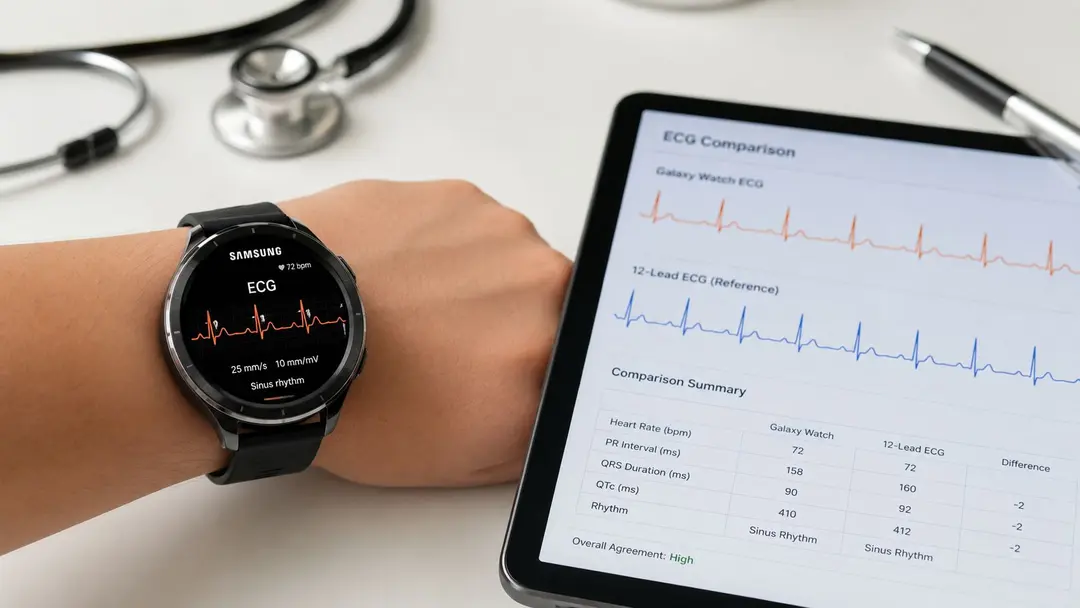


Hello Heart Hero.
Your Galaxy Watch just flagged something, or maybe it didn't, and now you're staring at the screen wondering what to trust. That's a very normal place to land, especially when the result says possible AFib, sinus rhythm, or inconclusive and your body still feels off.
The honest answer to Samsung ECG accuracy is not a simple yes or no. The published evidence says Samsung's ECG can perform well for atrial fibrillation screening under the right conditions, but the same evidence also shows that accuracy shifts with signal quality, study design, and what the watch is being asked to detect. If you've been searching for a straight answer, this article will give you the more useful one, which is, accurate for what, in whom, and under what conditions.
| Study or validation | What it found for Samsung ECG | What to notice |
|---|---|---|
| FDA submission testing for Samsung ECG App v1.3 | 96.0% sensitivity, 98.7% specificity, 98.7% visually interpretable waveforms FDA summary | Strong AFib screening performance in a regulated submission |
| Earlier FDA clearance testing | 98.1% sensitivity, 100% specificity for AF detection FDA clearance summary | Different cleared version, different validation scenario |
| Systematic review and meta-analysis | 86% sensitivity, 76% specificity when unclassified ECGs were counted as errors systematic review | Real-world handling of unreadable tracings changes the numbers |
| Head-to-head clinical validation of five wearables | 97% sensitivity, 91% specificity, about 24% inconclusive readings comparative validation | Samsung can screen well, but inconclusive traces still matter |
| Heart rate testing during rapid rhythm conditions | 100% accurate within ±5 bpm at baseline, 90% within ±10 bpm during induced SVT PubMed study | Heart-rate precision can slip as rhythm conditions get harder |
A Warm Hello and Why You're Asking This Question
You probably didn't open your watch app because you were bored. You opened it because your heart felt strange, the rhythm looked odd, or a notification made your stomach drop. That's a stressful moment, and it makes sense to want something more reliable than a vague label on a tiny screen.
Samsung's ECG feature has enough clinical backing that your question is reasonable, not paranoid. It's also fair to be skeptical, because a watch is not a cardiologist, and a good result in a controlled setting doesn't automatically mean the same thing at home while you're moving, talking, cold, or anxious.
The most helpful way to think about Samsung ECG accuracy is as a narrow but real tool. It can be useful for rhythm screening, especially for atrial fibrillation, but it doesn't answer every heart question, and it doesn't erase uncertainty when the tracing is messy. That's why the details matter so much.
Practical rule: if the reading affects how scared you feel, it deserves a better explanation than the app gives you.
The point here isn't to sell you on the watch or talk you out of using it. It's to translate the evidence into plain language so you can decide what to do with a reading, not just stare at it. If you want a clinician-style companion to the numbers, this guide to wearable ECG interpretation is a useful complement.
What ECG Accuracy Really Means in a Clinical Study
Sensitivity, specificity, and the part people forget
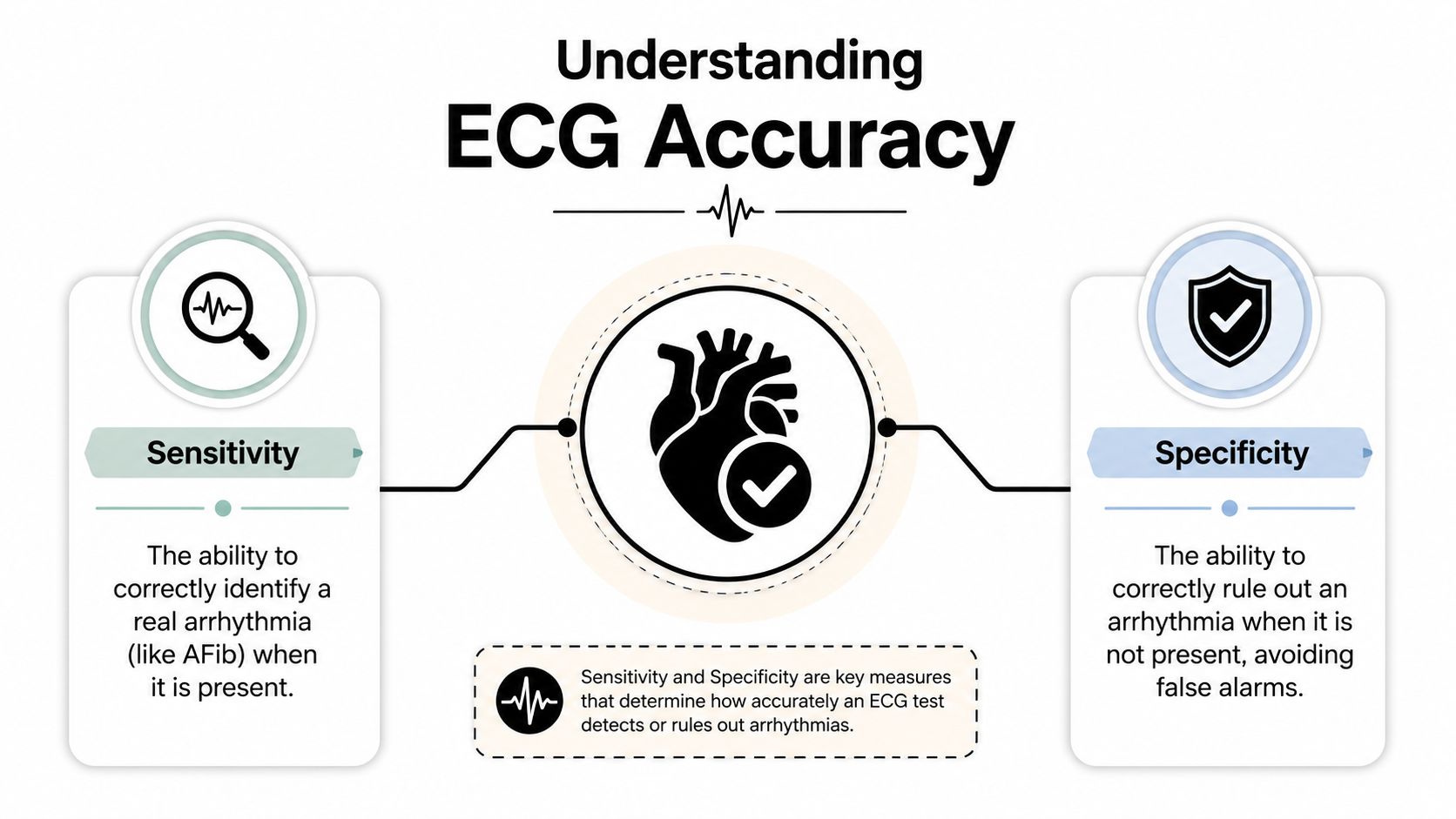
A clinical ECG study usually asks a simple question with three possible answers. Did the watch catch the rhythm when it was present, did it avoid sounding an alarm when the rhythm was not there, and what happened when the tracing was too messy to classify?
Sensitivity is the first part. It tells you how often the device correctly identifies a real rhythm problem, such as atrial fibrillation, when that problem is present. Specificity is the second part. It tells you how often the device correctly says “this is not atrial fibrillation” when the rhythm is normal.
The third bucket matters more than most marketing copy admits. Uninterpretable or inconclusive readings are not the same thing as correct or incorrect, but they still affect your experience and your trust. If a device keeps giving you readings it can't classify, that is not a minor nuisance, it is part of the accuracy story.
Here's the easiest way to picture it. If 100 people have AFib, a sensitivity of 96.0% means the watch would correctly flag about 96 of them and miss about 4, based on the Samsung validation data FDA summary. If 100 people do not have AFib, a specificity of 98.7% means it would correctly reassure about 99 of them and falsely flag about 1.
Why the study design changes the headline
The reason this gets confusing is that the same watch can look better or worse depending on how researchers handle unreadable traces. If a paper counts inconclusive ECGs as errors, the performance drops. If it excludes them, the numbers look cleaner, but that doesn't reflect the experience of someone whose watch keeps refusing to classify the rhythm.
That's why a careful reader should never ask only, “Is it accurate?” The better question is, “How often does it work, what did the study count, and what kind of heart rhythm was being tested?” Once you see the study that way, Samsung's numbers become more useful, and also more honest.
Samsung's Own Validation Numbers and What They Cover
Samsung's clearest validation data come from the FDA-reviewed testing of its ECG app. In the updated ECG App v1.3, a multi-center study enrolled 1,013 adults and produced 453 atrial fibrillation recordings and 691 sinus rhythm recordings for primary analysis FDA summary. In that dataset, Samsung correctly classified 435 of 453 AFib tracings, which equals 96.0% sensitivity, and 682 of 691 sinus rhythm tracings, which equals 98.7% specificity.
That same validation also reported that 98.7% of ECG recordings produced visually interpretable waveforms FDA summary. That matters because a reading has to be readable before it can be right. A watch that often gives a clean tracing is easier to trust than one that keeps making you repeat the test.
Samsung also stated that the performance was comparable to the Apple ECG 2.0 app in its documentation FDA summary. That is a careful claim, and it belongs in the same category as the rest of the submission, which is AFib-focused rhythm classification under test conditions. It does not mean Samsung has a full diagnostic range, and it does not mean every real-world recording behaves the same way.
Two valid studies can still disagree
Samsung's earlier ECG monitor app also cleared the U.S. FDA as substantially equivalent to Apple's ECG app, and in that testing it showed 98.1% sensitivity and 100% specificity for AF detection FDA clearance summary. That sounds even stronger than the updated app data, but the difference is not a contradiction. It is a reminder that different cleared versions and different test setups can produce different numbers.
A smart reader should treat those differences as a clue, not a problem. Clinical validation is not a single eternal score, it's a snapshot of performance in a specific test population. Samsung's own data support the idea that its ECG can screen for AFib well, but only within the boundaries of the testing that was done.
For readers comparing watch ECGs, this earlier guide to Apple Watch ECG accuracy helps put Samsung's numbers in context without pretending all smartwatches perform the same way.
The strongest numbers are still conditional numbers. They describe one test environment, not every messy morning at home.
When you want clean data management around this kind of testing, even schema discipline matters. A practical primer on data integrity with Matil is a good reminder that validation only works when the input conditions are clear and consistent.
How Independent Studies Compare Samsung to Other Watches
Independent research is where the Samsung story gets more complicated, and more useful. A 2022 systematic review and meta-analysis reported Samsung AF detection at 86% sensitivity and 76% specificity when unclassified ECGs were counted as errors systematic review. In the same analysis, Apple came out at 94% and 84%, while Samsung also had a higher proportion of uninterpretable tracings, 15% versus 2% for Apple and 4% for Withings systematic review.
That does not mean Samsung is “bad.” It means the way a study handles unreadable recordings changes the result in a way that matters to real users. If your watch says inconclusive often, that affects your confidence even if the algorithm does well on clean traces.
A different head-to-head clinical validation of five direct-to-consumer wearables told a more favorable story for Samsung. In that study, Samsung's AF detection was 97% sensitivity and 91% specificity, with around 24% inconclusive readings comparative validation. That is still not perfect, but it shows why Samsung can look strong in one design and weaker in another.
What those comparisons really tell you
The useful takeaway is not that one brand always wins. It is that Samsung's ECG sits in a range where study methods matter a lot, especially around unreadable signals and the exact rhythm being tested. The same watch can look excellent under one set of rules and merely fair under another.
GP triage teams that rely on structured intake, such as those using GP Triage on Webflow, know this problem well. When the input is messy, the workflow has to make room for ambiguity instead of pretending it isn't there.
Here's the practical reading of the evidence:
- Samsung can screen AFib well in some controlled settings.
- Samsung's performance drops when unreadable tracings are counted as errors.
- Samsung's share of inconclusive recordings is not trivial in some studies.
- Samsung is not consistently better or worse than every other watch, the context decides.
If you want the short version, Samsung ECG accuracy is real, but it's not uniform. The more a study resembles everyday life, the more you see the tradeoffs.
What Samsung ECG Does Not Detect and Why That Matters
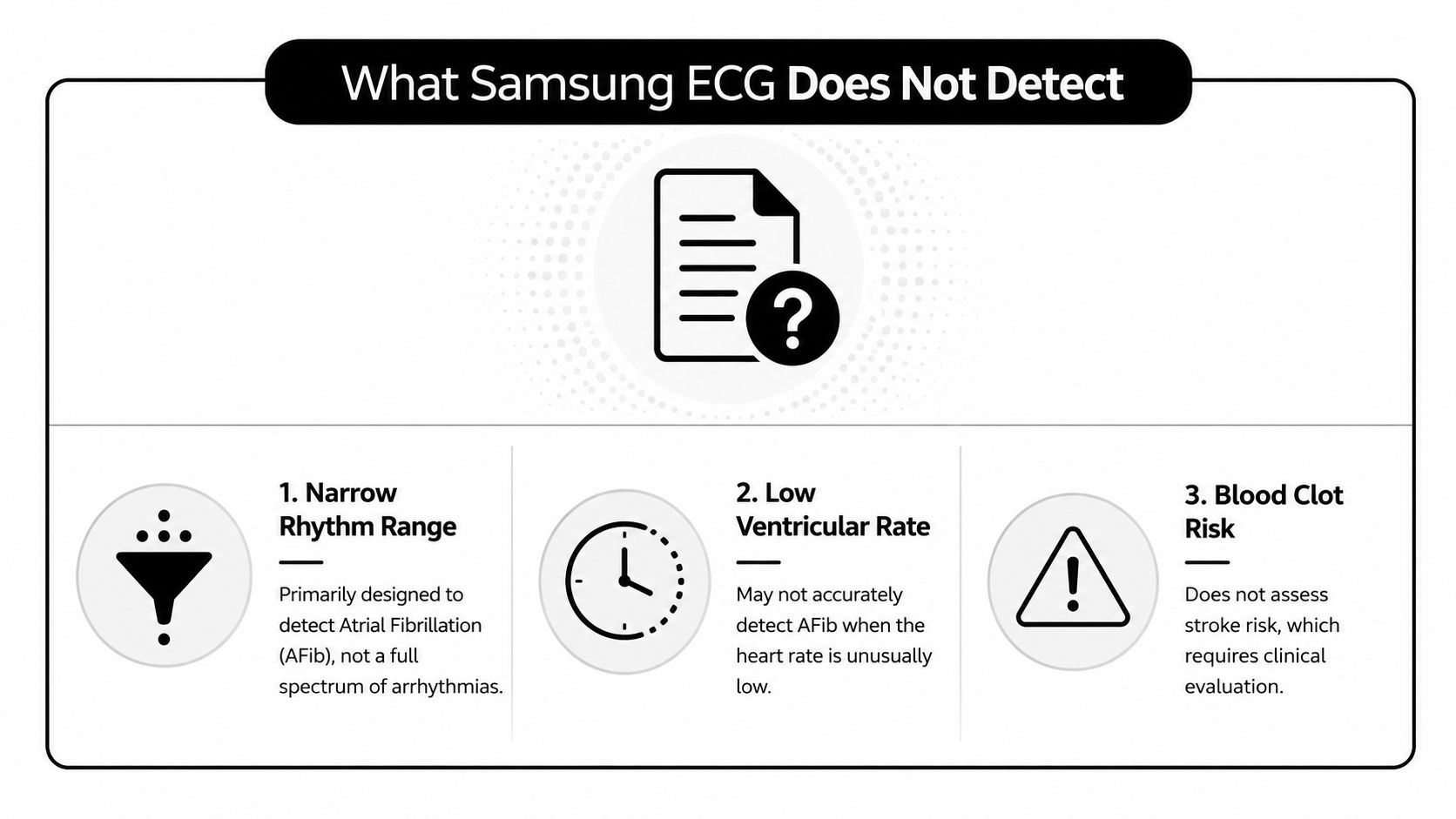
Samsung's ECG app is aimed at a narrow rhythm problem, and that limit matters more than many realize. A normal reading does not mean your heart is fine in every sense, it means the watch did not identify the specific rhythm it was trained to recognize in that moment.
The gap shows up most clearly with atrial fibrillation at unusual heart rates. Expert reviews note that AF with a ventricular rate below 50 bpm is not detected by any smartwatch ECG, and that at higher rates there is a cutoff above which AF is no longer tested, which for many watches is around 120 bpm expert review. That is a big deal for people with medication-related bradycardia, palpitations, or fast intermittent rhythms who assume a normal trace rules everything out.
Samsung's own validation data do not change that boundary. They show that the app can perform well for AFib and sinus rhythm under test conditions, but they do not expand the rhythm range beyond what the device is designed to classify FDA summary. A watch ECG is still a single-lead snapshot, not a broad cardiac workup.
The missing piece is often the real-world symptom
The most frustrating part for many users is that the symptom is real even when the label is not. A person can feel racing, fluttering, or skipped beats and still get a normal Samsung reading if the episode falls outside the tested rhythm window or the tracing is too noisy to classify.
One comparative study also found that Samsung's expert interpretation accuracy was lower than Withings and Apple, with 15% uninterpretable tracings versus 2% and 4%, respectively systematic review. That does not mean the watch is useless. It means the device is better at answering a narrow question than at reassuring someone with broader symptoms.
A normal result is therefore not a full clearance note from the heart. It is only a sign that, in that moment, the watch did not detect the rhythm it knows how to detect.
Get your ECG checked by certified experts within minutes on the Qaly app.


When Samsung ECG Becomes Unreliable in Everyday Use
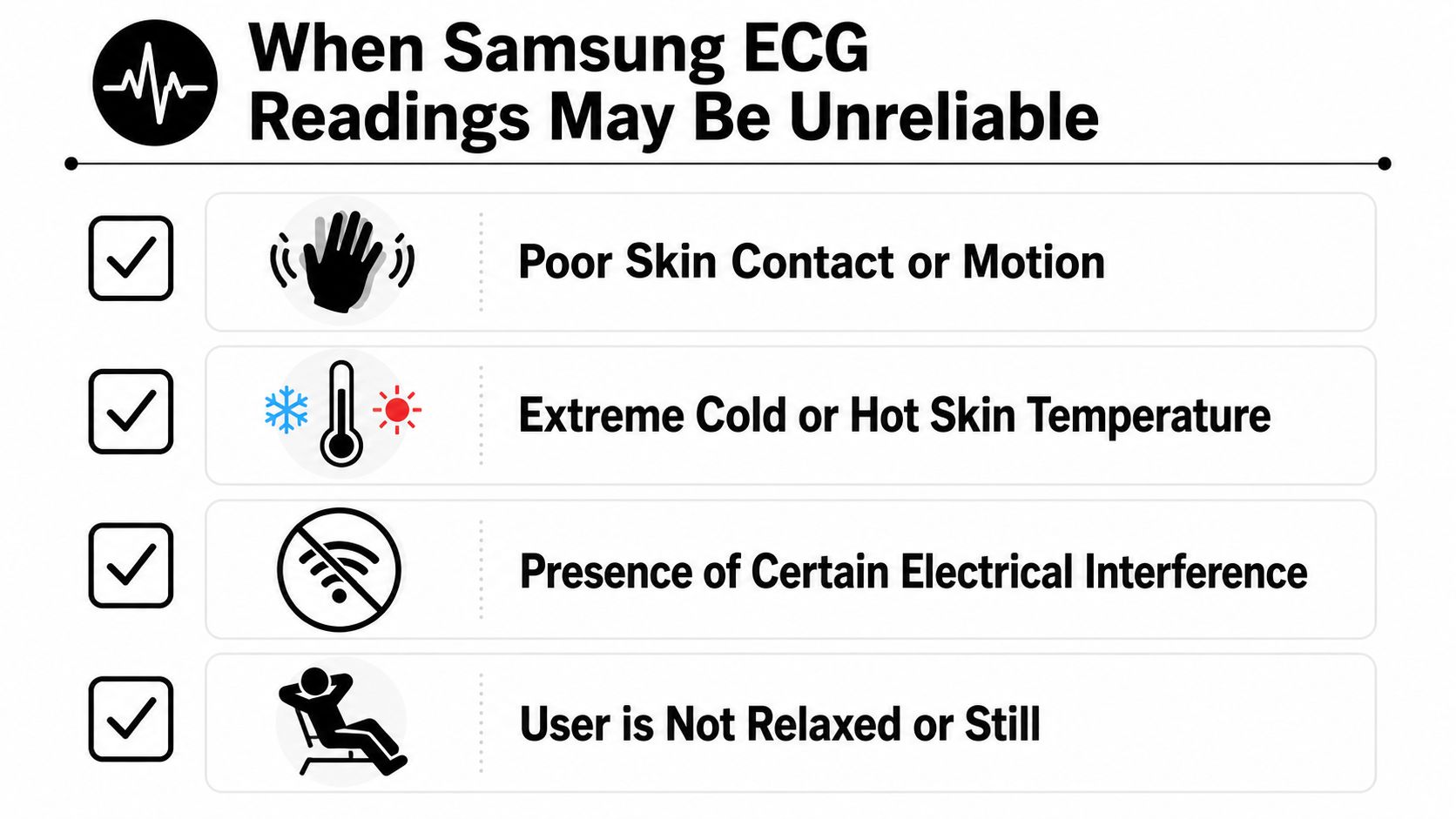
Samsung's own guidance is refreshingly blunt about the situations that can degrade a reading. The company warns that measurements may be inaccurate with movement, cold temperatures, loose fit, body hair, dirt, alcohol, smoking, talking, very high or very low heart rates, and even thin wrists, and it recommends repeated measurements for the most accurate results Samsung guidance. That list reads a lot like ordinary life, which is exactly why the warning matters.
The problem is not only whether the watch can ever be accurate. It's whether it can stay accurate when your body is doing the kind of messy things bodies do. A calm seated trace is one thing. A post-walk recovery, a cold morning hand, or a loose strap is another.
A 2025 comparative presentation reported that Samsung showed significant heart-rate errors above 100 bpm, with deviations up to 50 bpm, and weaker ECG signal fidelity than Apple and Fitbit in some metrics comparative presentation. That does not mean every fast reading is wrong, but it does mean the watch becomes less dependable as the conditions get harder.
What “unreliable” looks like in practice
The best way to use this evidence is as a checklist for doubt. If the watch is acting up during a shaky moment, the result deserves less trust than a clean, still, warm reading.
- Poor Contact or Motion: A moving wrist or loose fit can blur the tracing and make the algorithm hesitate.
- Cold Skin or Dry Fingers: Temperature and poor contact can raise the chance of a bad signal.
- Talking or Fidgeting: Small muscle movements can be enough to disturb the waveform.
- Fast or Very Slow Rhythm: Heart rate outside the app's comfort zone can reduce confidence in the label.
For readers who keep seeing inconclusive results, this guide on what inconclusive means on the Samsung ECG is worth a look, because the label often says more about signal quality than about danger.
If the reading was taken during a bad signal day, treat it like a blurry photo, not a final diagnosis.
That is the core idea. Samsung ECG accuracy is not a fixed property of the watch, it's a property of the watch plus the moment plus the person wearing it.
Adding Human Review to Close the Gaps
Human review earns its place. A Samsung tracing can tell you that the watch captured a waveform, but it cannot always tell you what the waveform means in context, especially when the result is inconclusive, borderline, or paired with symptoms that don't fit neatly into a label.
A human-reviewed ECG service fills that gap by taking the tracing seriously enough to interpret it, not just classify it. Qaly offers 24/7 human review by CCT-certified cardiographic technicians for wearable and at-home ECGs, including Samsung, Apple Watch, Fitbit, Kardia, Withings, and Holter monitors. The service reports over 500,000 ECGs evaluated, and it returns interval measurements and narrative reports within minutes.
That matters because a label like “possible AFib” or “inconclusive” can be emotionally loud and clinically quiet at the same time. A reviewed waveform gives you more to bring to a clinician, more context to track symptoms over time, and less guesswork when you're trying to decide whether the watch is showing something important or just a noisy recording.
A complement, not a replacement
Human review does not replace a doctor, and it should not pretend to. What it can do is reduce the amount of staring at a screen alone, wondering whether a reading is meaningful. For people who are skeptical of the healthcare system and trying to make sense of symptoms on their own, that middle layer can be very useful.
The practical value is simple. You keep the watch, but you stop treating the watch as the final word. Instead, you use the device to capture the moment and a human reviewer to interpret the tracing in a way that's easier to act on.
Your Next Steps with a Galaxy Watch ECG
If you want the simplest possible rule, make the reading as clean as you can before you decide what it means. Sit down, relax your arm, and take the ECG when you're still and warm, not while you're rushing around or arguing with the app in your head.
If you get possible AFib, repeat the recording a few minutes apart. That doesn't prove the watch is right or wrong, but it can help separate a one-off noisy trace from a repeatable rhythm pattern. Write down what you felt, when it happened, and what you were doing right before the reading.
A normal Samsung reading is reassuring, but it does not rule out everything, especially rhythms outside the watch's tested range. If your symptoms keep happening, or they feel severe, don't let the watch talk you out of seeking medical attention.
A short, practical game plan
- Record while calm: Take the ECG seated, with your arm supported and your body as still as possible.
- Repeat suspicious results: If the app says possible AFib or inconclusive, take another tracing after a short pause.
- Tag the moment: Write down symptoms, timing, and what you were doing right before the reading.
- Share the file: Send the ECG to a human-reviewed service or your clinician before your next appointment instead of guessing alone.
If you want to export the tracing from your watch, this step-by-step guide to exporting Samsung ECGs will help you keep the record in a form someone else can review.
The goal is not to chase perfect certainty from a watch. The goal is to get a useful answer, use it carefully, and act on symptoms without either panicking or dismissing them.
If your Galaxy Watch has been giving you mixed signals, don't sit with the uncertainty alone. Capture a clean ECG, write down what you felt, and have the tracing reviewed before your next appointment so you can walk in with something concrete instead of a vague worry.
Unsure what your Galaxy Watch ECG means? Certified experts review ECGs within minutes.


