


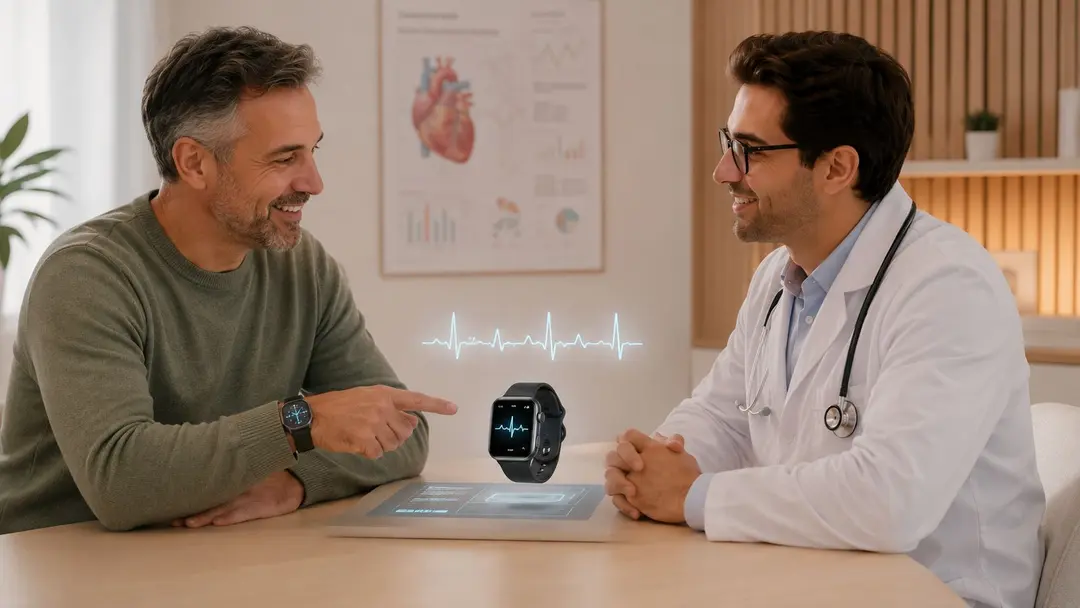


Hello Heart Hero.
Your watch buzzes, your ECG trace looks strange, and your mind jumps straight to the worst-case scenario. Maybe it was a weird flutter after coffee, maybe a skipped beat while you were walking the dog, or maybe it was a full-on spike of panic when the screen showed something you didn't expect. You're left staring at the phone, wondering whether to ignore it, Google it, message your doctor, or head to urgent care.
That's exactly where shared decision making helps. It gives you a calm way to turn a confusing heart rhythm moment into a real conversation, one where your clinician brings the medical expertise and you bring the part only you know, your symptoms, fears, routine, and what you're willing to live with. If you've ever felt rushed, dismissed, or told to “just watch it,” this guide is for you.
For people using wearables like Apple Watch, Fitbit, Kardia, or similar tools, what cardiac monitoring actually does matters because the data can feel both overwhelming and complex at the same time. The point isn't to replace medical care. The point is to help you walk into the appointment with enough clarity to ask better questions and make a decision you can stand behind.
Hello Heart Hero and Why This Guide Exists
A person gets a watch alert after a skipped-beat feeling during a run. The tracing doesn't look normal, but it also doesn't clearly look like an emergency, and that in-between feeling is often the hardest part. You're not just asking, “What is this?” You're also asking, “What am I supposed to do with this information now?”
That's where many people get stuck. One clinician may want more monitoring, another may want to wait, and a third may suggest medication after a quick glance at the same rhythm strip. The problem isn't only the ECG, it's the uncertainty that follows it.
Shared decision making gives that uncertainty a shape. It's the process of talking through the evidence, the choices, and your own priorities so the plan isn't just medically reasonable, it also fits your life. If you've felt like appointments move too fast, or that your wearable gave you data but not direction, this approach helps bridge that gap.
A practical way to think about it is this, the clinician brings the heart rhythm expertise, and you bring the lived reality. Maybe you're training for a race, maybe you can't tolerate side effects, or maybe you're more worried about missing a serious rhythm than about taking a pill. That's not extra noise. That's the decision itself.
Practical rule: If the result changes what you might do next, it deserves a shared decision, not a rushed yes or no.
What Shared Decision Making Really Means
A patient gets a wearable ECG alert after feeling a flutter in the chest. The strip is not clearly normal, and it is not clearly dangerous either. That gray area is where shared decision making belongs, because the next step is not only about reading the tracing, it is about choosing what makes sense for this person.
Shared decision making is a structured conversation between clinician and patient. It replaces the old “doctor knows best” model and the equally frustrating “figure it out on your own” approach with a practical middle ground. The clinician brings the medical evidence, and the patient brings the lived reality of side effects, routines, worries, and limits.
A co-pilot model fits well here. The clinician knows the rhythm patterns, the likely risks, and the treatment choices. The patient knows whether they are training for a race, caring for someone at home, trying to avoid fatigue from medication, or feeling worn down by uncertainty after every watch alert. Better choices come from both kinds of knowledge being in the room.
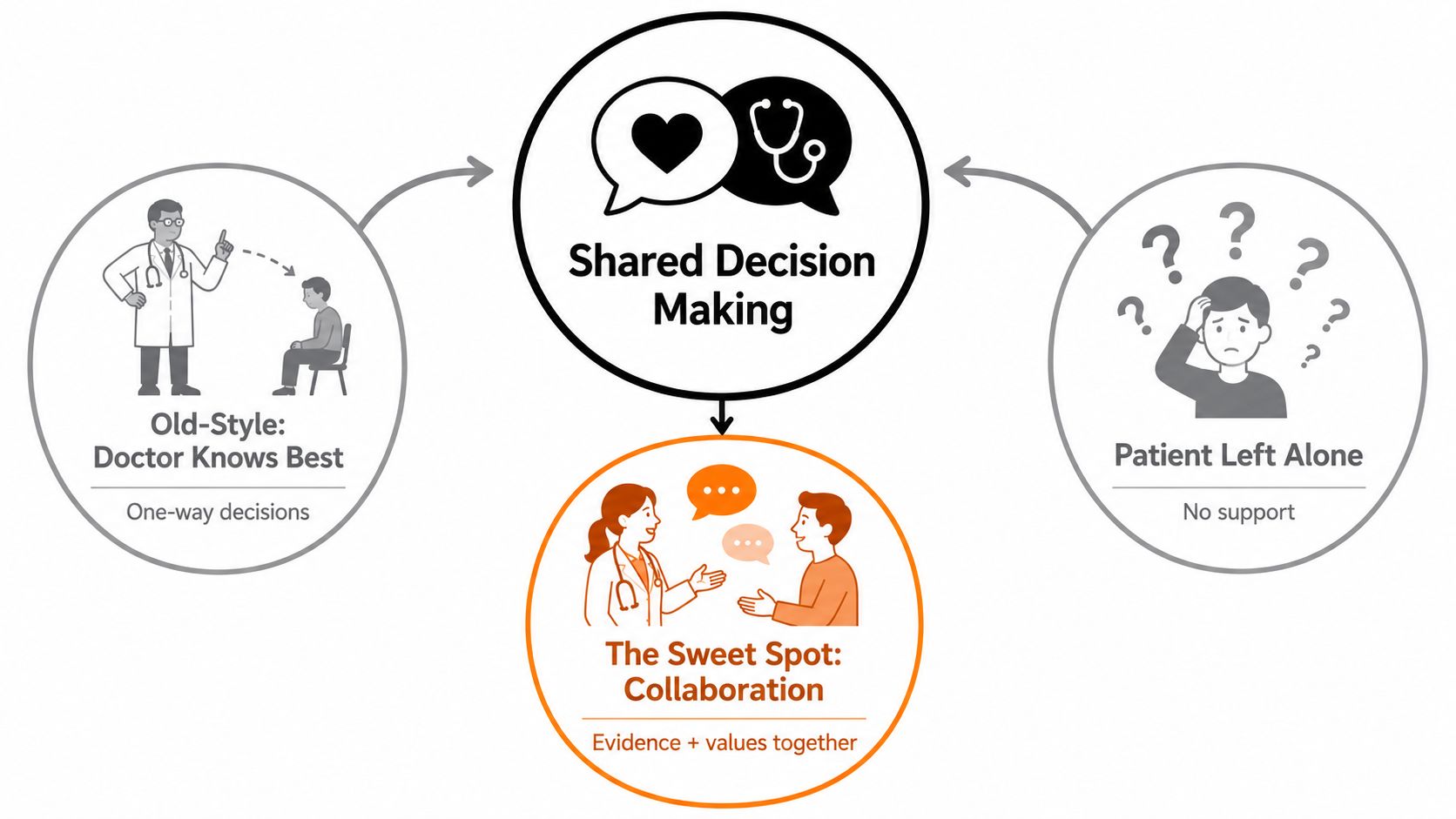
A clean way to say it is this, shared decision making means medical evidence plus your values plus a real conversation. It is not about second-guessing your doctor. It is about making the plan easier to trust, easier to live with, and easier to follow once you leave the exam room.
The same logic shows up in collaborative decision making frameworks, where people make better choices when the right voices are included. Health care is more personal than business, but the basic idea holds. Good decisions happen when information moves in both directions, not just from clinician to patient.
This matters for smaller arrhythmia choices too, not only big ones like surgery. It applies when you are deciding whether to keep watching a few PVCs, ask for a Holter monitor, try lifestyle changes first, or start a medication that might help but could also cause side effects. Those choices are still real choices, even if they do not feel dramatic.
It is not about giving patients the final word in isolation. It is about making sure the plan reflects both the evidence and the person living with it.
The SHARE Model and the Three Talks
The clearest way to make shared decision making practical is to break it into steps. AHRQ's SHARE model does exactly that, with five parts that move the conversation forward: Seek, Help, Assess, Reach, and Evaluate. A widely used companion framing also breaks the interaction into choice talk, option talk, and decision talk, which helps the conversation feel less vague and more real (AHRQ SHARE approach, AHRQ resource on the SHARE steps, three-talk model overview).
Seek and choice talk
Seek means the clinician invites you into the decision instead of assuming you want to be passive. Choice talk is the moment they say, in plain language, that there's more than one reasonable path. In wearable ECG care, that could sound like, “We've got a few ways to handle this tracing, and I want to walk through them with you.”
Help and option talk
Help means comparing the choices clearly. That's where the clinician lays out what each option might do, what it might cost you in effort or side effects, and what happens if you do nothing for now. Option talk is the same idea in a more detailed form, and it matters when the options are both medically acceptable but lead to different trade-offs.
Assess, reach, and decision talk
Assess means asking what matters most to you. If your fear is stroke risk, the conversation will sound different than if your biggest worry is feeling tired on a beta blocker or missing workouts. Reach means deciding together, or sometimes deciding to test or monitor a little longer. Decision talk is the part where the final choice gets shaped around your preferences instead of being dropped on you.
The last step, Evaluate, is easy to forget but important. It means checking whether the plan is working in real life, because a good choice on paper can still be a poor fit at home. If the plan feels off later, the conversation isn't over.
Why Shared Decision Making Matters in Arrhythmia Care
A wearable ECG can raise a question long before it gives a clear answer. A watch may flag a possible episode of atrial fibrillation, a single-lead tracing may show frequent PVCs, or a patch monitor may capture a rhythm that looks minor on paper but feels major to the person who lived through it. At that point, the medical question and the human question sit side by side.
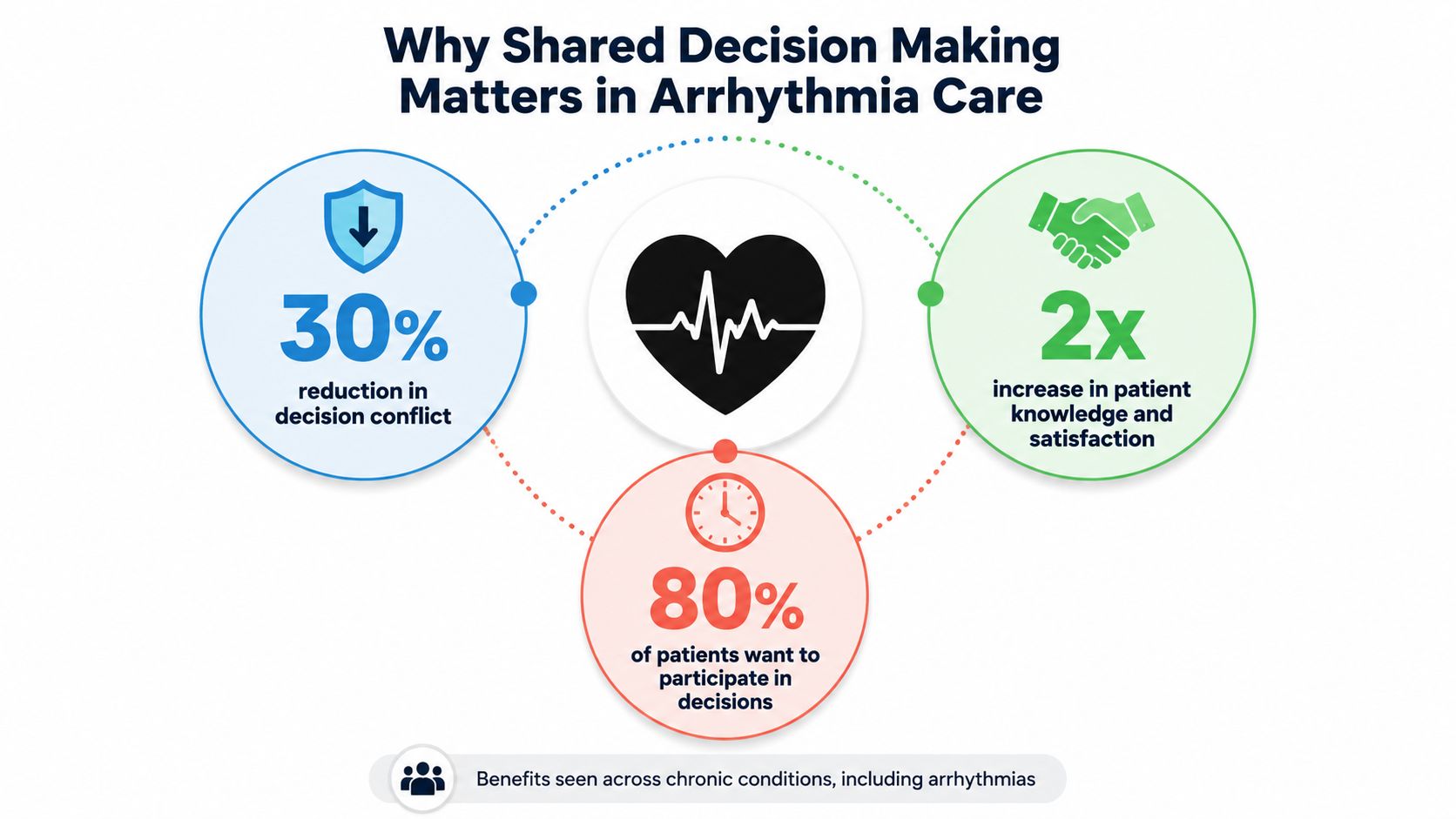
Research on shared decision making shows a clear pattern, it helps most with knowledge, understanding, satisfaction, and decisional confidence, while effects on hard clinical outcomes are less consistent. In one systematic review, 10 of 22 studies showed a significant improvement in at least one outcome, while 12 showed no greater improvement than controls. Across all outcomes, 39% were significantly improved, and when studies did show benefit, 57% of relevant outcomes improved (reviewed evidence). Those results matter because they set a realistic expectation for what this approach can and cannot do.
What that means at the bedside
In arrhythmia care, the clearest gain is often not a dramatic change on a monitor. It is the feeling that you understand what the rhythm might mean, you know why one path is being suggested, and you leave less tangled up in confusion. Another review found SDM was most likely to improve affective-cognitive outcomes, like satisfaction and decisional confidence, compared with behavioral or health outcomes (same evidence base).
That distinction matters in the exam room. If your Apple Watch shows a possible Afib episode, the next decision might be whether to repeat the tracing, order a longer monitor, or talk about medication. If you are dealing with repeated premature beats, the question might be whether reassurance is enough or whether a beta blocker is worth trying. The right answer depends on your symptoms, your risk tolerance, and what side effects you can realistically live with.
Shared decision making does not promise a perfect rhythm outcome. It gives you a better way to choose among real options, especially when one path lowers uncertainty but another lowers daily burden. In arrhythmia care, that can make a scary result feel more manageable, and tools for remote patient monitoring in arrhythmia care can fit into that conversation when you need more information before deciding.
Get your ECG checked by certified experts within minutes on the Qaly app.


Conversation Scripts You Can Use at Your Next Visit
A lot of people know what they want to ask, but the room gets tense and the words disappear. Having a script in your notes app can change that. It doesn't need to sound polished. It just needs to get the truth onto the table.
A patient script
“On my watch ECG, I saw [brief description]. I'm not sure what it means. Can you tell me whether this looks concerning, and what the options are from here? I'm worried about [side effects, stroke risk, exercise, cost, or anxiety], and I'd like to leave today with a plan for what to do next.”
That script works because it does three things at once. It names the data, asks for interpretation, and states what matters to you. If you're not sure how to phrase it, write it down exactly like that and edit the brackets.
A clinician script
“I see why this is bothering you. Let's go through the options, talk about the benefits and downsides of each, and then decide together what fits best with your priorities. What matters most to you right now, avoiding medication side effects, getting more certainty, or reducing the chance of missing something important?”
That version keeps the clinician from jumping too fast to a recommendation. It also leaves room for the patient's life to enter the room, which is where good decisions live.
For a quick visit, a tighter version helps. “We've only got a few minutes, so let's focus on one question, what's the best next step for this rhythm finding, and what would make that step worthwhile for you?” That one sentence can keep the discussion focused instead of rushed.
If you want more help preparing, questions to ask a cardiologist can be useful to compare with your own notes before the appointment.
How Wearable ECGs and Expert Tools Like Qaly Fit In
Wearable ECGs are useful because they catch real moments, but they can also create a mess of partial information. A person may have a tracing from Apple Watch one day, a Fitbit reading the next, and a Kardia strip after a fluttering episode, then spend hours trying to decide whether any of it means anything. That's a hard job to do alone, especially when symptoms are intermittent.
Turning scattered tracings into a story
Shared decision making works best when the data coming into the visit is organized. Clean examples of the episodes, a clear timeline, and a simple summary of what happened before and after the rhythm all help the clinician interpret what they're seeing. Tools like Qaly are built around that need, by giving patients human-reviewed wearable and at-home ECG interpretation, interval readings, and a narrative report they can bring to the appointment. It's not a replacement for clinical care, it's a way to make the conversation less guessy.
That bridge matters because the clinician doesn't just need a strip. They need context. Was the person running, anxious, dehydrated, asleep, or recovering from a recent illness? Did the rhythm happen once or multiple times? Was there dizziness, shortness of breath, chest discomfort, or nothing at all? The clearer the story, the easier it is to choose between watchful waiting, more monitoring, lifestyle changes, or medication.
Why cleaner data helps the decision
Wearable ECGs also raise practical questions about rhythm type and interval trends, especially when a person is trying to decide whether to take the next step. A structured report can help separate what's urgent from what still needs context. That makes the appointment feel less like a guessing game and more like a shared review of the evidence.
For people who want a second set of eyes before the visit, remote patient monitoring benefits are often discussed in exactly this context, because the advantage is not the device itself, it's the way the information gets turned into something usable. When the data is easier to read, the conversation gets sharper.
Common Barriers and Honest Workarounds
Shared decision making sounds simple until you're sitting in a busy clinic with a rushed schedule and a printer jam somewhere down the hall. Time pressure, jargon, and old habits can make even a good clinician fall back into one-way instructions. That doesn't mean you failed. It means the system is hard.
Language barriers and low health literacy can shut people out too. So can mistrust from prior experiences, especially if you've felt dismissed before, and family dynamics when the person making the decision isn't the only person affected. For some patients, the question isn't “What do I want?” It's “Who needs to be involved before I can even answer that?”
Small moves that help
- Bring a one-page summary: Write down what your watch showed, when it happened, what you felt, and what you want to ask.
- Ask for plain language: If the explanation gets dense, say, “Can you put that another way?”
- Use teach-back: Ask the clinician to explain the plan, then repeat it back in your own words to make sure you understood.
- Invite the right person in: If a spouse, parent, or adult child helps you think clearly, bring them into the visit.
- Ask for a written next step: A short plan is easier to follow than a long verbal explanation.
A simple, direct request often helps most. “I'd like to use shared decision making today.” Good clinicians usually welcome that prompt, because it tells them you want to participate instead of just receive instructions.
If you're not getting clear answers in the room, second opinion services can also be part of the workaround when you need another set of eyes on the rhythm and the plan. The important thing is not to sit alone with uncertainty when better structure is available.
Practical rule: If you leave confused, the decision is not finished yet.
Putting It All Together and Quick Answers
Shared decision making is a structured way to combine medical evidence with what matters most to you. In heart rhythm care, that can mean deciding whether to keep monitoring, repeat a tracing, start a medication, or watch and wait with a clearer plan. Wearable ECGs make the question more visible, and expert review makes the conversation easier to ground in facts.
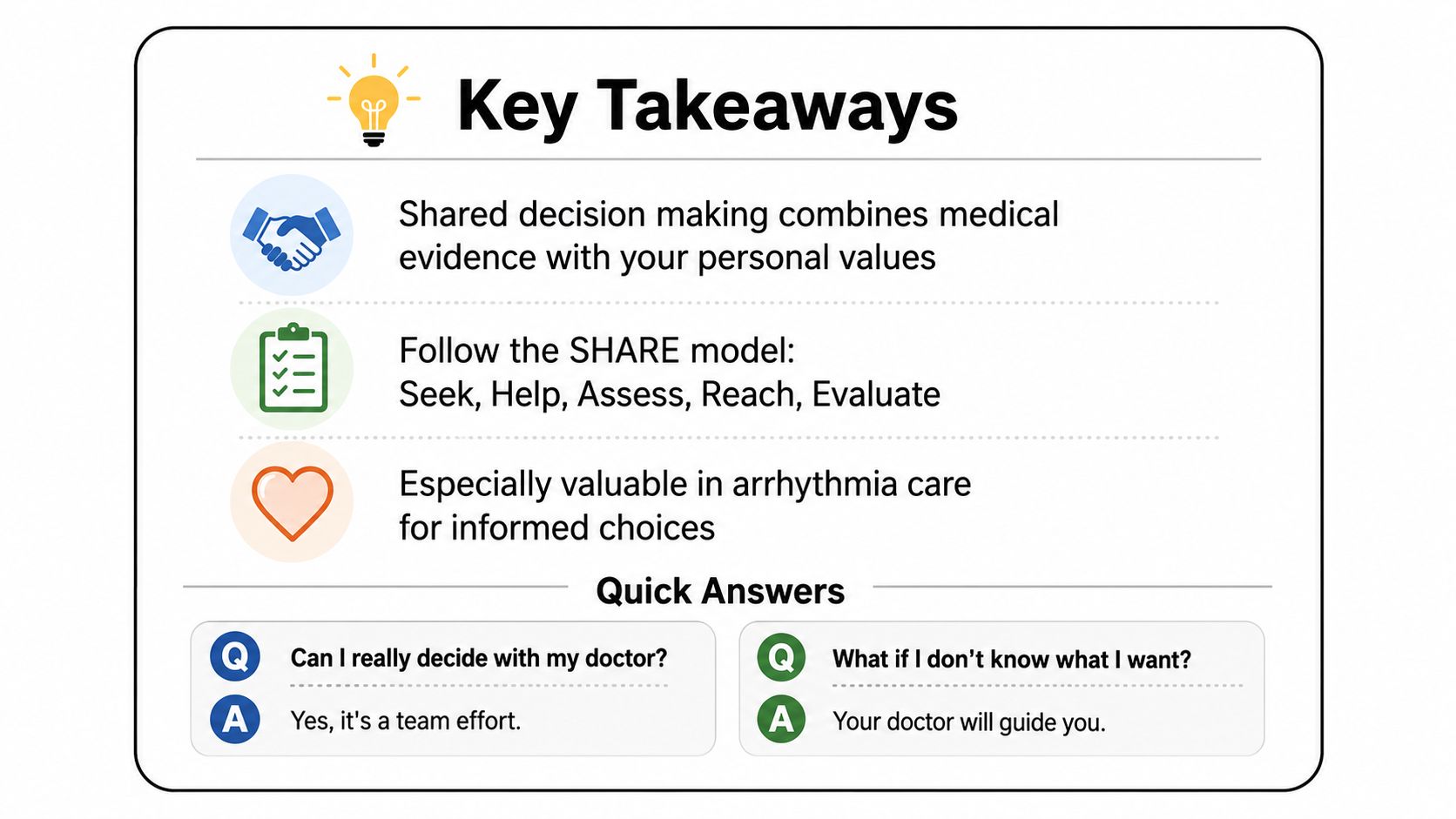
Can I really ask for shared decision making? Yes. You can say, “I'd like to go through the options together.” That's a reasonable request, not a difficult one.
How long should it take? It can be brief when the question is simple, or longer when the trade-offs are complicated. The key is not the clock. The key is whether you understand the options and feel clear on the next step.
How is it different from informed consent? Informed consent often focuses on permission before a procedure or treatment. Shared decision making is broader, it helps shape the choice itself before anyone gets to the final yes or no.
What if I'm dealing with an urgent rhythm problem? Emergencies are different. If symptoms are severe, or you're worried something is actively wrong, urgent medical care comes first. Shared decision making is most useful when there's time to compare reasonable options.
The most important part is this, you don't need to walk into the next visit with perfect medical vocabulary. Bring the tracing, bring your questions, and bring the part of the story that only you know. If you want help making that conversation cleaner before your appointment, start with Qaly and use it to organize your wearable ECG data into something your clinician can work with.
Unsure what your wearable ECG means? Certified experts review it within minutes.


