




Hello Heart Hero. You finish a sugary coffee, dessert, or sweet snack, then notice a flutter in your chest. Maybe your heart feels faster for a moment. Maybe there's a skipped beat that leaves you wondering whether the food caused it or whether something more serious is happening.
That experience can feel frightening, especially when appointments are difficult to schedule or you want more information than a short visit provides. Sugar can affect cardiovascular health through blood pressure, metabolism, inflammation, and overall strain on the body. It isn't proof that every palpitation comes from a sweet food, but it's a useful pattern to investigate calmly.
This guide connects sugar and heart health with practical rhythm tracking. A wearable ECG can help you record what your heart is doing during symptoms, then compare your patterns as you make gradual dietary changes. If you're also researching weight-related approaches and their relationship to cardiovascular concerns, you may find this resource on how to compare GLP-1 options for hearts helpful. It's not a substitute for medical care, but better information can help you have a more productive conversation with your clinician.

Hello Heart Hero and the Sugar Connection
A single flutter after a dessert is often harmless, but repeated symptoms deserve attention. Premature beats can feel like a pause, thump, or brief flip-flop in the chest. Stress, poor sleep, caffeine, dehydration, illness, and other factors can also contribute, so it's important not to blame sugar automatically.
The more useful question is: does a consistent pattern appear? You might notice symptoms after a sweetened coffee but not after plain coffee, or after a large dessert paired with a heavy meal rather than after fruit. Recording the timing, food, symptoms, and ECG rhythm gives you something more reliable than memory.
A practical mindset: Don't aim to prove that sugar caused every flutter. Aim to identify patterns that you can discuss with a healthcare professional.
Added sugar matters because it's easy to consume quickly and repeatedly. Sweetened drinks, flavored dairy products, baked goods, sauces, and packaged snacks can contribute to a high daily intake without feeling like a full meal. The concern is less about fearing every carbohydrate and more about understanding how frequent added sugar, especially in beverages, fits into your overall cardiovascular risk.
A wearable ECG can add another layer of clarity. When a symptom occurs, an on-demand recording may show whether the sensation coincided with a regular rhythm, an early beat, or another rhythm pattern. That information can support a calmer, more focused evaluation.
How Sugar Affects Your Cardiovascular System
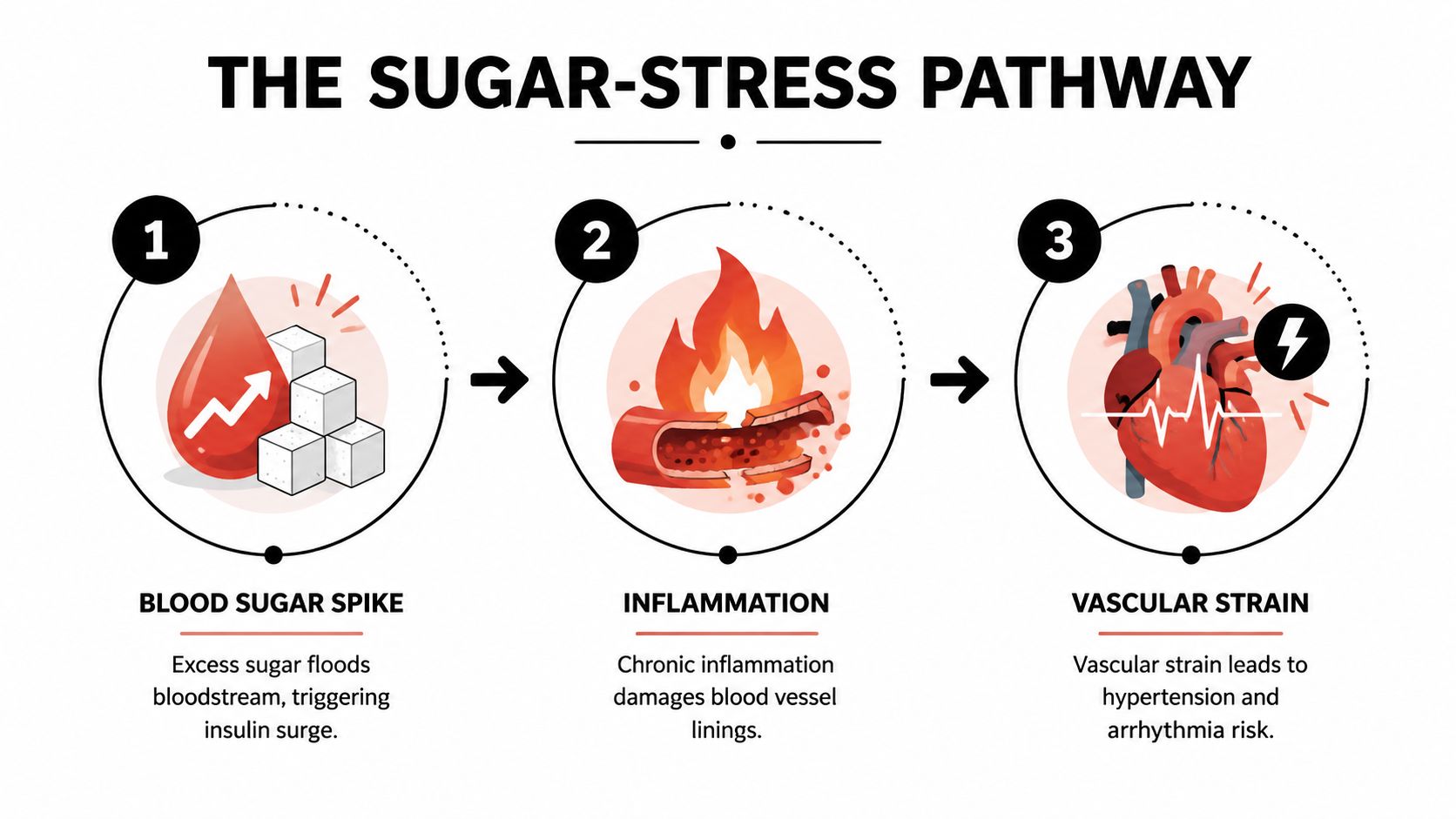
Your body handles sugar through several connected systems. After you consume a substantial amount of rapidly available sugar, blood glucose rises and the pancreas releases insulin. Insulin helps move glucose into cells, but repeated metabolic demand can accompany changes in blood fats, blood pressure, inflammation, and energy balance.
Think of blood vessels as flexible pipes. When inflammation and metabolic stress persist, the vessel lining may function less smoothly. Stiffer, less responsive vessels can increase the heart's workload, much like water moving through pipes that no longer expand and contract easily.
The USDA Nutrition Evidence Systematic Review found moderate evidence that higher added sugar intake, particularly from sugar-sweetened beverages, is associated with higher risk of hypertension, stroke, and coronary heart disease in adults. The review also described more consistent associations with higher triglycerides and blood pressure, two factors that can contribute to a pro-atherogenic and pro-hypertensive environment. The USDA review provides a detailed summary of this evidence.
Why the source matters
Sugar in a whole fruit arrives with fiber, water, and other nutrients. Those features affect how quickly you eat and digest the food. Added sugar is different because manufacturers or cooks put it into a product, often making it easy to consume in concentrated amounts.
A sweetened drink is a particularly important example. Liquid calories provide little chewing and may not create the same fullness as solid food, so you can consume more sugar before feeling satisfied. A sweet drink can also become a daily habit, turning an occasional choice into a repeated exposure.
Where rhythm symptoms fit
Sugar doesn't directly explain every irregular heartbeat. However, cardiovascular strain can make the body more sensitive to triggers, while blood pressure elevation, insulin resistance, dehydration, stress, or changes surrounding a large meal may affect how palpitations feel. Electrolyte changes can also act like static interference in the heart's electrical system, although a wearable recording is needed to determine what rhythm occurred.
The key distinction is between a symptom and a diagnosis. A flutter tells you how your heartbeat feels. An ECG shows electrical activity during that moment. Both matter, but they answer different questions.
What the Research Shows About Sugar and Heart Risk
The strongest evidence concerns cardiovascular outcomes rather than the claim that every sweet food causes an immediate rhythm disturbance. In a 2014 cohort analysis published in JAMA Internal Medicine, adults consuming 25% or more of daily calories from added sugar had more than twice the risk of dying from cardiovascular disease compared with adults consuming less than 10% of calories from added sugar. The paper also discussed the World Health Organization recommendation to keep added sugar below 10% of calories and American Heart Association limits of about 100 calories per day for women and 150 for men. Read the original JAMA analysis.
Later evidence continued to point toward a relationship between higher intake and cardiovascular events, especially when sugar comes from drinks. A Swedish cohort analysis of 69,705 adults found that added sugar above 20% of energy was associated with a 39% higher risk of coronary events and a 31% higher risk of stroke compared with lower intake categories. A separate meta-analysis found that at least one sugar-sweetened beverage per day was associated with a 29% higher risk of total cardiovascular disease, a 35% higher risk of coronary heart disease, and a 30% higher risk of stroke. The prospective and meta-analytic evidence is summarized in this review.
How to interpret the thresholds
| Daily Added Sugar Intake | Associated Risk Level | Real-World Equivalent |
|---|---|---|
| Below 10% of daily calories | Consistent with WHO guidance and the lower comparison category used in major research | A pattern centered on minimally sweetened foods, with added sugar kept modest |
| 10% to below 15% of daily calories | Above the WHO ceiling, with risk depending on source and total dietary pattern | Added sugar spread across drinks, desserts, breakfast products, or sauces |
| 15% or more of daily calories | Associated with higher total cardiovascular disease and coronary heart disease risk in a large analysis | A daily pattern containing several sweetened items, especially when drinks are included |
| 25% or more of daily calories | More than twice the cardiovascular mortality risk compared with below 10% in the JAMA analysis | A heavily sugar-sweetened pattern, not an occasional dessert |
The relationship isn't perfectly simple. A 2024 Swedish cohort found different patterns by outcome and intake category, while a 2025 analysis linked higher added sugar, particularly from beverages, with higher all-cause mortality and cardiovascular risk. These findings reinforce an important point: source, dose, and total energy balance matter. You don't need to treat a piece of fruit like a soda.
For broader personal risk context, you can review a risk score for cardiovascular disease, then discuss the result with a qualified clinician. Gradual reduction is a sensible strategy. Replacing one habitual sweetened drink or snack can be more sustainable than trying to eliminate every sweet food overnight.
Get your ECG checked by certified experts within minutes on the Qaly app.


Practical Ways to Reduce Added Sugar in Your Diet
Start with the label, not the front of the package. Nutrition facts panels separate total sugars from added sugars, so check the added-sugar line and the serving size. A product may look reasonable until you realize the package contains multiple servings or that your usual portion is larger than the listed serving.
Ingredient lists reveal another layer. Sugar may appear as maltose, dextrose, rice syrup, corn syrup, cane sugar, honey, or fruit juice concentrate. The name changes, but the practical question stays the same: how much added sugar does this product contribute to your day?
Build a realistic target
The American Heart Association's practical limits are about 100 calories per day for most women and 150 calories per day for most men, as described in the U.S. dietary guidance on added sugars. The same source discusses keeping free sugars below 10% of total daily energy, with additional benefits below 5%.
For a flavored yogurt, compare the added-sugar amount with plain yogurt before adding fresh fruit. For a granola bar, look at the first ingredients and the serving size. If a syrup or sugar appears near the beginning of the list, the product may be sweeter than its health-focused packaging suggests.
Make the change easier
- Replace the liquid first: Try water infused with citrus or berries, sparkling water, or unsweetened herbal tea instead of a sugary drink.
- Keep sweetness attached to food: Choose plain yogurt with fresh fruit rather than a pre-sweetened variety, so fiber and texture make the snack more satisfying.
- Use the first-three-ingredients rule: If sugar, syrup, or a sweetener appears among the first three ingredients, compare another product.
- Prepare simple snacks: Nuts, vegetables with hummus, plain yogurt, or fruit can reduce reliance on packaged sweets.
- Question the health halo: Granola, protein snacks, smoothies, and breakfast products can sound nutritious while still containing substantial added sugar.
For more practical ideas, explore these healthier low-sugar strategies from Rip Van. You can also connect food changes with broader lifestyle changes for heart disease.
Track your symptoms for two to four weeks without judging yourself. Note the food, timing, caffeine, sleep, hydration, activity, symptoms, and any ECG recording. A pattern of fewer episodes is encouraging, but it doesn't prove that sugar was the only cause.
When Heart Palpitations Need Closer Attention
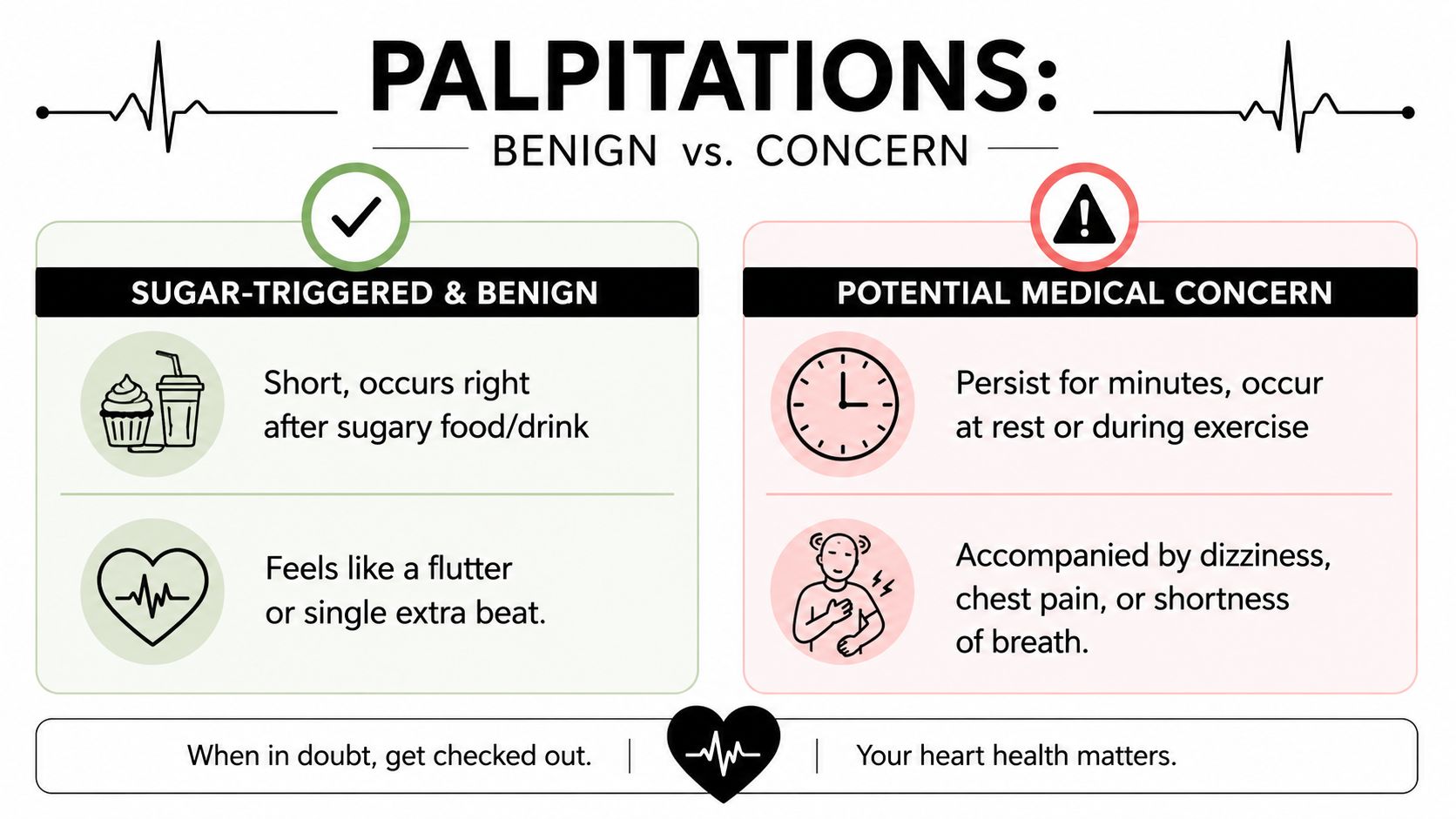
An occasional flutter or single skipped beat after a meal is often a premature contraction and may be harmless. Still, the sensation alone can't identify the rhythm. Some people feel a benign extra beat intensely, while others have a significant rhythm disturbance with surprisingly mild symptoms.
Seek prompt medical attention if palpitations last longer than a few minutes, occur with dizziness, chest pain, shortness of breath, or fainting, or involve an irregular rhythm that feels chaotic rather than fast. A resting heart rate consistently above 100 beats per minute also deserves clinical assessment. If symptoms are severe, sudden, or accompanied by fainting or chest pain, use emergency services rather than waiting for an app or appointment.
Why timing changes the evaluation
Clinicians need symptom-rhythm correlation. A description such as “my heart raced after dessert” gives context, but an ECG captured during the episode can show whether the rhythm was regular, irregular, early, or sustained. Sustained tachycardia and atrial fibrillation can carry important risks, including stroke and heart failure, so persistent or concerning symptoms shouldn't be explained away as sugar sensitivity.
Traditional testing can include a Holter monitor worn for a set period or an event recorder used when symptoms occur less often. These tools can be valuable, but intermittent symptoms may not happen during the scheduled monitoring window. That gap can leave patients with a strong sensation and no recording to explain it.
Record instead of guessing
A wearable ECG can help capture the electrical rhythm while the symptom is happening. Record the episode when it starts, follow the device's instructions, and save the time, food, activity, and associated symptoms. Guidance on whether sugar can increase heart rate can help you think through possible triggers, but it can't diagnose an arrhythmia.
Safety comes first: An ECG app can support evaluation, but it doesn't replace urgent care, a clinician's examination, or emergency treatment.
Share recordings with your healthcare professional, especially if episodes repeat, last longer, or change in character. A clear record can make the conversation more specific and reduce the pressure to remember every detail under stress.
Using Wearable ECG Technology to Track Your Rhythm
Smartwatches and portable ECG monitors can record a single-lead electrocardiogram when you activate them. Depending on the device and the recording, they may help identify patterns associated with atrial fibrillation, premature ventricular contractions, supraventricular tachycardia, or other rhythm abnormalities. They aren't equivalent to every clinical test, but they can capture an important moment that a scheduled appointment may miss.
The most useful feature is on-demand recording. If a flutter starts after a sweetened drink, record while the sensation is present, then write down what you consumed and how long the episode lasted. Repeating that process over several weeks can help you compare symptom frequency and recorded rhythms before and after reducing added sugar.
Qaly is one option that connects wearable ECG recordings with certified cardiographic technicians and electrophysiology reviewers. Its workflow allows a user to record a 30-second ECG, upload it through the app, and receive human-reviewed analysis that can be shared with a cardiologist. The service supports recordings from devices such as Apple Watch, Samsung, Fitbit, Kardia, Withings, and Holter monitors. You can learn more about heart rhythm monitoring with wearable ECG recordings.
Turn lifestyle changes into observations
Use a simple tracking routine:
- Record the symptom and ECG when possible.
- Note added-sugar sources, caffeine, sleep, hydration, and exercise.
- Review patterns weekly rather than reacting to one isolated episode.
- Bring concerning recordings or repeated trends to your clinician.
A decrease in palpitations after dietary changes may feel reassuring, but it doesn't rule out an underlying condition. The value of monitoring is that it replaces vague speculation with time-stamped information you can discuss with a professional.
Your Next Steps for Better Heart Health
Reducing added sugar and monitoring your rhythm work well together. Food changes address a modifiable contributor to cardiovascular strain, while ECG recordings show what your heart's electrical activity is doing when symptoms occur.
Begin with one manageable action. Replace one sugary beverage with infused water or unsweetened tea, check added sugars on the products you buy most often, and record an ECG the next time you feel an irregular heartbeat. Keep the notes simple, and focus on consistency rather than perfection.
Remember the most important boundaries:
- Use practical limits: Keep the AHA guidance in mind, about 100 calories of added sugar daily for most women and 150 for most men.
- Read beyond the front label: Check serving size, added sugars, and ingredient names.
- Prioritize drinks: Beverage-based sugar is a particularly useful first target.
- Respect warning signs: Persistent palpitations or symptoms such as chest pain, fainting, dizziness, or shortness of breath need medical attention.
You can take control without trying to solve everything at once. Start today by choosing your first lower-sugar swap, and keep a wearable ECG ready so your next symptom becomes useful information rather than another unanswered worry.
Choose one sugary drink or snack to replace this week, record your symptoms and rhythm when needed, and bring any concerning pattern to your healthcare professional.
Flutter after something sweet? Certified experts review your ECG within minutes.


