





Key Takeaways

User Profile
Hello, Heart Hero. If you’ve noticed an unusual rhythm on your wearable's ECG, it’s completely normal to feel a bit unsettled. We get it. The healthcare world can feel confusing, and sometimes you just want clear answers you can trust. By learning more about what you're seeing on your own device, you're taking a powerful step toward understanding your heart. This guide is designed to replace that confusion with confidence.
Let's start with a simple and effective technique. To calculate your atrial rate, the most common approach is the 6-second method. All you have to do is find a 6-second strip of your ECG, count the number of P waves (those are the small bumps before the main spike), and then multiply that number by 10. This gives you a solid estimate of your atrial beats per minute.
Your Guide to Understanding Atrial Rate
It can be jarring to see something on your ECG that you don't recognize. We're here to give you the tools to make sense of it all.
Why Atrial Rate Matters
Think of your heart's two upper chambers, the atria, as the starting point for every beat. They contract first, pushing blood down into the lower chambers. Your atrial rate is simply the tempo of these upper chambers.
An ECG captures this electrical journey, and that very first small bump you see in each heartbeat cycle is called the P wave. This little blip is the key to figuring out your atrial rate.
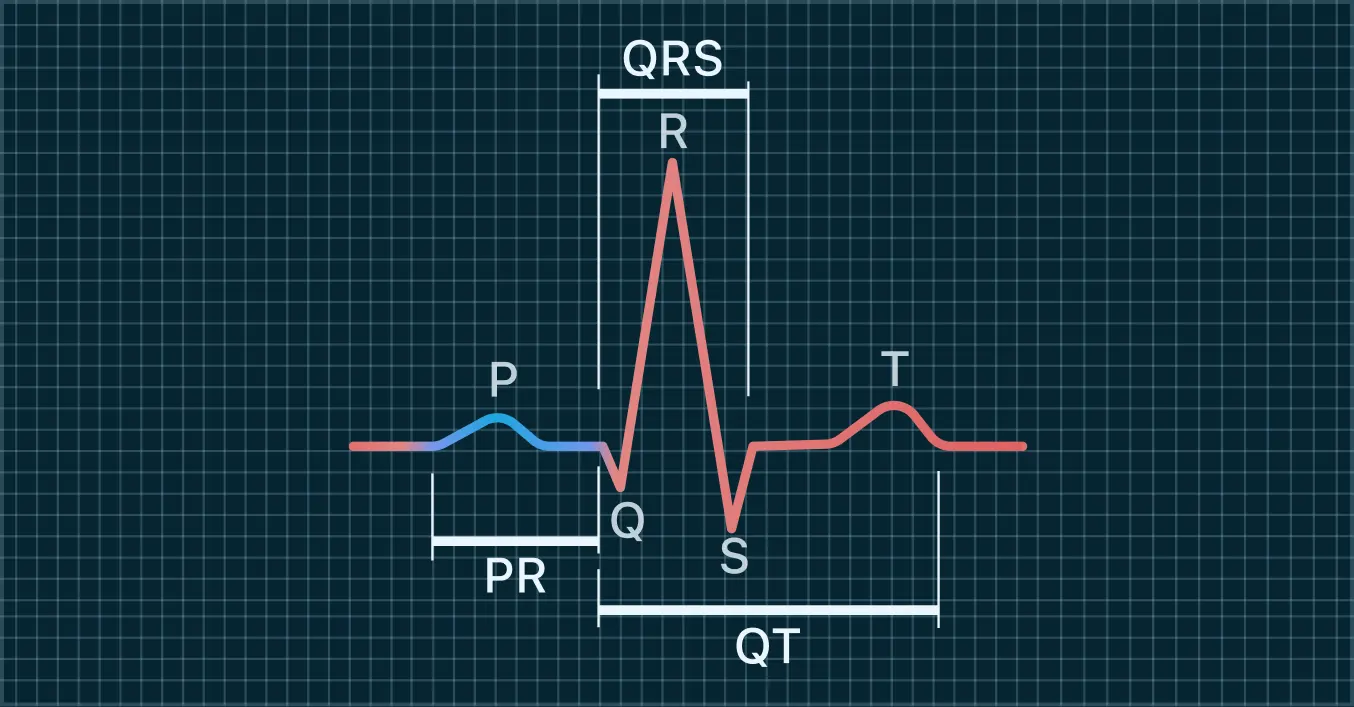
Keeping an eye on this rhythm is especially useful if you're monitoring for conditions like atrial fibrillation or atrial flutter, where the atria can beat irregularly or much faster than the rest of the heart.
By learning to calculate your atrial rate yourself, you can:
- Get a much deeper insight into your heart's electrical patterns.
- Spot potential irregularities that a simple heart rate number might not show.
- Have more specific and productive conversations with your doctor.
This isn't about self-diagnosing. It's about self-empowerment. Knowing how to interpret the basic signals from your own body gives you a greater sense of control on your heart health journey.
This skill turns a confusing squiggle on a screen into something you can actually use. It’s a practical ability that helps you feel more in tune with your body. To dive even deeper into the basics of what you're looking at, check out a cardiologist's guide to the smartwatch ECG. Our goal is to demystify your heart’s rhythm, one P wave at a time.
How to Find the P Wave on Your ECG Strip
Before you can calculate your atrial rate, you need to know what you’re looking for on your watch’s ECG strip. Think of this as your personal map to the ECG, where the single most important landmark for this measurement is the P wave. This little wave is the starting point for every heartbeat's electrical signal.
So, how do you spot it? Look for a small, usually rounded bump that comes just before the big, spiky part of the heartbeat (that’s the QRS complex). In a normal, steady rhythm, you should see one of these gentle hills right before each sharp peak, marching along in a nice, consistent pattern.
Recognizing Different P Wave Patterns
P waves aren’t always perfect little bumps. Their appearance can change quite a bit, offering clues about what your heart's upper chambers (the atria) are actually doing. Knowing these variations is the key to making sense of your reading.
For instance, certain heart rhythms have very distinct P wave characteristics:
- Atrial Flutter often creates a "sawtooth" pattern. Instead of individual P waves, you might see a series of jagged, rapid waves crammed between the spiky QRS complexes.
- Atrial Fibrillation is a different beast entirely. Here, the atria quiver chaotically, so you might not find any clear P waves at all. The baseline between the QRS complexes often looks wavy and disorganized instead.
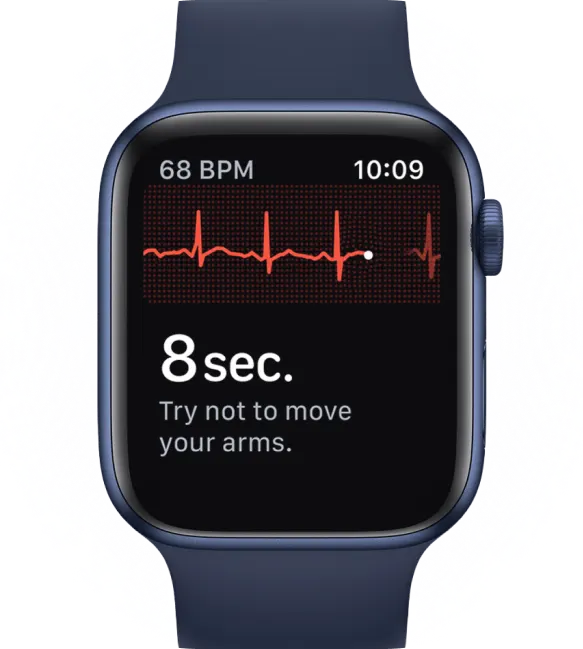
The goal here isn’t to diagnose, but to build your confidence in identifying these patterns. When you can pull up an ECG from your Apple Watch or Kardia device and spot the P waves, or notice their absence, you can say, “Okay, I see what’s happening here.”
Learning to visually identify these electrical signals is the first practical step toward turning your ECG data into useful information. To dig deeper with more visual examples, check out our detailed guide on what P waves look like in your watch ECG. Mastering this foundational skill will make you feel much more prepared for the next step: the calculation itself.
Calculating Atrial Rate with the Six Second Method
Now for the practical part. Let’s make this as simple as possible. We’re going to use the most common and reliable approach for at-home ECGs, a technique called the Six Second Method.
An ECG strip from your device is a visual map of your heart's electrical activity over time. On a standard ECG, the paper speed is set so that 30 large squares represent exactly six seconds. This little detail is what makes our calculation so straightforward.
Breaking Down The Calculation
The process involves just two simple actions: counting and multiplying.
First, you need to find a 6-second segment of your ECG trace. Then, carefully count every single P wave you can identify within that specific window.
Once you have your total count, you just multiply that number by 10. That's it! For example, if you count 8 P waves in your 6-second strip, your atrial rate is 80 beats per minute (bpm). This method is incredibly useful because it works well even with the irregular rhythms that many wearable users are concerned about.
This visual guide shows what to look for when identifying P waves in different rhythms, from a normal heartbeat to flutter or AFib.
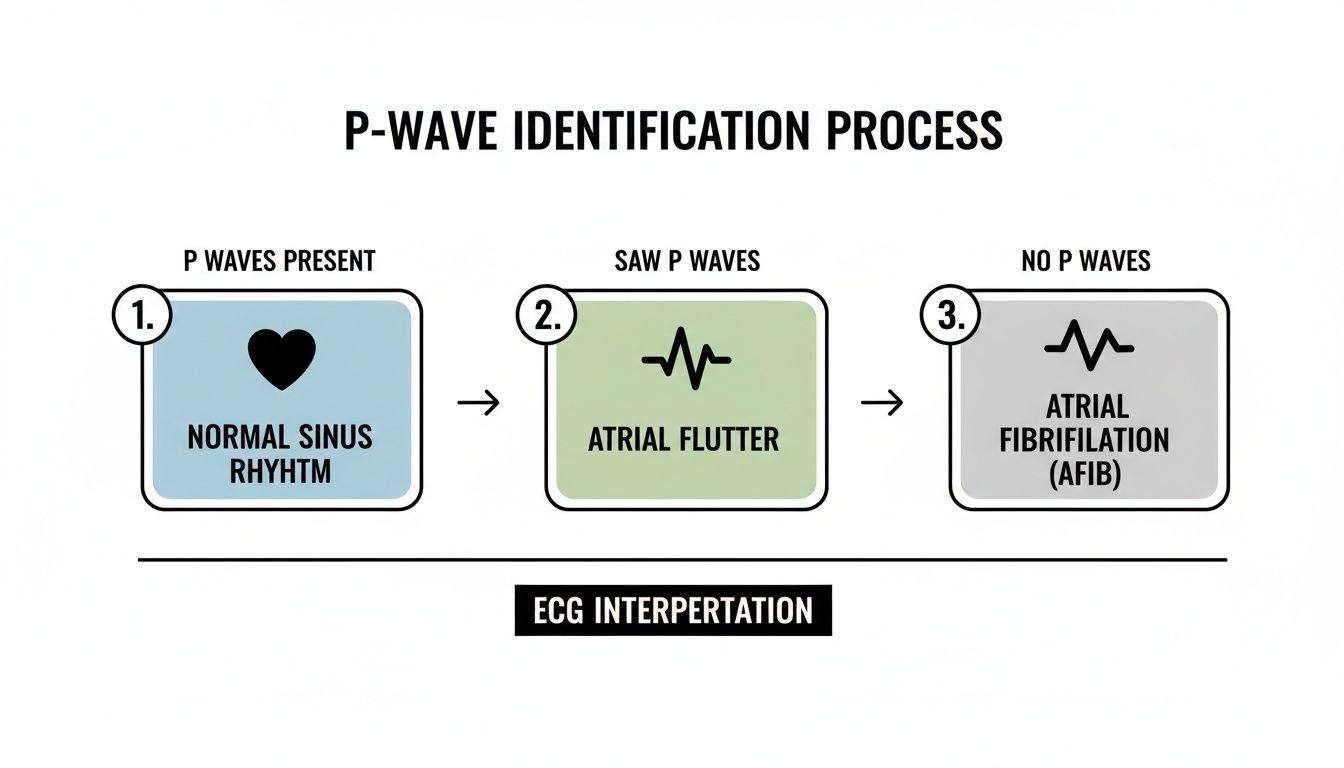
The key takeaway here is that identifying the P wave pattern is the first critical step before you can even begin to count.
Putting The Method Into Practice
Mastering the Six Second Method is a core skill for anyone monitoring their heart. On an ECG where the paper moves at 25 mm per second, those 30 large squares are your 6-second marker. Count the P waves within that block and multiply by 10. For instance, spotting 10 P waves means an atrial rate of 100 bpm.
This simple multiplication trick turns a complex-looking line graph into a number you can actually use. It’s about taking back control and understanding the data your own body is providing.
This technique is particularly helpful for checking on irregular rhythms tied to palpitations, which affect over 17 million people in the US alone. Remember, the goal is to transform your ECG data into meaningful information, giving you a powerful starting point for understanding your heart.


What Your Atrial Rate Calculation Might Mean
Okay, so you've crunched the numbers and have your atrial rate. The big question is, what does that number actually tell you? It's easy to feel a bit on edge at this point, but remember, this is all about gathering information, not jumping to a diagnosis.
Let's put your calculation into perspective.
For most adults at rest, a typical atrial rate hangs out somewhere between 60 and 100 beats per minute (bpm). This is the range doctors often associate with a normal sinus rhythm, where everything is ticking along nicely and your atria and ventricles are in sync. A number in this ballpark is usually a reassuring sign.
Looking Beyond the Normal Range
But what if your atrial rate is faster or slower than that 60 to 100 bpm sweet spot? It's important not to panic. A single ECG is just a snapshot in time. Plenty of things, like a stressful meeting, that extra cup of coffee, or a rough night's sleep, can temporarily throw your heart rate for a loop.
Where it gets more interesting is when you see a consistently high atrial rate, especially when you pair that number with the specific patterns on your ECG trace. For instance, if you calculated an atrial rate of 250 bpm and also spotted that classic "sawtooth" pattern we talked about, it could point toward something like atrial flutter. In atrial flutter, your atria are firing off signals way faster than your ventricles can keep up.
Another possibility is if your ECG shows a chaotic, irregular rhythm where you can't even find clear P waves. This is often a tell-tale sign of atrial fibrillation. The real insight comes from looking at both the rate and the rhythm together.
Think of this self-monitoring as a tool for awareness, nothing more. Your calculation is a valuable piece of data that lets you have a much more specific and informed conversation with your doctor or a Qaly technician.
Ultimately, your goal here is to get a better handle on what your body is trying to tell you. An unusual number isn't a final answer; it’s the perfect starting point for a more productive conversation about your heart health.
When Your ECG Needs a Second Look
So you’ve run the calculation, but something still feels off. Maybe the rate you came up with seems unusually high or low, or the rhythm just looks chaotic and tough to decipher. It’s perfectly normal to feel a bit uncertain when you're trying to make sense of your own health data.
This is exactly why getting a second, expert opinion can be so valuable. It’s one thing to learn how to calculate the atrial rate yourself, but it’s another to have a trained professional confirm what you’re seeing. This isn't about doubting your own abilities; it's about adding a layer of confidence to your findings.
How Expert Analysis Can Help
Imagine being able to send that same ECG strip you just puzzled over to a certified cardiographic technician and get a detailed interpretation back, often within minutes. This service doesn't replace your doctor's advice. Think of it as a way to get timely, human-reviewed information that can reduce anxiety and give you concrete data to discuss at your next medical appointment.
This effectively bridges the gap between seeing a confusing rhythm on your watch and waiting weeks for a doctor's visit. If you're curious about the technology itself, a good place to start is learning more about how accurate the ECG is on your Apple Watch.
The goal is to move from uncertainty to clarity. An expert-backed report provides peace of mind and transforms your at-home ECG from a source of worry into a powerful tool for managing your heart health.
When you share your ECG, you can expect a report that not only confirms the atrial rate but might also identify specific patterns or arrhythmias. This gives you clear, actionable information to bring to your healthcare team, making sure your conversations are productive and focused on what really matters.
Common Questions About Atrial Rate
It's natural to have more questions as you get comfortable with a new skill like reading your own ECG. Think of it as a journey. Every question you ask is a step toward better understanding your heart. Let's tackle a few common ones that pop up.
What if I Cannot See Any P Waves on My ECG
If you're looking at your ECG and can't spot any clear P waves, don't panic. You aren't necessarily missing something obvious. This is actually a really important observation.
When the baseline of your ECG trace looks wavy or chaotic instead of showing those distinct P wave bumps, it might be a sign of atrial fibrillation (AFib). In AFib, the atria are quivering instead of beating normally, which is why P waves disappear. In this case, you'd shift your focus to the ventricular rate (by counting the tall QRS spikes) instead of the atrial rate. Seeing this is a great reason to share the reading with your doctor.
Is the Atrial Rate Always the Same as My Heart Rate
In a normal, healthy heart rhythm, the answer is yes. Your atrial rate and your ventricular rate, which is the pulse you feel, should line up perfectly.
However, in certain arrhythmias like atrial flutter, the atria can beat much, much faster than the ventricles. You might calculate an atrial rate of 300 bpm, while the pulse you feel at your wrist is only 150 bpm. This happens because the heart's "gatekeeper" (the AV node) blocks some of those super-fast atrial signals from reaching the ventricles.
This is exactly why learning to spot P waves is so powerful. It helps you uncover discrepancies that a simple pulse reading from your wearable would completely miss, giving you a much richer picture of your heart's activity.
Can My Wearable Device Calculate Atrial Rate for Me
Most smartwatches and wearables are programmed to calculate your ventricular rate, which they then display as your "heart rate." They're designed to lock onto the biggest, most obvious electrical signal, which is the R wave of the QRS complex.
These devices don't typically analyze the smaller P waves or calculate the atrial rate separately. By learning to count the P waves yourself, you're unlocking a deeper layer of insight that your device simply isn't built to provide.

When you need clarity on your ECG, Qaly provides expert, human-reviewed analysis in minutes. Get peace of mind by having your ECGs reviewed by certified professionals.



.png)
.png)