




Key Takeaways

User Profile
Hello Heart Hero. Being jolted awake by a pounding heart is a deeply unsettling feeling. If this has happened to you, the first thing to know is that you're not alone. We're here to offer some clarity and reassurance, especially if you've felt unheard or are just starting to look for answers on your own terms.
Our goal is to empower you with knowledge in a calm, welcoming space. Understanding what's happening inside your own body is the first real step toward peace of mind. So, let's explore why these nighttime heart rate spikes happen and how you can use modern tools to get a clearer picture, all without the stress of an immediate, intimidating doctor's visit.
Your Heartbeat During Sleep
It might sound strange, but your heart isn't supposed to beat like a metronome all night long. Its rhythm naturally ebbs and flows as you drift through different stages of sleep.
These ups and downs are usually a sign that your nervous system is working exactly as it should. The real concern comes when these changes are so abrupt that they wake you up or leave you feeling anxious.
Waking up to a racing heart can be frightening, but it’s more common than you might think. Often, these events are a normal part of your body's nightly routine, especially during dream-filled REM sleep.
These heart rate spikes are very often tied to your REM (Rapid Eye Movement) sleep cycles. During REM, your brain becomes much more active, and surges in your nervous system can trigger responses that mimic being awake and stressed, including a faster heartbeat.
In fact, research shows that during REM sleep, which makes up about 20 to 25 percent of your total sleep time, your heart rate can climb significantly. Understanding this natural pattern is key to telling the difference between a normal fluctuation and something that might need a closer look.
Why Your Heart Races When You Should Be Resting
It’s an unsettling feeling, isn't it? Waking up to a racing heart when you’re supposed to be in a deep, restorative sleep. The good news is that many of these nighttime heart rate spikes are completely normal and are just a part of the incredible journey your body takes every single night.
Think of your sleep not as one long rest, but as a cycle through different stages. One of the most active stages is REM (Rapid Eye Movement) sleep. This is where your most vivid dreams happen. During REM, your brain activity can look surprisingly similar to when you're awake, and your nervous system often follows suit, causing your heart rate to naturally tick up.
Everyday Triggers for Nighttime Heart Spikes
Beyond your natural sleep cycles, several everyday habits can send your heart a false alarm while you’re trying to rest. The great thing is, these are often small things in your daily routine that you have complete control over.
Common culprits include:
- Late-Night Meals or Snacks: Eating a heavy meal too close to bedtime forces your metabolism to work overtime right when it should be powering down. This can easily keep your heart rate elevated.
- Alcohol Before Bed: That nightcap might make you feel drowsy at first, but alcohol is notorious for disrupting sleep quality later in the night, often causing your heart rate to climb.
- Daily Stress and Anxiety: If you go to bed with your mind still racing from the day's worries, your body can remain in a state of high alert, making it tough for your heart to settle into a relaxed rhythm.
- Dehydration: Simply not drinking enough water during the day puts a strain on your heart, forcing it to pump harder even when you’re lying still.
Understanding Your Heart’s Rhythm
It's important to know that these brief increases in heart rate are different from heart palpitations, which often feel more like a fluttering, skipping, or flip-flopping sensation. While both can be unnerving, occasional spikes are frequently just your body reacting to dreams or digesting that late-night snack.
If you want to dive deeper into the different sensations you might feel, check out our guide on what causes heart palpitations.
Remember, a temporary rise in your heart rate during sleep is often your body's normal reaction to internal events like dreaming. It doesn’t automatically signal a problem.
By understanding these common, and usually harmless, causes, you can start connecting the dots between your daily habits and your heart's activity at night. This knowledge is the first real step toward gaining peace of mind and figuring out what’s normal for you.
When Nightly Heart Spikes Might Signal Something More
While many of those nighttime heart rate spikes are perfectly normal, it's smart to know when they might be your body's way of flagging a deeper issue. This isn't about creating anxiety; it's about being empowered. Knowing what to look for helps you spot patterns that might tell a more complete story.
Think of it like a smoke alarm going off in your house. Most of the time, it's just burnt toast. But you still check, just in case it's something that really needs your attention. Sometimes, these heart rate episodes are tied to underlying conditions that mess with your sleep and, by extension, your heart rhythm.
Conditions That Can Cause Heart Rate Spikes
Let's walk through a few common culprits. The key is often in the surrounding details and other symptoms you might be feeling. Do you notice anything else happening when your heart races?
- Sleep Apnea: This is a big one. It's a condition where you repeatedly stop breathing for brief moments during sleep. When that happens, your blood oxygen levels drop. Your brain senses the danger and hits the panic button, releasing a jolt of adrenaline to wake you up just enough to gasp for air. This causes a sudden, sharp spike in your heart rate. Waking up choking or gasping is a classic tell-tale sign.
- Nocturnal Panic Attacks: Anxiety doesn't always clock out when you go to bed. A nocturnal panic attack can rip you from a deep sleep with a pounding heart, sweating, and a wave of intense fear, often with no obvious trigger from a dream. It feels completely out of the blue.
- Supraventricular Tachycardia (SVT): This is a specific type of heart rhythm problem that can cause an incredibly fast, steady heartbeat that starts and stops on a dime. It literally feels like someone flipped a switch, sending your heart rate into overdrive, and then flipped it right back off just as suddenly.
Another major player that can stir up your heart at night is simply not getting enough sleep. Sleep deprivation is more than just feeling groggy; it directly messes with your nervous system's balance, fueling those heart rate spikes. Even a single night of bad sleep can raise your heart rate in a way that's similar to stress, a pattern that often gets worse during your REM sleep stages. You can learn more about how sleep loss impacts your heart rhythm.
Recognizing specific patterns can be incredibly powerful. A spike that comes with gasping for air tells a different story than one that feels like a sudden, perfectly rhythmic racing that stops on a dime.
By paying close attention to these details, you shift from a place of worry to one of informed observation. It’s not about diagnosing yourself. It’s about gathering valuable clues. This knowledge helps you understand your body on a deeper level and gives you the confidence you need when something feels consistently off. You are the number one expert on your own body, and noticing these patterns is the first step toward getting answers and real peace of mind.
Using Your Wearable to Capture What Is Happening
Waking up to a racing heart can leave you feeling powerless, but this is exactly where you can turn that anxiety into action. Your wearable device, whether it’s a smartwatch or a fitness tracker, is an incredibly powerful tool for gathering clues about what's going on. Instead of just worrying about a fleeting event, you can actually capture it.
This isn’t about diagnosing yourself. It’s about collecting clear, objective information that you can use. Having an actual recording of an episode puts you firmly in the driver's seat, transforming a scary, confusing moment into valuable data.
Be Prepared to Capture the Moment
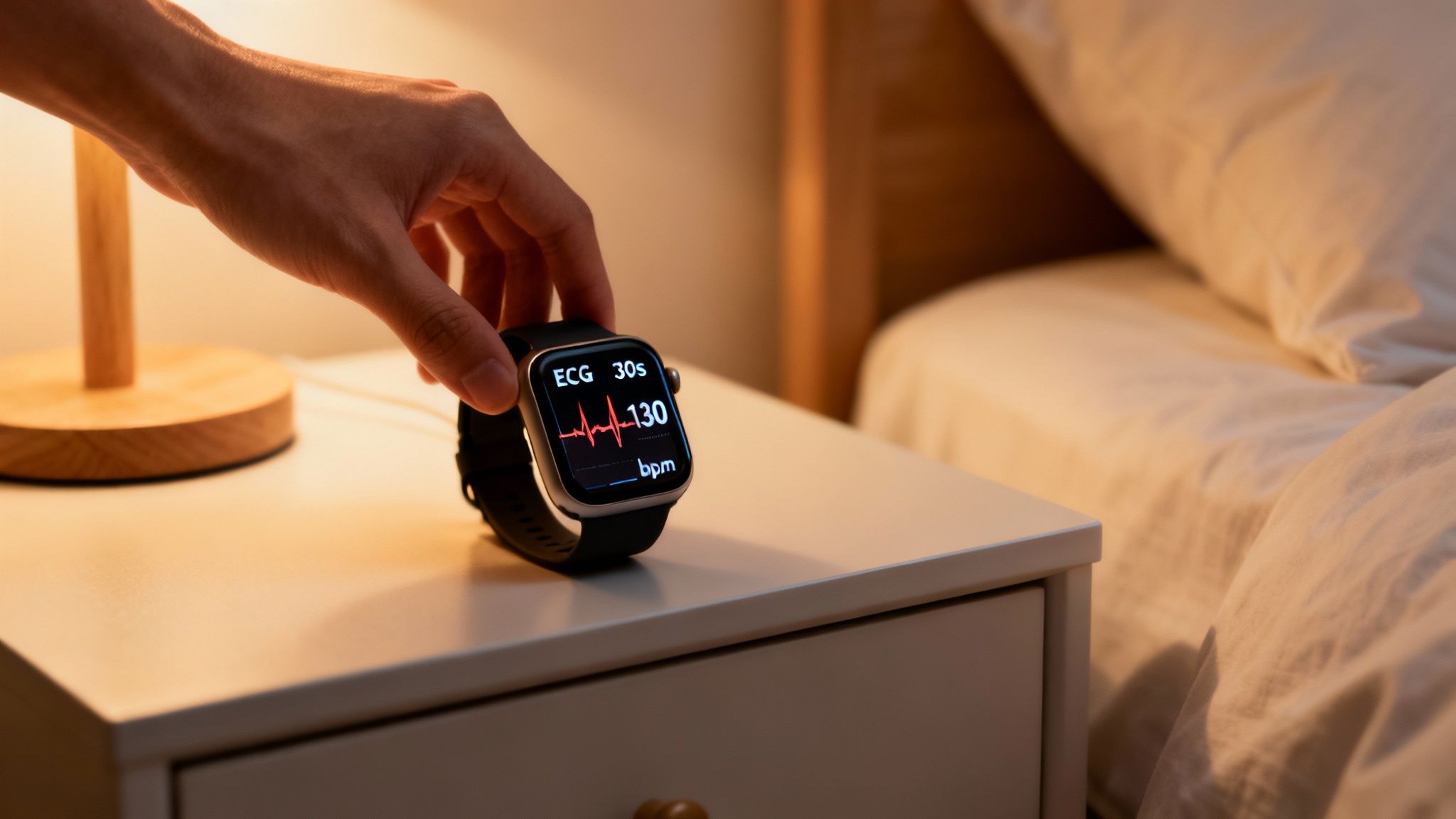
The real key to getting a good recording is being prepared before it happens. When you’re jolted awake with a racing heart, the last thing you want to be doing is fumbling for your device in the dark.
A few simple steps can make all the difference:
- Keep Your Device Close: Always place your smartwatch on your nightstand, right within arm's reach.
- Know Your App: Practice taking an on-demand ECG reading during the day. You want the steps to feel like second nature, so you're not trying to figure it out at 3 AM.
- Stay as Calm as Possible: When you wake up, take a slow, deep breath. Try to relax your arm and body to ensure you get a clear, clean ECG strip without a lot of artifact or "noise."
For a broader perspective, it's also worth exploring options for how to check your heart health at home. On top of that, many devices let you set up alerts for unusual heart activity. You can learn more about how to set up high heart rate notifications on an Apple Watch.
Understanding Age and Heart Rate Variability
It's also helpful to know that heart rate spikes while sleeping can be connected to natural, age-related changes in your heart rate variability (HRV). Think of HRV as your heart's ability to adapt and respond smoothly.
One study that analyzed over 18 million sleep sessions found that a key HRV metric tends to decline as we age. This lower variability can make your heart more prone to sudden spikes because its ability to regulate itself gracefully weakens a bit. So, if your wearable flags an irregular rhythm at night, it could be tied to this natural shift.
Capturing an ECG during an episode is one of the most proactive steps you can take. It provides a real snapshot of your heart’s electrical activity, offering far more insight than just a heart rate number alone.
By being prepared, you empower yourself to capture exactly what's happening in the moment. This gives you concrete information, which is always more useful than trying to describe a feeling from memory. It’s a powerful step toward getting the answers and peace of mind you deserve.
Making Sense of Your At Home ECG Recording
Alright, so you managed to capture a recording of that heart rate spike. Now you're staring at this squiggly line on your screen, and it probably feels like trying to read another language. It's easy to get overwhelmed, but you don't need a medical degree to understand the basics. Let's break it down together.
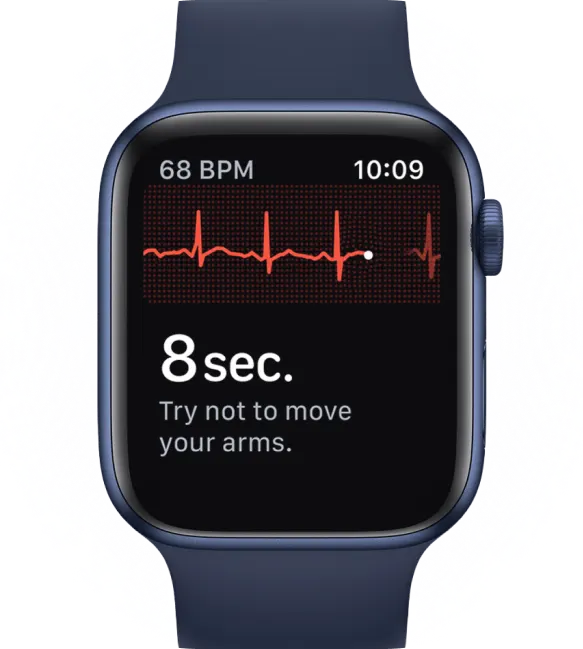
Think of your ECG as a short story of a single heartbeat, told through three main "characters": the P wave, the QRS complex, and the T wave. Each one tells us what your heart's chambers were up to at that moment. Was the rhythm just fast and steady, or was it chaotic and disorganized? Learning to spot these simple patterns is your first real step toward understanding what your body is trying to tell you.
The Basic Story of a Heartbeat
Your wearable ECG captures the electrical signals that make your heart muscle contract. Just getting a handle on the fundamentals can give you incredible insight into what was happening during one of those nighttime episodes.
Here’s a simple play-by-play of what those squiggles actually mean:
- The P Wave: This is the first small bump. It shows the electrical signal kicking off in your heart's upper chambers (the atria), telling them to squeeze blood down into the lower chambers.
- The QRS Complex: This is the big, sharp spike you can't miss. It represents the powerful contraction of your heart's lower chambers (the ventricles) as they pump blood out to your lungs and the rest of your body.
- The T Wave: This is the final, rounded bump. It's the signal that your ventricles are resetting, getting ready for the very next beat.
The goal isn’t to diagnose yourself. It's to build your confidence so you can understand the reports you receive and have more informed conversations later on. You're simply gathering clues.
The real power in this is seeing if that P-QRS-T pattern stays consistent, even when your heart rate is flying. This is exactly what services like Qaly analyze in detail. A very fast but regular rhythm, for instance, tells a completely different story than a rhythm that is both fast and totally irregular. If you want to dive deeper into the basics of this tool, check out this guide on what is an ECG test.
Understanding these basic concepts can transform that at-home recording from a source of anxiety into a source of empowerment. It's the first step toward decoding your heart's signals and taking control. For more detailed guidance, you can learn more about how to read an ECG from your wearable device.


How Human-Reviewed ECGs Provide Peace of Mind
Alright, so you've captured your ECG. Now what? Staring at those squiggly lines on your own can feel just as baffling as the strange feeling that made you take the recording in the first place.
While the automated reading on your watch is a decent start, it can’t offer the nuance or genuine reassurance that a trained human eye can. This is where your data gets a dose of real, professional insight.
Imagine this: instead of spending days or weeks waiting for a doctor's appointment, stewing in anxiety about those heart rate spikes while sleeping, you get a clear answer in minutes. That's the peace of mind a human-reviewed ECG service brings to the table. A certified cardiographic technician can look over your recording, day or night, and give you clarity right when you need it most.
Why Human Insight Matters
Think of an automated algorithm as a spell-checker. It's great at spotting the big, obvious errors. But it can easily miss subtle arrhythmias, or get thrown off by "noise" from you simply moving in your sleep, leading to an inconclusive or even flat-out wrong result.
A trained human technician, on the other hand, does a lot more than just read data points.
- They spot the subtle stuff: A technician can pick up on complex or rare arrhythmias that an algorithm might glide right over.
- They filter out the noise: They have the experience to tell the difference between a genuine heart rhythm issue and simple interference from a restless night.
- They provide actual context: You get a simple, plain-English explanation of what they're seeing, which is infinitely more comforting than a cold, generic label from an app.
The real value isn't just in the analysis itself, but in the speed and compassion of the response. Getting an expert-reviewed report in minutes can slash the anxiety that often comes with these nighttime heart scares.
This rapid turnaround closes the gap between that moment of worry and the moment you get real answers. It shifts you from a place of fear to a place of empowerment, because now you're holding a detailed, credible report.
Turning Data into a Doctor’s Ally
This professional analysis isn't meant to replace your doctor. Not at all. Instead, it arms you for a much more productive conversation when you finally see them.
Walking into an appointment with a clear, technician-reviewed ECG that shows exactly what happened is a game-changer. It gives your doctor the concrete information they need to understand your experience and map out the best next steps.
You're no longer just describing a weird feeling you had in the middle of the night; you're presenting them with clear, hard evidence. This proactive step puts you back in the driver's seat of your health journey, giving you the answers and reassurance you deserve.
Frequently Asked Questions About Nighttime Heart Spikes
We’ve covered a lot of ground, but it’s completely normal if you still have a few questions rolling around in your head. Let’s walk through some of the most common things people wonder about when they see their heart rate jump during sleep.
My goal here is to give you clear, straightforward answers to help put your mind at ease. Think of it as a final check-in to make sure you have the clarity you need.
What Is a Normal Heart Rate While Sleeping?
This is a great question, but the answer isn't a single magic number. For most adults, a typical sleeping heart rate can fall anywhere between 40 and 100 beats per minute (BPM). It’s such a wide range because your heart rate is incredibly personal.
A few things that play a role include:
- Your fitness level (highly active people often have a lower resting rate)
- Your age and overall health
- Stress levels from your day
- What you ate or drank right before bed
Honestly, the most helpful thing you can do is get to know your own baseline. A temporary spike is usually way less concerning than a heart rate that shoots up and stays high all night long.
Should I Worry If My Heart Rate Spikes During Sleep?
Occasional heart rate spikes while sleeping are often a totally normal part of your sleep cycle, especially during the dream-heavy REM stage. Your brain is buzzing with activity then, and your heart naturally follows suit.
A momentary jump in your heart rate, particularly if you wake up from a vivid dream, is usually nothing to worry about. It’s when these spikes are frequent, very high, or come with other symptoms that it becomes worth paying closer attention.
The key is to look at the bigger picture. Does the spike happen along with other symptoms like gasping for air, chest pain, or feeling extremely dizzy? Does it happen almost every single night? Those are the details that help you tell the difference between a normal fluctuation and something worth investigating.
When Should I Talk to My Doctor?
Trust your gut. You’re the expert on your own body, and if something feels consistently “off,” it's always worth a conversation with your doctor.
It’s definitely a good idea to make an appointment if:
- Your heart spikes are becoming more frequent or feel more intense.
- You experience symptoms like shortness of breath, chest pain, or fainting.
- You feel wiped out all day, every day. That kind of exhaustion could point to poor sleep from something like sleep apnea.
- You’ve managed to capture an ECG during an episode that shows a really fast, irregular, or unusual rhythm.

Navigating these nighttime events can be unnerving, but you don't have to do it alone. The Qaly app was designed to give you rapid peace of mind by connecting you with certified experts.



.png)
.png)