


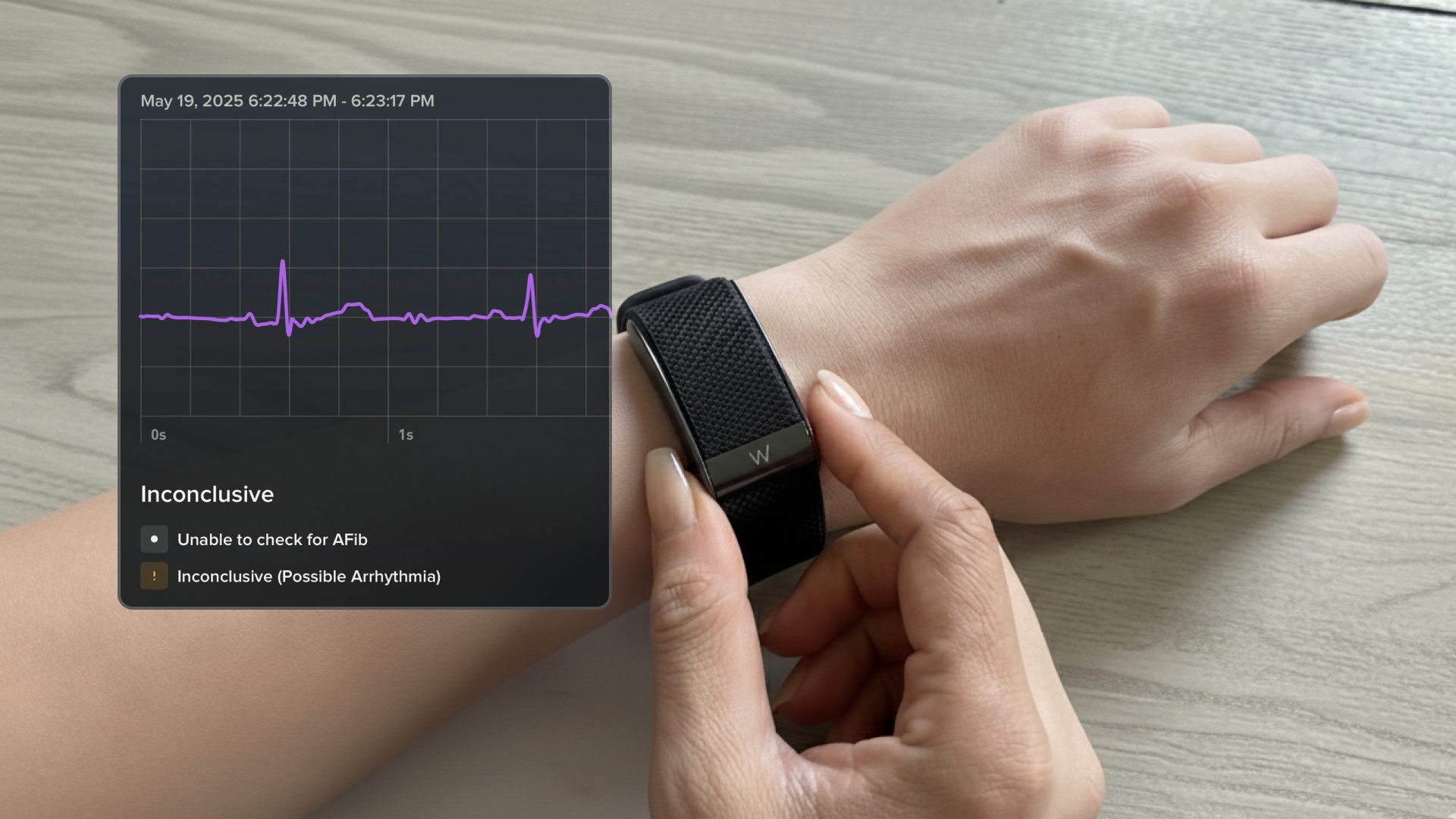


Key Takeaways
- WHOOP Inconclusive ECGs aren't always a cause for concern, though they can be a sign of irregular heartbeats or abnormal heart rhythms.
- To start, we'll show you how to take ECGs from your WHOOP that are less likely to result in an Inconclusive.
- If you're still seeing Inconclusive ECGs, you may have an abnormal heart rhythm that's not detectable by the WHOOP ECG feature.

- WHOOP Inconclusive ECGs aren't always a cause for concern, though they can be a sign of irregular heartbeats or abnormal heart rhythms.
- To start, we'll show you how to take ECGs from your WHOOP that are less likely to result in an Inconclusive.
- If you're still seeing Inconclusive ECGs, you may have an abnormal heart rhythm that's not detectable by the WHOOP ECG feature.
User Profile
Got other questions on your WHOOP? See the complete set of Qaly guides on WHOOP:
- How to Read an ECG: Stanford Cardiologist Explains
- The Ultimate Cardiologist's Guide to the Smartwatch ECG
Introduction
The Inconclusive WHOOP ECG result is one of the most frustrating experiences when monitoring your heart health. In your frustration, you might be wondering, "What does Inconclusive mean on my WHOOP ECG?" Or you might be thinking, "Why does my WHOOP ECG keep saying Inconclusive?" In this guide, we'll help answer these questions, and we'll share some tips on how to take ECGs that don't result in Inconclusive. Let's dive in.
What Does Inconclusive Mean on My WHOOP ECG?
An Inconclusive WHOOP ECG means your recording couldn't be classified. This could be due to any of the following reasons:
- The way you're taking your ECG is leading to a low signal quality.
- Your heart rate is outside the range where WHOOP can reliably classify rhythms.
- You have a pacemaker or implantable cardioverter defibrillator (ICD).
- You're showing signs of other arrhythmias or heart conditions outside of Sinus Rhythm, Atrial Fibrillation, Low Heart Rate, and High Heart Rate that the WHOOP ECG feature isn't designed to recognize.
Other arrhythmias that might cause an Inconclusive ECG on WHOOP include Premature Atrial Contraction (PAC), Premature Ventricular Contraction (PVC), Supraventricular Tachycardia (SVT), and Ventricular Tachycardia (V-Tach).


How Do I Avoid an Inconclusive ECG?
First things first, let's make sure you're taking an ECG properly, so that your WHOOP doesn't label your ECG Inconclusive. To do this, see if you're still getting an Inconclusive ECG after each of the following steps:
- Get comfortable and relax. If you take your ECG when your arms are shaking or moving, it can lead to an Inconclusive ECG. Sit down. Take three, long, deep breaths. Place your arms flat on a table or flat in your lap in order to minimize movement.
- Make sure your WHOOP fits snugly. Your ECG's signal quality is low when your WHOOP is so loose that it doesn't touch your skin. Fasten your WHOOP so that it's snug on your wrist, and so that the sensors are making good contact with your skin.
- Keep your skin and WHOOP clean and dry. Sweat, lotions, or moisture can interfere with the signal quality of your ECG. First, take off your WHOOP. Then, dry the area where you normally wear your WHOOP on your wrist. Next, dry both your thumb and index finger that you'll use to place on the sensor indents of the clasp. Last, dry your WHOOP's sensors and clasp to clean all of the sensors involved in taking your ECG. You're now ready to strap your WHOOP back on and take another ECG.
- Follow WHOOP's hand placement instructions carefully. WHOOP requires you to place your thumb and index finger on the sensor indents of the ECG-conductive clasp while keeping your arm still. Make sure you're maintaining firm, steady contact with both sensor indents throughout the entire 30-second recording. Light, inconsistent pressure can result in poor signal quality.
- Distance yourself from other electronics. If you have electronic devices nearby that are plugged into an outlet, it can cause electrical interference with your ECG. If you can, try moving away from any electronic devices that are plugged into an outlet.
- Ensure your WHOOP battery is adequately charged. Low battery levels can sometimes affect sensor performance. Make sure your WHOOP has at least 20% battery before attempting an ECG reading.
If you're still seeing an Inconclusive WHOOP ECG after taking steps to prevent your WHOOP from labeling your ECG Inconclusive, it may be a sign of an underlying heart abnormality like an SVT ECG or a Short PR Interval.
Will WHOOP Detect Abnormal ECGs?
WHOOP will not always detect abnormal ECGs. For example, an SVT ECG, which WHOOP cannot detect, may come up as an Inconclusive ECG. In these cases, get your Inconclusive ECG read by experts like the ones on the Qaly app (App Store or Play Store). As always, if you're experiencing symptoms with your Inconclusive ECG, or if you see any signs of abnormal heart rhythms, contact your healthcare provider as soon as possible to rule out underlying heart conditions. To better understand how to see signs of abnormal heart rhythms on your ECG, take a look at Qaly's guide on how to read your ECG.
Conclusion
Well, that just about wraps up our guide on what an Inconclusive ECG means on your WHOOP. We hope this could be of some help to you. If you're still getting Inconclusive ECGs or if you need help interpreting your Inconclusive ECGs, don't worry, we understand how frustrating and confusing it can be to experience them. That's why we created the Qaly app for you and for the hundreds of millions of people around the world who experience irregular heartbeats and abnormal heart rhythms. On the Qaly app, human experts will interpret your Inconclusive ECGs within minutes for clarity and peace of mind. To get started with the Qaly app, grab the Qaly app from the App Store or Play Store today. If you have any more questions, or if you need our help in any other way, don't hesitate to reach out to us at support@qaly.co.
As always from the team at Qaly, stay heart healthy ❤️

Got a WHOOP Inconclusive ECG? On the Qaly app, certified human experts review your WHOOP ECGs within minutes. Get clarity today.



.png)
.png)