


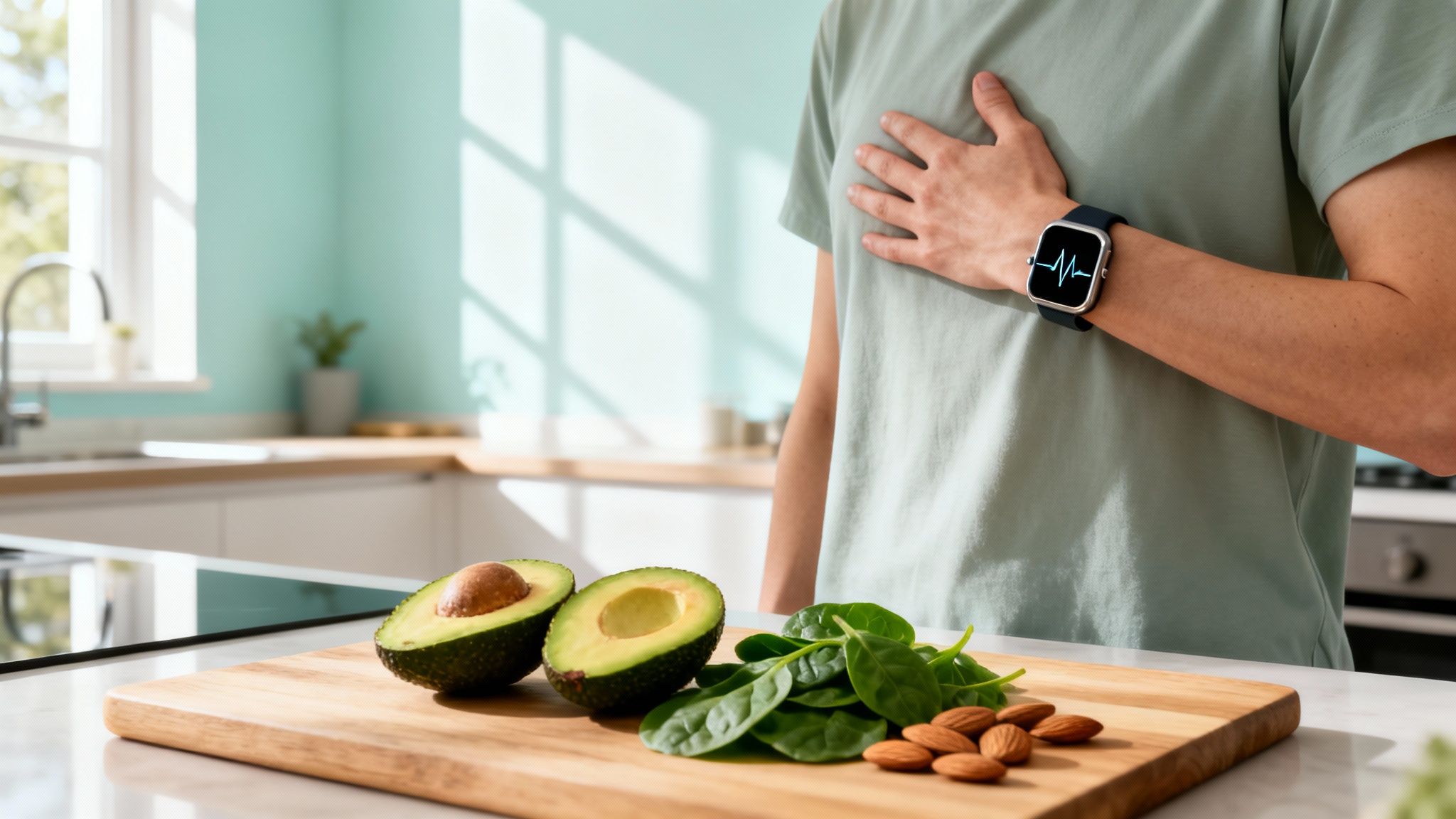


Key Takeaways

User Profile
Hello, Heart Hero.
Feeling a flutter, skip, or a sudden pound in your chest after starting the keto diet can be really unsettling. You're definitely not alone in this. It's a common concern for many people making this big dietary shift. Often, these feelings are simply a sign that your body is getting used to a whole new way of producing energy.
Your Guide to Keto Heart Palpitations
We get it. You're probably looking for answers that go beyond the usual "drink more water" advice. Many people find the traditional healthcare system doesn't always dive into the details of dietary changes like keto, leaving them to connect the dots on their own. Our goal here is to demystify why keto diet heart palpitations happen, using simple terms and practical insights.

Think of it like this: your body has been running on carbohydrates (gasoline) its whole life, and now you've switched it to ketones (high-performance racing fuel). The engine needs a little time to recalibrate. During that transition, you might notice some new rumbles and vibrations. That's pretty much what's happening inside you.
What You Will Learn
This guide is built to give you the knowledge you need to navigate your health journey with confidence. We'll walk through everything from the first few weeks on keto to long-term heart health considerations.
Here’s what we’ll explore together:
- The Initial Adjustment: We'll look at why palpitations are so common during the "keto flu" phase.
- Minerals and Hydration: This is a big one. We'll uncover the critical role electrolytes and water play in keeping your heartbeat steady.
- Actionable Solutions: You'll get practical, straightforward tips to manage and even prevent those flutters.
- When to Pay Attention: You'll learn how to tell the difference between a normal adjustment and something that needs a closer look from a professional.
This journey is all about listening to your body and making informed choices. The sensations you're feeling are just signals. By understanding what they mean, you can respond in a way that truly supports your health.
Ultimately, we want you to feel confident in managing these symptoms. You'll learn how to fine-tune your keto approach so it works for you, not against you. By the end, you'll have a clear roadmap for addressing keto heart palpitations, so you can get back to focusing on the health benefits you started this journey for in the first place.
Let's get started.
Why Your Heart Flutters on Keto, Explained Simply
Let's get right into the main reasons you might be feeling those unsettling heart flutters while on a ketogenic diet.
Think of your body as a hybrid car that's only ever run on gasoline (carbohydrates). When you switch to keto, you're suddenly telling it to run entirely on its electric motor, using ketones from fat for fuel. This massive metabolic shift, a process called keto-adaptation, can temporarily throw a wrench in your body's finely-tuned systems.

This initial transition period is often the primary cause of keto diet heart palpitations. The two biggest culprits are usually working in tandem: electrolyte imbalances and dehydration. They're closely linked and can brew up a perfect storm for an unsteady heartbeat.
The Electrolyte Exodus
When you dramatically cut your carb intake, your body burns through its stored glucose, known as glycogen. Here’s the catch: for every one gram of glycogen, your body holds onto about three to four grams of water. As you deplete those glycogen stores, all that water gets released and flushed right out of your system.
This has a powerful diuretic effect. While it feels fantastic when you see the numbers drop on the scale, it comes at a hidden price. As the water goes, it takes essential minerals called electrolytes along with it. And these aren't just any minerals; they're absolutely critical for your heart's electrical function.
Think of electrolytes as the spark plugs for your heart. Minerals like sodium, potassium, and magnesium carry the tiny electrical signals that tell your heart muscles when to contract. When these minerals run low, those signals can get weak or misfire, leading to the flutters, skips, or pounds you feel.
This electrical disruption is a huge reason why people experience palpitations. You can learn more about the direct connection between an electrolyte imbalance and your ECG.
Dehydration and Heart Strain
The same process that drains your electrolytes also leads directly to dehydration. When you lose a lot of water quickly, your total blood volume decreases. This makes your blood thicker and stickier, forcing your heart to work much harder to pump it throughout your body.
To make up for this, your heart has to beat faster and more forcefully just to circulate the same amount of oxygen and nutrients. You can often feel this increased strain as a racing heart or palpitations. It's your heart's way of telling you it needs more fluid to do its job.
This combination of faulty electrical signals from low electrolytes and mechanical strain from dehydration is the most common recipe for palpitations when you first start keto. While this is a very common part of the adaptation phase, it's important to know that significant disruptions can sometimes trigger more serious heart rhythm problems, even in healthy individuals.
For most people, these keto diet heart palpitations are temporary. By understanding that your body is simply recalibrating its fuel source and its internal wiring, you can take the right steps to support it through the change.
Exploring Other Hidden Triggers for Keto Palpitations
While electrolyte and hydration issues are the usual suspects for a fluttering heart, they aren't the only culprits. Sometimes, other lifestyle changes that tag along with the keto diet can create a perfect storm for palpitations. To really figure out what's going on, you have to look at the whole picture.
Think of yourself as a health detective. You've got the main clues of electrolytes and water, but solving the mystery of your keto diet heart palpitations requires digging a little deeper for the more subtle pieces of evidence.
The Stimulant Connection
A lot of people starting keto reach for an extra cup of coffee or tea to power through that initial "keto flu" fatigue. It's a natural instinct because you're tired and need a boost. The thing is, caffeine is a potent stimulant that directly interacts with your heart's electrical system.
For some people, that increased intake is just enough to tip them over the edge and trigger palpitations. It's like turning up the volume on your heart's electrical signals. If your system is already a bit sensitive from the big dietary shift, that extra caffeine can make those signals a little too loud and chaotic, causing that fluttery feeling.
Your body is in a state of adjustment. Adding more stimulants can be like asking a new driver to navigate rush hour traffic on a double espresso. It’s simply too much stimulation for a system that’s still learning the ropes.
How Medications Can Interact
Another hidden trigger might be lurking in your medicine cabinet. The ketogenic diet has a natural diuretic effect, which means it makes you lose water and, along with it, minerals. Some very common medications do the exact same thing.
If you're taking certain prescriptions, you might be unintentionally doubling down on this effect. Common examples include:
- Diuretics (Water Pills): Often prescribed for high blood pressure, these work by flushing excess sodium and water from your body.
- Certain Blood Pressure Medications: Some types can directly impact your electrolyte levels, especially potassium.
- Asthma Inhalers or Decongestants: Many of these contain stimulants that can rev up your heart rate.
When you combine the diuretic effect of keto with a medication that does the same, you can supercharge the loss of critical electrolytes like potassium and magnesium. This can create a much more severe deficit than the keto diet would alone, significantly increasing the odds of experiencing palpitations.
Pre-Existing Conditions Coming to Light
Sometimes, a major dietary change like keto doesn't create a new problem. Instead, it shines a spotlight on an issue that was already there, quietly humming in the background. A significant metabolic shift can put temporary stress on your body, and that can be enough to make a subtle, undiagnosed heart condition more noticeable.
This isn't meant to scare you, but to empower you. If your palpitations feel different, more intense, or show up with other symptoms, it might be your body’s way of signaling that there's more to the story. For a deeper dive into what causes heart palpitations in general, understanding the different factors can be incredibly helpful. Knowing the various possibilities gives you a better framework for talking with your doctor and finding the right path forward.
Practical Steps to Calm Your Heart and Find Balance
Knowing why keto might be causing heart palpitations is half the battle. Now, let's get into what you can actually do about it. These are real, actionable strategies you can start using today to get your heart back in a comfortable rhythm.

If you take only one thing away from this guide, let it be this: you have to be proactive about managing your electrolytes. Think of it like keeping a steady, reliable power supply flowing to your heart's electrical grid. When that grid is stable, the lights don't flicker.
Prioritize Your Electrolytes Diligently
Replenishing the key minerals your body flushes out, especially early on, is completely non-negotiable. The big three you need to keep a close eye on are sodium, potassium, and magnesium. If even one of them is out of whack, it can throw your heart's rhythm off.
You can get a good amount from keto-friendly foods:
- Sodium: Don't be afraid of high-quality salt like pink Himalayan or sea salt. Be generous with it on your meals, and you can even add a pinch to your water. Pickles and bone broth are also fantastic sources.
- Potassium: This mineral has a delicate dance with sodium. You can find it by loading up on leafy greens like spinach and Swiss chard, avocados, mushrooms, and salmon.
- Magnesium: Often called the "calming mineral," magnesium is critical for muscle relaxation, and that includes your heart muscle. Look for it in almonds, pumpkin seeds, dark chocolate, and spinach.
For many people, especially in the first few weeks of keto, food alone might not cut it. To really get ahead of palpitations, you might want to look into the best electrolyte supplements for the keto diet.


Master Your Hydration Habits
Right alongside electrolytes is hydration. It's easy to forget that the keto diet has a natural diuretic effect, so you have to be way more intentional about drinking fluids than you were before.
Your goal should be to sip water throughout the day, not just when you feel parched. A good starting point is to aim for half your body weight in ounces of water daily. Adding that little pinch of salt we talked about helps your body hold onto the water it needs.
Simply chugging water isn't always the answer. Without enough electrolytes, your body can't actually absorb and use that water effectively. They're a team. One can't do its job properly without the other.
Consider a Slower Transition into Keto
Jumping from a standard diet straight into a very low-carb lifestyle can be a major shock to your system. Easing into it can make the whole process smoother and dial back the intensity of adaptation symptoms like heart palpitations.
Instead of dropping to 20 grams of carbs overnight, try a more gradual ramp-down. You could start by cutting your carbs to 75 grams a day for a week, then 50 grams the next, before settling into your final goal. This gives your body a chance to adjust its fluid and electrolyte balance without the sudden "whoosh" that often causes problems.
Review Your Stimulant Intake
Have you found yourself reaching for an extra cup of coffee or tea to push through the initial keto fatigue? It might be time to scale that back. Caffeine is a direct stimulant to the heart and can easily trigger palpitations, especially if your system is already on edge from the dietary changes.
Try cutting your intake in half or switching to decaf for a while and see if your symptoms ease up. You might discover that as you become more keto-adapted, your energy levels stabilize on their own, and you won't need the caffeine crutch. For more information, you might be interested in our guide on magnesium supplements for heart health, as this mineral can help counteract some of the jitters from overstimulation.
Finally, take a moment to think about any medications you're on. It's so important to have an open conversation with your doctor about your new way of eating. They can review your prescriptions and see if any tweaks are needed to account for keto's diuretic effects, making sure your entire health plan works together safely.
Long Term Heart Health on Low Carb Diets
While most keto-related heart palpitations are just a temporary hiccup during the initial adaptation phase, it's always smart to look at the bigger picture. Understanding the long-term relationship between low-carb diets and your heart empowers you to make choices that are not just effective, but sustainable.
Many people absolutely thrive on keto, but it’s important to be aware of what some large-scale research has suggested. This isn't meant to cause alarm. It's about giving you a complete view so you can build the best possible plan for your unique body.
A Look at the Research
Some long-term studies have pointed to potential links between very low-carb eating over many years and certain heart rhythm issues. The goal of a ketogenic diet is often to improve metabolic health, and many people see fantastic results. For broader strategies on this, it's helpful to understand how to reduce insulin resistance naturally.
A landmark study that followed nearly 14,000 people for over two decades really brought this topic into focus. It found that individuals getting less than 44.8% of their daily calories from carbohydrates had an 18% higher likelihood of developing atrial fibrillation (AFib) compared to those eating a moderate amount of carbs. Interestingly, this increased risk seemed consistent whether the carbs were replaced with fats or proteins. You can dive deeper into the full report on these low carb diet findings.
This doesn't mean keto is automatically risky. It simply highlights that our bodies are all different. What works wonders for one person might need a few tweaks for another, especially over the long haul.
Why Might This Happen?
So, what's going on here? Researchers have a few theories.
One idea is that by strictly limiting carb-rich foods, people might accidentally cut back on certain fruits and vegetables. These foods are packed with anti-inflammatory compounds and micronutrients that are absolutely vital for cardiovascular wellness.
Another theory centers on the balance of fats and proteins. A diet that's extremely high in certain types of fats and proteins could potentially increase oxidative stress in the body over time. Think of oxidative stress as a kind of internal "rust" that can affect cells, including the delicate cells in your heart.
Building a Heart-Conscious Keto Plan
The key takeaway here is awareness. Knowing this information doesn't mean you have to abandon keto; it just means you can be more strategic and intentional about it. You can build a version of keto that is rich in nutrients and supports your heart for years to come.
This comes down to a few simple but powerful principles:
- Prioritize Nutrient Density: Focus on high-quality fats. Think avocados, olive oil, nuts, and seeds.
- Include Low-Carb Plants: Don't skimp on the veggies. Load up on leafy greens, broccoli, cauliflower, and other non-starchy vegetables to get those essential vitamins and antioxidants.
- Choose Quality Proteins: Opt for fatty fish like salmon, which is loaded with heart-supportive omega-3s, alongside other clean protein sources.
By focusing on a well-formulated, nutrient-rich ketogenic diet, you can tackle these long-term considerations head-on. This approach helps ensure you're not just cutting carbs, but actively building a strong foundation for lasting heart health.
When to Listen Closely and How to Monitor Your Heart
Most of the time, the flutters you feel when starting a new diet are simply your body adjusting. And while these temporary keto diet heart palpitations are often harmless, it's so important to know when your body might be sending a more urgent signal.
Think of it like this: a minor engine sputter as you switch fuel types is one thing, but a loud, persistent knocking sound is something you’d get checked out immediately. Your heart is the same way. It's crucial to recognize the red flags that need a professional opinion.
Recognizing the Red Flags
While most keto palpitations are benign, they should never be ignored if they show up with other symptoms. It's time to call your doctor if you experience palpitations along with any of the following:
- Chest pain or tightness: Any discomfort in the chest that comes with palpitations is a serious sign.
- Shortness of breath: If you find it difficult to catch your breath during an episode.
- Dizziness or lightheadedness: Feeling like you might faint is a major warning sign.
- Fainting: Actually losing consciousness during or after palpitations requires immediate medical care.
If you experience any of these, it's not the time to self-diagnose or wait it out. These symptoms could point to something more than just a simple electrolyte imbalance.
It's always better to be overly cautious and get checked out than to dismiss a potentially serious warning. You know your body best, and taking these signs seriously is the ultimate form of self-care.
Taking Control with Modern Technology
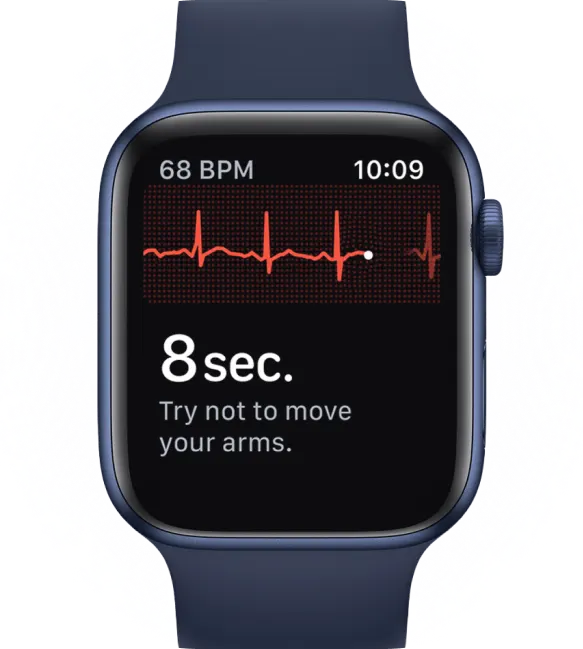
This is where today’s technology can be incredibly empowering. Instead of just worrying about a flutter, you can capture it in real-time. Wearable devices with ECG capabilities let you record your heart's rhythm the moment you feel a symptom. For a better understanding of how this works, you can explore our guide on what cardiac monitoring is.
But what do you do with that ECG reading? Instead of trying to interpret it yourself or waiting weeks for a doctor's appointment, a service like Qaly can bridge that gap. You can have your ECG reviewed by a certified human expert within minutes, 24/7. This provides incredible peace of mind and gives you concrete data to share with a healthcare professional.
It's also worth noting that some studies suggest long-term, very low-carb diets might be associated with an increased risk of atrial fibrillation. This can happen for a few reasons, including a lower intake of inflammation-fighting foods, increased oxidative stress from high fat and protein intake, and other cardiovascular mechanisms. You can read more about the potential link between low-carb diets and heart risks. Monitoring your heart gives you the power to stay on top of your health, making sure your diet truly supports your long-term wellbeing.
Common Questions About Keto and Heart Palpitations
Starting the keto diet can feel like you're learning a new language your body speaks, and a sudden flutter in your chest definitely gets your attention. It's totally normal to have questions and want clear answers when it comes to your heart. Let's tackle some of the most common concerns you might have.
How Long Do Keto Heart Palpitations Last?
For most people, heart palpitations that pop up when you start keto are a temporary nuisance. They're usually part of the infamous "keto flu," showing up within the first week or two as your body goes through a major metabolic shift.
Once you get the hang of replenishing your electrolytes and staying on top of your hydration, these flutters typically fade away on their own. If they stick around for more than a few weeks or feel particularly strong, that's your cue to check in with your doctor.
Can I Continue Keto With Palpitations?
In many situations, the answer is a resounding yes. The key is to figure out why they're happening. More often than not, it comes down to an imbalance of fluids and minerals. By consciously managing your intake of sodium, potassium, and magnesium, you can often stop the palpitations in their tracks.
But this is important: if the flutters don't stop even after you've adjusted your electrolytes, or if they come with friends like dizziness or shortness of breath, you need to hit pause and get medical advice before continuing. This is especially true if you have any history of heart issues.
As you can see, simply monitoring a minor flutter is a reasonable first move. But the moment you add other symptoms like lightheadedness or chest pain to the mix, it's time to see your doctor.
What Is the Fastest Way to Stop Keto Palpitations?
If you're in the middle of an episode and looking for a quick fix, your first move should be to tackle a potential electrolyte deficit head-on. A surprisingly effective trick is to drink a glass of water with a pinch of good-quality salt.
This provides a quick hit of sodium, which can help stabilize your heart's electrical system almost immediately. Following up with a magnesium supplement can also have a calming effect on your heart's rhythm. This is a great strategy for mild, occasional palpitations, but for anything that feels severe, please seek medical help right away.

When you feel a flutter, guessing isn't a strategy. Getting fast, reliable insight is what brings peace of mind. Instead of wondering, let Qaly provide an expert-reviewed analysis of the ECG from your wearable device in minutes.



.png)
.png)