




Key Takeaways

User Profile
Hello, Heart Hero. Chances are, your HRV is low because of some very common culprits: high stress, poor sleep, a really tough workout, dehydration, or even just a drink or two. These everyday things kick your body into "fight-or-flight" mode, which eats away at the natural, healthy variation between your heartbeats. A low number is simply a sign that your body is running on fumes and needs a break to find its balance again.
Your Guide to Understanding Low Heart Rate Variability
Seeing a low Heart Rate Variability (HRV) number flash on your wearable can be confusing, and let's be honest, a little unnerving. If you felt a jolt of concern, you're not the only one. More and more of us are using personal health data to understand our bodies, and a "low" reading without any real context is enough to make anyone worry. It’s easy to feel let down by a system that often doesn't listen, which is why taking control of your own health data is so empowering.
This guide is here to pull back the curtain on that number and, most importantly, put you back in the driver's seat. We're going to break down exactly what that metric means in a way that makes sense.
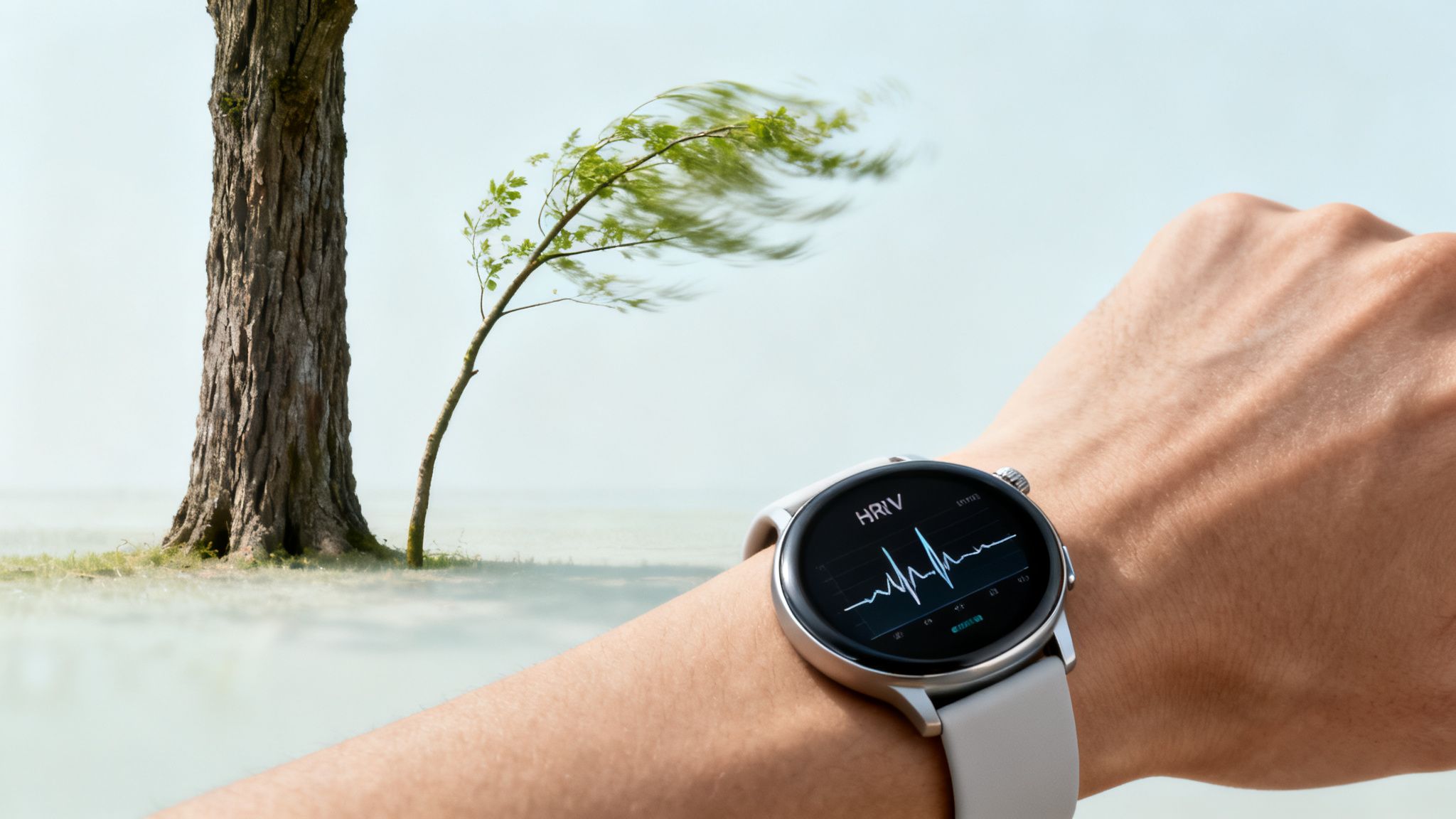
Think of your HRV as your body's built-in gauge for stress and recovery. It’s a fantastic window into how flexible and resilient your nervous system is at any given moment.
A high HRV is like a flexible young tree, able to bend with the wind of daily stress. A low HRV is more like a rigid, older tree, less adaptable to pressure and more vulnerable to breaking.
This simple picture really helps put things in perspective. A higher HRV means your body is rested, adaptable, and ready for whatever you throw at it. A lower HRV, on the other hand, is your body's way of sending up a flare. It's signaling that it's running on empty.
Why You Shouldn't Panic About One Low Reading
Here's the most important thing to remember: a single low HRV score is just a snapshot in time, not a final verdict on your health. It's a reflection of what's happening right now, or maybe what happened yesterday. All sorts of things can cause a temporary dip, like:
- That really demanding workout your body is still recovering from.
- A night of tossing and turning that robbed you of deep, restorative sleep.
- A high-stakes presentation at work that left you completely drained.
- Simply forgetting to drink enough water throughout the day.
Each of these is a short-term stressor that can push your HRV down. The real power of tracking this metric isn't in obsessing over daily ups and downs, but in watching the trends over time. A low reading isn't a failing grade; it's just information. Think of it as a gentle nudge from your body, asking for a bit more care. This guide will walk you through what's really going on and how you can start to take back control, one small step at a time.
If you've been staring at your wearable wondering, "why is my hrv so low," you're not alone. Let's break down what this number actually means without the dense medical jargon. It’s easy to get lost in the data, but understanding the core concept is the first step toward feeling empowered, not worried.
First off, Heart Rate Variability (HRV) isn't about how fast or slow your heart is beating. It's much more subtle than that. HRV measures the tiny, natural variations in time between each of your heartbeats. We're talking differences measured in milliseconds, so they're far too small for you to feel.
Think of your heart as a drummer. You might assume a perfect, robotic beat with the exact same interval every single time is a sign of health. But in reality, that kind of rigidity shows a system that's less adaptable. A healthy, relaxed drummer has a natural, human rhythm with very slight variations in timing. That subtle inconsistency is actually a sign of flexibility and resilience.
The Two Sides of Your Nervous System
So, what's pulling the strings and controlling this beat-to-beat variation? It all comes down to your Autonomic Nervous System (ANS). This is the automatic, behind-the-scenes control center for your body, managing things you don't consciously think about, like breathing, digestion, and your heart rate.
The ANS has two main branches that are in a constant, gentle tug-of-war:
- The Sympathetic Nervous System: This is your "fight-or-flight" system. Think of it as your body's gas pedal, revving you up to handle stress, danger, or intense physical activity. When it's active, your heart beats more regularly (less variability) to pump blood as efficiently as possible.
- The Parasympathetic Nervous System: This is your "rest-and-digest" system. It's the brake pedal, calming everything down so your body can recover, repair, and conserve energy. When it's in charge, your heart has more room for those healthy, natural variations between beats.
A low HRV score is often a signal that your "fight-or-flight" system is running the show. Your body is stuck with its foot on the gas, constantly on high alert.
What a Higher HRV Really Means
On the flip side, a higher HRV suggests that your "rest-and-digest" system has more influence. It means your body is responsive, recovered, and resilient. It can easily shift gears, revving up when needed and calming down efficiently afterward. This adaptability is a true cornerstone of good health.
Think of your HRV as a reflection of your body's readiness. A higher HRV is your body saying, "I'm rested, recovered, and ready for whatever challenges come my way." A lower HRV is it saying, "I'm running on fumes and could really use a break."
This balance is dynamic and changes constantly throughout the day. It’s completely normal for your HRV to drop during a workout or a stressful meeting. The key is its ability to bounce back up during periods of rest and recovery, especially overnight.
If you'd like to dive deeper, you can learn more about what is heart rate variability in our detailed guide. Understanding this fundamental balance between stress and recovery is the first, most crucial step in taking control of your well-being.
Common Lifestyle Reasons Your HRV Might Be Low
Before you jump to conclusions and worry that a low HRV number points to something serious, it’s worth taking a deep breath and looking at your daily habits. More often than not, the answer to "why is my HRV so low?" lies in the small, everyday choices we make. These lifestyle factors are the most powerful levers you have to influence your score.
Seeing a persistently low HRV can be frustrating, especially when you feel like you're doing everything right. If your score is stubbornly low, it’s often a sign that stress and poor recovery are quietly throwing your body’s natural balance out of whack. This is an incredibly common experience in our fast-paced world, which has fueled a huge demand for personal health trackers.
The global demand for HRV analysis systems is increasing significantly, driven by individuals seeking improved methods for managing stress and heart health. This trend indicates that you are certainly not alone in this pursuit. Let's explore the most common factors contributing to this interest. For further insights, refer to this HRV market analysis.
Chronic Stress and Your Nervous System
Think of your body’s stress response as a very effective alarm system. When you’ve got a tight deadline or a tough conversation ahead, the alarm goes off, putting your "fight-or-flight" system in charge. This is perfectly normal and healthy.
The real problem starts when the alarm never shuts off. Chronic stress from work, family life, or financial pressures keeps that system running on overdrive. When your body stays on high alert, your heart starts beating more like a rigid metronome, which causes your HRV to drop.
Poor Sleep and Lack of Recovery
Sleep is when your "rest-and-digest" system is supposed to take over, giving your body a chance to repair and recharge. This is typically when your HRV is at its highest, reflecting deep, restorative recovery.
But if your sleep is too short, constantly interrupted, or just poor quality, you're robbing your body of this crucial downtime. A single night of bad sleep can tank your HRV score, and consistent sleep deprivation will keep it suppressed, leaving you feeling drained and less resilient to whatever the next day throws at you.
Your HRV during sleep is a direct report card on your body's overnight recovery. Consistently low scores are a clear signal that you aren't getting the restorative rest needed to bounce back from daily stressors.
Overtraining and Under-Recovering
Exercise is a form of positive stress that, with the right amount of recovery, makes you stronger and actually raises your HRV in the long run. But like most things, there's a tipping point.
Pushing yourself through intense workouts without giving your body enough time to heal can completely backfire. Overtraining keeps you stuck in a prolonged "fight-or-flight" state, which starts to break your body down instead of building it up. A consistently declining HRV can be an early warning sign that you need to dial back the intensity or schedule more rest days.
Diet, Dehydration, and Alcohol
What you put into your body has a direct and almost immediate effect on your nervous system and, by extension, your HRV. These three factors are especially influential:
- Dehydration: Even being mildly dehydrated forces your heart to work harder to circulate blood. This is a form of physical stress that can drag down your HRV. Staying hydrated is one of the simplest and most effective ways to support your nervous system.
- Alcohol: While a drink might feel like it's helping you relax, it actually places a significant strain on your body. Alcohol metabolism messes with your sleep cycles and suppresses your "rest-and-digest" activity, which is why HRV often plummets after even moderate drinking.
- Processed Foods and Caffeine: A diet high in sugar and processed junk can fuel inflammation and put stress on your system. Similarly, stimulants like caffeine kick your "fight-or-flight" response into high gear. To get a better sense of how your morning cup might be affecting your numbers, you can explore our guide on coffee's impact on your heart.
The good news is that these are all areas where you're in the driver's seat. By making small, mindful adjustments to your daily routine, you can start supporting your body's natural resilience and see that progress reflected in your HRV trends.
When a Low HRV Can Signal Deeper Health Concerns
While everyday habits are usually the main culprit behind a low HRV, a persistent downward trend can sometimes be your body's way of sending a subtle but important message. It's completely normal to feel a bit uneasy when you see a number that's consistently lower than your baseline. The point isn't to cause alarm, but to arm you with knowledge so you can be a better advocate for your own health.
Most people think of HRV as just a fitness metric, but it goes so much deeper. Your wearable is more than a simple tracker; it’s a powerful tool for gathering long-term data. The real magic isn't in reacting to a single day's reading, but in watching the trend over weeks or months. This is where you might spot patterns that lifestyle tweaks alone don't seem to fix.
A consistently low HRV can be an early sign that your body is dealing with a deeper physiological strain. When this happens, your "fight-or-flight" system stays dominant not because of a stressful day at work, but because an underlying issue is creating a constant state of internal stress.
The Connection to Chronic Conditions
When your HRV stays stubbornly low despite your best efforts to sleep well, manage stress, and recover properly, it might be tied to underlying health challenges that are subtly altering your heart's rhythm. These conditions can create a low-grade, constant strain on your system that your wearable may be picking up on.
Some of these underlying concerns include:
- Chronic Inflammation: Conditions that cause persistent inflammation keep your body in a state of high alert, which naturally suppresses your "rest-and-digest" system and lowers your HRV.
- Metabolic Issues: Problems with how your body processes energy, like insulin resistance, can place a heavy burden on your system, often reflected in a lower HRV.
- Cardiovascular Strain: A low HRV can sometimes be linked to increased strain on the heart and blood vessels, serving as an early heads-up that your cardiovascular system is working harder than it should be.
This is why looking at the long-term trend is so critical. A single low reading after a terrible night's sleep is one thing; a steady decline over six weeks is a completely different conversation.
Your wearable's data trend is like a story about your health unfolding over time. Watching this story helps you shift from reacting to daily numbers to proactively understanding your body's deeper needs.
What the Broader Research Shows
You’re not just guessing about this connection; there's a growing mountain of research to back it up. Studies have found a clear link between lower HRV and an increased risk for more serious health issues down the line. For instance, a major review of previous research confirmed that a lower HRV is a significant predictor of both mortality and sudden cardiac death.
More recent findings are just as compelling. A 2023 study tied lower HRV to a decline in cognitive function and impairment. The global impact is also undeniable. In some parts of the world, like Eastern Europe, men faced a staggering 20.2% risk of premature death from certain cardiovascular diseases in 2019, conditions often linked with poor autonomic function. This isn't just a number on your watch; it's a meaningful health marker. You can find more details about these clinical links and global trends here.
Other health issues can also throw off your heart's rhythm and, in turn, your HRV. For example, you can learn more about the link between thyroid disorders and your heart in another one of our guides. This information helps build a more complete picture of your health.
If you've noticed a concerning trend in your data, it's easy to feel stuck or unsure what to do next. This is precisely where getting an expert analysis of your ECG patterns from a service like Qaly can provide the clarity and peace of mind you need. A professional review can help you understand what's really going on, giving you concrete information to share with your doctor and turning your data into a truly powerful tool for your health journey.
How to Get Accurate HRV Readings From Your Wearable
It's completely understandable to feel a moment of frustration when you see a low HRV number, especially when you feel like you’re doing everything right. But before you start questioning your health, it’s worth asking: could the problem be the data itself?
Sometimes, the issue isn't your body but a simple measurement error from your wearable. Getting reliable data is the first step to making sense of your HRV, because a single bad reading can send you down a rabbit hole of worry for no good reason. Let's walk through some practical advice to make sure the numbers you're seeing are a true reflection of your body's status.

Common Mistakes That Skew Your Data
Your wearable is a powerful tool, but it needs the right conditions to work its magic. Think of it like a sensitive microphone trying to pick up a whisper in a noisy room, if there's too much interference, the message gets garbled.
Here are some of the most common mistakes that can lead to a falsely low HRV reading:
- Wearing Your Device Too Loosely: For the optical sensors to get a clear signal of your pulse, the device needs to be snug against your skin. If it’s too loose, it can shift around and miss the subtle beat-to-beat changes it’s trying to measure.
- Measuring While Moving: HRV measurement requires you to be perfectly still. Taking a reading while walking, typing, or even fidgeting creates "noise" that corrupts the data, often resulting in an artificially low score.
- Inconsistent Timing: Your HRV naturally fluctuates throughout the day. To get a meaningful trend, you have to measure it at the same time every day, ideally right after you wake up, while you're still lying in bed. This gives you a consistent baseline.
A reliable HRV trend is built on consistency. Measuring at the same time and in the same state each morning removes the daily variables, giving you a clearer picture of your underlying recovery and readiness.
How Your Actions Can Affect a Reading
Beyond the physical setup, what you do right before taking a measurement can also throw off your numbers. Your nervous system is incredibly responsive, and even small actions can cause a temporary dip in your HRV score.
For example, checking your HRV right after a cup of coffee will almost certainly show a lower number because caffeine stimulates your "fight-or-flight" system. The same goes for eating a large meal, which diverts resources to digestion and can temporarily lower your score. It's best to build a routine where your morning measurement happens before you eat or drink anything.
When Your Heart's Rhythm Confuses Your Device
This is a crucial point that often gets overlooked. Consumer wearables are amazing, but their algorithms are designed to analyze "normal" heart rhythms. If your heart has extra or irregular beats, the device can get completely confused.
Conditions like premature ventricular contractions (PVCs), which are extra, early heartbeats, or atrial fibrillation (AFib), an irregular and often rapid heart rhythm, can totally baffle a wearable’s HRV algorithm. The device may interpret these irregular intervals as extremely low variability, giving you a shockingly low or "unreadable" score.
This is where the limits of technology highlight the need for human expertise. When your device struggles to make sense of your rhythm, a human-led analysis is invaluable. A service like Qaly can have a certified expert review your ECG, accurately interpret the underlying rhythm, and explain why your HRV numbers might look the way they do. This can provide much-needed clarity and reassurance.
If you want to understand more about the technical side, you can explore our guide on how to calculate HRV from an ECG.
Seeing that low number on your screen can feel discouraging, but now comes the empowering part: taking action. Knowing the "why" behind your low HRV gives you a roadmap to actually change it. Think of this as your practical playbook for boosting that score and, more importantly, improving your overall well-being.

We're going to focus on manageable strategies that are proven to help rebalance your nervous system. By sticking with these techniques, you can start to see tangible proof in your data that your efforts are making a real difference.
Master Your Sleep Routine
Your highest HRV scores should happen during deep, restorative sleep. This is prime time for your "rest-and-digest" system to take over and repair your body. An inconsistent sleep schedule is one of the fastest ways to keep your HRV suppressed.
Start by aiming for a consistent bedtime and wake-up time, even on weekends. This simple habit helps regulate your body's internal clock, or circadian rhythm, leading to more efficient and deeper sleep.


Practice Mindful Breathing
One of the most direct ways to influence your nervous system is through your breath. Slow, controlled breathing exercises activate the vagus nerve, which is a key player in your calming "rest-and-digest" system.
Just a few minutes of deep, diaphragmatic breathing can send a powerful signal to your body that it's safe to relax. This simple practice helps shift you out of a stressed "fight-or-flight" state and can immediately begin to improve your HRV.
Try a simple box breathing exercise: inhale for four seconds, hold for four, exhale for four, and hold for four again. Repeat this for five minutes daily and just watch what happens to your trends.
Optimize Your Nutrition and Hydration
What you eat and drink directly fuels your body and impacts its stress levels. Chronic inflammation from a diet high in processed foods and sugar can be a major drag on your HRV.
Focus on bringing in anti-inflammatory foods like leafy greens, berries, fatty fish, and nuts. On top of that, even mild dehydration is a physical stressor that can tank your HRV. Make sure you're drinking enough water throughout the day.
Train Smarter, Not Just Harder
Exercise is fantastic for your long-term HRV, but overtraining can absolutely crush it in the short term. Your HRV is a great tool for gauging your recovery. If your score is consistently low, it might be a sign that you need more rest, not another grueling workout.
Try incorporating active recovery days with light activities like walking, stretching, or yoga. This helps your body repair itself without piling on more stress, allowing your HRV to bounce back even stronger.
Ever wondered why readings on your Apple Watch or Fitbit might be dipping low? A significant factor is the global rise of cardiovascular diseases, which directly impacts heart rate variability. According to the World Heart Federation's 2023 report, these diseases caused a staggering 33% of all global deaths in 2019, totaling about 17.9 million lives. Low HRV is strongly linked to these risks, making it an important marker to monitor.
By focusing on these key areas, you can start to take meaningful control. If you're looking for more practical steps, explore these actionable ways to regulate your nervous system, which directly support and improve your HRV.
Your Low HRV Questions, Answered
Seeing a low HRV number can be confusing, and it's totally normal to have questions when you're trying to make sense of your body's data. Let's clear things up with some straightforward answers to the most common concerns.
What Is a Good HRV Number to Aim For?
Honestly, there's no magic "good" HRV number that fits everyone. This metric is incredibly personal and shifts based on your age, fitness, gender, and even your genetics. It’s far more useful to stop comparing your score to anyone else’s.
Instead, the real gold is in your own personal trend. A "good" HRV for you is one that’s either stable or, even better, slowly climbing over time. The true insight comes from watching how your score reacts to your life, seeing it rise after a great night's sleep or dip after a stressful day tells you a lot more than chasing some arbitrary number.
How Long Does It Take to Improve HRV?
This really varies from person to person. Some people might see positive changes in just a week after making simple tweaks, like locking in a consistent sleep schedule or trying out daily breathing exercises. It can be that responsive.
For others, especially if the low HRV is linked to chronic stress or overtraining, it might take several weeks of consistent effort to see a meaningful upward trend. Patience is key here. Just keep tracking your progress, and you'll start to see those gradual improvements that keep you motivated.
When Should I See a Doctor for Low HRV?
A single low reading usually isn't a reason to panic, especially if you can point to a likely cause like a bad night's sleep, a few drinks, or an unusually tough workout.
However, it's a smart move to talk to your doctor if you see a consistent downward trend over several weeks that isn't getting better with lifestyle changes. It's especially important to get medical advice if your low HRV comes with other symptoms like heart palpitations, dizziness, or shortness of breath.

When your wearable's data feels confusing, Qaly provides clarity by having certified experts analyze your ECGs.



.png)
.png)