


Key Takeaways

User Profile
Hello Heart Hero.
If you’ve ever felt that flutter in your chest or a suddenly racing heartbeat, you know the unsettling feeling that comes with it. The term AFib burden might sound a bit clinical, but it’s really just a way of measuring the total amount of time your heart spends in Atrial Fibrillation. Getting a handle on this one idea can be the key to seeing your heart health more clearly than ever before.
Your Guide to Understanding AFib Burden
Trying to navigate your heart health can feel like a maze, especially when you feel like you're on your own and just want straight, reliable answers. We get how frustrating it is to have symptoms but not fully understand what's causing them, particularly when getting clear information can be a challenge. This guide is here to help fix that by breaking down the crucial concept of 'AFib burden' into simple terms you can actually use.

Many people know they have AFib, but they have no idea how much it's really impacting them day to day. This is exactly where knowing your AFib burden changes the game. It tells a much richer story about your heart’s rhythm than a single ECG at a doctor's office ever could.
Moving Beyond a Simple Diagnosis
An Atrial Fibrillation diagnosis is really just the first page of the story. Think of it like a weather report. A simple "yes, you have AFib" diagnosis is like being told it's raining. But knowing your AFib burden tells you if it's just a passing shower or a week long storm. It’s that level of detail that truly matters for managing your health.
Instead of a black and white "yes" or "no," your burden gives you a percentage. This number shifts you from just being a patient to becoming an active, informed partner in your own healthcare journey.
Understanding your AFib burden is about taking control. It’s the difference between knowing you have a leaky faucet and knowing exactly how many gallons of water it's wasting each day. Only with that specific knowledge can you decide the best way to fix it.
What You Will Learn in This Guide
In this guide, we’ll walk through why tracking your AFib burden is so important. We'll break down how this single number can influence everything from how you feel each day to the major treatment decisions you and your doctor make. We'll help you understand:
- The "Why" Behind Your Symptoms: We’ll connect the dots between your AFib burden and those feelings of fatigue, palpitations, or shortness of breath.
- How Doctors Use This Information: You’ll see how your AFib burden helps your doctor create a care plan that’s personalized for you.
- Modern Tools for Clarity: We’ll explore how today’s technology can give you the insights you need to track your heart health right from home.
Our goal is simple: to give you the confidence that comes from genuine understanding. By the time you finish this guide, you won't just know what AFib burden is; you’ll know how to use that knowledge to take charge of your heart health journey.
What Exactly Is AFib Burden
Let's demystify the term AFib burden. It might sound a little technical, but the idea behind it is actually pretty simple, and it's a powerful way to understand your own heart health.
Imagine your heart has two settings. The first is its normal, steady beat, which doctors call sinus rhythm. The second is the chaotic, irregular rhythm of Atrial Fibrillation (AFib). AFib burden is simply the percentage of time your heart spends in that irregular AFib mode.
This measurement is calculated over a specific period, like a day, a week, or even a month. A higher percentage means that AFib is happening more often or for longer stretches of time.
Why Burden Is More Than a Diagnosis
Getting a simple "yes or no" AFib diagnosis from a single ECG at a clinic is just a snapshot. It doesn't tell the whole story. Measuring your AFib burden, on the other hand, is like watching a full length movie of your heart's activity.
Here’s a quick example to make it crystal clear:
- If your heart was in AFib for 30 minutes over a 24-hour day, your AFib burden would be about 2%.
- If it was in AFib for six hours that same day, your burden jumps to 25%.
These two scenarios paint very different pictures of what's happening inside your chest, even though both people would have an AFib diagnosis. Knowing the percentage gives you and your doctor much deeper insight. Just like AFib, other irregular heartbeats can also be measured by how often they happen. If you're curious, you might be interested in our guide on understanding ectopic beat burden.
This metric is becoming more critical as Atrial Fibrillation's impact grows worldwide. The number of AFib cases more than doubled between 1990 and 2019, jumping from around 28.3 million to 56.7 million. This sharp increase highlights why personal monitoring and knowing your specific AFib burden are more important than ever. You can learn more about the global rise of atrial fibrillation on ajmc.com.
An Analogy to Understand AFib Burden
Think of it like a leaky faucet. Knowing that the faucet is leaking is the first step. That's like getting an AFib diagnosis. But that information alone doesn't tell you how serious the problem is.
Measuring your AFib burden is like placing a bucket under that leaky faucet for a day. At the end of the day, you can see exactly how much water you’ve lost. Is it a few drops, or has the bucket overflowed?
This measurement tells you the true scale of the issue. A few drops might not require immediate, drastic action, but an overflowing bucket certainly does. Your AFib burden provides that same level of crucial detail, turning a vague concern into a clear, manageable number.
How AFib Burden Impacts Your Health and Treatment
Knowing your AFib burden is about much more than just having a number. It’s about connecting that number to your daily life, your long term health, and the conversations you have with your doctor. This knowledge is empowering. It directly links the data from your heart to the way you feel and the treatments that can help you.
A higher AFib burden is often the culprit behind those frustrating symptoms you might be feeling. It’s the invisible force that can leave you drained, breathless, or on edge from constant palpitations. Understanding this connection validates your experience; it's not "all in your head," it's a measurable part of your heart's health.
When your heart spends more time in AFib, it has to work much harder to pump blood efficiently. This extra strain is what leads to those physical symptoms you can't ignore.
The Link Between AFib Burden and Your Symptoms
Think of your energy level like a phone battery. On a good day, your heart is an efficient charger, keeping you powered up. But when AFib kicks in, it's like running a dozen power hungry apps in the background. Your battery drains much, much faster.
A higher AFib burden means your heart is stuck in that "battery draining" mode more often. This can lead to:
- Persistent Fatigue: That feeling of being tired all the time, even when you’ve had a full night's sleep.
- Shortness of Breath: Getting winded from simple activities, like climbing a flight of stairs.
- Heart Palpitations: A very noticeable and often unsettling awareness of your own chaotic heartbeat.
- Dizziness or Lightheadedness: A direct result of inefficient blood flow to your brain.
Recognizing that your AFib burden is driving these symptoms is the first real step toward finding relief. It gives you and your doctor a clear target to aim for.
Why Your Doctor Cares So Much About This Number
Your AFib burden is one of the most critical pieces of data your doctor uses to build a treatment plan that’s right for you. It helps them move from a general AFib diagnosis to a specific, personalized strategy. After all, a low burden might call for a completely different approach than a very high one.
Your AFib burden percentage isn't just a data point; it's a critical guide for medical decisions. It helps determine the urgency and type of treatment needed to protect your heart and prevent serious complications.
This number becomes especially vital when it comes to assessing stroke risk. A higher AFib burden has been clearly linked to an increased risk of stroke. Why? Because the chaotic rhythm in the heart's upper chambers gives blood a chance to pool and form clots.
This is why one of the most important decisions your doctor will make is whether to prescribe blood thinners. An AFib burden of more than 5% is often a key threshold that prompts doctors to strongly consider these medications to slash that stroke risk. To dig deeper, you can learn more about the role of blood thinners for AFib in our detailed guide.
Guiding Advanced Treatment Decisions
Beyond medication, your AFib burden helps your care team decide if more advanced procedures are on the table. If medications aren't controlling your symptoms or your burden stays stubbornly high, your doctor might bring up options like a cardiac ablation.
An ablation is a procedure that creates tiny scars in the heart tissue to block the faulty electrical signals causing AFib. Knowing your burden helps your doctor determine if you're a good candidate for this procedure and, just as importantly, measure its success afterward. By tracking your burden post procedure, you get a clear, objective answer to the question: "Did it work for me?"
Measuring Your AFib Burden with Modern Technology
Not too long ago, measuring your AFib burden felt like a major ordeal. It usually meant a trip to the hospital to get strapped into a bulky Holter monitor, wires, sticky electrodes, and all. You’d have to wear it for a day or two. While it worked, it was a hassle and only gave a very short snapshot of your heart's activity.
Thankfully, technology has put the power of monitoring right where it belongs: in your hands, and on your wrist. Today’s wearable devices have completely changed the game for tracking heart health, making it possible to gather information whenever and wherever you need it.
This shift is incredibly empowering. You no longer have to wait for a doctor's appointment to investigate that strange fluttery feeling. You can capture a medical grade ECG the moment you feel symptoms, creating a real time diary of your heart's behavior.
The Rise of At-Home ECG Monitoring
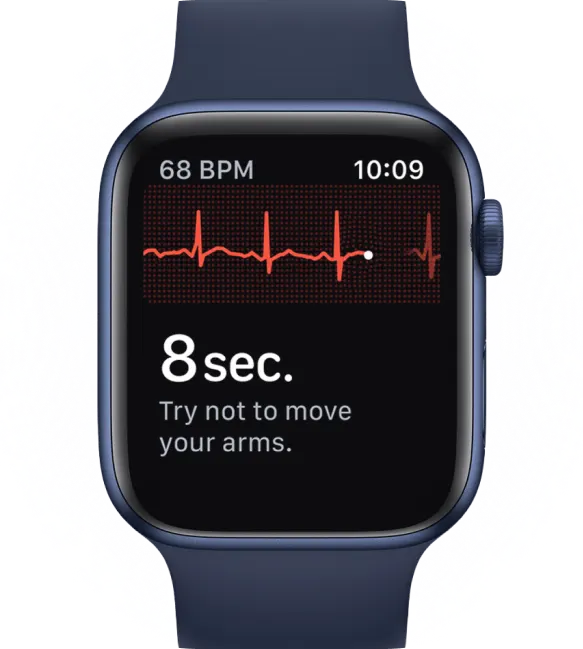
Devices like the Apple Watch, Fitbit, Samsung Galaxy Watch, and KardiaMobile have become powerful allies in managing AFib. They use sophisticated sensors to record the electrical signals from your heart, giving you an on the spot reading that can detect signs of Atrial Fibrillation.
This easy access is a game changer for calculating an accurate AFib burden. Instead of relying on a single 24 hour snapshot from an old school monitor, you can now collect data points over weeks or even months. This long term view provides a much more honest and complete picture of how often your heart is truly in AFib.
Here’s why that matters so much:
- Catching Those Sneaky Episodes: AFib can come and go, sometimes for just a few minutes. Wearables help you catch these fleeting events that a short term monitor would almost certainly miss.
- Connecting Symptoms to Data: You can finally link that feeling of fatigue or those palpitations directly to an ECG reading. This gives you solid proof of what’s happening inside your body.
- Building a Comprehensive Health Record: Over time, these individual ECGs add up. They create a detailed log of your heart’s rhythm, which is exactly what you and your doctor need to calculate your burden.
As we dive into these modern tracking methods, it's also helpful to remember the broader importance of monitoring cardiovascular health. These tools give us an unprecedented window into our bodies.
The Hidden Challenge: Device Algorithms
But here’s the thing: getting the data is just the first step. The real challenge, and where a lot of people feel let down, is figuring out what it all means. Your watch is great at recording an ECG, but its automated algorithm isn't always perfect at reading it.
These algorithms are programmed to be cautious. If the signal quality isn’t perfect, maybe you moved your arm, or if your heart rate is too high or low, you’ll often get a frustrating "Inconclusive" or "Unclassified" reading. This leaves you with data but no real answers, which can create even more anxiety. The device basically says something might be wrong but doesn't give you the clarity you need.
An ECG from your watch is like a high-quality photograph of your heart’s electrical activity. But without an expert to analyze it, you might be missing crucial details in the picture. An algorithm can spot the obvious, but a trained human eye can see the nuances.
This is the critical gap between consumer tech and true medical insight. To accurately calculate your AFib burden, you need to know for sure whether each of those "inconclusive" readings was actually AFib or just a false alarm.
The diagram below shows how understanding your AFib burden directly influences your symptoms and the treatment decisions you and your doctor will make together.
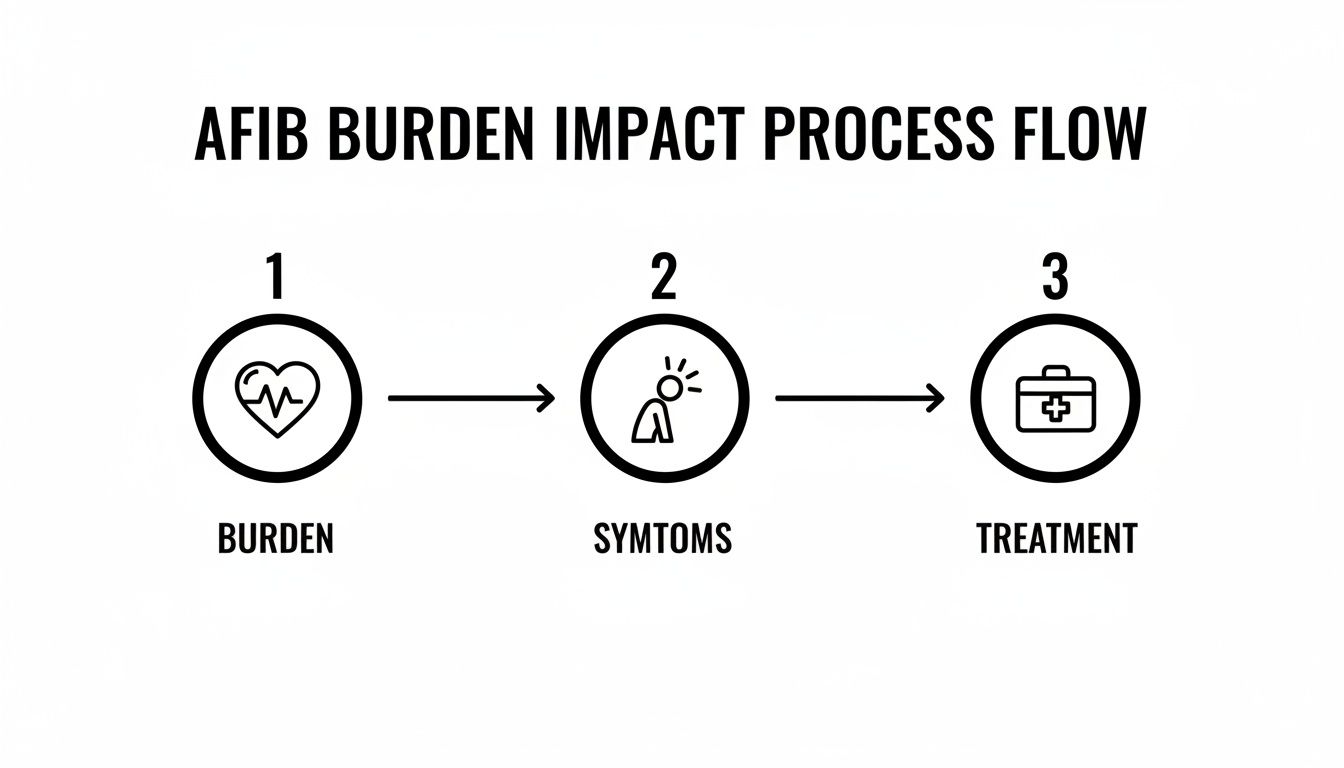
This process makes one thing clear: reliable data is the foundation of good AFib management. That’s why having your ECGs interpreted accurately is absolutely essential. For a deeper dive into the basics, check out our guide on what is cardiac monitoring. This is where having a human expert review your ECGs becomes not just helpful, but necessary for getting a burden calculation you can truly trust.
Why Expert-Reviewed ECGs Are a Game Changer
So, you've got a smartwatch or a portable ECG, and you’re doing the right thing. You are taking readings whenever you feel that tell tale flutter. That’s a massive step in owning your heart health. But it leads to the big question: what do you actually do with these ECGs?
Seeing an automated notification like “Inconclusive” or even “AFib Detected” pop up can feel like a double edged sword. Sure, you have data. But you’re also left with more questions than answers, which can kick off a cycle of worry and uncertainty. Was that a real AFib episode? Or was it just a glitch because you moved your arm? This is where the limits of technology alone become crystal clear.
Automated algorithms are built to be cautious. They're pretty good at spotting clear cut signals, but they often get stuck when a reading isn't textbook perfect. This is precisely why having a certified human expert review your ECGs changes everything.


Beyond the Algorithm: The Power of Human Insight
A human in the loop approach bridges the gap between raw, confusing data and genuine medical insight. Think of your wearable device as a skilled photographer, capturing detailed images of your heart’s electrical activity. An algorithm can tell you if the picture is blurry, but a certified cardiac technician can analyze the subtle details in that picture to give you the full story.
This expert review delivers two critical things that algorithms alone can't: accuracy and confidence. Instead of guessing what an “Inconclusive” reading really means, you get clear confirmation from a trained professional. It’s the only way to be certain whether a specific ECG showed AFib, another type of arrhythmia, or just a normal rhythm with a bit of noise.
If you're curious about what these different rhythms look like, you can learn more about what Atrial Fibrillation looks like on your watch ECG in our other guide.
From Scattered Data to a Clear AFib Burden Report
A single ECG, even if it's accurately read, is just one dot on a map. To truly understand your AFib burden, you need to connect those dots over time to see the whole landscape. This is where consolidating all your expert reviewed readings becomes so powerful.
Each verified ECG becomes a trusted piece of the puzzle. When you put them all together, a clear pattern starts to emerge. This process transforms a folder full of random ECG strips into a single, actionable report that calculates your true AFib burden.
Instead of just collecting data, you’re building evidence. An expert-reviewed AFib burden report is a credible, comprehensive summary of your heart’s behavior that you can share with your doctor with complete confidence.
This is especially critical when you consider the bigger picture. The prevalence of Atrial Fibrillation varies dramatically around the world, with North America having some of the highest rates at over 1,000 cases per 100,000 people. Knowing your own risk and getting fast, expert analysis is a key part of managing your heart health proactively. You can find more on the global impact of atrial fibrillation on aerjournal.com.
When you have this kind of reliable information, you can have a much more productive conversation with your doctor. You’re no longer walking into an appointment with just a vague feeling or a handful of confusing watch notifications. Instead, you arrive with a clear, documented history of your heart's activity, making you an informed and active partner in your own care.
Common Questions About AFib Burden
It's completely normal to have questions as you navigate your heart health. Feeling uncertain just means you're paying attention and looking for answers, and that’s a powerful first step. Here are some straightforward answers to the questions we hear most often about AFib burden.
What Is Considered a High AFib Burden?
This is the big question, and the answer has a few layers. While there's no single magic number that applies to everyone, many cardiologists start paying closer attention when AFib burden hits the 1% to 5% range.
An AFib burden over 5% is often seen as a critical threshold. At this point, the risk for complications like stroke can increase, which usually sparks a conversation with your doctor about starting blood thinners or adjusting your treatment.
But "high" is also a personal number. If you're very sensitive to your symptoms, even a low burden might feel significant and disruptive. The key is to track your burden consistently and talk with your doctor about what that number, and how you feel, means for you.
Can Lifestyle Changes Lower My AFib Burden?
Yes, absolutely. You have more power over your heart health than you might realize. Lifestyle changes can make a real, tangible difference in calming an irritable heart and lowering your AFib burden.
Think of it this way: your heart is deeply connected to your overall well being. Simple, consistent actions can help reduce its irritability over time. Here are a few great places to start:
- Manage Stress: Chronic stress is a known trigger for AFib. Finding what calms your nervous system, whether it's meditation, deep breathing, or just some quiet time, can be incredibly effective.
- Limit Alcohol and Caffeine: Both are common irritants that can provoke AFib episodes for many people. Simply cutting back can be a powerful move.
- Prioritize Sleep: Poor sleep puts a heavy strain on your entire body, including your heart. Aiming for a consistent sleep schedule can have a huge positive impact.
- Embrace Gentle Movement: Regular, moderate exercise, like a daily walk, strengthens your heart muscle and improves your overall cardiovascular fitness.
Remember, this isn't about perfection. It’s about making small, sustainable choices that add up. Every healthy decision is a step toward lowering your AFib burden and regaining a sense of control.
How Can I Best Explain My AFib Burden to My Doctor?
Walking into your appointment with clear, organized information transforms the entire conversation. It moves you from saying "I've been having palpitations" to providing concrete data your doctor can actually work with.
Try to bring a simple summary of your AFib burden percentage from the last month or so. Point out how many ECGs you recorded and highlight any specific days or weeks when your burden was higher. This turns a vague feeling into a solid data point.
When you can show your doctor the numbers, it helps them make better, more personalized decisions about your care. It’s the best way to make sure you and your doctor are on the same page.

Don't let inconclusive ECGs from your watch leave you guessing. With Qaly, certified experts analyze every reading, giving you the clarity and confidence you need to manage your heart health.



.png)
.png)