




Key Takeaways

User Profile
When your heart rate randomly spikes, it's often just a temporary reaction to everyday things like stress, caffeine, or not drinking enough water. While these episodes are usually harmless, a sudden jump in heart rate can sometimes point to an underlying issue, especially if you also feel dizzy or have chest pain.
Understanding Your Heart’s Unpredictable Rhythm
Hello, Heart Hero. Feeling your heart suddenly start pounding for no apparent reason can be really unsettling. That unexpected thumping in your chest often kicks off a wave of anxiety, leaving you wondering what on earth is going on. First off, know that you’re not alone in this, and what you’re feeling is completely valid.

This guide is meant to be a calm, clear companion to help you make sense of these moments with more confidence. We get it; navigating the healthcare system can be frustrating, and feeling unheard only makes things more stressful. Our goal here is to arm you with knowledge so you can feel more in control.
Why This Feeling Is So Common
The sensation that your heart rate randomly spikes is something many people experience. Your heart is an incredibly responsive organ, reacting to everything from your emotions to the coffee you had this morning. Think of it like a sensitive instrument that sometimes hits a loud, surprising note.
These spikes can be set off by all sorts of things, including:
- Emotional responses like a sudden jolt of stress, excitement, or anxiety.
- Physical triggers such as dehydration, a bad night's sleep, or even just standing up too fast.
- Dietary influences from caffeine, alcohol, or a sugary snack.
Most of the time, these are just your body's normal reactions to life. Learning to recognize these potential triggers is the first step toward demystifying the experience and taming the anxiety that often tags along.
Your body is constantly sending you messages. A sudden spike in your heart rate is just one of them. Our job is to learn how to interpret that message without jumping straight to alarm.
Taking Control of the Narrative
This article is all about shifting from a place of fear to one of empowerment. We’ll walk through the common, and less common, reasons your heart might race. More importantly, we'll talk about how to tell the difference between a harmless flutter and a pattern that deserves a closer look. To do that, it's helpful to have a basic grasp of your heart's electrical system, which you can learn more about in our guide on what a heart rhythm disorder is.
By the end, you'll have practical, easy-to-digest information. You’ll be better prepared to track your symptoms, pinpoint your personal triggers, and have more productive conversations with your doctor, all backed by data from your own body. You're in the right place to start making sense of it all.
Why Your Heart Rate Spikes for No Obvious Reason
It’s a deeply unsettling feeling. Your heart suddenly starts racing, thumping in your chest for no reason you can pinpoint. Your mind immediately jumps to the worst-case scenario. The good news? Most of the time, these spikes are just your body's natural reaction to subtle, everyday triggers you might not even be aware of.
Think of your heart’s rhythm like a finely tuned orchestra, with a conductor keeping everything in perfect time. But every now and then, something, or someone, can jump on stage and throw the tempo off. Let's break down some of the most common culprits behind these surprising performances.
Everyday Physiological Triggers
Often, the reason your heart rate randomly spikes is simply physiological. It’s a direct, physical response from your body to something you’ve consumed or a state it’s in. These are some of the most frequent, and generally harmless, causes.
- Dehydration: When you don't drink enough water, your blood gets a little thicker. This forces your heart to pump harder to push it through your veins, and that extra effort can easily make your heart rate jump.
- Stress and Anxiety: When you feel stressed, your body goes into "fight or flight" mode by releasing adrenaline. This powerful hormone is designed to get you ready for action, and one of its main jobs is to crank up your heart rate. This can happen even with low-level, subconscious stress that you're not actively thinking about. You can learn more about how anxiety can cause arrhythmia right here.
- Caffeine, Nicotine, and Alcohol: These are the usual suspects for a reason. They're well-known stimulants (or in alcohol's case, a depressant that can have a rebound stimulating effect) that can directly interfere with your heart's electrical signaling, often causing temporary spikes.
For some people, these spikes can be a direct result of supplements, like a pre-workout with caffeine. It always pays to know exactly what’s in the products you’re taking, as they could be the trigger you’re looking for.
How Your Body's Inner Workings Play a Role
Beyond the obvious daily triggers, sometimes the cause lies a bit deeper, tied to your body's metabolic or hormonal state. These internal factors can make your heart more sensitive and prone to sudden rhythm changes.
For instance, shifts in your metabolism, like a sudden drop in blood sugar (hypoglycemia), can put your whole system on high alert. Your body might release a shot of adrenaline to help raise your sugar levels, which in turn spikes your heart rate. Hormonal changes, especially those connected to thyroid issues or menopause, can also have a big impact on your heart's rhythm.
Understanding these potential triggers is the first step toward reclaiming your peace of mind. By connecting your daily habits and bodily functions to your heart's behavior, the "random" spikes start to feel much less random.
This kind of self-awareness is more important than ever. Cardiovascular disease remains a huge global issue, responsible for about 33% of all deaths worldwide. That staggering number is precisely why tools that help us monitor our heart's activity, like wearable ECGs, have become so vital for catching potential issues early and providing peace of mind.
When Medications Might Be the Culprit
Finally, it’s crucial to look at the medications you might be taking. Many common prescription and over-the-counter drugs can affect your heart rate as a known side effect.
A few examples include:
- Certain asthma inhalers (like albuterol)
- Decongestants found in many cold and allergy medicines
- Some antidepressants and ADHD medications
If you notice your heart rate randomly spiking more often right after starting a new medication, it's definitely something to bring up with your doctor. The goal here isn't to self-diagnose, but to become a better detective for your own body. The more you learn to identify patterns, the more in control of your health you'll feel.
Benign Spikes Versus Concerning Patterns
One of the biggest sources of anxiety is the unknown. When your heart rate randomly spikes, it’s natural to wonder, "Is this just a harmless flutter, or is it something I need to worry about?" Learning to tell the difference is a powerful step toward gaining control and reducing unnecessary fear.
Not all heart rate spikes are created equal. Some are just your body’s normal, temporary reactions, while others can be signals that something more significant is happening. Let’s break down the key differences so you can better understand what you're feeling.
What a Benign Spike Usually Feels Like
Think of a benign spike as a brief, loud interruption in an otherwise calm conversation. It gets your attention for a moment, but then things quickly return to normal. These spikes are typically harmless and don't indicate a deeper problem.
Here are the classic signs of a benign heart rate spike:
- It’s short-lived: The racing sensation usually lasts for only a few seconds or, at most, a couple of minutes before your heart rate settles back down on its own.
- It has a likely trigger: You can often connect the spike to something specific, like drinking a strong coffee, feeling a sudden scare, or doing a bit of physical exertion.
- You feel fine otherwise: Aside from the startling sensation of a racing heart, you don't experience other major symptoms.
These episodes are often just your heart reacting to a stimulant or a surge of adrenaline. While they can feel alarming, they are a very common and usually non-threatening part of how our bodies function.
Identifying Concerning Red Flags
Now, let's talk about the patterns that deserve a closer look. These aren't the brief, isolated flutters. Instead, they’re spikes that come with friends: other symptoms that suggest your body is struggling in some way.
It's time to pay closer attention if your heart rate spike is accompanied by any of these red flags:
- Chest pain or discomfort: This is the most critical warning sign. Any racing heart sensation paired with tightness, pressure, or pain in your chest needs immediate evaluation.
- Shortness of breath: If you feel like you can't catch your breath or are struggling to breathe during a spike, it’s a major red flag.
- Dizziness or lightheadedness: Feeling faint, woozy, or like you might pass out is a sign that your brain may not be getting enough oxygen, which can be serious.
- Fainting: Actually losing consciousness during an episode is always a reason to seek urgent medical care.
A heart rate spike by itself is often just a sensation. A heart rate spike accompanied by other significant symptoms is a signal that requires action.
The Importance of Context and Frequency
Beyond these immediate red flags, the context of your spikes matters. If they start happening more frequently, last longer than a few minutes, or seem to happen without any clear trigger at all, it’s a good idea to start tracking them.
Similarly, some arrhythmias don't always produce obvious symptoms. You can learn more about understanding asymptomatic arrhythmias on your ECG in another one of our guides.
This isn't about creating more anxiety, but about empowering you. Knowing these distinctions helps you filter out the noise of harmless flutters and focus on what truly matters. It allows you to feel reassured during a benign episode and act decisively when you experience something more concerning.
Becoming Your Own Health Detective with Wearable Tech
We’ve all been there. You try to explain to your doctor that your heart rate randomly spikes, but the words just don't do it justice. Trying to describe a fleeting sensation that vanished days ago often falls flat, leaving you feeling unheard, anxious, and right back where you started.
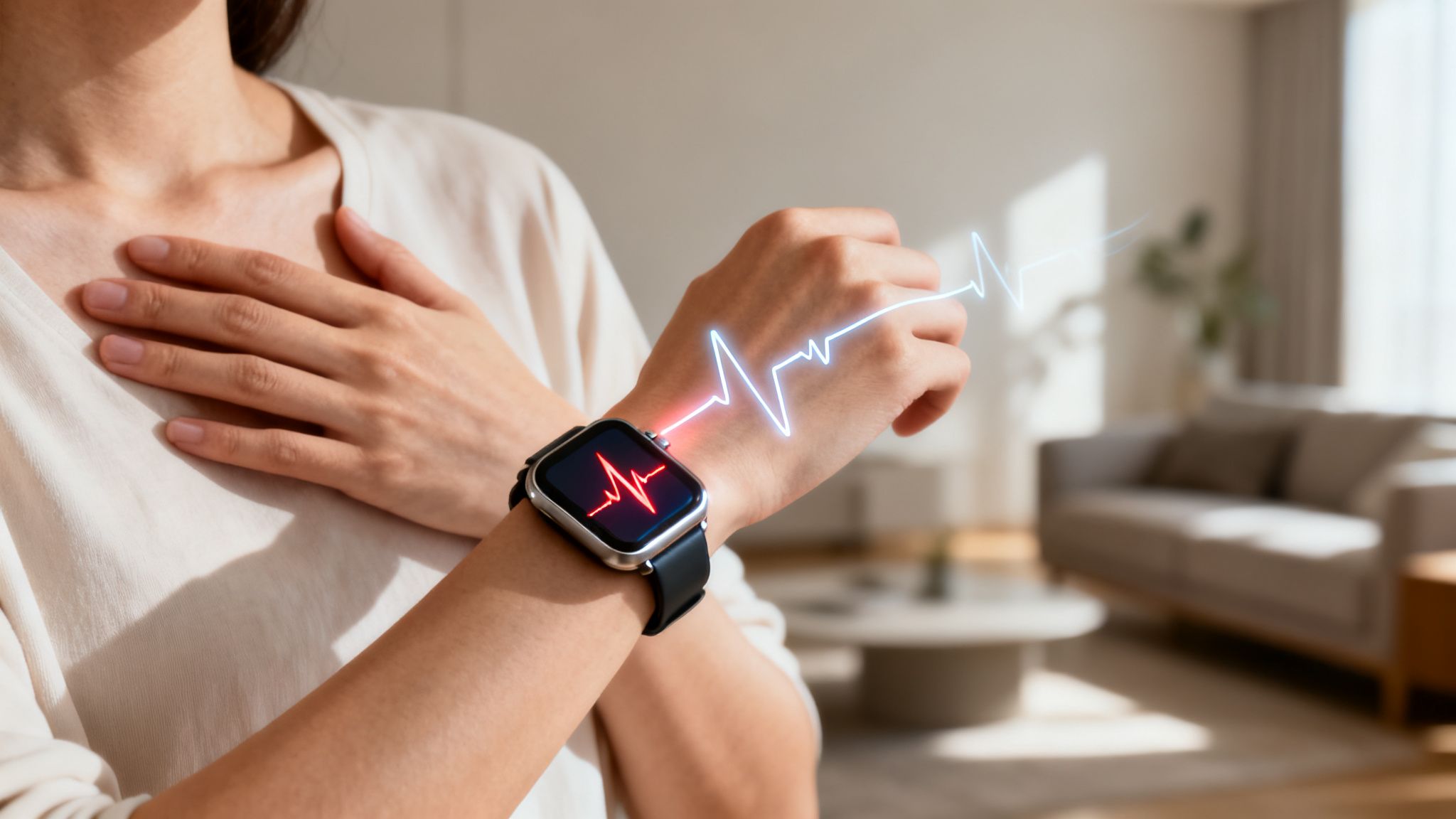
This is exactly where the technology on your wrist can become your best advocate. Your Apple Watch, Fitbit, or other smart device is so much more than a fancy step-counter; it’s a personal health monitor ready to capture precisely what's happening the second you feel that spike.
Capturing the Moment a Spike Happens
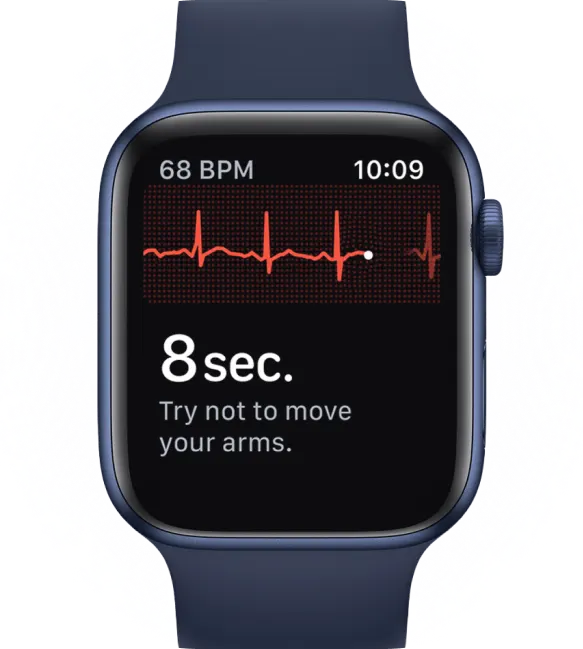
The trick is to shift from being a passive observer to an active participant in your own health monitoring. The moment you feel that familiar flutter, thud, or racing sensation is your cue to take action. Most modern smartwatches with ECG capability let you record a single-lead electrocardiogram (ECG) in just about 30 seconds.
This simple act is an absolute game-changer. It transforms a subjective feeling, "my heart felt weird," into an objective piece of data. Instead of relying on memory, you now have a digital snapshot of your heart’s electrical activity during the exact event that worried you. Mastering this simple process is key, and you can get a detailed walkthrough on how to take an ECG with your Apple Watch.
The ability to capture real-time data is increasingly significant. The global market for heart rate analysis systems is projected to continue growing, highlighting the growing number of people using technology to gain insights into their heart health.
Turning Raw Data into Clear Answers
Okay, so you’ve recorded an ECG. Now what? Staring at those squiggly lines on your own can be confusing, and honestly, it might just create more anxiety. This is where the next crucial step comes in: bridging the gap between capturing data and actually understanding what it means.
Services now exist that connect you directly with certified cardiographic technicians who can interpret your wearable ECGs. You can simply upload your recording and, often within minutes, get a professional analysis of what it shows.
This process provides two powerful benefits right away:
- Clinical Insight: The technician can identify the specific rhythm. Was it a run of premature ventricular contractions (PVCs)? A short burst of supraventricular tachycardia (SVT)? Or was it just your normal sinus rhythm picking up the pace for a moment?
- Peace of Mind: Getting a fast, expert review can be incredibly reassuring. It can confirm if an event was benign or flag it as something that genuinely needs a doctor's attention.
When you can capture and interpret an ECG in minutes, you transform a moment of anxiety into a valuable, actionable data point. You move from a position of uncertainty to one of empowered understanding.
Having a More Productive Doctor's Visit
Armed with this information, your next conversation with a healthcare provider will be entirely different. You’re no longer just a patient describing a vague, hard-to-pin-down symptom. You are now a partner in your own care, coming to the table with concrete evidence.
Instead of saying, "My heart felt funny last Tuesday," you can say, "I experienced palpitations last Tuesday at 3 PM. I captured an ECG, and the analysis by a certified technician indicated frequent PVCs. Here is the report."
This shift is monumental. It validates your experience, commands attention, and helps your doctor make a much more informed decision about what to do next, whether that’s ordering further tests or adjusting a treatment plan. It ensures that when your heart rate randomly spikes, your concerns are backed by data, making them impossible to ignore.
Practical Steps for Managing Sudden Heart Rate Spikes
Knowledge is empowering, but taking action is what truly creates change. You've gotten a much better handle on the "why" and "what" behind those surprising jumps in your heart rate. Now, let's get into the "how": the practical steps you can take to manage and hopefully reduce those random spikes.

This isn't about a massive overhaul. It's about making small, sustainable adjustments that add up to a big impact on how you feel every day. When you combine smart lifestyle choices with the data from your wearable, you step into a proactive, confident role in your own heart health journey.
Master Your Lifestyle Triggers
More often than not, the path to a calmer heart rhythm starts with simple, everyday habits. Before jumping to complex medical conclusions, it's incredibly helpful to rule out the usual suspects that can make your heart a bit more reactive. The best part? You can start making these changes today.
Here are a few key areas to dial in:
- Hydration is Key: Even mild dehydration can cause your blood volume to drop. This forces your heart to pump harder and faster just to keep up. Aim to sip water consistently throughout the day, not just when you feel parched.
- Mind Your Stimulants: Caffeine and alcohol are well-known triggers for a reason; they directly stimulate the heart. Try cutting back or simply paying attention to the timing and amount you consume. You might find a direct link to your spikes.
- Balance Your Blood Sugar: Big swings in your blood sugar can send a jolt of adrenaline through your system, kicking your heart into high gear. Try to avoid large, sugary meals and focus on balanced plates with protein, fiber, and healthy fats to keep your energy nice and steady.
Think of these as building a stable foundation. A well-hydrated, balanced body makes your heart far less likely to overreact to small stressors.
The Power of Calm and Conscious Breathing
When your heart rate randomly spikes, the natural instinct is often to panic. But that panic just dumps more adrenaline into the mix, fueling the very fire you're trying to put out. One of the most powerful tools you have is right under your nose: your breath. Simple, intentional breathing activates your parasympathetic nervous system, your body's built-in "rest and digest" mode.
A great technique to try is the 4-7-8 method:
- Breathe in quietly through your nose for a count of 4.
- Hold that breath for a count of 7.
- Exhale completely through your mouth with a whooshing sound for 8 counts.
Repeat this cycle three or four times. For a deeper dive into managing the daily stressors that can contribute to these episodes, check out these strategies for reducing stress naturally.


Become a Meticulous Note Taker
Keeping a symptom journal is one of the single most effective things you can do. It helps turn what feels like a random collection of events into a clear, understandable pattern. Every time you feel that spike, just jot down a few key details.
Your symptom journal is more than just a diary. It's the evidence you need to connect the dots between your life and your heart's behavior, turning vague feelings into concrete, actionable information.
Your notes should include things like:
- The date and time of the spike.
- What you were doing (sitting at your desk, walking up stairs, feeling stressed).
- What you ate or drank recently.
- How you felt emotionally (anxious, calm, surprised).
- Any other symptoms that came along for the ride (dizziness, shortness of breath).
This meticulous tracking, especially when paired with ECG readings from your watch, gives you a powerful story to share with your clinician. It elevates your concerns from just a feeling to something backed by real data.
And that data is getting better all the time. A 2024 study highlighted just how reliable our smartwatches are becoming, showing they can measure high-resolution heart rate data in near real-time with an 81% median rate of data validity. This capability allows you to objectively measure those spikes and get closer to figuring out if they're a benign stress response or a rhythm that needs a closer look from a doctor. You can read the full research about these findings for more detail.
Finding Your Path to Peace of Mind
Feeling your heart randomly spike can be an incredibly isolating experience, but you're no longer navigating this journey in the dark. You now have the knowledge, powerful tools, and a much clearer path forward. The path to peace of mind doesn't start with eliminating every single palpitation; it begins with understanding them.
This journey is all about turning uncertainty into action. By now, you know the difference between a harmless flutter and a pattern that needs a closer look. You also realize the immense power you hold in your hands, or rather, on your wrist. Your wearable is your personal health advocate, ready to capture objective data the moment you feel something change.
From Anxiety to Empowerment
Every ECG you capture is a step away from anxiety and toward clarity. Instead of just feeling a symptom, you're documenting it. This simple act shifts the dynamic entirely, empowering you to become an active, informed partner in your own healthcare.
Your heart health is a partnership. With the ability to capture and interpret your own heart data, you show up to that partnership as a more confident and informed advocate for your own well-being.
You no longer have to rely on describing a fleeting sensation that was gone minutes ago. Instead, you can show your doctor a professionally analyzed report that details exactly what was happening with your heart's rhythm. This is how you bridge the communication gap that so many people find frustrating.
Your Key Takeaways for Lasting Reassurance
Let's boil this down to the core principles that will guide you from here. Think of this as your personal roadmap to feeling more in control and less afraid of your body’s signals.
- Understand Your Triggers: Pay close attention to what’s going on when you feel a spike. Is there a connection to your lifestyle, stress levels, or something you ate? Tracking these patterns is the first step to managing them.
- Embrace Your Technology: Use your wearable device to its full potential. Capture an ECG every time you feel a significant spike or flutter. You’re turning a moment of worry into a valuable data point.
- Seek Expert Interpretation: Don't let the squiggly lines create more confusion. A service like Qaly gives you rapid, human-reviewed analysis, providing the context you need to understand what you’re seeing.
- Advocate with Confidence: Armed with data and expert interpretations, you can have much more productive conversations with your doctor, ensuring your concerns are heard and properly addressed.
Remember, the goal isn't just to manage symptoms. It's to build a foundation of knowledge and confidence that brings you lasting peace of mind. You have the tools and the ability to get reassurance when you need it and to advocate for yourself with clarity and data.
Frequently Asked Questions
Trying to make sense of random heart rate spikes can bring up a lot of questions. It's totally normal to want some clarity when your body is sending you signals that feel off. Here are some straightforward answers to the questions we hear most often, aimed at giving you a little extra reassurance.
Can Anxiety Cause My Heart Rate to Spike Even When I Don't Feel Anxious?
Yes, absolutely. This is a super common experience and a big source of confusion for many people. Your body's stress response system can get triggered on a subconscious level, causing a physical reaction, like a racing heart, even if you don't mentally feel stressed or anxious in that exact moment.
Think of it as a smoke alarm that's just a little too sensitive. It's often a sign that your autonomic nervous system is stuck in a state of high alert, maybe from chronic, low-level stress you've gotten used to. Keeping a log of when these spikes happen can sometimes help you connect the dots to subtle triggers you weren't even aware of.
How Accurate Is My Smartwatch for Detecting a Serious Heart Problem?
Your smartwatch is an amazing screening tool, but it's not a diagnostic one. A single-lead ECG from a device like an Apple Watch or Fitbit is quite good at detecting certain arrhythmias, especially Atrial Fibrillation. However, it can't diagnose a heart attack or give the complete, detailed picture that a 12-lead ECG in a hospital setting can.
The real power of your watch is its ability to capture your heart’s rhythm while you're feeling symptoms. This used to be incredibly difficult information to get. Having a certified technician look over that ECG adds a critical layer of professional analysis, which gives you a much better idea of whether the rhythm is something to worry about and worth a doctor's visit.
A wearable ECG doesn't replace your doctor, it empowers your conversation with them. It provides the objective data needed to make sure your subjective feelings are taken seriously.
Should I Be Concerned If My Heart Rate Spike Only Lasts a Few Seconds?
Brief spikes that are over in a few seconds and go away on their own are often benign. This is especially true if they happen without any other scary symptoms like fainting, chest pain, or severe shortness of breath. They can be caused by things like premature ventricular contractions (PVCs) or premature atrial contractions (PACs), which are very common and usually harmless little "hiccups" of the heart.
But context is key. If these little flutters become really frequent, show up in clusters, or start making you feel unwell, it’s always a smart move to try and capture an ECG during one. Sharing that recording with your doctor or an interpretation service is the best way to play it safe. Your peace of mind is a huge part of your overall health, after all.

When you need clarity in moments of uncertainty, Qaly provides expert, human-reviewed analysis of your wearable ECGs in minutes, 24/7.



.png)
.png)