





Key Takeaways

User Profile
Hello Heart Hero.
You take a puff of your albuterol inhaler because your chest feels tight. A minute later, your breathing starts to open up, but now your hands feel shaky and your heart seems to thump harder or faster than usual. That moment can be very unsettling, especially if you also wear an Apple Watch or another device that keeps reminding you that your heart is doing something noticeable.
If that sounds familiar, you're not overreacting. A racing heartbeat after albuterol can feel scary, even when it's a known medication effect. The hard part is that your body may feel like it's sending a danger signal at the exact moment you were trying to fix one problem, which was breathing.
A lot of people get brushed off with a vague “that's normal,” and that isn't very helpful when you're the one feeling fluttering in your chest. What helps more is understanding what albuterol side effects usually feel like, why they happen, how long they tend to last, and how to tell the difference between a common medication reaction and something that deserves urgent care.
Your Guide to Navigating Albuterol Side Effects
Albuterol is a rescue inhaler. Its job is to act fast when your airways tighten. For many people, it works exactly as intended. But because it stimulates parts of the body beyond the lungs, it can also create sensations that feel dramatic.
That's where confusion starts.
You may use albuterol for wheezing, asthma, exercise-related symptoms, or breathing flare-ups. Then, instead of feeling only relief, you notice jitters, a pounding heartbeat, or a strange sense of internal “buzzing.” If you've ever thought, “Did this inhaler just cause a heart problem?” you're asking a very common and very reasonable question.
Why this feels so alarming
Breathing symptoms and heart symptoms overlap in a way that can make anyone anxious. Shortness of breath can make your heart race. A medication that opens your airways can also make your heart race. Anxiety about both can amplify the sensation further.
That doesn't mean it's all in your head. It means several real things can happen at once.
A side effect can be real, noticeable, and still not be a medical emergency.
People often get stuck on one question: “Is this dangerous?” A better first question is, “What pattern am I seeing?” A brief fast heartbeat after a rescue inhaler is different from severe chest pain, fainting, or breathing that keeps getting worse after the inhaler.
What makes this guide different
You don't need sugar-coated reassurance. You need useful clarity.
So this article treats albuterol side effects the way a careful health educator would. We'll separate common effects from serious symptoms, explain the heart connection in plain language, walk through who may be more sensitive, and show you how wearable ECG tools can help you capture what's happening instead of guessing.
That shift matters. Once you move from “I'm panicking” to “I can observe this pattern,” you usually feel more grounded and more prepared for your next step.
Common Side Effects vs Serious Symptoms
Some albuterol side effects are common enough that they should be expected rather than treated as strange. According to StatPearls on albuterol adverse effects, the primary adverse effects are tremors and nervousness, and these occur in approximately 1 in every 5 patients, about 20%. The same source notes that insomnia and nausea occur in about 1 in every 10 patients, about 10%.
That matters because it helps put your symptoms in context. If your hands shake after a puff, or you feel keyed up, you're not having an unusual reaction. You're experiencing a known effect of a medicine that stimulates certain receptors in the body.
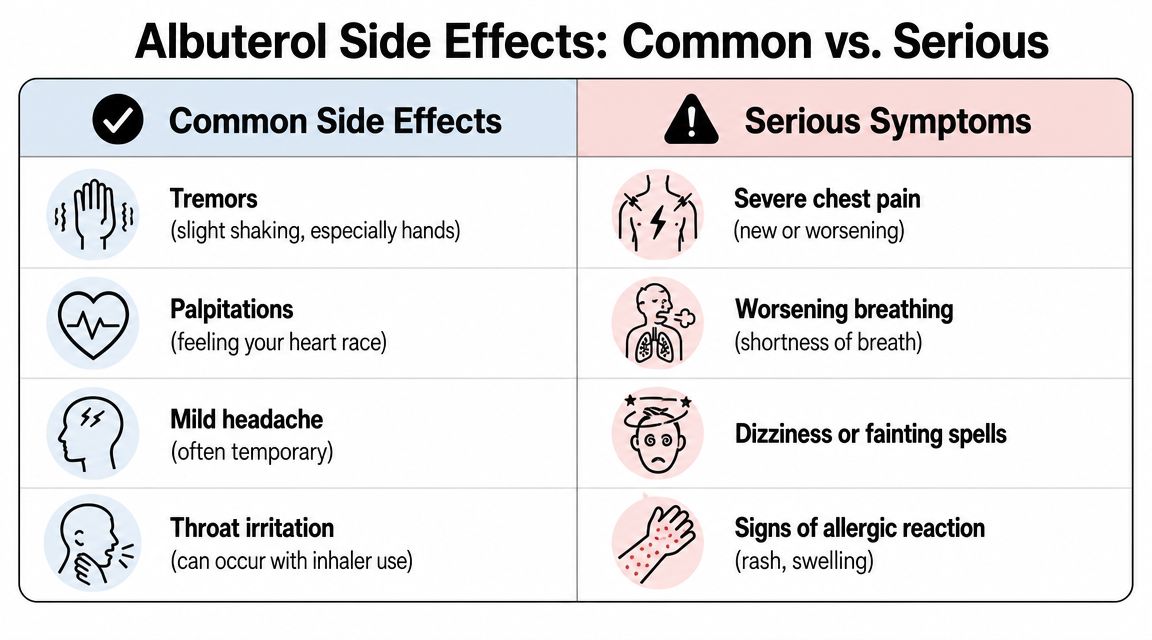
Common effects that often pass on their own
Many people notice symptoms that are uncomfortable but temporary.
- Shakiness or tremor. This is one of the best-known albuterol side effects. It often shows up in the hands.
- Feeling nervous or wired. Some people describe this as an “adrenaline” feeling.
- Palpitations. You may feel your heart beating faster, harder, or more noticeably.
- Mild headache or throat irritation. These can happen with inhaler use.
- Insomnia or nausea. These are also recognized side effects.
The key point is that these effects often come from the same mechanism that helps the medicine open the airways. Your body is responding to a stimulant-type signal, not necessarily signaling heart damage.
Symptoms that need more caution
Some symptoms deserve a higher level of attention because they go beyond the usual “my inhaler made me shaky” pattern.
Watch more carefully if you notice:
- Severe chest pain that's new, intense, or worsening
- Breathing that worsens or doesn't improve after using albuterol
- Dizziness or fainting
- Signs of an allergic reaction such as rash, swelling, or hives
- A chaotic or irregular feeling heartbeat rather than just a faster one
Practical rule: Fast and regular is often less concerning than fast and erratic, but severe symptoms always deserve prompt medical attention.
A simple way to sort what you're feeling
When you're unsure, think in categories:
- Expected and temporary
Shaky hands, feeling jittery, a mild pounding heartbeat, or a brief headache. - Needs follow-up soon
Side effects that keep happening, feel stronger than usual, or start showing up with less medication than before. - Needs urgent evaluation
Severe chest pain, fainting, worsening breathing, or signs of an allergic reaction.
That sorting process won't diagnose you. It will help you stay calmer and decide what kind of response makes sense.
Why Albuterol Can Make Your Heart Race
Albuterol is designed to relax the muscles around your airways so you can breathe more easily. A useful way to picture it is as a medicine that presses the body's “speed up” pedal in selected places. The main target is the lungs, but the effect doesn't stay perfectly boxed in.
That's why a rescue inhaler can help your breathing and still leave you feeling revved up.
The accelerator analogy
Think of your airways like narrow roads during traffic. Albuterol helps clear the jam by relaxing the muscles squeezing those roads. More air gets through. That's the benefit you want.
But if a little of that “accelerator” effect spills into the heart and the rest of the body, you may feel:
- A faster pulse
- A stronger heartbeat
- Internal shakiness
- A brief sense of restlessness
This is why people often report palpitations after using a rescue inhaler. The sensation can feel dramatic, but the cause is often pharmacologic, meaning it comes from how the drug works in the body.
Palpitations and tachycardia in plain language
Palpitations means you're more aware of your heartbeat. It may feel like pounding, fluttering, skipping, or racing.
Tachycardia means a faster-than-usual heart rate. With albuterol, this can happen because the medicine increases adrenergic stimulation. In plain English, it can nudge your body into a more activated state.
If your watch captures a fast rhythm after albuterol, one common pattern is sinus tachycardia, which is the heart's normal rhythm moving faster than usual. If you want a plain-English explanation of that pattern on wearable recordings, this guide on sinus tachycardia on your watch ECG can help.
The potassium piece people often miss
A more advanced reason albuterol can affect rhythm is hypokalemia, which means low potassium. GoodRx notes in its review of albuterol side effects that albuterol can lower serum potassium, and that this effect is more likely with overuse or with potassium-depleting drugs such as loop diuretics, as explained in this review of albuterol side effects and hypokalemia.
Why does that matter? Potassium helps heart cells conduct electrical signals smoothly. If potassium shifts lower, some people may become more prone to extra beats or more noticeable rhythm symptoms.
A racing heart after albuterol is often the body reacting to stimulation. The bigger concern is the pattern, the dose, and what else is going on around it.
That's especially important if symptoms are new, much stronger than usual, or happening alongside repeated rescue inhaler use.
Are You at Higher Risk for Side Effects
Not everyone feels albuterol the same way. Two people can take the same inhaler and have very different experiences. One barely notices anything. The other feels like they drank strong coffee on an empty stomach.
That difference often comes down to your body, your health history, and your medication mix.
Patterns that can increase sensitivity
Some situations make albuterol side effects more noticeable.
- Frequent inhaler use. The more often you need albuterol, the more likely you are to notice the stimulating effects.
- Heart rhythm sensitivity. If you already pay close attention to skipped beats, pounding beats, or heart rate changes, albuterol may feel more intense.
- Thyroid issues or other stimulant-like states. Some body states already make the heart more reactive. If that sounds familiar, this overview of hyperthyroidism and heart palpitations may help you connect the dots.
- Concurrent medications. Some drugs can amplify heart-rate effects or change how your body handles potassium.
Medication combinations worth discussing
You don't need to memorize a long drug interaction list. You do need to mention your full medication list when side effects feel stronger than expected.
Bring up things like:
- Diuretics if you take them, because potassium balance matters
- Other stimulants including heavy caffeine use or decongestants
- Beta-blockers, which can complicate how bronchodilators and heart rate interact
- Antidepressants or other prescription meds that affect the nervous system
A useful way to think about it is stacking. Albuterol may be manageable on its own, but if your body is already under stress, low on sleep, dealing with thyroid issues, or taking another activating medication, the same puff can feel much bigger.
Your own history matters more than averages
If you've used albuterol for years and suddenly develop stronger palpitations, that change is worth noticing. If you've always been very sensitive to it, that history also matters.
Neither pattern means something terrible is happening. It means your personal response should guide the conversation, not just a generic handout.
How to Manage Albuterol Side Effects at Home
When albuterol side effects hit, the goal is to lower the “alarm level” in your body while staying alert to red flags. Most of the time, simple steps can make the experience easier to tolerate.
The first step is surprisingly basic. Stop moving around for a moment.
What to do right after a dose
Try this sequence after using your inhaler if you feel shaky or your heart starts pounding:
- Sit down or lean back
If you're already anxious, pacing can make the sensation worse. - Take slow breaths
Breathe in gently through your nose, then exhale slowly. Don't force giant breaths. The point is to settle your nervous system, not to “win” at breathing. - Notice the pattern instead of chasing it
Ask yourself if your heartbeat feels faster, or irregular and chaotic. - Avoid adding more stimulation
Skip caffeine, energy drinks, nicotine, and intense activity around that time if possible. - Hydrate and give it time
A lot of people feel better once the peak passes.
Mayo Clinic notes that if a person uses albuterol three or more days a week or finishes an entire inhaler canister within a month, their care team should reassess the treatment plan. The same Mayo Clinic page states that Poison Control notes inhaled albuterol side effects typically last 2 to 6 hours, depending on the number of puffs, in this guidance on albuterol use and side effects.
That gives you a helpful frame. Brief side effects can happen. Frequent need for albuterol is a separate issue that may point to poor symptom control.
What overuse can look like
Some people think overuse only means “I'm taking way too much.” In real life, it often looks subtler:
- You're reaching for it several days each week
- You feel anxious without it nearby
- You're finishing canisters faster than expected
- You're using it again and again because symptoms keep returning
That's a clue to review your treatment plan, not just tough out the side effects.
If your rescue inhaler is becoming part of your daily routine rather than your backup plan, it's time for a treatment check-in.
Ways to feel more in control
If palpitations are the part that rattles you most, these tips for stopping heart palpitations can help you calm the moment while you monitor what's happening.
It also helps to keep a simple symptom note in your phone:
- when you took albuterol
- how many puffs you used
- what symptoms appeared
- how long they lasted
- whether your watch showed a fast rhythm
That record turns a fuzzy memory into something much more useful.
Using Your Watch ECG to Understand Your Symptoms
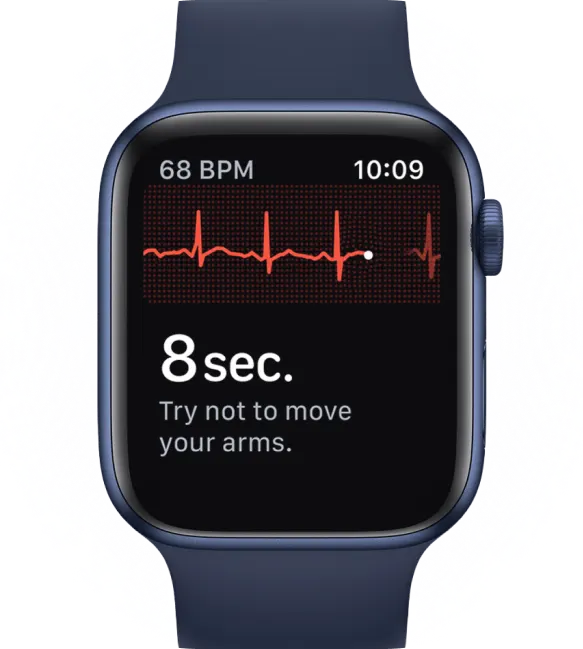
Palpitations are subjective. You feel them, but it can be hard to describe them clearly later. That's where wearable ECG tools can be helpful. They don't replace medical care, but they can capture a moment that would otherwise disappear.
If you use an Apple Watch, Fitbit, Kardia, Samsung watch, or another wearable rhythm tool, the best time to use it is when symptoms are happening or right after they start.

What your wearable can tell you
A wearable ECG may help you answer basic but important questions:
- Was the rhythm fast but regular?
- Did the episode happen soon after albuterol use?
- Did it settle as the side effects wore off?
- Does the pattern repeat each time you use the inhaler?
That's useful because “my heart felt weird” is hard to act on. “I took albuterol, then recorded a fast regular rhythm within minutes” is much more concrete.
For Apple Watch users, this guide on how to take an ECG with your Apple Watch gives a practical walk-through.
What to look for without self-diagnosing
Try to stay simple. You're collecting information, not trying to become your own electrophysiologist.
A few helpful observations:
- Fast and regular can fit with a medication-related increase in heart rate
- Occasional extra beats may feel like skips or thumps
- Wildly irregular symptoms deserve more caution
- Normal-looking recordings between episodes can still be useful for comparison
What matters most is the timing. If the rhythm change reliably follows albuterol use, that pattern becomes part of the clinical story.
Turn symptoms into a better doctor conversation
Wearable data helps when it's organized. Save the ECG, write down the timing, and note the dose you used. Then bring that to your clinician.
This changes the conversation from “I think maybe my inhaler bothers my heart” to something more specific:
“I used two puffs, felt palpitations within minutes, recorded a fast rhythm on my wearable, and the sensation faded later.”
That kind of detail often leads to a much more productive visit. It can help your clinician think about dose, inhaler technique, frequency of use, other medications, and whether the rhythm needs more formal evaluation.
Used well, a watch ECG doesn't feed anxiety. It gives shape to it.
When to Call Your Doctor or Seek Urgent Care
Most albuterol side effects are uncomfortable, not dangerous. But some symptoms should never be brushed off as “just the inhaler.” The safest mindset is simple: if the symptom is severe, escalating, or doesn't fit your usual pattern, get help.
This is especially true when breathing symptoms and heart symptoms appear together.
Red flags you shouldn't ignore
Seek urgent care or emergency help if you have:
- Breathing that worsens or does not improve after using albuterol
- New, severe, or worsening chest pain
- Dizziness, near-fainting, or actual fainting
- Signs of an allergic reaction such as facial swelling, throat swelling, rash, hives, or severe itching
- Any new severe symptom that feels clearly outside your usual side-effect pattern
Call your doctor promptly if the symptoms are less dramatic but still concerning, especially if palpitations are becoming more frequent, stronger, or more irregular.
Why acting early matters
Waiting too long can turn a manageable problem into a bigger one. A rescue inhaler should help relieve breathing symptoms. If it doesn't, that's important information. If it triggers symptoms that feel qualitatively different from your usual reaction, that's also important information.
People who feel skeptical about the healthcare system often delay calling because they don't want to be dismissed. That's understandable. It can help to organize your notes, your medication timing, and any wearable ECG recordings before you call. Clear information often leads to better conversations.
Severe chest pain, worsening breathing, fainting, or allergic symptoms are not “wait and see” problems.
Trust the pattern. Trust the severity. And if your gut says this feels different, it's appropriate to seek care.


Albuterol side effects got you guessing? Qaly delivers human-reviewed analysis of your wearable ECG recordings.



.png)
.png)