


Key Takeaways

User Profile
Catheter ablation in the U.S. is often quoted as roughly $25,000 to over $70,000, but that's a very wide estimate and provides less specific insight into costs. A major 2023 U.S. analysis found the procedure itself cost about $26,656, while the longer-term cost difference versus drug therapy narrowed to about $15,516 over a lifetime.
Individuals inquiring about catheter ablation cost are usually not asking a finance question alone. They're asking a fear question. How bad is this going to be for my body, my budget, my family, and my peace of mind?
That worry makes sense. You may be reading this after an atrial fibrillation diagnosis, after weeks of palpitations, or after hearing your doctor say the word “ablation” and feeling your stomach drop. The hard part is that hospital pricing often feels opaque. One person talks about a hospital bill. Another talks about insurance. Someone else mentions deductibles, prior authorization, and repeat procedures. It can all feel slippery.
The useful way to think about catheter ablation cost is not as one price tag, but as a financial journey. There's the testing before the procedure, the procedure day itself, the first few months after, and then the longer-term question: did it reduce symptoms, medication burden, and future care?
That full picture matters more than the sticker price.
Your Guide to Navigating Catheter Ablation Costs
You leave a cardiology visit with a recommendation for catheter ablation. On the drive home, your mind may split in two directions at once. One part is asking, “Will this help my heart rhythm?” The other is asking, “What will this cost me?”
Both questions matter.
The confusing part is that catheter ablation is not a single purchase, like buying a device off a shelf. It works more like a trip with several stops. There may be heart monitoring, office visits, imaging, lab work, prior authorization, the procedure itself, follow-up appointments, medications, and sometimes more care if symptoms return. The number on a hospital estimate rarely captures that whole path.
Patients often want more than a single number. They want to know what they may owe before the procedure, what happens on procedure day, and what costs can show up afterward.
That broader view matters because the true financial story is tied to the health story. If the procedure controls symptoms well, cuts down on urgent visits, or reduces the need for long-term medications, the long-range picture can look very different from the first bill. If recovery is more complicated or repeat treatment is needed, the path can look different too.
A simple way to frame it is this. The sticker price is the front door. Your real out-of-pocket cost depends on everything behind it.
This guide is built to make that process easier to handle. You will see what tends to shape catheter ablation cost, how insurance changes the math, which charges people often miss, and which questions can prevent unpleasant billing surprises. If you want a plain-language overview of the medical side while you read, this patient-friendly guide to AFib ablation basics can help round out the picture.
The goal is not to scare you with a long list of possible bills. It is to give you a clearer map, so the decision feels less foggy and more manageable.
What Is Catheter Ablation in Simple Terms
Your heart runs on electricity. If the electrical signals fire in the wrong place or loop in the wrong pattern, your heartbeat can become irregular, too fast, or chaotic.
Catheter ablation is a procedure that tries to fix that faulty signal. A heart rhythm specialist threads thin tubes called catheters through a blood vessel and into the heart. Then they identify the tissue causing the electrical problem and treat that tiny area so the abnormal rhythm is less likely to keep happening.
A house wiring analogy
Think of your home's wiring. If one wire keeps sparking and making the lights flicker, you don't replace the whole house. You find the trouble spot and repair it.
That's the basic idea here. The doctor is not “stopping” your heart or removing large sections of tissue. They're targeting a small area that is misfiring.
For many people, that explanation alone lowers the temperature a bit. The procedure is specialized, but the logic is straightforward. Find the bad electrical pathway. Interrupt it. Help the heart return to a steadier rhythm.
If you want a patient-friendly overview focused on atrial fibrillation, this guide to AFib ablation basics explains the medical side in plain language.
Why doctors recommend it
Doctors may suggest ablation when symptoms are disruptive, when medications haven't worked well enough, or when the side effects of long-term rhythm drugs are becoming a problem. The exact reason depends on the arrhythmia.
Some people pursue ablation because they're tired of living around episodes. Others want a treatment that addresses the rhythm problem more directly than medication alone. That difference matters when you later think about cost, because the financial question isn't just “What does the procedure cost?” It's also “What am I paying to avoid in the future?”
What Really Drives the Cost of Catheter Ablation
The final catheter ablation cost is built from several separate charges. That's why two patients can both say they had “an ablation” and still receive very different bills.
The bill is really a stack of bills
One major part is the facility fee. This covers the electrophysiology lab, nursing support, recovery area, equipment in the room, and sometimes an overnight stay. Hospitals often make this the largest piece.
Then there are physician fees. Your electrophysiologist bills for performing the procedure. An anesthesiologist or nurse anesthesia team may bill separately. You may also see charges tied to pre-procedure visits or interpretation of testing.
A third layer involves diagnostic workup. That can include blood tests, electrocardiograms, imaging, and rhythm monitoring before or after the procedure. These may be billed by the hospital, a separate physician group, or an outside imaging center.
For readers who have heard the word “fluoroscopy” and weren't sure what it meant, this plain-English explanation of what fluoroscopy is during heart procedures can help decode one part of the procedural setup.
Technology choice can change downstream costs
People often assume the most important number is the initial supply cost. In reality, the technology used can affect what happens later, especially if it changes the odds of needing another ablation.
A U.S. cost-minimization model for paroxysmal atrial fibrillation found that steerable-tip catheters had lower modeled 1-year ablation-visit costs than some comparators. The modeled average 1-year costs were $24,400 for steerable-tip, $25,888 for standard focal, and $28,894 for cryoballoon, with estimated savings of $1,488 versus standard focal and $4,494 versus cryoballoon because repeat ablation rates were lower in the model, according to this analysis of catheter technology and one-year ablation economics.
Practical rule: Ask not only what device will be used, but whether your center expects that approach to reduce the chance of repeat procedures.
That doesn't mean one device is automatically “best” for every patient. It does mean the supply list is not just a technical detail. It can shape the cost journey after procedure day.
Understanding the Real Price Range
You get a call from the hospital scheduler, ask what catheter ablation costs, and hear a number that sounds large but still oddly incomplete. That reaction is normal. A quote often captures only one stop on a longer road that starts before procedure day and continues through follow-up visits, monitoring, and the question every patient cares about most: whether one procedure solves the problem or whether more care is needed later.

A better way to read the price range is to separate three buckets that often get blended together. First is the hospital or facility charge. Second is the insurer-negotiated rate. Third is your own out-of-pocket share. Those numbers can differ sharply, which is why two patients can hear very different quotes for care that sounds similar on paper.
What published numbers can and cannot show
A major 2023 U.S. cost-effectiveness analysis found that in the first 3 months, catheter ablation cost $20,794 more than drug therapy, largely because the procedure itself cost about $26,656. Over a lifetime, the average total cost difference narrowed to $15,516, according to the study on catheter ablation versus antiarrhythmic drug therapy economics.
Those figures are useful as a map, not a quote sheet.
They show that the upfront expense is often the steepest part of the journey, while the longer-term picture depends on what happens after ablation. If symptoms improve, repeat care may drop. If follow-up is more involved, the total path can look very different. That is why the sticker price alone rarely answers the question patients are asking, which is, "What will this end up costing me over time?"
Why the range stays wide
Even within the same city, the billed amount can vary for understandable reasons:
- Where the procedure is done. A large academic center and a community hospital often price care differently.
- How complex the rhythm problem is. A straightforward case and a more involved ablation do not use the same time, staff, or resources.
- What services surround the procedure. Pre-procedure testing, anesthesia, overnight observation, imaging, and follow-up monitoring can each add separate charges.
- Whether additional care is needed later. Medication adjustments, extra clinic visits, and repeat procedures can change the total cost trajectory.
A simple comparison helps here. The procedure day is like the airfare. It is important, but it is not always the whole trip cost. Baggage fees, ground transportation, and hotel nights are the medical equivalents of testing before ablation and follow-up care after it.
If you're trying to compare this procedure with other major heart care expenses, My Policy Quote's 2026 guide offers a useful high-level look at how hospital, surgeon, and insurance factors shape big cardiac bills more broadly.
Use any published range as a planning starting point. Then ask your care team for the likely full episode of care, including the steps before the ablation and the follow-up period after it.
How Insurance Helps Cover the Cost
The hospital's charge is one number. Your out-of-pocket cost is another.
In many cases, catheter ablation is treated by insurers as a medically necessary procedure when the clinical criteria are met. But coverage doesn't mean “free,” and that's where confusion starts.
The three insurance terms that matter most
Deductible means the amount you may need to pay before your plan starts sharing costs.
Coinsurance is the percentage you may owe after the deductible is met.
Out-of-pocket maximum is the ceiling on covered medical spending you pay during the plan year before the insurer takes over covered costs more fully.
Those terms can sound abstract until you ask a direct question: “Has my deductible already been met this year, and is this hospital in network?”
The step that protects you most
Pre-authorization matters. Your doctor's office usually handles it, but you should never assume it's complete just because a procedure date has been scheduled.
Call your insurer yourself and ask these questions plainly:
- Has the procedure been authorized? Ask for the authorization number if one exists.
- Is the hospital in network? Don't stop there. Ask whether the electrophysiologist, anesthesia group, and any assistant physicians are also in network.
- What billing code or procedure description is attached? That helps if you later need to challenge a denial.
- What is my expected patient responsibility? Ask them to explain it in dollars if they can.
A scheduled procedure is not the same thing as an approved claim.
The Long-Term View and Financial Strategies
It helps to stop thinking about catheter ablation cost as only a bill and start thinking about it as a timeline. The upfront phase is expensive. The later phase may look very different, especially if symptoms improve and care becomes simpler.


When the economics can even out
Historical evidence on paroxysmal atrial fibrillation found that catheter ablation costs ranged from $16,278 to $21,294, with annual costs of $1,597 to $2,132, while annual medical therapy costs ranged from $4,176 to $5,060. That study concluded cumulative costs equalized after 3.2 to 8.4 years, and summarized the result as cost equivalence after about 4 years, according to this PubMed-indexed study on long-run cost equivalence between ablation and medical therapy.
That doesn't mean every patient personally “saves money” after a fixed number of years. It means the long-term comparison is more nuanced than a one-day hospital charge.
What to do if the out-of-pocket side scares you
Financial stress can worsen an already stressful diagnosis. If your estimate looks unmanageable, try these actions early:
- Call hospital financial counseling. Ask about payment plans before the procedure, not after the bill goes to collections.
- Request an itemized estimate. A broad bundled quote can hide separate physician or anesthesia bills.
- Ask about financial assistance. Nonprofit hospitals often have charity care or hardship policies.
- Time the procedure thoughtfully if possible. If you've already met much of your deductible or out-of-pocket maximum this year, timing can matter.
Medical debt is a real source of fear for many families. If that's weighing on you, this explanation of how medical debt affects households gives helpful context on why planning ahead matters.
Recovery is financial too
People often focus only on the bill from the hospital. But your real financial picture may also include time away from work, travel to appointments, childcare, pharmacy costs, and follow-up monitoring.
That's why long-term planning matters as much as price shopping.
For a practical look at the patient side after the procedure, this guide to life after cardiac ablation can help you think through recovery, symptom tracking, and follow-up expectations.
The best financial plan is not just “How do I pay for procedure day?” It's “How do I manage the months around it without surprises?”
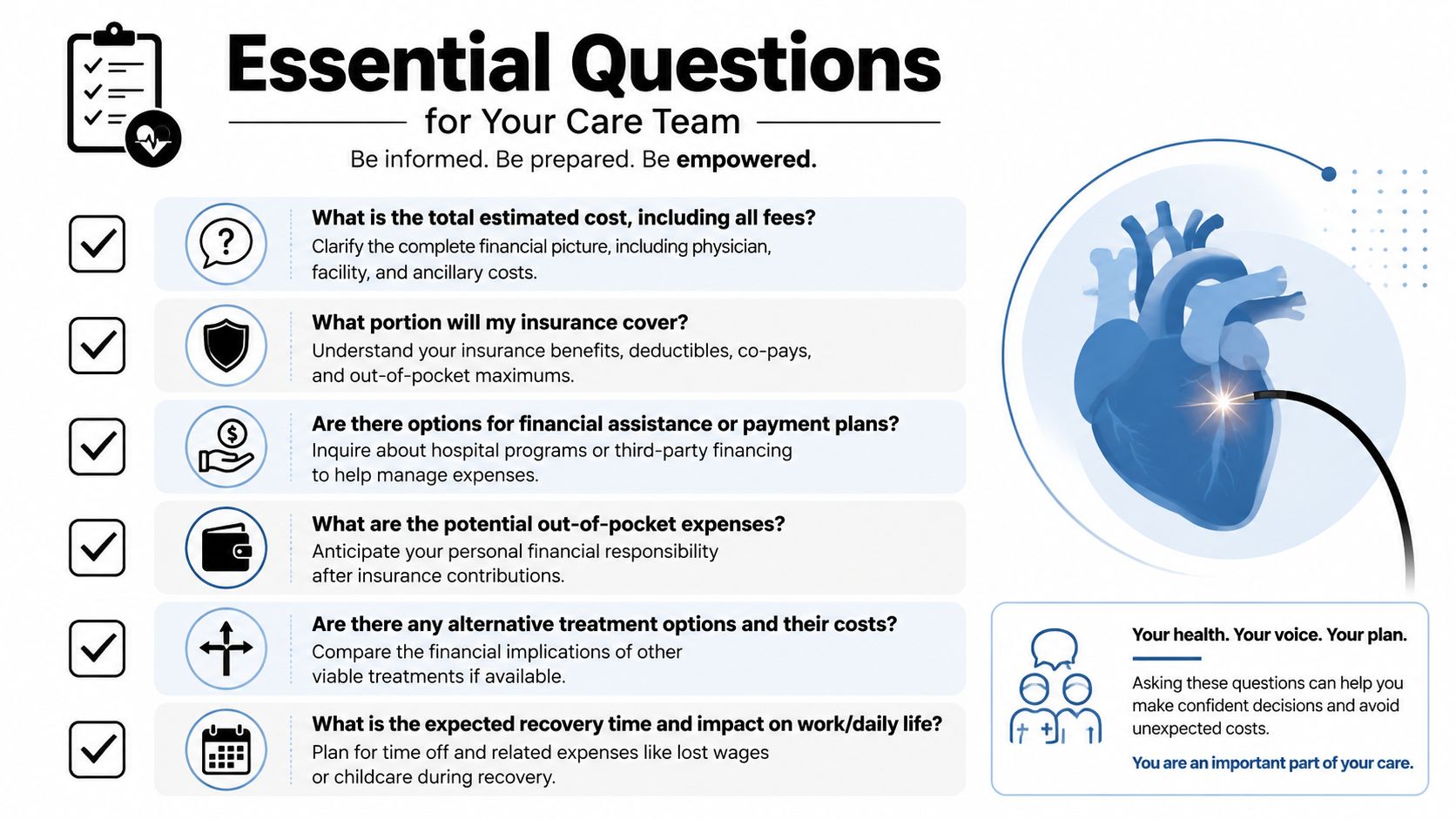
Essential Questions to Ask Your Care Team
Patients sometimes worry that asking money questions will make them sound difficult. It won't. It makes you organized.
Bring a written list to your electrophysiology visit and to the hospital billing office. When people are anxious, memory gets worse. Notes help.
Questions for the doctor
- Do you expect this to be outpatient or involve a hospital stay? That can affect facility costs.
- What kind of ablation technology are you planning to use? The tool choice can affect downstream care.
- How likely is it that I might need repeat treatment in my situation? You want the doctor's judgment about your specific rhythm problem.
- What medicines will I still need afterward, at least for a while? That helps you plan for pharmacy costs.
If you want a stronger script before the appointment, this list of questions to ask your cardiologist is a useful prompt.
Questions for billing and insurance staff
Ask these in plain language, and don't leave until you understand the answer:
- Can you give me an itemized estimate?
- Are the hospital, electrophysiologist, and anesthesia team all in network?
- Has prior authorization been approved?
- What separate bills should I expect after the procedure?
- Do you offer payment plans or financial assistance?
A good estimate won't remove all uncertainty. It will remove a lot of avoidable uncertainty, which is what usually drives the most frustration.
Frequently Asked Questions
What happens if my first ablation isn't successful
Sometimes a second procedure is needed. That possibility is emotionally hard, but it's not rare enough to ignore in planning. Ask your doctor how they think about repeat ablation in your case, and ask your insurer whether a medically necessary repeat procedure would fall under the same coverage rules.
This is also why the total cost trajectory matters more than the sticker price. A lower-looking first estimate is not automatically the better value if it leads to more follow-up intervention.
Are there cheaper alternatives to catheter ablation
The usual alternative is medication-based rhythm or rate control. Drugs often have a lower upfront cost, which can make them look simpler at first glance.
But “cheaper today” is not the same as “less costly over time.” Ongoing medication, follow-up visits, monitoring, and symptom burden can accumulate. That's why some long-term analyses have found that ablation and medical therapy can move toward cost equivalence over several years.
How can I track my heart's recovery after ablation
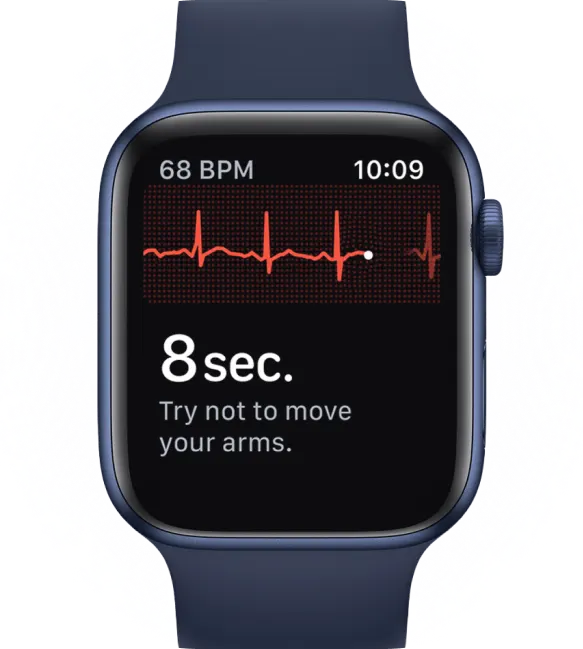
Keep a simple symptom log. Write down palpitations, skipped beats, dizziness, exercise tolerance, and any triggers like alcohol, poor sleep, or illness. If your doctor recommends home rhythm monitoring, use it consistently and save tracings you can share.
What helps most is good documentation, not panic-checking. A clear record of symptoms and rhythm strips gives your care team better information than vague memories at a follow-up visit.

Heart feels off? Get your ECGs read by certified experts within minutes, for peace of mind ❤️



.png)
.png)