




Key Takeaways

User Profile
Hello Heart Hero.
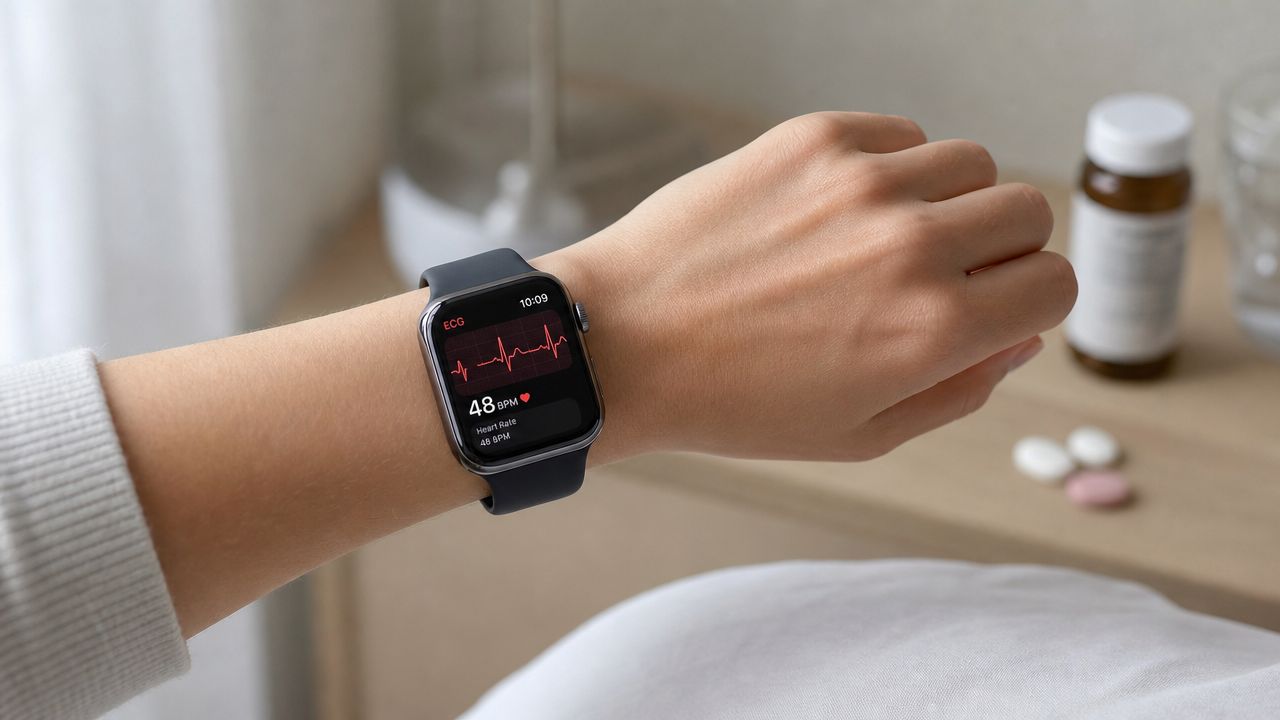
You take a beta blocker because your heart needs steadier pacing, less strain, or both. Then one day your watch shows a lower heart rate than usual. Maybe you feel washed out, a little dizzy, or mentally foggy. Maybe you tell yourself it's stress, poor sleep, or dehydration. But part of you wonders if the medicine that helps your heart could also be causing a problem.
That question is reasonable.
A lot of people use wearable ECG devices because they want answers before things get worse. They don't want to be brushed off, and they don't want to ignore something important. If that sounds like you, you're in the right place. Beta blocker toxicity can be confusing because the early signs often overlap with ordinary medication side effects, anxiety, fatigue, or even a bad day.
Beta Blocker Safety
A familiar situation goes like this. Someone takes metoprolol, propranolol, atenolol, or another beta blocker every day. They've done the responsible thing. They're following instructions, trying to protect their heart, and keeping an eye on their watch ECG. Then the pattern changes. Their pulse seems slower than usual. Standing up feels harder. The watch tracing looks different, but they're not sure what they're seeing.
That uncertainty can be unsettling, especially if you've had experiences where getting clear answers from the healthcare system felt harder than it should be.
Beta blockers are common medications, and their use is generally safe. Still, it helps to know what trouble looks like. A 2015 poison center report noted 10,577 beta-blocker exposures in the United States, with 9.6% leading to moderate-to-major health outcomes, as summarized in StatPearls on beta-blocker toxicity. That doesn't mean you should panic every time your pulse is low. It means awareness matters.
Why wearable users need a different kind of guide
Most articles stop at “watch for dizziness” or “seek help if symptoms are severe.” That advice isn't wrong, but it misses something important for people using Apple Watch, Fitbit, Kardia, Samsung, or similar tools. Your device may show rhythm or conduction changes before you feel dramatically worse.
If you're still learning how to interpret those recordings, this cardiologist's guide to the smartwatch ECG is a helpful starting point.
You're not overreacting by looking into this. You're paying attention early, and early attention is often what keeps a manageable problem from becoming an emergency.
What Beta Blocker Toxicity Actually Means
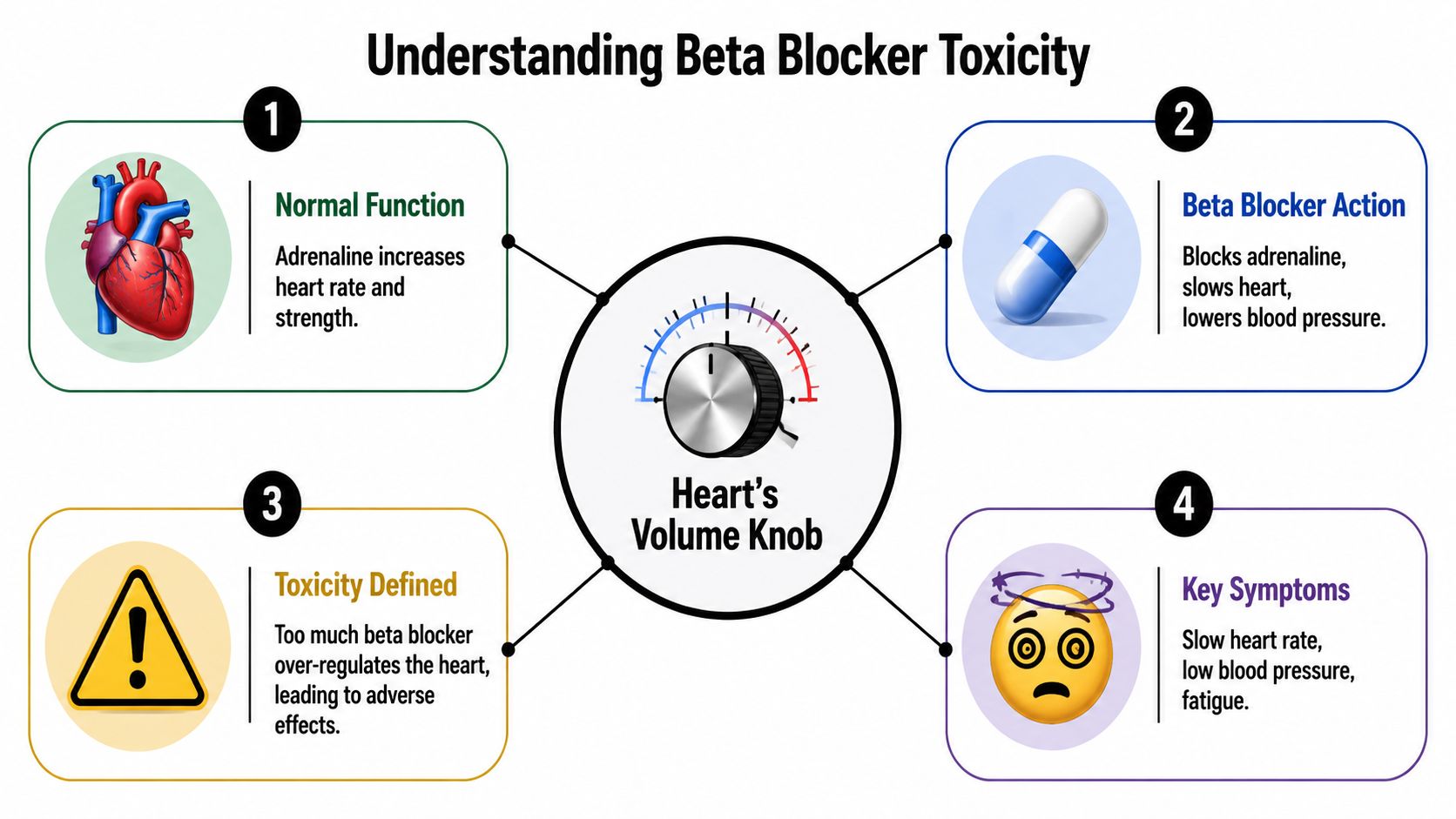
Think of your heart as a car with a gas pedal and a brake. Stress hormones like adrenaline press the gas. Beta blockers soften that signal, which helps the heart beat less forcefully and often more slowly. That's useful in many conditions because it lowers workload.
Beta blocker toxicity happens when that braking effect becomes too strong.
What changes inside the body
When the medication effect is too strong, the heart may slow down too much. It may also pump less effectively. Blood pressure can fall. When that happens, your brain, muscles, and other organs get less blood flow than they need. That's why people may feel weak, faint, cold, or confused.
This isn't about blame. Toxicity can happen from an accidental extra dose, a medication interaction, a formulation issue, or an overdose. It describes a body state, not a character flaw or a “mistake you should have known better than to make.”
Why some cases are mild and others are dangerous
There's a spectrum. On one end, a person may feel unusually tired and notice a lower pulse. On the other, they may develop severe low blood pressure, serious rhythm problems, or collapse. The classic toxic pattern is bradycardia plus hypotension, meaning a slow heart rate and low blood pressure together.
.webp)
Some beta blockers are more concerning than others. If you want a more detailed explanation of how these medications affect heart rhythm and conduction, this guide on how beta blockers affect your heart and ECG explains the basics well.
A simple way to think about it is this:
- Normal treatment effect: Your heart works more calmly.
- Too much effect: Your heart slows or weakens more than your body can safely handle.
- Higher-risk pattern: The medication also interferes with the heart's electrical wiring, not just its speed.
Practical rule: A beta blocker should calm the heart, not leave you barely able to stand, think clearly, or stay awake.
What wearable users often miss
Many people focus only on the heart rate number. That's understandable, but it's incomplete. A low number by itself doesn't always mean toxicity. Athletes, people at rest, and people on a stable dose may naturally have lower readings. What matters is the full picture. How you feel, whether the tracing changed from your baseline, and whether the ECG suggests slowed conduction all matter.
That's where watch ECGs can become more than a reassurance tool. They can help you notice when the heart's “brake” is becoming too heavy.
Understanding Real World Causes and Risk Factors
People often assume beta blocker toxicity only happens after a massive overdose. Real life is messier than that. Sometimes the trigger is simple. A person takes the morning dose and forgets, then takes it again. A family member helps with pills and grabs the wrong bottle. A new prescription gets added, and nobody catches that both drugs can slow the heart.
It's often not just the beta blocker
One of the biggest real-world risks is co-ingestion or interaction with other substances that also slow the heart, lower blood pressure, or deepen sedation. Recent clinical reviews note that severe cases often involve combinations with calcium-channel blockers, tricyclic antidepressants, clonidine, lithium, ethanol, or opioids, and that treatment can require supportive care plus targeted therapies such as high-dose insulin euglycaemia therapy, vasopressors, calcium salts, and ECMO in refractory cases, as discussed in this review of beta-blocker and calcium-channel blocker toxicity.
That matters because many people don't ask, “Did I overdose?” They ask, “Does this become dangerous with my sleep medication, pain medication, or blood pressure medication?” That's the better question.
Not all beta blockers behave the same way
Different drugs in the same class can carry different risks. In a 2023 clinical-epidemiological study, propranolol was the most common subtype, representing 84.4% of cases, according to the clinical study on beta-blocker poisonings. In plain language, propranolol shows up again and again when toxicity is discussed.
That doesn't mean everyone on propranolol is in danger. It means the class isn't uniform. Drug choice matters. Formulation matters. What else was taken matters.
Everyday situations that deserve extra caution
Here are some patterns that should make you more alert:
- Double dosing: This happens more easily than people think, especially with morning and evening schedules.
- Mixed medication effects: A beta blocker plus another heart-slowing medicine can push the body further than either would alone.
- Alcohol on top of medication: Ethanol can make low blood pressure and sedation more pronounced.
- Shared caregiving confusion: When multiple people help with medications, errors become more likely unless the system is very clear.
If medication management feels chaotic at home, practical systems can make a real difference. This guide on how to organize pills and reduce stress offers useful ideas for families trying to prevent exactly this kind of mix-up.
How Beta Blocker Toxicity Looks and Feels
Beta blocker toxicity doesn't typically manifest as a dramatic movie scene at first. It usually starts with a sense that something is off. A person gets up from the couch and suddenly feels lightheaded. A short walk feels harder than usual. Their thinking feels slow, like they're moving through mud.
The body's most common signal
The classic presentation is bradycardia plus hypotension, meaning the heart is beating too slowly while blood pressure is also too low. Toxicology guidance also notes that certain agents, especially propranolol, can add sodium-channel blockade, which may widen the QRS on ECG and increase the risk of dangerous arrhythmias, as explained in this beta-blocker ingestion toxicology guidance.
That combination explains a lot of symptoms people describe:
- Dizziness: Less blood reaches the brain, especially when you stand.
- Profound fatigue: Your body isn't getting the flow and output it expects.
- Weakness or near-fainting: The heart may not be maintaining circulation well enough.
- Cold or clammy feeling: Poor circulation can show up in the skin.
- Shortness of breath: A struggling pump can leave you feeling air hungry.
What this can feel like in real life
One person might say, “My watch said my pulse was low, but the scary part was how heavy I felt.” Another might notice they can't finish a normal routine without stopping. Someone else may feel okay sitting still but become dizzy the moment they walk to the bathroom.
That's why symptoms matter just as much as the number on the screen.
If you're trying to understand whether your watch tracing shows a slow rhythm or something more concerning, this article on what sinus bradycardia looks like on your watch ECG can help you learn the visual basics.
A low heart rate without symptoms can be a medication effect. A low heart rate with faintness, confusion, or worsening weakness is a different situation.
When it moves into emergency territory
Severe toxicity can reduce blood flow to the brain enough to cause confusion, severe disorientation, or seizures. Some people become hard to wake up. Others collapse. If propranolol is involved, the electrical risk can be greater because the problem may no longer be just “too slow.” It may be “too slow and electrically unstable.”
That's why “I'm just tired” shouldn't automatically reassure you if the tiredness is sudden, extreme, and paired with abnormal watch findings.
Using Your Watch ECG to Spot Early Warnings
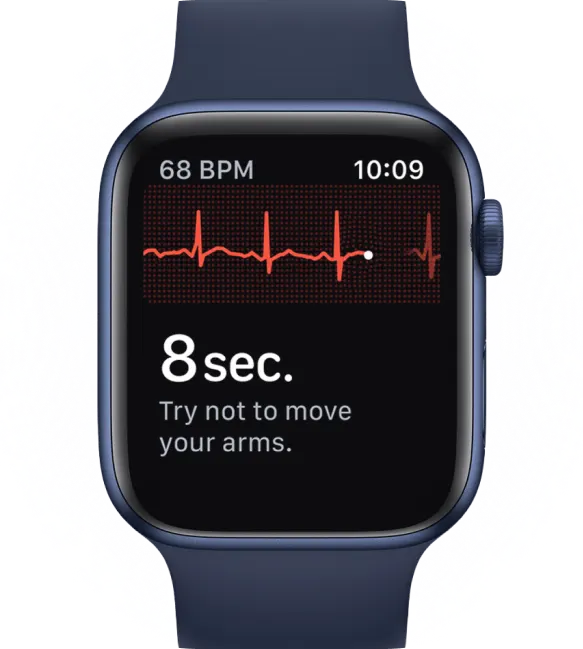
Wearable ECGs don't replace emergency care, but they can help you recognize trouble earlier. For beta blocker toxicity, that early clue may be visible before a person becomes critically ill.
Don't look at heart rate alone
A watch may show a low rate, but the waveform matters. An important early warning sign is PR prolongation or AV block, which means the electrical signal is taking too long to travel from the upper chambers to the lower chambers of the heart. Toxicology teaching also notes that propranolol may widen the QRS because of sodium-channel effects, and ECG monitoring should be repeated because toxicity can evolve over time, as summarized in this LITFL review of beta-blocker and calcium-channel blocker toxicity.
That's an important point for watch users. You might catch a change early, then miss the trend if you only record once and move on.

What to look for on your tracing
If you use a single-lead wearable ECG, focus on patterns rather than trying to diagnose yourself with precision.
Look for:
- A slower rhythm than your usual baseline: Especially if it comes with dizziness or weakness.
- A longer gap from the P wave to the QRS: That may suggest PR prolongation.
- Dropped beats or irregular conduction: Sometimes the signal from top to bottom chambers isn't getting through consistently.
- A wider-looking QRS than usual: This is especially concerning if propranolol is involved.
If the terms feel technical, this explainer on demystifying PQRST intervals on the Apple Watch ECG makes them easier to recognize.


A simple way to use your device safely
Try this approach:
- Compare with your own baseline
Don't compare yourself to a stranger online. Compare today's ECG with recordings from times when you felt normal. - Match the tracing to symptoms
A mildly slow tracing when you feel fine is different from a slow tracing during near-fainting. - Repeat if things are changing
If you feel worse over the next hour, a repeat tracing may show progression. - Escalate sooner if conduction changes appear
PR prolongation, AV block, or a widened QRS deserve urgent attention, especially if you're also symptomatic.
When outside help makes sense
Some people want a second set of eyes on a wearable ECG before talking with a clinician. Tools that review PR, QRS, and rhythm trends can help organize what you're seeing. One option is Qaly, which provides human-reviewed interpretation for wearable and at-home ECGs. That kind of service can be useful for understanding a recording, but it does not replace emergency care if you're fainting, confused, or rapidly worsening.
If your watch ECG shows a new conduction problem and your body feels worse, treat that as a medical issue, not just a data curiosity.
Emergency Steps and Medical Management
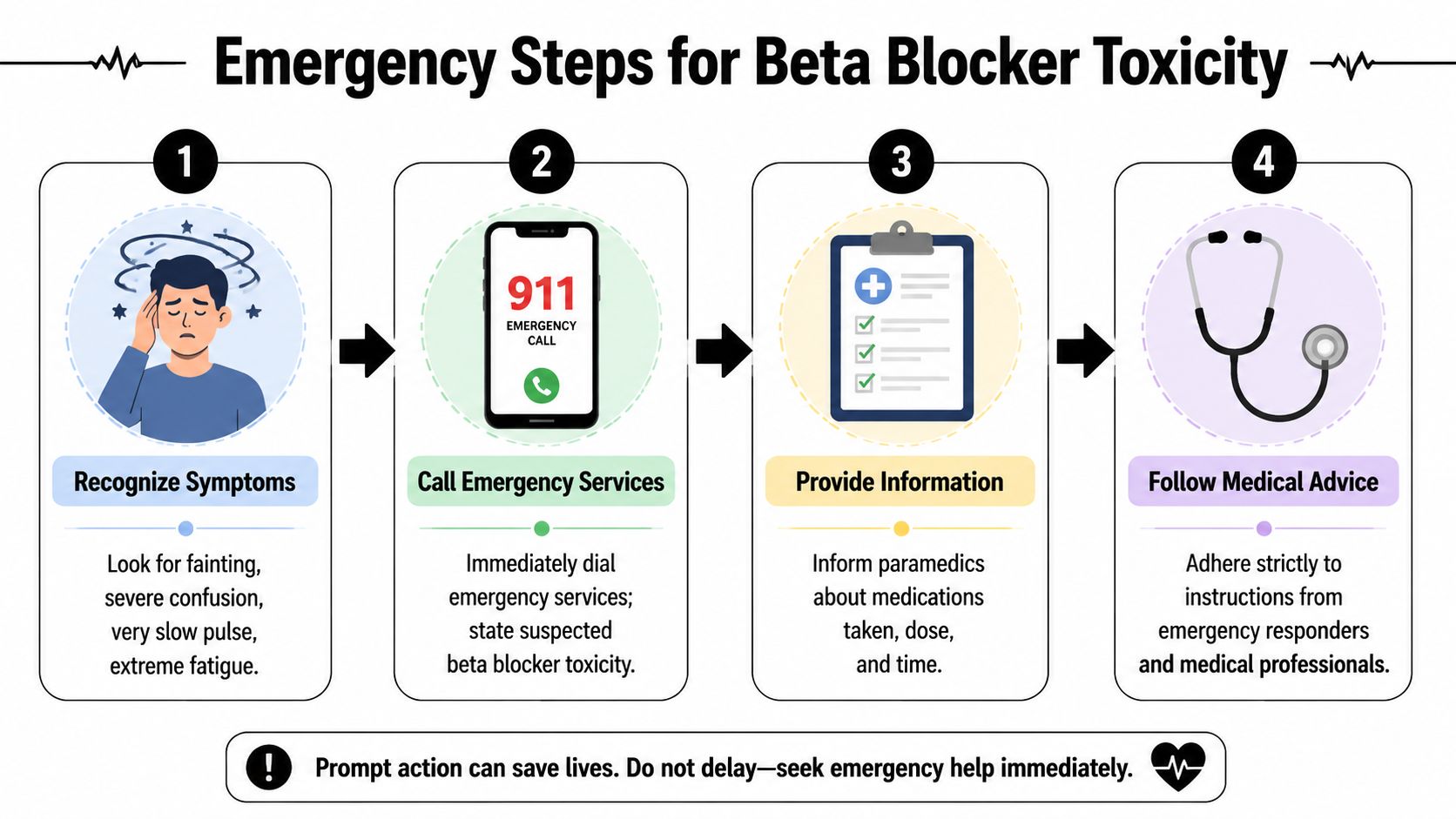
If you suspect beta blocker toxicity and the person has severe dizziness, fainting, confusion, seizure-like activity, or is hard to wake, call emergency services right away. This is not something to “sleep off” or monitor casually for the rest of the day.
What to do right now
Do the practical things first.
- Call emergency services: Say the medication name if you know it, and say beta blocker toxicity is a concern.
- Keep the person safe: If they're awake, have them lie down so they're less likely to fall.
- Gather the bottles: Bring the medication containers, dose information, and timing if possible.
- Don't give extra medicines to “balance it out”: Home improvisation can make things worse.
This short video can also help you think through the emergency response mindset:
What the hospital usually focuses on
In the hospital, the team's job is to support circulation and watch the heart closely. Depending on the case, care may include IV fluids, continuous monitoring, medications to improve heart rate or blood pressure, and targeted treatments such as glucagon, high-dose insulin euglycaemia therapy, vasopressors, calcium salts, or even ECMO in refractory poisoning.
That list sounds intimidating, but it helps to remember what it means. The team is trying to keep blood moving, support the heart, and buy time while the toxic effect wears off.
A small preparation step that helps in a big moment
Families often lose precious time trying to remember medication names, doses, and who prescribed what. If your household has multiple medicines in play, a system for managing family medical records can make emergency care smoother and less chaotic.
Bring the exact pill bottle, not just your memory of the pill. In emergencies, that detail can change decisions fast.
Your Path to Heart Health Confidence
Fear grows in uncertainty. Clarity shrinks it.
You don't need to become your own toxicologist to use this information well. You just need to recognize the patterns that matter. Beta blocker toxicity is most concerning when the heart slows too much, blood pressure drops, or the ECG begins to show conduction trouble such as PR prolongation, AV block, or a widened QRS.
What confidence looks like now
Confidence doesn't mean ignoring symptoms. It means responding wisely.
- Know your medication: Especially if you take propranolol or combine several heart-active medicines.
- Trust changes from your baseline: Your usual watch ECG is more useful than generic internet examples.
- Take symptoms seriously: Severe fatigue, faintness, confusion, or collapse need urgent attention.
- Use your wearable as an early warning tool: It can help you notice changes before a crisis.
If you've read this far, you're already doing something important. You're paying attention before the situation forces you to. That's not anxiety. That's skill.
Your watch won't make the diagnosis on its own. But paired with symptoms, medication awareness, and timely action, it can give you a head start. And with heart-related problems, a head start matters.

Need help understanding a slow rhythm or unusual ECG? Get human-reviewed analysis with Qaly.



.png)
.png)