


Key Takeaways

User Profile
Hello Heart Hero.
You finish a walk, jog, or bike ride. Your watch flashes a heart rate number that seems higher than expected. Maybe you also felt a flutter, a skipped beat, or that strange thump in your chest that makes you stop and wonder if you pushed too hard. One part of you feels proud for moving your body. Another part of you feels unsettled.
That mix of motivation and worry is common, especially if you've had palpitations, atrial fibrillation, PVCs, SVT, or plain old heart health anxiety. A lot of fitness advice assumes every heart beats in a neat, predictable pattern. Real life doesn't work that way. Many people are trying to make sense of numbers from an Apple Watch, Fitbit, Kardia, or Samsung device while also wondering whether those numbers even apply to them.
Understanding heart rate zones can help, but only if you treat them as a guide, not a verdict. These zones aren't there to shame you, push you into fear, or tell you your body is broken. They help you learn your body's effort levels in a more organized way.
Your Heart's Rhythm and Your Fitness Journey
A common scene looks like this. You check your workout summary and see a colorful graph with terms like fat burn, cardio, peak, or vigorous. You remember breathing steadily most of the time, yet the graph says you spent a surprising chunk of time at a high effort.
If you've had palpitations before, that can send your mind spinning. Was that a normal rise from exercise? Was your watch confused? Was that one racing stretch from actual exertion or from an irregular rhythm?
Those questions matter. They also don't mean you're overreacting.
Why the numbers can feel personal
Heart rate data feels different from step counts or calories. A heart number lands emotionally. It can feel like your body is sending a warning, even when you were doing something healthy.
People who feel skeptical about one-size-fits-all health advice usually have a reason. Maybe you were told your tests were "fine" while you still felt off. Maybe your symptoms were brushed aside. Maybe your wearable gave you more information than anyone had explained clearly.
Practical rule: Heart rate zones work best when they help you understand effort. They work poorly when they become a source of panic.
What you're actually trying to learn
You aren't trying to force your heart into an average person's pattern. You're trying to learn the difference between:
- Normal exercise strain that rises as your body works harder
- Device noise or misreadings that don't match how you feel
- Rhythm-related spikes that may need a different kind of attention
That shift matters. It changes heart rate zones from a scary scoreboard into a useful map.
When people start understanding heart rate zones in this more personal way, they usually feel less trapped by the data. The goal isn't perfect numbers. It's better judgment.
The Five Heart Rate Zones Explained
A simple zone chart can calm a lot of worry. It gives you a way to sort effort into levels, so a rising heart rate during activity feels more interpretable and less random.
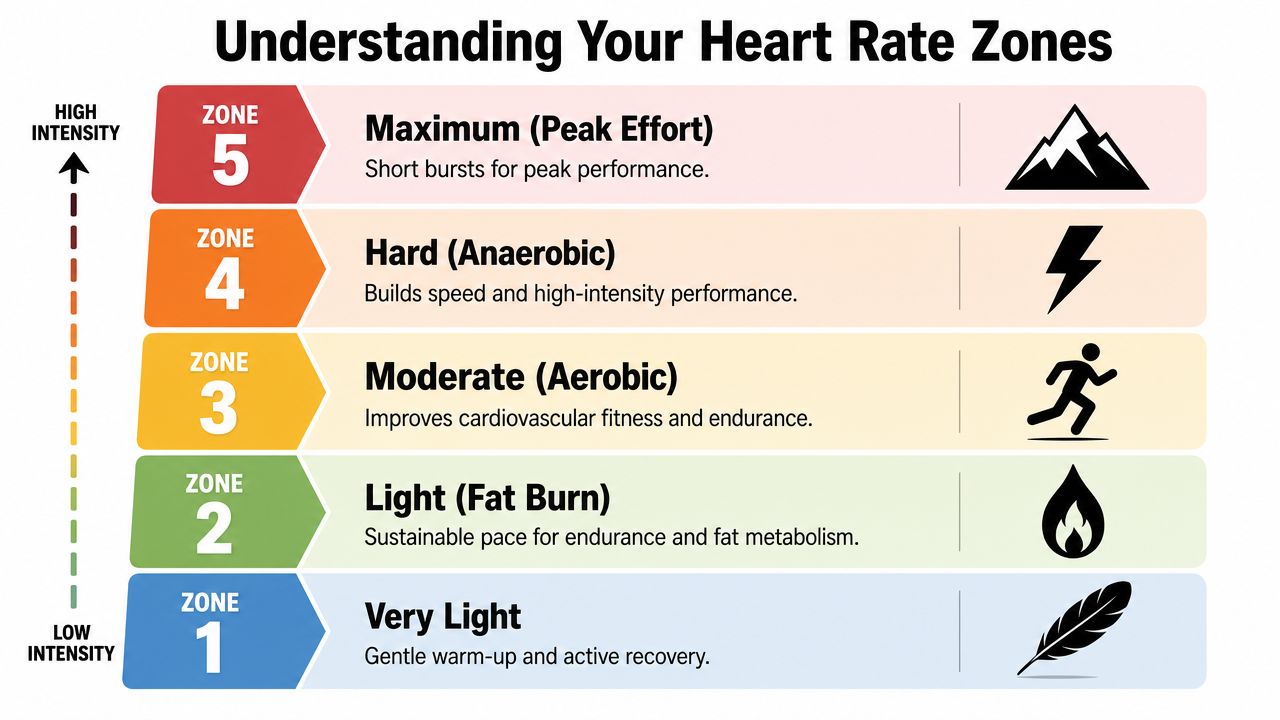
Heart rate zones are usually grouped into five bands based on how close you are to your own maximum heart rate. The exact cutoffs can vary a bit by system, but the pattern stays the same. The lower zones feel easy and sustainable. The higher zones feel harder, shorter, and more demanding.
Zone 1 and Zone 2
Zone 1 is very light effort. This is warm-up, cooldown, easy walking, and recovery territory. Your breathing stays relaxed, and talking feels easy.
Zone 2 is still comfortable, but your body is doing more work. You can usually speak in full sentences, though you may not want to sing. For people trying to improve your aerobic fitness, this zone gets a lot of attention because it builds endurance without pushing you near your limit.
These lower zones often feel safer to heart-anxious people for a reason. They give you room to notice patterns. You can observe whether your heart rate rises gradually with effort, settles down during recovery, and matches how your body feels.
Zone 3
Zone 3 is moderate effort. Breathing becomes more noticeable. Conversation gets shorter. You feel like you are exercising with purpose, not just moving around.
This zone can confuse people with palpitations because it sits in the middle. The number is high enough to get your attention, but not so high that it automatically means danger. A useful check is whether the rise feels smooth and predictable, like climbing a hill step by step, or sudden and out of proportion to what you are doing.
Zone 4 and Zone 5
Zone 4 is hard effort. Breathing is heavy, and speaking more than a few words can be difficult. Healthy athletes may use this zone for short intervals, but it is not the place where someone with frequent palpitations needs to prove anything.
Zone 5 is near-maximum effort. It is usually brief and intense. For someone with heart health anxiety, this zone can feel alarming on a watch screen, which is one reason context matters so much. A short spike during an all-out burst is different from a jump that appears while you are barely working.
If your watch shows a zone that does not fit your symptoms or effort, treat that mismatch as useful information, not a personal failure.
A simple way to remember the zones
A staircase works well here. Each step asks a little more from your heart and lungs.
- Zone 1: Very easy, recovery pace
- Zone 2: Steady, sustainable effort
- Zone 3: Moderate, clearly working
- Zone 4: Hard, limited talking
- Zone 5: Very hard, short bursts only
If you track zones often, it helps to understand how heart rate monitors work in everyday training so odd readings feel less mysterious and easier to question calmly.
Finding Your Personal Heart Rate Zones
You finish a walk, glance at your watch, and see a number that looks higher than expected. If you have palpitations or a history of odd beats, that moment can spiral fast. The goal of heart rate zones is to give that number some context, so it feels less like a threat and more like a guide.
A common starting point is the 220 minus age formula. It gives you an estimated maximum heart rate, and your zones are then calculated as percentages of that estimate.
For a 40-year-old, that rough calculation gives a maximum of 180 beats per minute. Using the simple percentage method, Zone 2 would land around 108 to 126 bpm.

That estimate is useful, but it is still only a sketch.
Why the basic formula is not enough for everyone
Age-based math works like buying shoes by length alone. It gives you a decent guess, but it does not account for width, arch, or how the shoe feels once you start walking.
Your heart works the same way. Two people of the same age can have very different resting heart rates, fitness levels, medication effects, and rhythm patterns. If you have palpitations, take a beta blocker, or notice sudden jumps on your watch, a generic formula can make your zones feel confusing instead of calming.
That mismatch matters. A zone that is set too high may push you to work harder than your body wants. A zone that is set too low can make ordinary movement look alarming on the screen.
A more personal option
The Karvonen formula adds your resting heart rate to the calculation. That makes the result more specific to your baseline, not just your age.
Here is the basic idea:
- Estimate your maximum heart rate.
- Subtract your resting heart rate.
- Multiply that number by your target intensity.
- Add your resting heart rate back in.
The math is not fancy for the sake of being fancy. It adjusts the target to reflect your starting point more closely.
One example from start to finish
Stay with the same 40-year-old whose estimated max is 180 bpm. The percentage method puts Zone 2 at 108 to 126 bpm.
Now add resting heart rate. If that person has a lower resting rate, their personalized training range may shift in a way that feels more consistent with their breathing and effort. If they have a higher resting rate, the range may shift differently. That is why two people with the same age can end up with different zone numbers and both be correct.
If your goal is to improve your aerobic fitness, that more personal approach can make your training feel steadier and easier to trust.
What to do if the numbers and your body do not match
Use the formula as a map, not a verdict.
If your watch says you are in a higher zone but you can still talk comfortably, slow down your interpretation before you slow down your body. If the number looks calm but your rhythm feels jumpy, fluttery, or irregular, your symptoms still matter. People with heart anxiety often assume the number is the final answer. It is only one clue.
A practical way to sort this out is:
- Start with the basic formula: It gives you a rough range.
- Add resting heart rate if you can: This makes the range more personal.
- Compare the number with how you feel: Breathing, effort, and rhythm all count.
- Use ECG context when available: understanding heart rate from ECG recordings can help clarify what a pulse number alone cannot show.
The main takeaway is simple. Your personal zones should fit your body closely enough to guide you, not scare you.


How to Use Zones for Training and Health Goals
It's often assumed the highest zone must deliver the best results. That's rarely the smartest way to think about training, especially if your nervous system already goes on alert every time your heart races.
For long-term health, the most useful zone is often the one that feels almost too modest.

Why Zone 2 gets so much attention
According to this physiology overview of heart rate zones, Zone 2, defined here as 60–70% of maximum heart rate, is where the body achieves maximum fat oxidation. The same source explains that training in this zone supports mitochondrial density, which is a key marker of endurance, without the heavier lactate buildup and stress that show up at higher efforts.
In plain language, Zone 2 is where your body gets better at doing work efficiently.
That efficiency matters for people who want better stamina, steadier energy, and a calmer relationship with exercise. It also matters if hard workouts tend to leave you wiped out or worried.
What Zone 2 usually feels like
Zone 2 often feels almost boring at first. That's one reason people skip it.
You may be moving at a pace where you can still talk, your breathing is controlled, and you could imagine continuing for a while. Many people mistake that for "not enough." In reality, it's often exactly enough for foundational fitness.
A workout doesn't need to feel extreme to help your heart and metabolism adapt in a meaningful way.
How the higher zones fit in
Higher zones still have a purpose. They're just not the only purpose.
- Zone 3: Useful when you want a stronger aerobic challenge and can recover well from it.
- Zone 4: Better suited for shorter, harder efforts where speed or performance matters.
- Zone 5: Best treated like a specialty tool, not your daily default.
The further up you go, the less room there is for drifting on autopilot. Effort climbs fast. Recovery becomes more important. For people prone to palpitations, that intensity can also bring more uncertainty.
A practical way to choose the right zone
Match the zone to the goal, not to your ego.
If your goal is sustainable health, consistency usually beats drama. If your goal is performance, then selective higher-intensity work may help. If you're trying to make sense of breathing changes near the edge of hard effort, this guide to understanding lactate threshold pace can give useful context for why certain paces suddenly feel much tougher.
A lot of people do best with a simple pattern:
- Most sessions in easier ranges: Comfortable, repeatable movement
- Some moderate work: Enough challenge to build fitness
- Very hard efforts used carefully: Only when they serve a clear purpose
That approach tends to support health without turning every session into a stress test.
Navigating Zones with Palpitations or Arrhythmia
Standard zone advice often proves inadequate.
Most fitness articles assume your heart rate rises smoothly when effort rises. If you live with atrial fibrillation, PVCs, SVT, or frequent palpitations, you already know that's not always how your body behaves. Your watch might show a sudden jump that doesn't match your breathing, pace, or level of strain. That doesn't mean you're imagining things, and it doesn't automatically mean you're in danger. It means you need a smarter lens.
Why wearable zone readings can feel wrong
Heart rate zones are built around rhythm regularity. Arrhythmias disrupt that regularity. A skipped beat, burst of fast rhythm, or uneven pulse can make the device interpret your effort incorrectly.
This is especially stressful when you're trying to do everything right. You choose a gentle walk, keep your breathing steady, and then your wearable tells you you're suddenly in a much harder zone. The number can trigger fear before you even have time to ask whether it makes sense.
That's why body awareness matters so much here. If your chest feels fluttery but your breathing and effort feel light, the raw number may not be telling the whole story.
When lower may be wiser
For some people with heart rhythm conditions, the usual zone framework needs to be adjusted. According to this discussion of heart rate zones and exercise, Zone 2 may need to be recalibrated to 50–60% of maximum heart rate for individuals with atrial fibrillation or other conditions, and efforts in Zones 4 and 5, above 80% of maximum heart rate, can increase the frequency of PVCs or SVT episodes in predisposed individuals.
That doesn't mean movement is off-limits. It means generic targets may not fit your situation.
If a "normal fitness" recommendation makes your symptoms worse or your anxiety spike, it's reasonable to adjust the target instead of forcing yourself to fit it.
Use more than one signal
When you're prone to palpitations, a single heart rate number shouldn't act as judge and jury. Use several signals at once:
- Your breathing: Can you still speak comfortably, or are you straining?
- Your symptom pattern: Did the reading rise with effort, or did it jump suddenly out of nowhere?
- Your recovery: Does the sensation pass quickly when you slow down, or does it linger in a way that feels unusual?
- Your device context: Apple Watch and similar wearables can be helpful, but they don't always distinguish exertion from rhythm disruption.
A calmer way to exercise with uncertainty
One of the best strategies for anxious exercisers is to create a "confidence ceiling." That means choosing an effort level where you feel safe, symptoms stay manageable, and your body gives consistent feedback. You can build from there instead of chasing someone else's target zone.
For many people, that looks like:
- Starting with walking, easy cycling, or gentle jogging
- Watching for symptom trends, not isolated blips
- Backing off when rhythm sensations and device numbers don't agree
- Getting more specific guidance if atrial fibrillation is part of the picture
If that's your situation, this guide on whether you can exercise with Afib may help you frame exercise decisions more safely.
The most important mindset shift is this. A higher reading isn't always a harder workout. Sometimes it's an arrhythmia, a sensor issue, or a brief rhythm event that needs interpretation rather than panic.
How to Monitor Your Heart with Confidence
At some point, most wearable users realize a basic truth. A heart rate number tells you how fast your heart seems to be beating. It doesn't always tell you why.
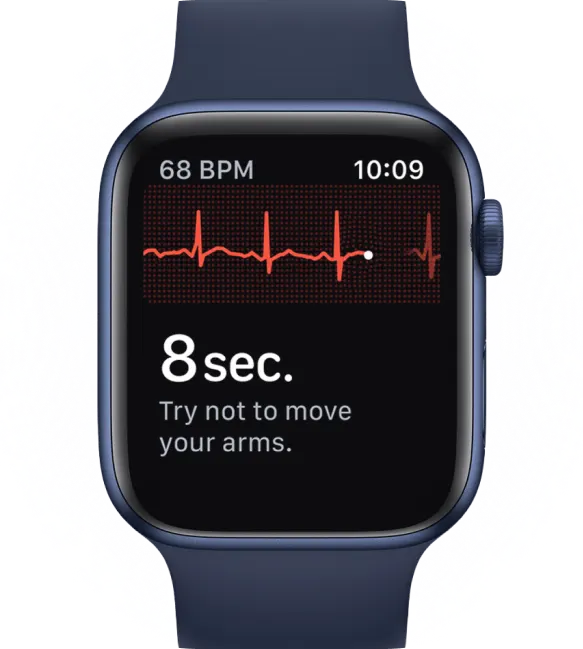
That missing why is exactly where confusion grows. If you're logging symptoms on an Apple Watch, Kardia, Fitbit, or Samsung device, the ECG tracing often carries the detail that the heart rate summary leaves out. That's especially important when you're trying to distinguish a harmless-looking spike from a rhythm pattern worth following more closely.
Resting heart rate is the baseline, not the full answer
Your resting heart rate still matters. The CDPHP Fitness Connect overview of target heart rate zones notes that the average resting heart rate for adults is between 60 and 100 beats per minute, and that baseline helps support more personalized methods like Heart Rate Reserve.
But resting heart rate alone won't explain palpitations. It's one piece of context, not the whole interpretation.

What gives people more peace of mind
Confidence usually comes from combining several layers:
- Your symptom log: What you felt and when you felt it
- Your wearable trend: Whether a reading was isolated or part of a pattern
- Your ECG waveform: The rhythm detail behind the number
- A human review: Someone trained to look at the tracing, not just the average pulse
If you're trying to build a broader picture of your heart beyond workout stats, resources focused on understanding your cardiovascular health can help you ask better questions and notice patterns that matter.
The more anxious you feel about the number alone, the more valuable it becomes to look at the rhythm behind the number.
For ongoing wearable users, heart rhythm monitoring with at-home devices can make that process feel more structured and less reactive.
Your Heart, Your Pace
Heart rate zones can be useful. They can also be misunderstood. The healthiest way to use them is as a personal guide to effort, not a rigid grading system.
If you have palpitations or arrhythmia, your situation deserves more nuance than generic fitness advice usually gives. Your watch may help, but it won't always tell the full story. Your breathing, symptoms, recovery, and rhythm context all matter.
That's why understanding heart rate zones gets more powerful when you stop asking, "What zone should I be in no matter what?" and start asking, "What does safe, meaningful effort look like for my body?"
You don't need perfect data to make good decisions. You need enough understanding to notice patterns, enough self-trust to respect your symptoms, and enough support to get clarity when the numbers feel off.
If you want help interpreting wearable ECGs and palpitations with more confidence, Qaly connects at-home and wearable ECG recordings with certified cardiographic technicians for human-reviewed rhythm analysis. That kind of added context can make exercise feel less scary and your data a lot more useful.

Unsure what your ECG means? Certified experts review it within minutes.



.png)
.png)