


Key Takeaways

User Profile
You may be reading this because your heart did something strange today. A flutter in your chest while folding laundry. A sudden racing pulse when you were sitting still. A skipped beat that made you stop and wonder, “Was that anxiety, caffeine, or something real?”
That uncertainty can feel awful. You notice a symptom, finally get seen, and then the office ECG looks normal because the episode passed. It's easy to feel dismissed, or to worry that you'll never catch what's happening at the right moment. If you're skeptical of a system that sometimes feels rushed or fragmented, that reaction makes sense.
The good news is that modern heart rhythm monitoring gives you more ways to capture useful information outside the clinic. The shift from brief in-office testing to longer at-home monitoring has become a major part of care for people with intermittent palpitations, post-event follow-up, and medication-related rhythm surveillance because short snapshots can miss problems that come and go, as noted in this clinical review of ambulatory ECG monitoring.
That doesn't mean every alert is dangerous, and it doesn't mean you have to diagnose yourself. It means you can become a better observer of your own body. When you understand what your device is measuring, how to record a cleaner tracing, and how to share that information well, you walk into appointments with something many people never get: context.
Welcome to Your Heart Health Journey
A lot of people start here with two competing thoughts. The first is, “I know something felt off.” The second is, “I'm scared I'm overreacting.”
Both thoughts can be true at the same time. Palpitations are common, and many are not dangerous. But “common” doesn't mean “imaginary,” and “probably okay” doesn't mean “ignore it forever.” Good heart rhythm monitoring helps separate noise from signal.
Why your own data matters
When a symptom is brief and unpredictable, memory alone usually isn't enough. By the time you explain it, the moment is gone. That's why recorded rhythm data can be so helpful. It gives you and your clinician something more solid than a vague description like “my chest felt weird.”
Practical rule: Your job isn't to prove a diagnosis. Your job is to capture the moment as clearly as you can.
That shift can reduce anxiety. Instead of checking your pulse over and over or spiraling after a watch notification, you can use a simple plan. Notice the symptom. Record if possible. Write down what you were doing. Save the tracing. Share it appropriately.
A better way to approach the system
If you've ever felt brushed off, heart rhythm monitoring can help you communicate in a way that doctors can act on. A clean recording taken during symptoms often carries more value than a long story told from memory. It can also help when your symptoms happen less often, when you're recovering after a heart-related event, or when a medication might affect rhythm.
That's the essential promise here. Not perfect certainty. Better evidence, less guessing, and more productive conversations.
What Is Heart Rhythm Monitoring Anyway
Your heart runs on electricity as well as muscle. With each beat, a small signal starts in the upper chambers, travels through a relay point, and then moves into the lower chambers. That timing lets the heart squeeze in sequence so blood moves forward instead of sloshing around inefficiently.
Heart rhythm monitoring records that timing. It helps answer a practical question: are your symptoms happening alongside a normal electrical pattern, or is the pattern itself off?
For a plain-language overview of how these tools are used, this cardiac monitoring explainer is a helpful starting point.
Pulse is not the same as rhythm
This is a common point of confusion.
Your pulse is the wave of blood you can feel at your wrist or neck. Your rhythm is the electrical instruction that tells the heart when to contract. They are connected, but they are not the same measurement. A device that reads pulse is noticing the aftermath of a beat. An ECG-based device captures the electrical event itself.
That difference matters in real life. If your watch says your heart rate was normal, you may still wonder why the beats felt uneven, skipped, or fluttery. In some cases, the rate stays in a normal range while the pattern is irregular. The pattern is as important as the rate.
What monitoring is actually looking for
A rhythm monitor does more than count beats per minute. It looks at several features at once:
- Timing between beats
- Regularity of the pattern
- Shape of the electrical tracing
- Match between symptoms and the recording
A simple example helps. A fast heartbeat during exercise can be expected. A similar rate while you are resting, paired with dizziness or a strange tracing, raises a different question. That is why clinicians care about context, not just a single number on a screen.
You can think of a recording as a timestamped note from your body. It gives your doctor something concrete to review instead of asking everyone to rely on memory alone.
Why longer monitoring can matter
A clinic ECG is useful, but it is only a brief snapshot. If your symptoms appear for a few minutes, then disappear, an office test can easily miss the episode. That does not mean nothing happened. It often means the recording window was too short.
For symptoms that show up less often, doctors may suggest monitoring over days or weeks rather than minutes. The goal is simple: increase the odds of catching the rhythm while you are feeling it.
That longer window can make appointments more productive. Instead of trying to persuade a clinician that something felt wrong, you may be able to show what your heart was doing at that exact time. Some people also use home equipment or review options to organize recordings before a visit, while clinical settings may rely on systems such as DME Superstore patient monitors for ongoing vital sign observation. Different tools serve different jobs, but the shared purpose is clearer communication and better follow-up care.
Your Guide to Different Monitoring Methods
A good monitor is less like a grade on your health and more like the right camera for the job. A quick photo can catch one moment. A longer recording can catch the part your doctor needs to see.
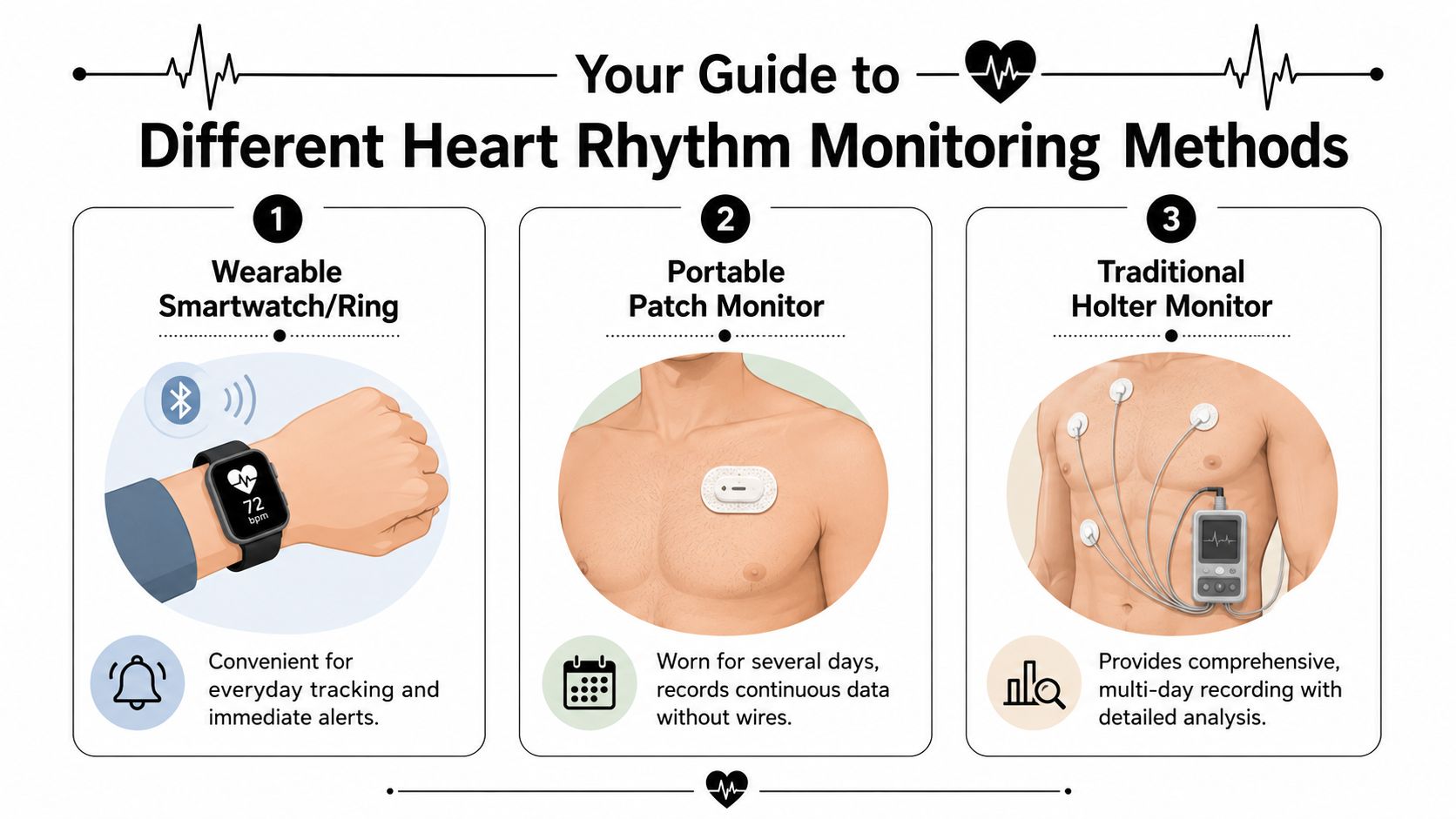
Smartwatches and fitness trackers
Apple Watch, Fitbit, Samsung Galaxy Watch, and similar wearables are often the first tool people try because they are already part of daily life. They can flag an irregular pulse, show heart rate trends, and in some models record a short ECG on demand.
That convenience matters. If you feel a flutter while standing in the kitchen or walking to your car, a device on your wrist may let you capture something before the feeling passes.
Still, smartwatch data has limits. Some devices mainly use PPG, a light-based method that tracks blood flow changes rather than the heart's electrical signal itself. ECG-enabled wearables record electrical activity directly, which gives your doctor a more useful rhythm strip when the question is, "What rhythm was happening right then?" A Cleveland Clinic heart rate monitor review explains why ECG confirmation can improve atrial fibrillation screening compared with pulse sensing alone.
Portable single-lead ECG devices
Handheld devices such as KardiaMobile sit between consumer wearables and prescribed monitors. They are designed for one job: recording a short rhythm strip when symptoms happen.
You usually place your fingers on the sensors and wait about 30 seconds. That simple step can turn a vague memory, "my heart felt odd earlier," into a time-stamped tracing you can save, label, and bring to an appointment.
For intermittent symptoms, that can be very helpful. A short, intentional recording sometimes catches an episode that a brief office ECG misses. It also gives skeptical patients something concrete to review instead of wondering if they are overreacting.
Clinical-grade monitors
This group includes Holter monitors, patch monitors, and event monitors prescribed by a clinician. These tools are often the best fit when symptoms are happening often enough to deserve a closer look, or rarely enough that a single office visit is unlikely to catch them.
A Holter monitor usually records continuously for a short set period. Patch monitors and event monitors may be worn longer, depending on the question your clinician is trying to answer. If you want a plain-language explanation of how longer recording works, this guide to continuous heart rhythm monitoring can help.
How to choose based on your situation
A simple way to choose is to match the tool to the pattern of your symptoms.
- For general awareness or occasional checks: A smartwatch or ring can help you notice trends and capture a brief ECG if your device offers that feature.
- For symptoms that come and go without warning: A dedicated single-lead ECG device can be a practical way to record a focused strip right when you feel a flutter, pause, or racing beat.
- For symptoms your doctor needs to investigate more carefully: A prescribed Holter, patch, or event monitor can collect more medically useful information over a longer span of time.
Some people also track blood pressure, pulse, or oxygen levels at home alongside their rhythm symptoms. If you are comparing broader home equipment, DME Superstore patient monitors show the kind of bedside-style devices some families look at, though they do not replace ECG-based rhythm diagnosis.
The goal is not to collect more data for its own sake. The goal is to gather the kind of recording that helps you and your clinician make clearer decisions together.
Making Sense of Your ECG Measurements
An ECG can look like a row of mysterious spikes until you learn the basic story of one heartbeat. Once you do, it becomes much less intimidating.
The story of one heartbeat
A simple heartbeat tracing has three main parts.
- P wave: This is the electrical signal moving through the top chambers of the heart, the atria.
- QRS complex: This sharp spike reflects the signal moving through the main pumping chambers, the ventricles.
- T wave: This is the reset phase, when the ventricles recover and prepare for the next beat.
If you'd like a visual walkthrough, this guide on how to read an ECG pairs well with what you're learning here.
The P wave is the cue to get ready. The QRS is the main action. The T wave is the recovery.
What the intervals mean
People often see terms like PR, QRS, and QTc and immediately worry. These are just timing measurements.
- PR interval: How long it takes the electrical signal to travel from the top chambers toward the bottom chambers.
- QRS duration: How quickly the ventricles activate.
- QTc interval: How long the ventricles take to activate and then recover, adjusted for heart rate.
Those intervals can give clues, but they aren't something you should diagnose alone from one screenshot. A value can look different because of the device, the way the tracing was taken, your body position, or temporary factors like stress and movement.
Keep in mind: A tracing is a clue, not a verdict.
Why timing and duration matter so much
If your symptoms happen only once in a while, one perfect-looking ECG taken when you feel fine doesn't settle much. Duration of monitoring often matters more than intensity of worry.
The Mayo Clinic notes that a Holter monitor typically records continuously for 1 to 2 days, while some event monitors can be worn for up to a month, which improves the chance of linking a brief symptom to an abnormal rhythm in a way a short office ECG may miss, as explained in this Mayo Clinic overview of Holter monitoring.
What you can usefully notice yourself
You do not need to become your own cardiologist. You only need to recognize a few practical patterns:
- Was the reading taken during symptoms or after they passed?
- Did the tracing look steady and clean, or shaky and noisy?
- Do repeated recordings show a similar pattern, or is this a one-off odd strip?
- Did the device give numbers for PR, QRS, or QTc that seem different from your usual pattern?
That last point can be especially useful over time. Trends can help doctors more than isolated moments.
When you know the names of the waves and intervals, the tracing stops being a scary squiggle. It becomes a record of timing, and timing is something doctors can work with.
How to Get a Clear and Trustworthy Recording
A messy tracing can create more confusion than comfort. The good news is that recording quality is one area you can influence directly.
A simple setup that helps
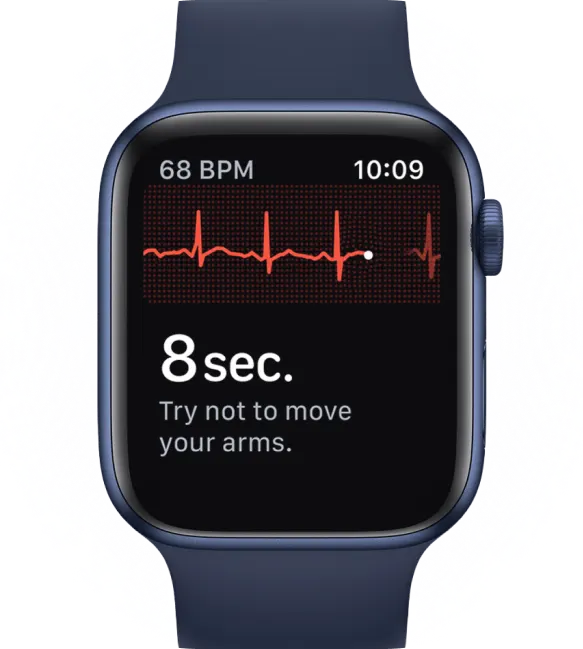
Before you take a reading, sit down. Rest your arm on a table if you're using a watch or handheld device. Relax your shoulders, uncross your legs, and breathe normally. Movement creates noise, and muscle tension can do the same.
Skin contact matters too. If your hands are very dry, very cold, or damp with sweat, the device may struggle. Clean skin and a calm posture usually give the best result.
What to avoid in the moment
Don't try to take your most important reading while jogging to the car, talking animatedly, or immediately after intense exercise unless your clinician specifically wants exercise-related symptoms captured that way. If the symptom is still present, pause first and then record.
These habits usually help:
- Be still: Tiny shifts can distort the tracing.
- Stay quiet: Tensing your chest and arm muscles can add artifact.
- Use good contact: Make sure the watch is snug or your fingers are placed correctly.
- Take more than one reading if needed: If the first strip is noisy, wait a moment and repeat calmly.
If you're using an Apple Watch, this step-by-step Apple Watch ECG guide is a practical reference.
The cleaner the recording, the less room there is for guesswork.
Don't let one bad strip scare you
An “unclassified” or noisy result doesn't automatically mean danger. Sometimes it just means the signal was poor. People often feel reassured by learning a bit more about rhythm-related metrics in broader wellness contexts too. If that interests you, Peak Performance's HRV episode offers a useful discussion on heart rate variability and how people think about recovery and nervous system state.
Good technique won't replace medical judgment, but it can make your recordings much more useful.
The Human Touch in a Digital World
You get an alert on your watch late at night. Your heart may have skipped, fluttered, or raced for a few seconds. You save the tracing, stare at the screen, and still have the same question: what does this mean for me?
That gap between having data and understanding it is often the hardest part.
Why human review still matters
A device can record electrical activity. It cannot know your full story. It does not know whether you were anxious, dehydrated, recovering from illness, starting a new medication, or feeling symptoms that matter more than the strip itself.
Heart rhythm data works a bit like a snapshot from a security camera. The image may capture something important, but a trained person still has to ask what happened before, during, and after that moment. That is why review by a skilled human remains a key part of making sense of wearable ECGs. A clinical review of wearable ECG monitoring described research from the Heart Rhythm Society showing stronger performance from monitors that depended on human oversight than from models relying mainly on AI, as discussed in this review of wearable ECG technology and outcomes.
Human review also helps with a very common problem. Noise can look scary. A poor-quality tracing can mimic an abnormal rhythm, and a machine may not always sort that out cleanly.
Using review services as a bridge
For some patients, a review service fills the space between an at-home device and a doctor visit. Qaly is one example. It reviews wearable and home ECG recordings through certified cardiographic technicians and provides measurements and written interpretation that people can save and share with their clinicians.
That can make a medical visit more productive. Instead of saying, "I felt something weird last Tuesday," you can bring a time-stamped tracing, notes about symptoms, and a report that helps your clinician decide what needs follow-up.
This matters for people who worry they will be dismissed. It also matters for people who worry they are overreacting. Clear records can lower friction on both sides of the conversation.
A well-organized report can turn a vague memory into something your care team can examine.
When to Act and Your Path Forward
Your watch buzzes during dinner. You feel a flip in your chest, then nothing. Ten minutes later, you are left with the hardest question. Do you watch and wait, call your doctor, or get help now?
A rhythm alert is a signal to sort out, not a verdict. Your heart's electrical system works a bit like home wiring. A brief flicker can be harmless, but repeated flickers, symptoms, or signs that the whole system is struggling deserve attention.
When a non-urgent call makes sense
Call your doctor's office soon if you are having repeated palpitations, a new pattern of irregular beats, or recordings that keep showing something unusual. The same applies if symptoms are starting to interfere with sleep, exercise, work, or your sense of safety.
Bring what you have. A time-stamped tracing, a short note about what you felt, and the time it happened can give your clinician something concrete to review. That often leads to a better conversation than trying to reconstruct the moment from memory.
Skepticism can cut both ways. Some people minimize symptoms because they do not want to seem alarmed. Others worry they will be told it is "just anxiety." Clear records help both situations. They give the visit a starting point.
When not to assume the alert is the diagnosis
Consumer devices can catch useful clues, but they can also misread motion, poor skin contact, or signal noise as a rhythm problem. A single alert does not prove you have a dangerous arrhythmia.
That is why confirmation matters.
A clinician may compare your symptoms, your tracing, your medications, and your health history before deciding whether the alert matches a true rhythm issue. The goal is not to dismiss what you felt. The goal is to label it correctly, because the right label guides the right next step.
When to seek urgent care
Get urgent medical help if rhythm symptoms come with chest pain, severe shortness of breath, fainting, near-fainting, new confusion, or a strong sense that you are seriously unwell. If that happens, stop trying to capture the perfect recording and focus on getting care.
One good rule is simple. If the rhythm symptom stays in your chest but you otherwise feel stable, a prompt office call may be reasonable. If the symptom starts affecting your breathing, thinking, consciousness, or ability to function, treat it as urgent.
You do not have to choose between staying calm and taking symptoms seriously. You can do both. Record what you can when it is safe, get human review if that helps clarify the picture, and bring organized information to your clinician. That is how patients use modern monitoring tools to work through uncertainty and get to clearer care faster.


Get human-reviewed ECG interpretations with Qaly and track trends in PR, QRS, and QTc.



.png)
.png)