


Key Takeaways

User Profile
You leave the appointment with a new prescription in your hand, a few rushed instructions in your head, and a lot of questions nobody really answered. Is this medicine supposed to fix the rhythm, just slow it down, or both? If your watch still shows irregular beats, does that mean it isn't working? And if your ECG intervals change, should you worry?
Those are normal questions. A new heart medication can feel like stepping into a system that expects trust before it gives clarity.
A Guide to Your New Prescription
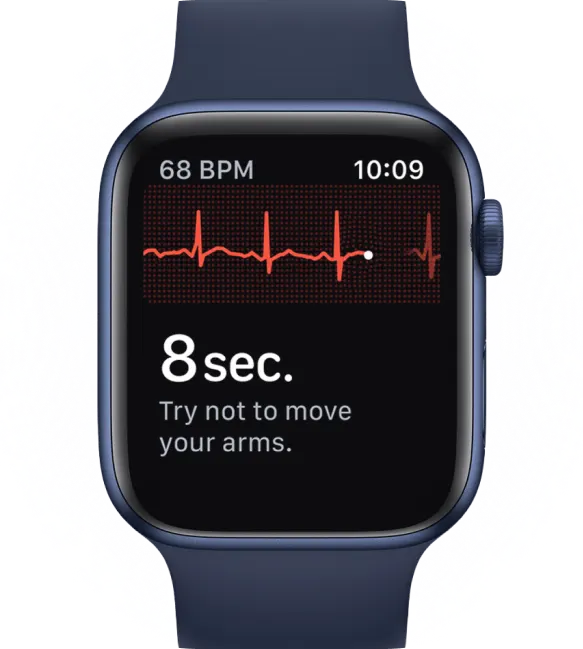
A lot of people end up here after a very specific kind of day. You felt palpitations, fluttering, or a fast pulse. Maybe your Apple Watch, Kardia, Samsung, or Fitbit ECG caught something odd. Then came the clinic visit, the serious conversation, and a prescription for a medication that sounds familiar but still feels mysterious. Metoprolol. Diltiazem. Digoxin. You're told it's for “rate control,” and then you're sent home to figure out what that means in real life.
If you feel hopeful and uneasy at the same time, that makes sense. Heart symptoms are personal. Medication decisions can feel impersonal. Many patients want more than a quick explanation. They want to understand what the medicine is doing inside the heart and what they should expect to see on their own wearable ECG.
That's a smart instinct.
If your prescription is a beta-blocker such as metoprolol, it may help to review common questions about metoprolol side effects and what they can feel like day to day. Knowing what's expected can make the first week a lot less scary.
You do not need to become your own cardiologist. But understanding the basics can make you a calmer, more confident patient.
Rate control medication isn't about chasing a perfect-looking tracing every second of the day. It's about helping your heart work more efficiently, reducing symptoms, and giving the lower chambers time to fill and pump.
Understanding the Goal of Rate Control
You may look at your wearable ECG, see an irregular pattern, and wonder how a medicine can be helping if the tracing still does not look normal. That is one of the biggest points of confusion with rate control.
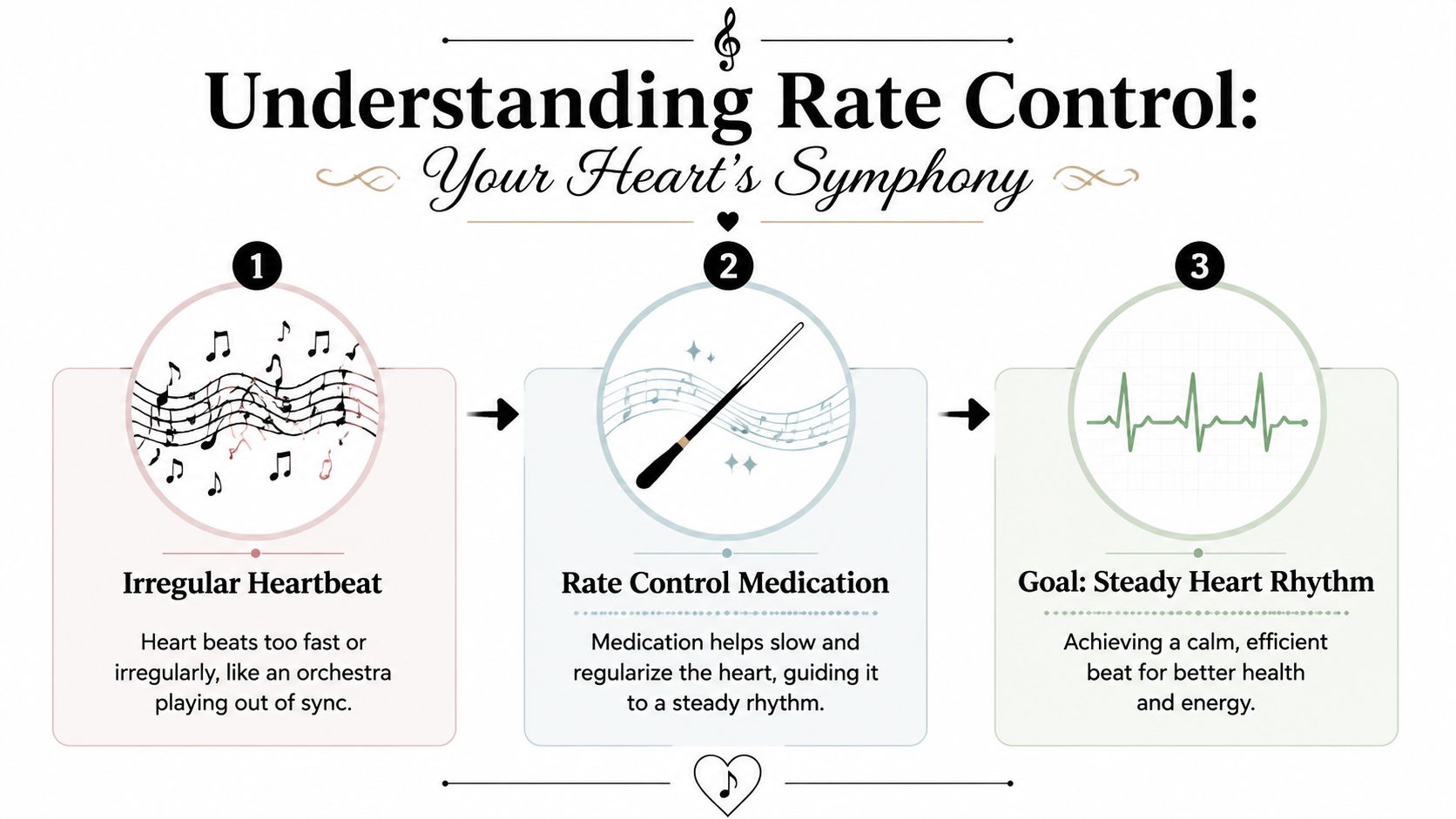
When doctors talk about rate control medication, they usually mean medicine that slows how quickly the heart's lower pumping chambers respond to a fast signal coming from the upper chambers, especially in atrial fibrillation. The rhythm may still be irregular. The goal is to keep the ventricles from being pushed into an exhausting sprint.
Atrial fibrillation works a bit like a busy hallway with too many people trying to get through one door at once. The upper chambers send out rapid, disorganized signals. Rate control medication helps the AV node act more like a traffic officer, letting fewer of those signals reach the lower chambers. Your heart often feels steadier because fewer impulses are getting through.
What your doctor is trying to accomplish
The practical goal is simple. Give the heart more time to fill, pump, and work with less strain.
That matters because a very fast ventricular rate can leave the heart beating hard but less efficiently. Many patients notice this as pounding, shortness of breath, chest discomfort, exercise intolerance, or a washed-out feeling. If the rate comes down, symptoms often improve even if the rhythm is still not perfectly regular.
This approach became common because research showed that rate control can be a reasonable main strategy for many people with atrial fibrillation, especially when avoiding the downsides of antiarrhythmic drugs matters. In the same review, studies involving 6,615 patients supported rate control as an accepted option, beta-blockers were reported to achieve rate control more often than calcium channel blockers in the AFFIRM analysis, and lenient control performed similarly to strict control in selected patients in RACE II (Circulation review of rate versus rhythm control).
That last point surprises many patients. Your doctor is often not trying to create a perfectly calm pulse every minute of the day. They are usually trying to get you into a safer, more comfortable range without slowing you too much.
If you have been comparing your wearable numbers to a single “danger zone” cutoff, it helps to read this guide on what counts as a dangerous heart rate with AFib. Context matters.
What you may notice on your wearable ECG
Your watch or handheld ECG may not show “normal sinus rhythm” after you start treatment. That does not mean the medication failed.
What you may see instead is a lower average heart rate, fewer very fast runs, and less dramatic jumping from one beat to the next. On a single-strip ECG, the spacing between beats may look less frantic. If you use Qaly, interval analysis can add another layer of understanding. Some rate control medicines can slow conduction through the AV node, which may show up as a longer PR interval. The QRS usually does not change much from rate control alone, and QTc changes depend on the specific medicine and your overall situation.
That is helpful because it turns an abstract prescription into something you can follow. You are not just waiting to see whether the medicine “works.” You can watch for patterns in heart rate and conduction, then use Qaly to help interpret what your wearable ECG is showing.
Practical rule: A rate control medication can be doing its job even when your wearable still labels the rhythm as irregular. A calmer ventricular response is often the real target.
The Three Main Types of Rate Control Medication
When people hear “rate control medication,” they often imagine one specific drug. In practice, doctors usually choose from three broad categories. Each slows the heart in a different way, and each has its own personality.
Beta-blockers
These are the “gentle brakes” medicines. They reduce the heart's response to adrenaline and other stress signals, which can help keep the pulse from surging.
Examples patients often recognize include metoprolol, atenolol, carvedilol, and propranolol.
People are often prescribed a beta-blocker if their heart rate rises with stress, activity, anxiety, or atrial fibrillation. On a wearable ECG, they may notice the heart rate trends lower over time. Some also notice the signal moving more slowly from the upper chambers to the lower chambers, which can show up as a longer PR interval.
Calcium channel blockers
These are more like “gatekeepers.” They slow electrical traffic through the AV node and can also relax blood vessels.
The names most patients see are diltiazem and verapamil. If you want a simple patient-facing review, this article on calcium channel blockers and how they work is a useful companion.
These medicines are often used when a doctor wants rate control but the beta-blocker route isn't the right fit. Some people tolerate them well and feel less pounding or racing.
Digoxin
Digoxin is older, but it still has a role. It helps slow conduction to the ventricles and can also support the strength of contraction in certain situations.
It tends to come up in a different tone during visits. Not as the casual first option for everyone, but as a medication doctors may consider when the clinical picture calls for it.
Digoxin is not “outdated.” It's more selective. That's different.
How these choices feel different to patients
Patients usually don't care about receptor names. They care about daily life. So here's the practical comparison:
- Beta-blockers often feel calming: Some people notice fewer surges, less pounding, and a steadier pulse. Others feel more tired at first.
- Calcium channel blockers can feel smoother for some people: They may reduce rapid rates without creating the same sensation of being “slowed down,” though everyone's experience is different.
- Digoxin is often less about stress-related surges: It may be used when the doctor is thinking about rate control in a narrower clinical context.
What your prescription bottle doesn't tell you
The label tells you the name and dose. It doesn't tell you the strategy.
A doctor may choose one medication because your episodes happen with exercise. Another because your blood pressure matters. Another because your heart function or rhythm pattern changes the safest option. That's why two patients with similar smartwatch notifications may walk away with completely different prescriptions.
If that has made the system feel inconsistent or arbitrary, it usually isn't. It's more personalized than it looks from the outside.
What to Expect When You Start Your Medication
The first few days on a new heart medication can be emotionally loud. You notice every skipped beat, every wave of fatigue, every moment of dizziness when you stand up. You start wondering whether the medicine is helping or making things worse.
That reaction is common.

Why doctors often start low and go slow
With many rate control medications, the first dose is not meant to be the final dose. Doctors often begin conservatively because they're trying to avoid overshooting. Too much medication can make the heart rate too slow or blood pressure too low.
So the process may feel gradual. That doesn't mean your doctor is being vague. It usually means they're being careful.
Sensations that can happen early
Some people feel a little more tired at the beginning. Others feel mildly lightheaded, especially when standing up quickly. Some feel better almost right away because the racing settles down.
A few practical habits help during this adjustment period:
- Stand up in stages: Sit first, then stand. Give your body a moment to catch up.
- Keep notes: Write down symptoms, time of day, and what your wearable showed.
- Watch trends, not one moment: A single odd reading can be noise. Repeated patterns are more useful.
- Take it exactly as prescribed: Don't double up, skip around, or stop suddenly unless your clinician tells you to.
If you feel dramatically worse after starting a medication, don't try to “tough it out” for days. Contact the prescribing clinician.


A common misunderstanding
Many patients think, “If I still feel palpitations, the medicine failed.” Not necessarily. Palpitations can continue while the heart rate becomes safer and more manageable. The medication may be reducing the intensity of the problem before it removes the feeling of it.
That's one reason wearable ECGs can be so helpful. They give you another layer of information beyond sensation alone.
Using Your Wearable ECG to See Your Progress
You start a new rate control medicine. A few days later, your heart no longer feels quite as jumpy, but you still wonder, “Is this working?” That is where a wearable ECG becomes helpful. It gives you something more concrete than a sensation in your chest.
Doctors do not judge rate control from one pulse taken in an exam room. They want to know how your heart behaves across normal life. A review of AF rate-control strategy described common treatment targets used in AFFIRM, including a resting rate around 80 bpm and a rate no higher than 110 bpm during a 6-minute walk, and it also noted that longer monitoring such as a 24-hour Holter can catch patterns a single office reading may miss (review of rate-control targets and monitoring over time).
Here is the plain-language version. Your clinician is looking for steadier control across the day, not one perfect snapshot.
What heart rate targets mean
Rate control medication works a bit like turning down the volume on an overactive speaker. The rhythm problem may still be present, but the signal reaching the ventricles is less intense, so the heartbeat becomes more manageable. On your wearable, that may show up as fewer recordings with very fast rates and a calmer trend over time.
That matters because symptoms and numbers do not always move together. You might still notice flutters while your average rate is improving. Your watch can help you and your clinician separate “I feel something” from “my rate is still running too fast.”
What you may see on your wearable ECG

If you use a wearable ECG, several changes may become visible over time:
- Heart rate trend: Your recorded rate may come down, especially during episodes that used to run fast.
- PR interval: Medicines that slow conduction through the AV node, especially beta-blockers and sometimes verapamil or diltiazem, can lengthen the PR interval. That can reflect the medication slowing the signal on purpose.
- QRS interval: Rate control drugs are usually not trying to change the QRS, but it still helps describe how the ventricles are conducting.
- QTc interval: This interval is useful to follow when medications change, because it gives more context about repolarization and overall electrical timing.
A changed number does not automatically mean danger. Sometimes it means the medicine is doing the exact job it was prescribed to do. The key is context, repeat recordings, and knowing which interval changed.
Turning raw data into something useful
Clean recordings make trends easier to trust. If you want more consistent tracings, this guide on how to take an ECG with your Apple Watch walks through a repeatable method.
If you also care about how connected health tools are built and evaluated, it helps to understand the standards behind FDA and IEC compliant medical devices, because device design and safety practices shape the reliability of the broader monitoring ecosystem.
For patients using wearable ECGs, Qaly provides human-reviewed ECG interpretation and reports PR, QRS, and QTc intervals from compatible recordings. That gives you a practical way to connect your prescription to the numbers you can see on your own device. Instead of staring at a waveform and guessing, you can watch whether your rate is settling and whether intervals such as PR, QRS, or QTc are changing in a way that is worth discussing with your clinician.
A trend is more useful than one isolated ECG. Try to compare recordings taken under similar conditions, such as seated, rested, and around the same time of day.
What to Do When Rate Control Is Not Enough
You start the medication. Your watch shows the heart rate is lower. But you still feel washed out walking up stairs, short of breath during simple activity, or aware of a hard, uneven heartbeat.
That disconnect matters.
Rate control treats one part of the problem. It tries to keep the ventricles from racing, like turning down the speed on a motor that has been running too fast. But a slower rate does not always mean the rhythm is organized, well tolerated, or giving you the symptom relief you need.
When the plan needs to be revisited
Doctors often begin with a practical goal. If the resting rate comes down and symptoms improve, that may be enough. If symptoms continue, the target may need to be stricter, or the whole strategy may need another look. As noted in a review of evolving atrial fibrillation care, some patients do well with rate control alone, while others, including people with ongoing symptoms, heart failure, larger atria, or certain higher-risk features, may need a rhythm-control discussion instead (review on evolving AF strategy and early rhythm control).
This can feel confusing, because the medicine may be working exactly as prescribed and still not be the full answer.
A wearable ECG can help you describe that situation more clearly. Maybe your pulse is slower, but you keep seeing irregular tracings during symptoms. Maybe Qaly shows that the rate has settled, while the episodes themselves still keep happening. That gives your clinician a more complete picture than heart rate alone.
Signs that deserve a conversation
You do not need to figure out whether you need rate control, rhythm control, or another adjustment. Your job is to notice patterns and report them clearly.
Bring it back to your clinician if any of these keep happening:
- You feel better on paper than in real life: Your watch shows a calmer rate, but you still feel palpitations, breathlessness, fatigue, or poor exercise tolerance.
- Fast episodes still break through: Your wearable continues to capture bursts of rapid rhythm despite treatment.
- Symptoms repeat with activity: Daily tasks still trigger marked limitation, even though the resting numbers look improved.
- Your ECG trends raise new questions: For example, Qaly interval analysis may help show whether PR, QRS, or QTc values are changing after a medication change, which can add useful context to the conversation.
- You are still highly symptomatic: In some people, especially those who continue to feel unwell, a rate-only approach may not be enough.
The goal is not just a prettier number on the screen. The goal is a heart rhythm you can live with safely and comfortably.
Your Heart Health Partnership Plan
The strongest position you can be in is not blind trust and not total self-management. It's partnership.
Your doctor brings training and context. Your wearable brings real-world rhythm snapshots. Your own symptom notes bring the lived experience nobody else can supply. When those pieces come together, medication decisions usually get better.
When to contact your doctor
Use a simple checklist. Reach out promptly if you notice:
- Severe dizziness or fainting: Especially if it begins after starting or increasing medication
- A very slow or very fast pattern that keeps repeating: Particularly if it comes with weakness, chest discomfort, or shortness of breath
- Worsening exercise tolerance: If everyday activity suddenly feels much harder
- New swelling, breathlessness, or marked fatigue: These deserve attention
- Wearable ECG changes that concern you repeatedly: One odd tracing may not mean much. A pattern matters
What to bring to the appointment
Don't show up saying only, “I felt weird.”
Bring:
- Symptom notes: What you felt, when it happened, and what you were doing
- Wearable ECG captures: The clearest tracings, not every single one
- Interval trends if you have them: PR, QRS, and QTc can help frame medication effects
- Your medication list: Include dose changes and when you started them
That turns the visit into a real discussion instead of a guessing game. You're not challenging the system by being informed. You're making the system work better for you.

Want help understanding ECG changes after starting a rate control medication? Upload your ECGs to Qaly for human-reviewed PR, QRS, and QTc analysis.



.png)
.png)