


Key Takeaways

User Profile
Hello Heart Hero.
You might be here because a doctor asked, “Any family history of heart disease?” and your mind suddenly started racing. Maybe your dad had a heart attack young. Maybe your mother has an irregular heartbeat. Maybe you use an Apple Watch or Kardia device because of palpitations, and now you're wondering whether your symptoms are random or part of a bigger family pattern.
That uncertainty can feel heavy. It's even harder if you've had moments where the healthcare system felt rushed, vague, or dismissive. A quick appointment doesn't always leave room for the questions you care about, like what your family history really means, what it doesn't mean, and what you can do about it today.
The good news is that family history of heart disease is information, not a verdict. It can help you spot risk earlier, ask better questions, and use the right kind of monitoring if symptoms like palpitations keep showing up outside the clinic.
Your Guide to Understanding Family Heart Health
A lot of people carry around a blurry family story.
A grandfather “had heart trouble.” An aunt “passed out sometimes.” A sibling “gets flutters too.” None of that feels precise, and when details are fuzzy, it's easy to swing between two extremes. Either you ignore it, or you assume the worst.
A middle path is often necessary. That starts with turning family stories into useful medical clues.
Take a common situation. You're in your thirties or forties, generally functioning well, maybe trying to eat better and exercise, but every so often you feel a skipped beat or a sudden racing heart. You mention it to someone in your family and hear, “That runs in our family,” but nobody can tell you whether they mean cholesterol, a heart attack, fainting spells, or an actual rhythm problem.
That distinction matters.
Practical rule: Family history is most helpful when you know who had the problem, what the problem was, and how old they were when it happened.
Another source of confusion is the phrase “heart disease” itself. Many articles use it as if it means only blocked arteries. But patients with palpitations often need a wider lens. A family pattern of fainting, sudden collapse, or unexplained rhythm symptoms can point to inherited electrical problems, not just artery disease.
That's why a calm, step-by-step approach works better than generic reassurance. You don't need to panic, and you don't need to guess. You need a clear picture of your family's heart story, an understanding of your actual risk, and a plan that fits the symptoms you feel in real life.
What Family History of Heart Disease Really Means
When clinicians ask about family history, they usually mean your first-degree relatives. Think of a simple family tree with you in the center. The closest branches are your parents, siblings, and children. Those are the relatives that tend to matter most in routine risk assessment.
A distant cousin's diagnosis may still be interesting, but it usually doesn't carry the same weight as a parent or sibling with an early heart problem.
Why age matters so much
The second part is timing. Premature heart disease means the condition showed up earlier than expected, which raises more concern about inherited risk. A practical cutoff many clinicians use is before age 60.
That means if a parent or sibling had a heart attack, stroke, or was diagnosed with heart disease before age 60, this indicates a family history of premature heart disease, which raises your chances of developing the same condition higher than normal according to the Heart Foundation guidance on family history and heart disease.

If your father developed heart disease at 82, that still matters. But if your brother had a heart attack at 48 or your mother was diagnosed with heart disease in her fifties, most clinicians pay much closer attention.
What to write down before an appointment
Many people show up to a visit saying, “There's some heart disease in my family,” and that's where the conversation stalls. A more useful version looks like this:
- Who was affected: Father, mother, sister, brother, son, or daughter
- What happened: Heart attack, stroke, heart failure, atrial fibrillation, sudden death, fainting episodes, pacemaker, or “unknown rhythm problem”
- Age at diagnosis or event: Especially whether it happened before 60
- Anything unusual: Collapsing during exercise, sudden unexplained death, repeated fainting, or lifelong palpitations
The more specific your family history is, the more precise your care can be.
This doesn't require perfect records. Even partial details help. “My mother had recurrent fainting and later needed rhythm treatment” is far more useful than “heart issues run in the family.”
How Much Does Family History Increase Your Risk
A family history can feel abstract until you see what it means in practical terms. This isn't about scaring you. It's about replacing vague worry with a more honest picture.
A large cohort study found that a parental history of cardiovascular disease confers a 1.7-fold increased hazard of future cardiovascular events in offspring, with 6.8 major cardiovascular events per 1,000 person-years compared with 1.8 per 1,000 person-years in people without that parental history. The same study reported a hazard ratio of 1.71 (95% CI, 1.33–2.21), and the risk persisted even after accounting for standard modifiable risk factors in the Journal of the American Heart Association study on parental cardiovascular disease history.

That tells us something important. Family history isn't just a side note. It remains meaningful even when blood pressure or cholesterol don't look alarming today.
Premature events matter more
The risk gets stronger when the family history is premature. A review in the European guidelines review on family history in cardiovascular disease reports that having a first-degree relative with heart disease increases overall risk by 30%, but if that relative had premature cardiovascular disease, the risk increase rises to between 60% and 75%.
In plain language, an early event in a close relative is a louder signal than a later event in old age.
Another long-term review found that having a premature family history of coronary heart disease is associated with about a 50% higher lifetime risk for both coronary heart disease and cardiovascular disease mortality, with cardiovascular disease mortality of 21% versus 14.1% and coronary heart disease mortality of 13.7% versus 8.9% in those with versus without such a history. That same review notes a 5% absolute increase in lifetime mortality risk and states that about 30% of all cardiovascular disease cases are linked directly to genetic inheritance or family history in the review on family history and lifetime cardiovascular risk.
What these numbers mean for real life
You can think of lifestyle and family history as two different forces. Lifestyle matters a lot. But family history can shift your starting point before you've made a single choice.
That's why a risk calculator can be helpful, especially if you want to organize your questions before a visit. Qaly has a useful explainer on risk score for cardiovascular disease that can help you understand how family history fits into the bigger picture.
A normal checkup today doesn't erase inherited risk. It just means you have a chance to act earlier.
Inherited Conditions Beyond Blocked Arteries
When many people hear “family history of heart disease,” they picture clogged arteries, cholesterol, and heart attacks. That's only part of the story.
For people with palpitations, skipped beats, dizziness, or episodes of racing heart, the bigger question may involve the heart's electrical system, not just blood vessels. Regarding this, many articles leave patients stranded. They talk about prevention in broad lifestyle terms but don't help readers connect family history to inherited rhythm disorders.
The blind spot around arrhythmias
Cardiovascular disease has approximately 50% heritability, and guidance on inherited heart risk should include more than coronary artery disease, according to the Journal of Cardiology review on genetics and inherited cardiovascular disease00237-9/fulltext). That review also points to red flags such as sudden death in seemingly healthy relatives, fainting, and palpitations, which can signal hereditary rhythm disorders.
That matters if your symptoms sound like this:
- Fluttering or racing: Short bursts that come and go, often before you can get to a clinic
- Unexplained fainting: Especially during exercise, strong emotion, or with no clear trigger
- A “family tendency” to passing out: Sometimes described casually for years without a diagnosis
- Sudden death in a younger relative: Even if the family was told it was “just one of those things”
These patterns can fit inherited arrhythmias or structural heart conditions that deserve a closer look.
Palpitations in families deserve specific questions
If your wearable has captured irregular rhythms, don't stop at “Does heart disease run in my family?” Ask narrower questions.
Try these:
- Did anyone have atrial fibrillation, SVT, WPW, Long QT syndrome, or an unexplained rhythm issue?
- Did anyone faint repeatedly, especially when young?
- Did anyone die suddenly without a clear explanation?
- Did anyone need an ablation, pacemaker, ICD, or emergency evaluation for a racing heartbeat?
Those details can change the conversation.
This broader genetic view also helps people understand other conditions with a family component. If you're interested in how inherited risk gets discussed in another area of health, this article on is bipolar a genetic condition offers a useful example of how family patterns and personal risk can overlap without making destiny feel fixed.
For readers worried about inherited rhythm issues specifically, it also helps to understand conditions where interval tracking matters. Qaly's guide to understanding Long QT syndrome is a solid starting point for learning why fainting, palpitations, and family history sometimes belong in the same sentence.
If a family story includes fainting, palpitations, or sudden unexplained death, don't file it under “just bad luck.”


Recommended Screening and Smart Monitoring
If you have a family history, symptoms alone aren't a reliable filter. Some people have obvious warning signs. Others feel almost nothing until a problem is found by chance. And many people with palpitations notice that the episode is gone by the time they get medical attention.
That's why screening and monitoring serve different purposes.
What clinic-based testing does well
An in-office evaluation can establish a baseline. Depending on your history, that may include blood pressure checks, cholesterol testing, and a standard ECG. These are important because they identify common, treatable problems and can reveal clues that deserve follow-up.
For some people, a doctor may also discuss imaging or more advanced testing based on symptoms, risk profile, and the details of the family story. If you've heard terms like calcium scoring or coronary imaging and want plain-language context, Qaly has a straightforward overview of a cardiac CT scan.
What wearables add that the office often can't
The limitation of office testing is timing. A standard ECG records only a brief moment. If your palpitations happen at night, after caffeine, during stress, or once every two weeks, a clinic snapshot may look perfectly normal.
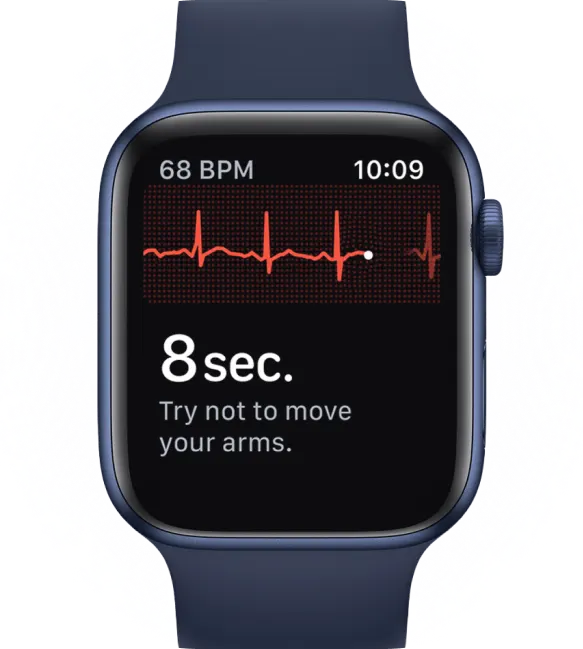
That's where wearable devices become useful. Apple Watch, Fitbit, Kardia, Withings, and similar tools let you record your heart rhythm during the actual symptom. That changes the conversation from “I sometimes feel weird” to “This is what my rhythm looked like when I felt the flutter.”
Wearables are especially helpful when symptoms are:
- Short-lived: Gone within minutes
- Inconsistent: Fine for days, then suddenly present
- Trigger-linked: During exercise, after alcohol, while lying down, or during stress
- Hard to describe: Skips, pounding, pauses, fluttering, or a rapid regular rhythm
Clinic tests are snapshots. Wearables can capture the movie.
Neither approach replaces the other. A smartwatch isn't a cardiologist, and a single office ECG can miss intermittent events. Used together, they can give a much clearer picture than either one alone.
Creating Your Proactive Heart Health Plan
A good plan lowers anxiety because it replaces guessing with action. You don't need to do everything at once. You do need a system.
Start with your family story
Make one simple note on your phone or in a notebook. Include names, diagnoses, ages, and anything unusual about the event.
A useful list might include:
- The relative: Mother, father, brother, sister, or child
- The issue: Heart attack, stroke, atrial fibrillation, fainting, sudden death, ablation, pacemaker, or unknown rhythm problem
- The age: Especially whether it happened before 60
- The setting: At rest, during exercise, during sleep, or completely unexplained
This turns “bad family history” into something your clinician can use.
Bring that history into a real conversation
When you meet with a clinician, be direct. Don't minimize symptoms because they come and go. Don't assume a normal visit in the past means the story is closed.
If your relatives have mostly had artery disease, it may help to read more about optimizing coronary artery disease care, especially if you want a better sense of how prevention and treatment decisions are made over time.
Build a monitoring routine that fits your symptoms
If you already use a wearable ECG device, create a habit around it. Save recordings when symptoms happen. Note what you were doing, how long it lasted, and whether you felt dizzy, short of breath, or faint.
This kind of pattern tracking can be more helpful than memory alone.

Lifestyle still belongs in the plan, but it shouldn't be your only pillar. Food, exercise, sleep, and blood pressure control matter. So does appropriate follow-up. If you want practical habits that support heart health without pretending they erase inherited risk, Qaly's article on lifestyle changes for heart disease is a sensible resource.
The strongest plans usually have three parts:
- Good background information: A specific family history
- Thoughtful medical care: Screening that fits your risk
- Ongoing rhythm awareness: Especially if you get palpitations that don't show up on office testing
Living Confidently with Your Family History
A family history of heart disease can feel like a shadow hanging over you. It doesn't have to stay that way.
The healthiest way to think about it is as an early signal. It tells you where to pay attention. It gives you a reason to ask sharper questions, notice patterns, and take symptoms like palpitations seriously without spiraling into fear.

You are not powerless if your family has a history of heart attacks, strokes, fainting, or irregular rhythms. You're in a stronger position once you know what to look for. Knowledge lets you prepare. Preparation lets you act earlier.
That's the goal. Not perfect certainty. Not false reassurance. Just a smarter way to care for your heart.
Your genes influence your path. They don't get the final say.
If you use a wearable ECG and want help turning those recordings into something more useful than a pile of screenshots, Qaly can be a practical next step. It connects at-home ECG recordings from devices like Apple Watch, Fitbit, Kardia, Samsung, and Withings with certified cardiographic technicians for human-reviewed analysis, interval tracking, and reports you can share with your clinician. You can learn more on the Qaly website.

Unsure what your ECG means? Certified experts review it within minutes.



.png)
.png)