




Key Takeaways

User Profile
Hello, Heart Hero. If you're reading this, you're taking an active role in your heart health, maybe after noticing palpitations or other signs on your wearable device. It’s completely normal to feel both curious and a little anxious when exploring what to do next.
We know the healthcare world can feel intimidating, especially if you're feeling skeptical about the system. That's why we’ve put this guide together, to give you clear, trusted information you can use.
Your Guide to Cardiac CT Scans
Think of this article as a friendly conversation about the cardiac CT scan, a powerful tool your doctor might recommend. We're going to demystify this advanced imaging test in simple, clear terms, explaining why it's a key method for getting a precise look at your heart's arteries.
Why This Scan Matters
The main reason for a cardiac CT scan is to look for signs of coronary artery disease. This is a condition where plaque, a waxy substance made of fat and cholesterol, builds up inside the arteries that supply blood to your heart. Over time, this buildup can narrow or even block those arteries, leading to serious problems.
A cardiac CT scan gives your doctor a direct view of these arteries. It’s like being able to inspect the plumbing of your house for clogs without having to tear down any walls. This non-invasive look provides critical information that helps guide important decisions about your health.
Think of this as your first step toward clarity and peace of mind. By understanding what a cardiac CT scan is and what it can reveal, you can have more confident conversations with your doctor and feel more in control of your health journey.
What You Will Learn in This Guide
We've structured this guide to walk you through everything you need to know, from the basics to the nitty-gritty details. Our goal is to replace uncertainty with understanding.
Here's a quick look at what we'll cover:
- The Different Types of Scans: We’ll explain the two main types, the Calcium Score and the CCTA, and why your doctor might choose one over the other.
- When to Talk to Your Doctor: Learn how to use data from your wearable device to have a productive conversation about whether a scan is right for you.
- What to Expect During the Scan: A step-by-step walkthrough of the procedure to help ease any anxiety about the test itself.
- Understanding Your Results: We’ll help you make sense of the numbers and terms in your report, so you know what they mean for your health.
What Exactly Is a Cardiac CT Scan?
Let's start with a simple analogy. Imagine your heart's arteries are a complex network of winding roads. A regular X-ray might give you a flat, basic map of the area, but a cardiac CT scan is like getting a detailed, 3D satellite view of that entire road system. We get it, exploring new medical tests can feel overwhelming, especially when you're navigating a healthcare system that can often feel confusing and impersonal.
A cardiac CT scan is designed to bring clarity. It uses specialized X-ray equipment to take hundreds of pictures of your heart from many different angles. A powerful computer then assembles these images into cross-sectional "slices," much like looking at individual slices of a loaf of bread to see the texture inside.
This process allows doctors to see your coronary arteries, heart muscle, and surrounding structures with incredible detail. It's a non-invasive way to look inside your body without any surgery, giving you and your doctor critical information to make informed decisions.
A Deeper Look Inside Your Heart
The main goal of a cardiac CT scan is often to find blockages or narrowing in your arteries. These problems are typically caused by a buildup of a waxy substance called plaque, a condition known as atherosclerosis. Think of it as plumbing inspectors using a high-tech camera to find clogs in your pipes before they cause a major flood.
By identifying plaque, a cardiac CT scan can help determine your risk for future heart events. This is a huge step beyond just tracking symptoms; it's about proactively understanding the physical state of your heart's arteries. While other tests look at how your heart functions, this scan looks at the actual structure. For a comparison with another powerful imaging technique, you can learn more about how a cardiac MRI provides different but complementary views of the heart.
This technology is a key element in modern cardiology. The global market for cardiac computed tomography (CT) is expected to experience significant growth by 2032. This increase is driven by the rising number of cardiovascular diseases, which result in approximately 20.5 million deaths each year, highlighting the importance of effective diagnostic tools.
How the Technology Creates a 3D Picture
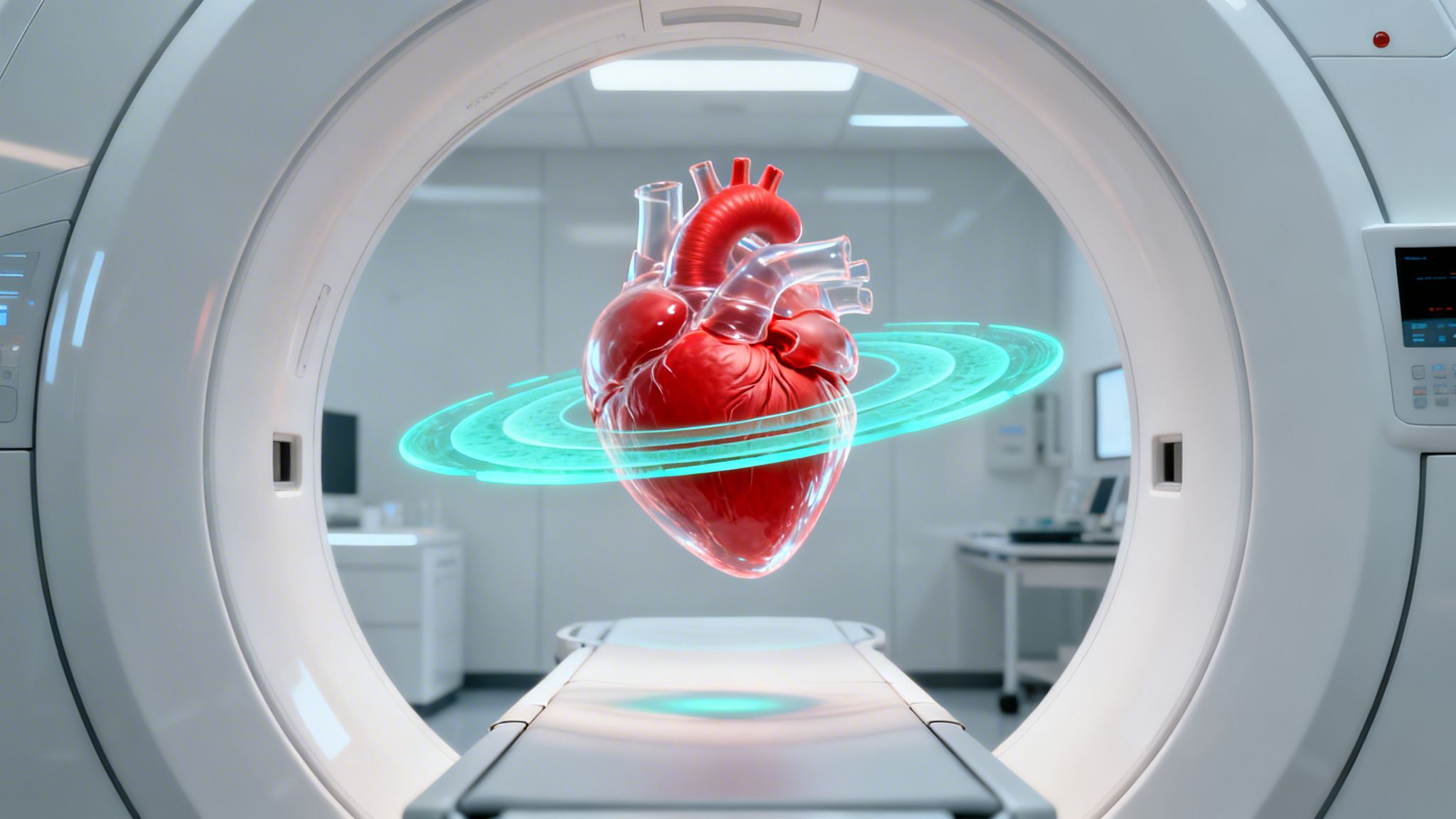
The "CT" in cardiac CT scan stands for computed tomography. The machine itself is a large, donut-shaped device that you lie inside. As you pass through the center, an X-ray source rotates around you, capturing those hundreds of images or "slices."
The power and detail of the scan depend on the number of slices the scanner can capture in a single rotation. Modern scanners can capture anywhere from 64 to over 640 slices at once. More slices mean a faster scan and a clearer, more detailed final image.
For cardiac imaging, a higher slice count is particularly important because the heart is always moving. A faster scan effectively freezes the motion, providing a sharp, blur-free picture of the coronary arteries.
This detailed 3D model allows your doctor to virtually fly through your arteries, checking for any signs of disease. It’s this ability to see the specific location and extent of plaque buildup that makes the cardiac CT scan such a valuable tool. It moves you from worrying about the unknown to seeing exactly what's going on.
The Different Types of Cardiac CT Scans
Cardiac CT scans aren't a one-size-fits-all tool. Think of it this way: if your car starts making a strange noise, you wouldn't immediately tear down the entire engine. You’d probably start with a quick diagnostic check to pinpoint the problem. Doctors approach heart imaging similarly, choosing specific types of cardiac CT scans based on what they need to learn about your heart.
Knowing the different types can make the whole process feel less mysterious and a lot less stressful. The two most common scans you'll likely hear about are the Coronary Artery Calcium (CAC) Score and the Coronary CT Angiography (CCTA). Each one gives your doctor a unique view of your heart health, and they serve very different purposes.
The Detective’s First Look: Coronary Artery Calcium Score
Imagine a detective showing up at a scene and doing a quick sweep for the most obvious clues. That’s a great way to think about the Coronary Artery Calcium (CAC) score, often just called a calcium score test. It's a fast, simple type of cardiac CT that hunts for one specific thing: hardened plaque in your coronary arteries.
Plaque is that sticky gunk made of fat, cholesterol, and other stuff that can build up in your arteries. Over time, this plaque can calcify, basically, it hardens up like bone. A CAC scan uses a CT machine to spot these tiny, hard deposits of calcium. The test is super quick, usually just a few minutes, and you don't need any special prep or injections.
The result you get is a number, your "calcium score."
A score of zero is what you want to see. It means no calcified plaque was found, which points to a very low risk of a heart attack in the near future. A score from 1 to 400 shows that plaque is present. The higher the number, the more buildup there is, and the greater your risk. A score above 400 signals a significant amount of calcified plaque and a high risk of future heart problems.
This score is a powerful tool because it directly measures the physical evidence of artery-clogging disease. It helps doctors go beyond just looking at risk factors (like cholesterol levels or family history) and see if the disease process has actually started. It's a straightforward first step in assessing your true risk.
The diagram below shows how the CT machine takes basic X-ray data and builds it up into a detailed 3D model of the heart.
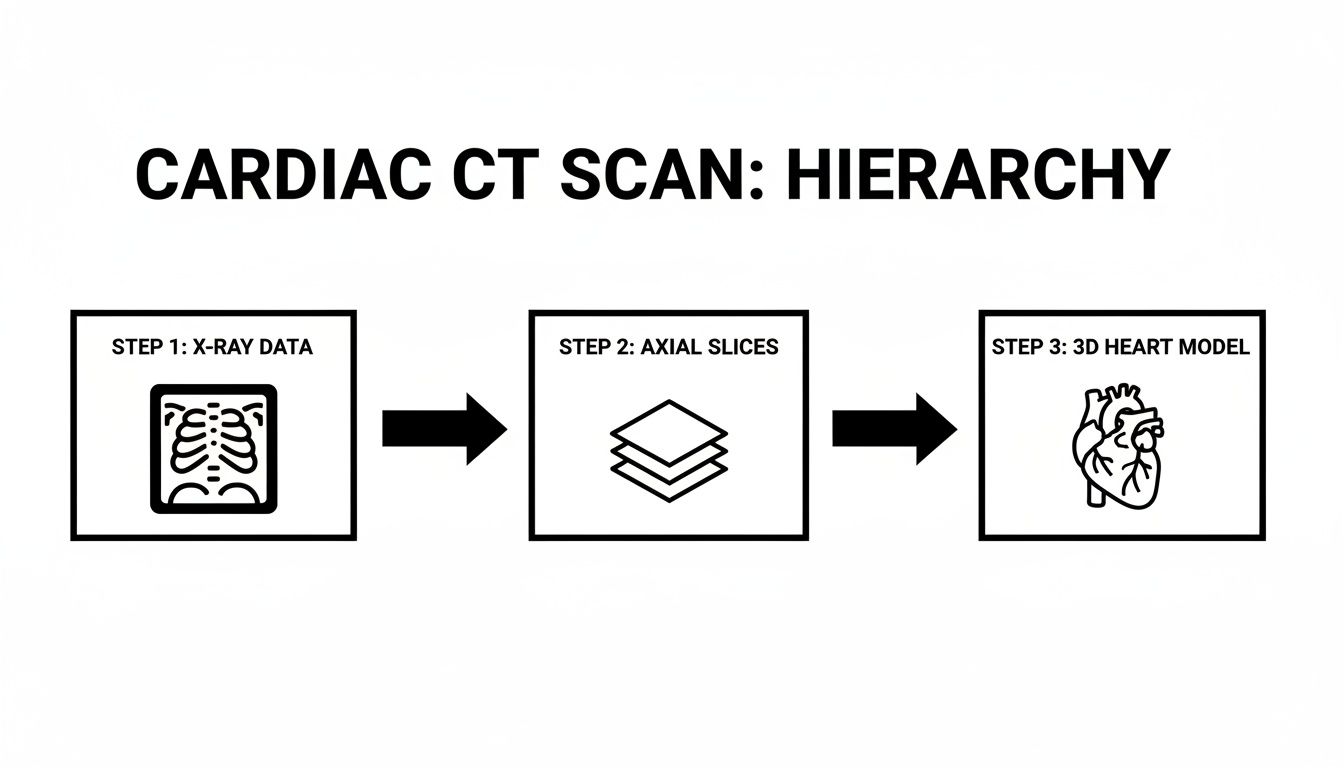
This process, turning X-rays into slices and then into a 3D picture, is the magic behind both the simple CAC score and the more advanced CCTA scan.
The Full Investigation: Coronary CT Angiography
If the CAC score is the detective's initial sweep, then Coronary CT Angiography (CCTA) is the full forensic team arriving on the scene to gather every last piece of evidence. This is a much more detailed test that gives a truly comprehensive look inside your coronary arteries.
For a CCTA, an iodine-based contrast dye is injected into a vein in your arm. As this dye flows through your bloodstream and into your heart's arteries, it makes them light up like a neon sign on the CT scan. This "illumination" allows doctors to see your arteries in stunning detail.
Unlike the CAC score, which only spots hardened plaque, a CCTA can reveal both hard (calcified) and soft (non-calcified) plaque. This is a huge deal because soft plaque is often more unstable and can be a major risk for causing a heart attack, even if it hasn't hardened yet.
A CCTA gives your doctor a complete road map of your arteries, clearly showing:
- The exact location of any blockages.
- The severity of the narrowing, often described as a percentage.
- The type of plaque present (soft, calcified, or mixed).
Because it provides so much rich detail, a CCTA is typically ordered when someone has symptoms like chest pain or shortness of breath, or if other tests point to a high chance of coronary artery disease. If you’re curious about other non-invasive heart tests, you can learn more about the transthoracic echocardiogram in our guide and see how it fits into the picture.
Ultimately, the choice between a CAC score and a CCTA depends entirely on your specific symptoms, your overall risk factors, and what your doctor needs to find out. It’s a decision you’ll make together as a team.
When to Discuss a Cardiac CT Scan with Your Doctor
So, you've been keeping a close eye on your heart with a wearable device. Maybe you've caught occasional palpitations on your ECG, or you're using a service like Qaly to get expert interpretations that show trends you find a little concerning. We get it. Holding all this data can stir up a mix of feelings, empowerment for being proactive, but also a bit of uncertainty about what to do next.
This is a totally normal and common part of taking charge of your heart health. You have information in your hands, and now the big question is: when is it the right time to bring up a cardiac CT scan with your doctor? It's not a test for everyone, but for some, it's the logical next step in solving the puzzle of your symptoms and risks.
From Wearable Data to Doctor Conversation
The data from your wearable ECG is incredibly valuable. Instead of just telling your doctor you "sometimes feel a flutter," you can actually show them a detailed report. When you provide your doctor with organized information showing trends in your heart's electrical activity over time, you give them the concrete data they need to make a solid, informed decision.
This is how you turn that nagging uncertainty into a productive conversation. Here are a few specific scenarios where your at-home ECG findings, paired with other factors, might make it worth discussing a deeper look like a cardiac CT scan:
- Persistent or Frequent Arrhythmias: If you're consistently logging arrhythmias like frequent PVCs, PACs, or even short runs of SVT, your doctor will want to get to the bottom of it. While these are electrical "glitches," they can sometimes be linked to underlying structural heart problems or artery disease that a CT can spot.
- Symptoms Paired with ECG Events: It's one thing to feel a symptom, and another to capture it on an ECG. When you experience things like chest tightness, shortness of breath, or dizziness that line up with specific events on your ECG, it makes a much stronger case for a more thorough investigation.
- Unexplained ECG Abnormalities: Maybe your ECGs are showing subtle but consistent oddities that aren't easily explained. A cardiac CT scan can be a great tool to help rule out structural issues with your heart muscle or coronary arteries.
Adding Risk Factors to the Picture
Your ECG data is just one piece of the puzzle. The picture becomes much clearer when you combine it with traditional risk factors. A cardiac CT scan often comes into play when you have an "intermediate" risk profile, that gray area where it's not obvious whether you need to start aggressive prevention strategies.
Think about these factors in combination with the data you've gathered from your wearable:
- Family History: Do you have a close relative (like a parent or sibling) who had heart disease at a young age? That's a big one.
- Concerning Lab Results: When you talk with your doctor about your heart health, things like cholesterol levels are key. Getting deeper insights into factors like LDL particle size can be crucial in deciding if a cardiac CT scan is needed.
- Borderline Risk Scores: Maybe you've calculated your cardiovascular risk and found yourself in that uncertain, middle-of-the-road category. To learn more about this, you can read our guide on understanding your risk score for cardiovascular disease. A cardiac CT, especially a calcium score, can provide the clarity needed to "break the tie" and guide your treatment plan.
- Other Health Conditions: Having conditions like high blood pressure, diabetes, or an autoimmune disease automatically bumps up your risk and might be reason enough for a closer look.
Groundbreaking research has shown just how powerful this can be. One study highlighted that individuals with a coronary artery calcium (CAC) score above zero were 2 to 3 times more likely to die from any cause compared to those without detectable calcium. This elevates the CAC score beyond just a cardiac risk tool and shows its broader health implications. Interestingly, the study also found that 8.5% of these patients had other significant incidental findings on their scans, showing the value of a cardiac CT scan for those escalating from wearable monitoring. To find out more about these important findings, you can read the full research highlights from the American Heart Association's scientific sessions.
Approaching your doctor is not about demanding a specific test. It's about presenting your well-documented concerns and asking, "Given my ECG data and these risk factors, could a cardiac CT scan give us a clearer picture of what's going on?"
This collaborative approach shows respect for your doctor's expertise while making sure your voice, and your data, are central to the decision-making process. It’s all about being a true partner in your own healthcare journey.
Preparing for and Experiencing the Scan
The thought of any medical test can be a source of stress, but knowing exactly what to expect can turn that anxiety into confidence. We get it, stepping into a hospital or imaging center can feel intimidating, especially when you’re already worried about your heart. Let's walk through the entire process of a cardiac CT scan together, from the simple prep to what happens right after, so you feel fully prepared and in control.
Our goal here is to replace the fear of the unknown with solid understanding. You're not just a patient; you're an active partner in your own healthcare, and knowing the details empowers you.


What to Do Before Your Scan
Preparing for a cardiac CT scan is surprisingly straightforward. There are no complicated or uncomfortable steps involved. The main goal is simply to get your heart rate low and steady, which helps the scanner capture the clearest possible pictures of your heart.
Your imaging center will give you specific instructions, but they usually include a few simple guidelines for the day of your scan:
- Avoid Caffeine: For about 12 to 24 hours beforehand, you’ll likely be asked to skip your coffee, tea, soda, and even decaf beverages. These can all contain small amounts of caffeine that might bump up your heart rate.
- Limit Certain Medications: Some medications, particularly certain stimulants or diet pills, might need to be paused. Always go over your full medication list with your doctor or the imaging staff.
- A Light Meal Is Okay: You can usually eat a light meal before your appointment, but it's best to avoid a large, heavy one right beforehand.
That’s really it. You won't need to fast for a long time or undergo any invasive prep. The simplicity is intentional, making the test as easy on you as possible.
What Happens During the Procedure
When you arrive for your scan, a friendly technician will greet you and explain everything that's about to happen. They are there to support you and answer any questions you might have. You're in a safe, controlled environment with professionals who do this every single day.
Here’s a step-by-step look at what the experience is like:
- Getting Ready: You may be asked to change into a hospital gown. The technician will then place small, sticky patches called electrodes on your chest, which connect to an ECG machine to monitor your heart's rhythm during the scan.
- Getting an IV Line: If you're having a Coronary CT Angiography (CCTA), a small IV line will be placed in a vein in your arm. This is for the contrast dye that helps light up your arteries for the pictures. It’s a quick and minor step.
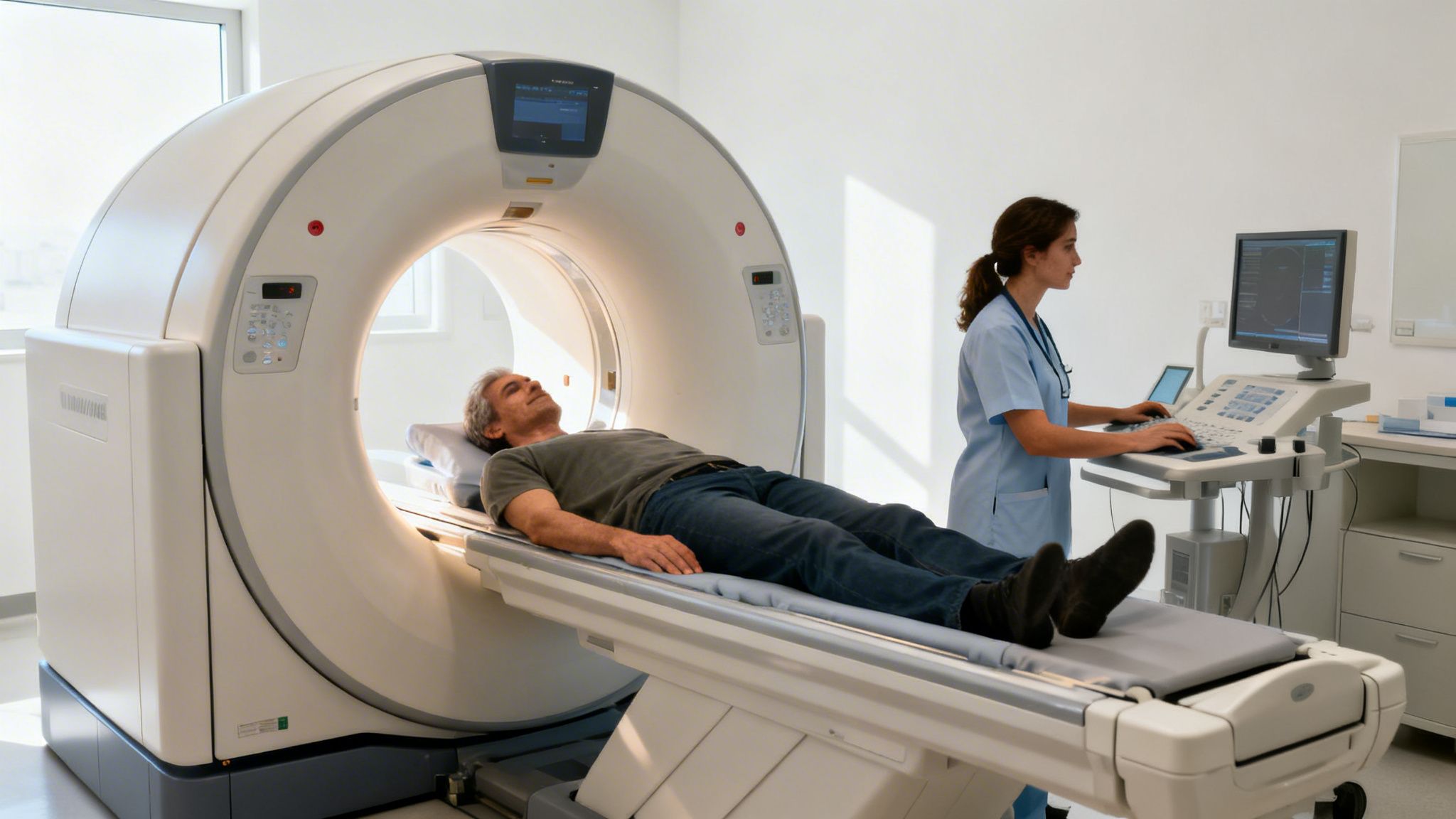
- Positioning on the Table: You'll lie down on a comfortable, padded table. This table will then gently slide you into the center of the CT scanner, which looks like a large, open donut. Your head and feet will stay outside the machine the whole time.
The scan itself is totally painless and very quick, often lasting only 10 to 15 minutes from start to finish. The most important thing you'll need to do is stay still for a few seconds at a time.
You’ll hear the whirring and clicking sounds of the machine as it works. The technician will be in the next room, but they can see you, hear you, and talk to you through an intercom the entire time. You are never alone.
The technician will ask you to hold your breath for brief periods of 5 to 10 seconds while the images are being taken. This helps "freeze" the motion of your chest and heart, just like holding still for a photograph prevents a blurry picture.
If you’re having a CCTA, you'll feel a brief, warm sensation spreading through your body as the contrast dye is injected. This is completely normal and fades away within a minute or so.
Once the images are all captured, the table slides back out, the IV and electrodes are removed, and you’re all done. There’s no recovery time needed, and you can go right back to your day as usual. This simple, non-invasive process provides an incredible amount of information that can guide the next steps in your heart health journey.
How to Understand Your Cardiac CT Scan Results
Getting your results is a big moment, and knowing what they mean is the key to feeling in control of your health. We get it, medical reports can look intimidating, packed with numbers and technical terms that don't make much sense at first glance.
Let's break down what your cardiac CT scan results might actually say, in simple, clear language.

This knowledge empowers you to understand the "why" behind your doctor's recommendations, whether that means lifestyle changes, medication, or more tests. It puts you back in the driver's seat.
Decoding Your Calcium Score
If you had a Coronary Artery Calcium (CAC) scan, your report will focus on one key number: your score. This score represents the total amount of hardened, calcified plaque found in your heart's arteries. Think of it as a direct measurement of your plaque burden.
Here’s what those numbers generally mean for your future risk:
A score of 0 (Zero) is fantastic news. It means no calcified plaque was detected, which points to a very low risk of a heart attack in the coming years. A score of 1-100 shows a mild amount of plaque. While it confirms you have some coronary artery disease, your risk is still considered relatively low. A score of 101-400 points to a moderate plaque burden. At this level, your doctor will likely want to discuss more proactive strategies to manage your risk factors. A score over 400 is a sign of extensive plaque buildup and a higher risk of future heart events. A score this high often triggers a more aggressive plan to protect your heart.
Making Sense of a CCTA Report
A Coronary CT Angiography (CCTA) report is much more descriptive. Instead of just a single number, it gives you a detailed road map of your arteries, explaining the location and severity of any blockages. It can seem more complex, but we can simplify the key terms.
You'll probably see descriptions of blockages using percentages. Let's use a road traffic analogy to make this easier to grasp:
A "mild" blockage (less than 50% narrowed) is like a road with one lane temporarily closed for minor work. Traffic still flows pretty well, but it's a sign that issues are developing. An "obstructive" or "severe" blockage (over 70% narrowed) is like a major traffic jam that significantly slows or stops the flow.
The report will distinguish between "non-obstructive" and "obstructive" disease. Non-obstructive means plaque is there, but it isn't seriously blocking blood flow. Obstructive disease is more serious and needs attention.
Your doctor will combine these findings with your at-home watch ECG data and expert analyses from services like Qaly to create a full picture of your heart's health. For instance, if you're also seeing red flags in other blood tests, like those discussed in our guide on troponin levels, it adds another important layer to the conversation.
This growing reliance on cardiac CT scans is a global trend. The Asia-Pacific cardiac CT market, for example, is the fastest-growing region, with a projected growth rate of 10-15.3% annually through 2030-2032, driven by rising health concerns. With 20.5 million cardiovascular deaths globally each year, the demand for a scan with 90-95% accuracy in early detection is soaring, making this powerful imaging more accessible for everyone. You can read more about these global cardiac CT market trends and what they mean for patient care.
Frequently Asked Questions About Cardiac CT Scans
We get it. Even after learning a lot about a medical topic, you might still have some questions floating around. That’s completely normal. Being curious and even a little skeptical is a sign that you're being a smart advocate for your own health.
Here are some straightforward answers to the most common questions people ask when they're thinking about a cardiac CT scan. Our goal is to give you the confidence you need for your next conversation with your doctor.
Is a Cardiac CT Scan Safe Given the Radiation?
This is a really common and totally valid concern. Modern CT scanners are built to use the absolute lowest radiation dose necessary to get clear, high-quality images of your heart.
For most people, the benefit of getting a definitive diagnosis far outweighs the small risk from the radiation. Your doctor will always weigh these factors before even suggesting a scan. To put it in perspective, the exposure is often similar to the natural background radiation you’d absorb from the environment over a couple of years.
How Is a Cardiac CT Different from My Watch's ECG?
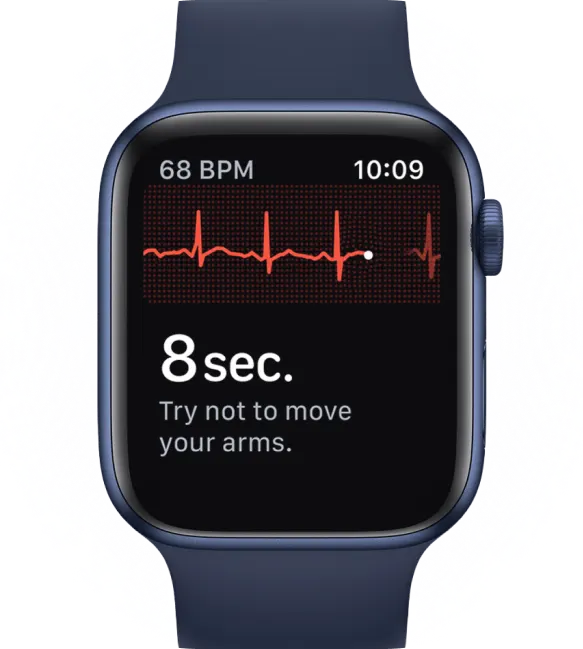
They're two very different but complementary tools for looking at your heart. Your wearable ECG, like on an Apple Watch or Fitbit, tracks your heart's electrical activity and rhythm. This is fantastic for spotting issues like Atrial Fibrillation or frequent PVCs.
A cardiac CT scan, on the other hand, looks at your heart's physical structure and plumbing. It shows the actual arteries and can reveal blockages or calcium buildup that an ECG simply can't see.
Think of it this way: your watch's ECG is like checking the electrical wiring in your house, while a cardiac CT scan is like having a plumber inspect the pipes for clogs.
Will Insurance Cover a Cardiac CT Scan?
This is a critical question, and the answer often comes down to your specific situation. Many insurance plans will cover a cardiac CT scan when your doctor considers it medically necessary, for example, to diagnose or rule out coronary artery disease, especially if you have symptoms or major risk factors.
However, coverage isn't universal. It’s always smart to call your insurance provider beforehand. A quick chat can help you understand your policy, what’s covered, and any potential out-of-pocket costs. This simple step can save you from a lot of surprises down the road.

If you're using a wearable to monitor your heart and want to make sense of your ECGs, Qaly can help. Certified human experts interpret your readings within minutes, giving you clear insights you can share with your doctor.



.png)
.png)