


Key Takeaways

User Profile
Hello Heart Hero.
You finish a workout and something feels off. Maybe your head is pounding harder than usual. Maybe you feel oddly breathless for the effort you gave. Maybe a machine at the gym flashes a blood pressure number that seems too high, and you leave with that uneasy thought many people know well: Was that normal, or did my body just warn me about something important?
If that's where you are right now, you're in the right place. A lot of people have normal or near-normal resting blood pressure and still notice strange symptoms or worrying readings during exercise. That gap can feel frustrating, especially if a quick office check doesn't seem to match what you experience in real life. If you want a simple primer on the basics of blood pressure before going deeper, this overview on understanding blood pressure readings can help.
This article is here to make a confusing topic feel manageable. You'll learn what exercise induced hypertension is, why doctors pay attention to it, how it's diagnosed, and how your wearable can help you gather useful information before your next appointment.
Introduction
Exercise is supposed to make your heart work harder. That's normal. The confusing part is figuring out when a normal rise in blood pressure turns into something worth checking.
Many people assume that if their resting blood pressure looks fine, their exercise response must also be fine. That's not always true. Some people only show an abnormal blood pressure pattern when their body is under physical stress. That can leave them feeling dismissed, especially if they know something doesn't feel right but can't capture it while sitting calmly in a clinic.
Practical rule: A strange pattern during exercise isn't something to panic about, but it is something to take seriously and document.
If you've been skeptical that the usual quick check tells the full story, that instinct makes sense here. Exercise induced hypertension often hides in plain sight. It may not show up until you're walking uphill, cycling, doing intervals, or even climbing stairs fast.
The good news is that this is a learnable problem. When you understand the pattern, collect clear observations, and bring useful data to a clinician, your conversation changes. You're no longer saying, "I just feel weird sometimes." You're saying, "Here is what happens, when it happens, and how often."
Understanding Exercise Induced Hypertension
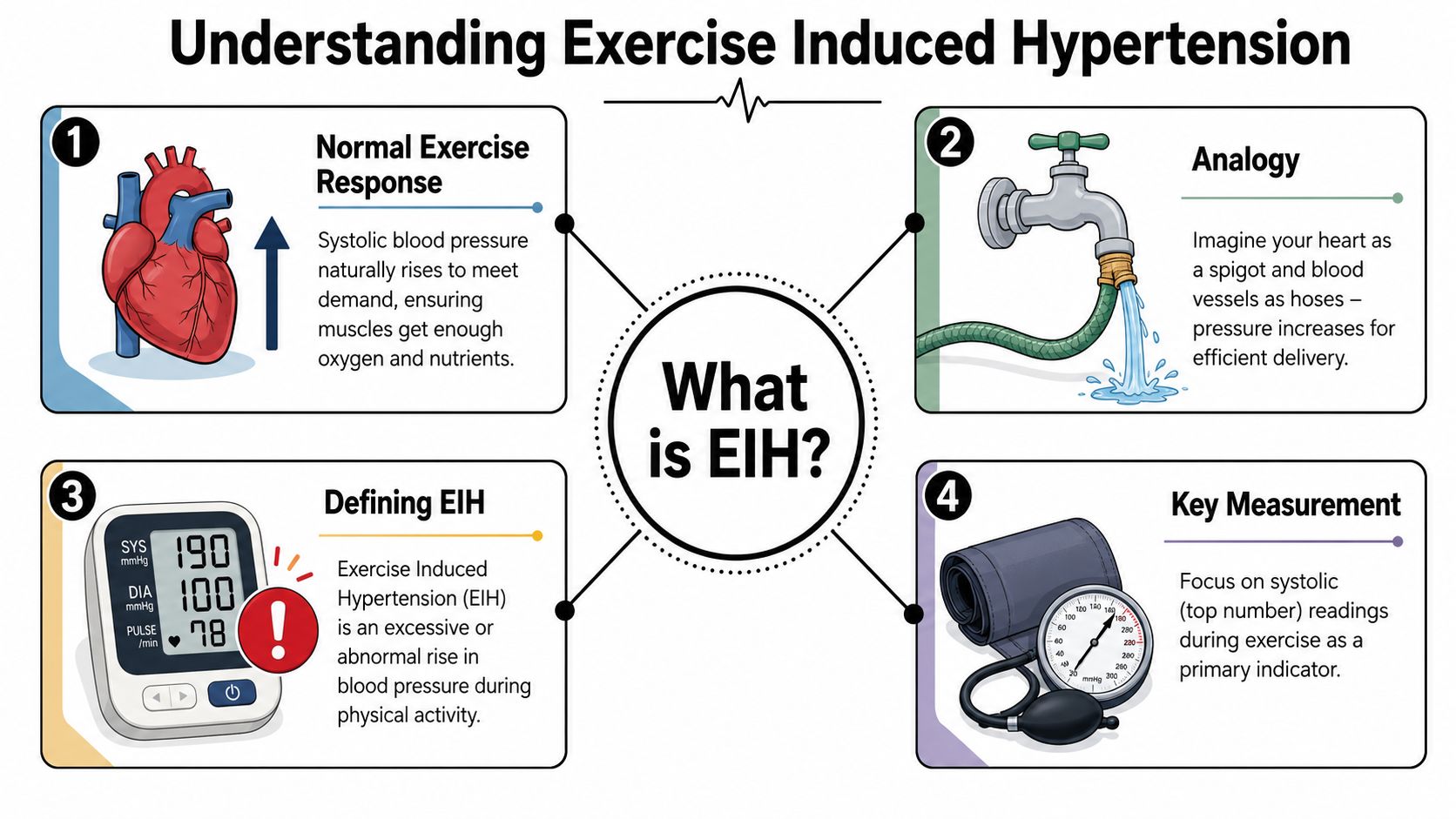
Blood pressure has two numbers. The systolic number is the top number, and it reflects the pressure when the heart pumps. The diastolic number is the bottom number, and it reflects pressure between beats.
During exercise, the top number usually rises because your muscles need more oxygen-rich blood. A simple way to think about it is this: your heart is the spigot, and your blood vessels are the hoses. When your body needs more flow, the spigot opens more forcefully. Pressure rises so blood can reach working muscles.
What makes the response abnormal
Exercise induced hypertension happens when that rise is exaggerated rather than appropriate. One accepted definition is a systolic blood pressure above 210 mmHg for males and 190 mmHg for females during exercise, or a diastolic pressure of 110 mmHg or higher for both sexes, even when resting blood pressure is normal. It has been found in 18% of normotensive individuals and 40% of those with established hypertension according to this review on exercise-induced hypertension definitions and prevalence.
That matters because the body isn't just having a random dramatic moment. A pattern like this can suggest the blood vessels are not relaxing as well as they should, or that the heart is working against more resistance than expected.
Why people miss it
Readers often get tripped up by this. They think, "If my home reading is fine while I'm sitting on the couch, then my exercise blood pressure must also be fine." But exercise induced hypertension often doesn't show itself at rest.
That's one reason the issue can feel hidden. You might only notice clues such as:
- Headache after exertion: not every post-workout headache is blood pressure related, but a repeated pattern deserves attention.
- Unexpected breathlessness: feeling more winded than the workout seems to justify.
- A pounding sensation: some people describe intense heart awareness during moderate activity.
- Confusing wearable trends: your heart rate may seem higher than expected for familiar effort, even though a wearable can't directly confirm blood pressure.
If you're already looking at rhythm and recovery patterns from a smartwatch or handheld ECG device, this guide on decoding ECG changes during exercise and recovery can help you separate normal exercise changes from patterns worth discussing with a clinician.
A useful way to think about it
A normal exercise response is like pressing the gas pedal when merging onto a highway. The engine works harder because it should. Exercise induced hypertension is more like the engine revving far too high for the speed you're trying to reach.
That doesn't mean something catastrophic is happening in that moment. It means your body may be revealing stress in the system earlier than a resting test would. If you want a clinician-oriented refresher on how blood pressure readings are interpreted in practice, these blood pressure insights for health professionals from Cartwright Fitness are a useful companion read.
The Hidden Risks of High Exercise Blood Pressure
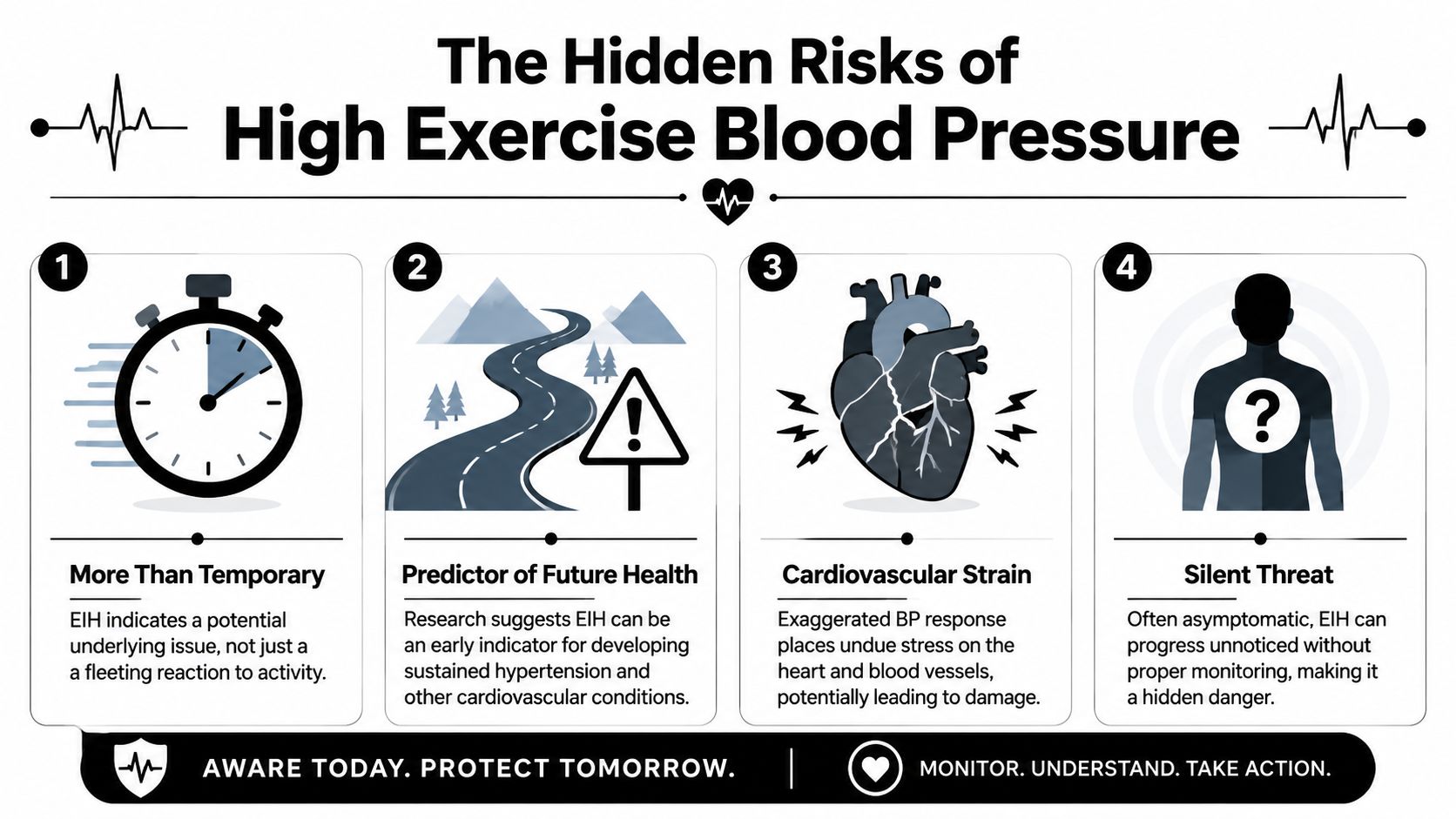
It's tempting to shrug off a high blood pressure response during exercise as "just because I was working hard." Sometimes that's true. But when the rise is excessive, doctors don't treat it as harmless noise.
Why this matters long term
In highly trained athletes, exercise-induced hypertension is associated with a 3.6-fold increased risk of developing hypertension later in life, and a review also identifies it as a risk factor for sudden cardiac death, with the majority of affected marathon runners showing signs of a hypertensive response to exercise, as described in this review on exercise hypertension in athletes.
That can sound scary, so it's worth slowing down here. The point isn't that one odd workout means disaster. The point is that a repeated exaggerated response may act like an early warning light on a dashboard. It can show that the cardiovascular system is under strain before everyday resting readings fully reflect the problem.
What may be happening under the surface
Exercise induced hypertension has been linked with changes such as cardiac remodeling, left ventricular dysfunction, and myocardial fibrosis in athletic populations, based on the same review linked above. In plain language, that means the heart and blood vessels may adapt in ways that aren't always healthy when they repeatedly face excessive pressure during exertion.
A high exercise blood pressure response is often important precisely because it appears before a person thinks of themselves as "someone with blood pressure problems."
This is one reason very fit people sometimes feel blindsided. They may assume frequent training protects them from any blood pressure issue. Fitness is valuable, but it doesn't erase every cardiovascular pattern.
What readers should take from this
You don't need to become afraid of movement. In fact, fear usually makes the situation worse by creating avoidance and uncertainty. A better mindset is this:
- Treat it as a signal: not a verdict.
- Look for patterns: one isolated reading means less than repeated responses.
- Use it to start better care: a good workup can clarify whether this is a true problem, a measurement issue, or a sign of another underlying condition.
If your body keeps sending the same message during exercise, it's worth listening.
Finding Answers How EIH Is Diagnosed
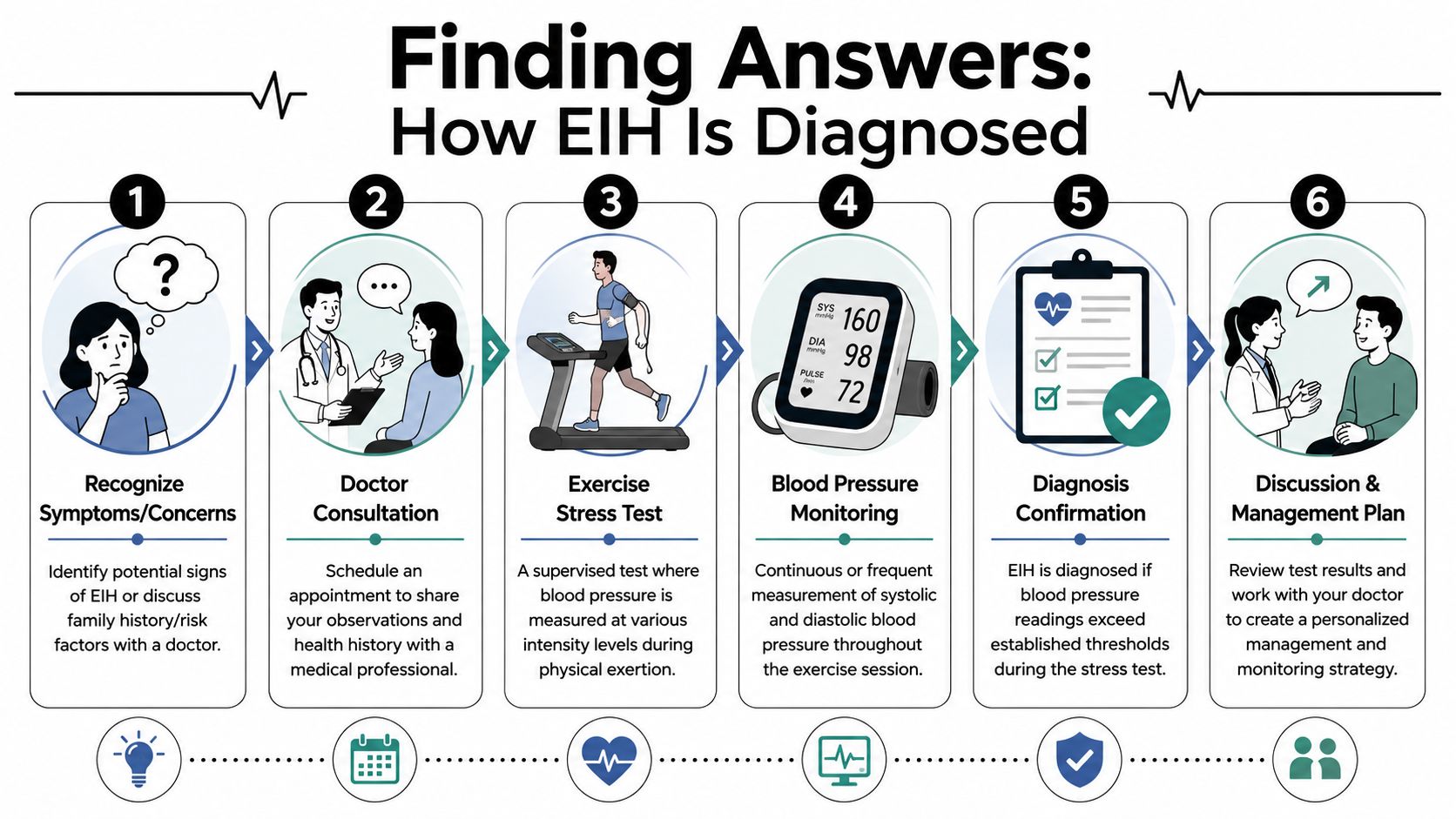
This is the part many people find validating. A standard seated blood pressure check may miss exercise induced hypertension entirely. If you've felt like "my problem only happens when I'm active," you're not imagining things.
The formal diagnosis usually depends on seeing what your cardiovascular system does during exertion, not only at rest.
What an exercise stress test usually looks like
The most common tool is an exercise stress test. You walk on a treadmill or pedal a stationary bike while a clinical team monitors your heart rhythm, heart rate, symptoms, and blood pressure as the workload increases.
Here is the process in simple terms:
- You explain the concern. Tell the clinician what you feel, when it happens, and what kind of exercise brings it on.
- They get a baseline. Resting vitals and a starting ECG are often checked.
- The exercise begins gradually. The intensity rises in stages rather than all at once.
- Blood pressure is checked during exertion. This is the key part for EIH.
- Recovery is monitored. What happens after stopping matters too.
- Results are interpreted in context. Symptoms, rhythm changes, and pressure response are looked at together.
Some people feel nervous about the ECG part. If the wires and waveforms seem intimidating, this beginner's guide to interpreting EKGs from ProMed Certifications can make the basics feel less mysterious.
Why wearables still matter
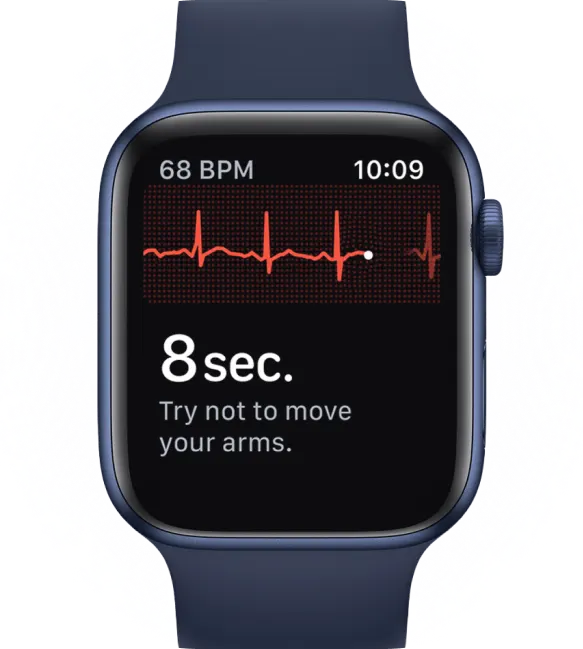
A smartwatch or handheld ECG device can't diagnose exercise induced hypertension by itself because it doesn't directly measure exercise blood pressure the way a cuffed stress test does. But it can still be useful.
Your wearable can help you document:
- Heart rate at the time of symptoms
- Whether palpitations happen with the pressure sensation
- Recovery trends after stopping
- Timestamps that match your symptom log
That kind of record can make the doctor's visit far more productive. If you're trying to build a clearer picture from your own devices, this article on what continuous monitoring means for patients gives a helpful overview.
Bring your notes to the appointment. A short log with activity, symptoms, time, and wearable data often says more than a vague memory of "I felt bad during a workout once."
Other testing you may hear about
Some clinicians may also consider ambulatory or home blood pressure monitoring, depending on the situation. Those tools don't replace an exercise stress test for confirming EIH, but they can add context about your broader blood pressure pattern across daily life.
The key idea is simple. If the concern shows up under stress, the testing needs to look at your body under stress.


Your Guide to Management and Monitoring
If you've been told you have exercise induced hypertension, it doesn't mean exercise is off-limits forever. It means your approach needs to become more informed, more measured, and more personalized for your physical state.

Start with what you can control
For many people, management begins with day-to-day habits. That may include adjusting exercise intensity, paying closer attention to hydration, improving sleep, reducing excess sodium, managing stress, and avoiding the temptation to jump straight into all-out effort.
A practical example helps. If you usually go from sitting all day to a hard Peloton session, your clinician may prefer a gentler ramp such as brisk walking, easier cycling, or controlled intervals while symptoms and blood pressure response are being sorted out. The goal isn't to make your life smaller. It's to lower uncertainty while keeping you active.
Medication deserves a second look
Many readers feel understandably frustrated. You may be told your blood pressure is "controlled" because your resting numbers look acceptable, yet your exercise symptoms continue.
That gap is real. According to the American Heart Association news report, up to 50% of patients with "controlled" resting BP still experience excessive spikes during exercise due to medication failure, and a U.K. study found treated patients had spikes that mirrored untreated hypertension. The report explains why this creates a major blind spot in treatment for EIH in this discussion of medicine failing to control blood pressure during exercise.
That doesn't mean medication is useless. It means the medication plan may need a more nuanced conversation.
Questions worth asking your doctor
You don't need to show up combative. You do need to show up prepared. Consider asking:
- Does my resting control match my exercise control? If not, the treatment picture may be incomplete.
- Should I have an exercise stress test with blood pressure monitoring? This is often the missing piece.
- Are my symptoms tied to blood pressure, rhythm, or both? Sometimes people have more than one issue happening during workouts.
- How should I modify training while we figure this out? Specific limits are more useful than vague warnings.
- Would tracking patterns at home help? A clinician may want logs of symptoms, heart rate, and recovery.
How to use your wearable wisely
A wearable isn't a blood pressure cuff, so it can't confirm exercise induced hypertension on its own. But it can be one of the best tools for pattern spotting if you use it carefully.
Try this simple framework:
- Before exercise: note how you feel, what workout you're about to do, and whether you've had caffeine, poor sleep, or unusual stress.
- During symptoms: save a note in your phone or wearable app. Record the time and what you felt. If your device can capture an ECG and you're having palpitations, save that recording.
- After exercise: check how long it takes you to feel normal again. Log headache, chest discomfort, unusual breathlessness, dizziness, or pounding sensations.
- Over time: look for repetition. Does it happen with hills, intervals, lifting, heat, or rushed workouts after a stressful day?
Remote tracking demonstrates its power. If you're curious how patient-generated data fits into care outside the clinic, this overview of the benefits of remote patient monitoring shows why these records can matter.
Your wearable is best used as a notebook with sensors. It won't replace a clinical diagnosis, but it can help you capture what your body is trying to tell you.
What not to do
Don't self-diagnose from one alarming reading alone. Don't keep pushing harder just to "see what happens." And don't assume that being fit means you're automatically safe from blood pressure problems during exercise.
The strongest position is calm and observant. Keep moving within reasonable limits, gather clean data, and ask better questions. That's how you shift from worry to useful action.
Your Path Forward with Heart Health Confidence
A diagnosis like exercise induced hypertension can make people feel fragile at first. That's understandable. But the better way to see it is this: you caught a signal that gives you a chance to act earlier, not later.
You now know something important that many people don't. Resting blood pressure and exercise blood pressure are not always the same story. If your body reacts abnormally under effort, that deserves a closer look, not a dismissive shrug.
Confidence comes from evidence
The healthcare system can feel rushed. Appointments are short. Symptoms that happen only during exercise can sound vague when you try to describe them from memory. That's exactly why your own records matter.
Bring the details. Bring the symptom log. Bring the timestamps from your Apple Watch, Fitbit, Kardia, Samsung watch, or other wearable. If your goal also includes body composition or training changes, balanced resources like this Venus Health fat loss and muscle guide can support a more thoughtful approach to exercise decisions while you work on heart health.
What empowerment looks like in real life
It doesn't mean you replace your doctor. It means you become a stronger partner in the process.
That can look like:
- Tracking patterns instead of guessing
- Requesting the right test instead of settling for only a resting check
- Adjusting workouts with intention
- Reviewing symptoms with real timestamps and device data
- Following up when the answer doesn't fit what you're experiencing
Your concern is valid. Your observations count. And when you combine your lived experience with good clinical testing, you give yourself a far better chance of getting clear answers.
If you use a wearable ECG device and want extra support reviewing rhythm recordings you capture during symptoms, Qaly can help you turn those at-home ECGs into human-reviewed reports you can share with your clinician. It's a practical way to add more clarity to the conversations that matter most.

Not sure what your exercise ECG shows? Certified experts review it within minutes.



.png)
.png)