


Key Takeaways

User Profile
Hello Heart Hero. You got a lab result, heard the word troponin, and now your mind is racing. Maybe you had chest discomfort, went to the ER, got blood drawn more than once, and left feeling like nobody explained the timeline in plain English. Or maybe you're checking your Apple Watch or Kardia readings at home and trying to connect those rhythm alerts to what the hospital tested.
That reaction makes sense. Heart testing can feel cold and rushed when you're scared, and a result like “increased troponin” sounds more final than it really is. The good news is that troponin follows a pattern, and once you understand that pattern, the result becomes much less mysterious.
Understanding Your Troponin Test Results
A lot of people first meet the word “troponin” in a stressful moment. A nurse draws blood. A doctor says they want to “trend your troponin.” Someone mentions heart damage. Then you're left staring at your phone, searching for answers and wondering if one abnormal result means the worst.
Troponin is a blood marker doctors use when they think the heart muscle may have been injured. That sounds frightening, but the timing matters just as much as the result itself. A number on its own rarely tells the full story.
Why the timing can feel confusing
One reason people get mixed messages is that troponin doesn't behave like an on off switch. It rises, stays up for a while, and then slowly comes down. So if your result is high, it may reflect damage that happened earlier, not necessarily something happening at that exact minute.
For Troponin I, one plain-language reference notes that it can remain higher than normal for 4 to 7 days after heart damage occurs (WebMD overview of the cardiac troponin test). That means a test can still catch an event even if the first scary symptoms were days ago.
Elevated troponin is a signal that deserves attention. It isn't a verdict by itself.
What worried patients often want to know
Readers aren't asking for a chemistry lesson. They want answers to questions like these:
- Did I have a heart attack
- If my level is still high, does that mean I'm getting worse
- Why was my first test normal and the next one abnormal
- How does this relate to what my wearable device has been showing me
Those are smart questions. They also explain why people sometimes feel skeptical of the system. When nobody explains the test clearly, it can sound like medicine is guessing. In reality, clinicians are often looking for a pattern over time, not reacting to a single isolated number.
What Troponin Is and Why It Matters
Think of your heart muscle cells like tiny houses. Inside each house are important tools that help the muscle squeeze and relax. Troponin is one of those tools. It normally stays inside the heart muscle cell where it belongs.
If a heart muscle cell gets injured, some of that troponin leaks into the blood. That's why doctors care so much about it. Finding cardiac troponin in the bloodstream is a strong clue that the heart muscle has been under stress or has been damaged.
A simple way to think about it
A wearable ECG and a troponin test are not doing the same job.
- Your wearable ECG looks at the heart's electrical rhythm
- A troponin blood test looks for biochemical evidence of heart muscle injury
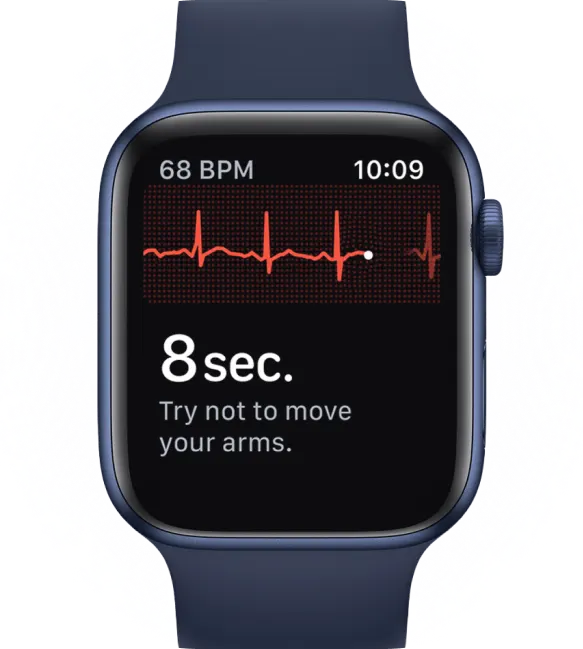
That difference matters. Your Apple Watch, Fitbit, Samsung watch, or Kardia device may help you notice palpitations, skipped beats, or an irregular rhythm. But a rhythm alert doesn't measure muscle damage. That's why people with abnormal symptoms often still need blood work.
Why doctors trust this marker
Troponin matters because it's tied closely to the heart. In everyday terms, it's a much more heart-focused clue than older blood markers doctors used in the past. If you want a patient-friendly primer on the basics, this explanation of troponin levels and what they mean gives a helpful overview.
Practical rule: Troponin tells doctors whether the heart muscle may have been injured. It does not, by itself, explain why.
That's where symptoms, ECG findings, medical history, and repeat blood draws come in. If you've ever felt dismissed because your symptoms didn't fit a neat script, this is important to know. Good heart care isn't supposed to rely on one number alone.


The Troponin Timeline Rise Peak and Fall
If you're asking how long does troponin remain high, the most honest answer is that it remains high for a window of time, not for one exact number of hours in every person.
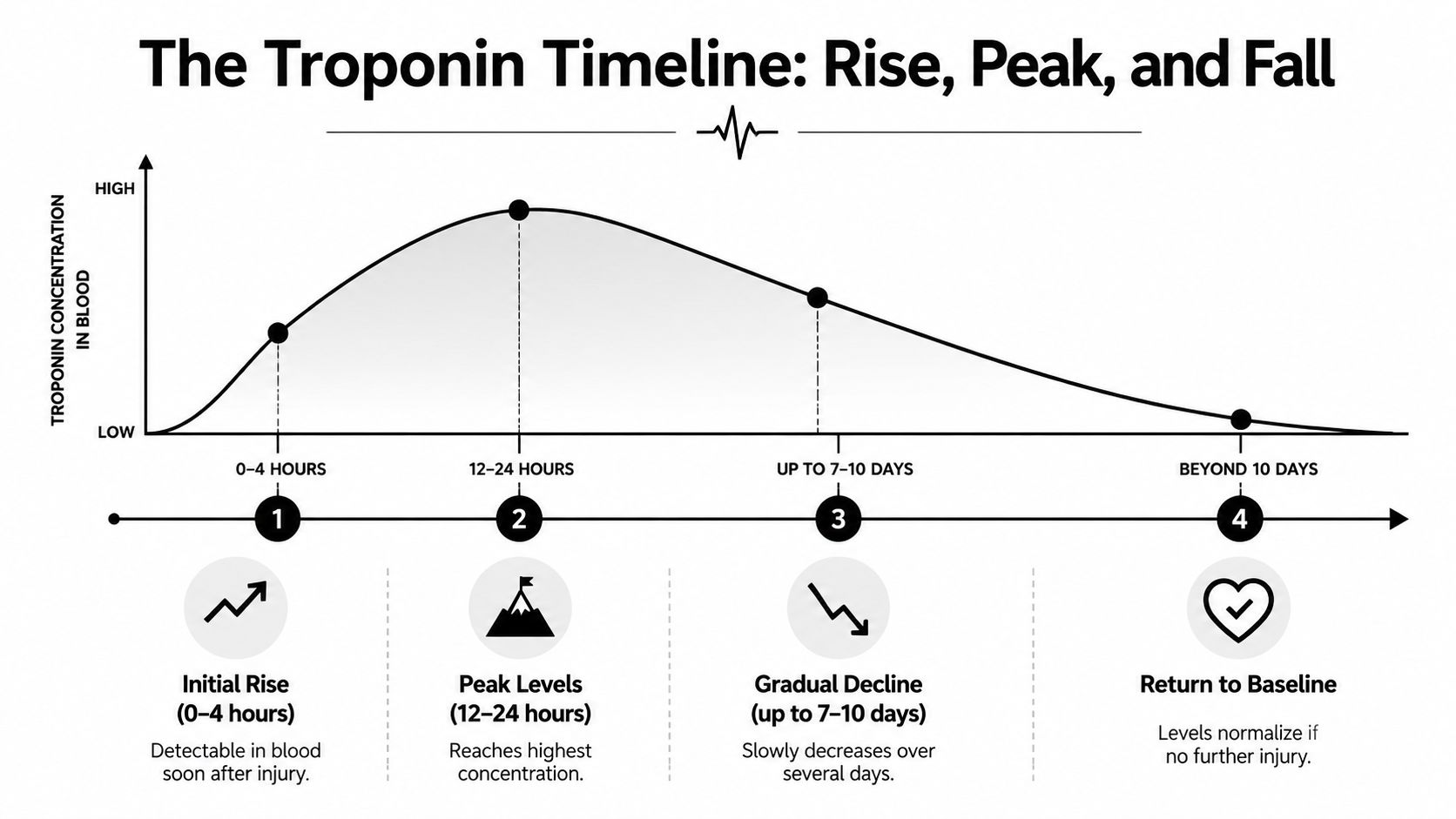
Soon after an acute ischemic heart injury, troponin usually starts to rise. One clinical review notes that serum troponin concentrations typically begin to rise within 2 to 3 hours after symptom onset, reach peak levels between 12 and 48 hours, and gradually return to baseline over 4 to 10 days. In that same review, cardiac troponin I remains above baseline for 7 to 10 days, while cardiac troponin T often remains above baseline for 10 to 14 days (NCBI Bookshelf review of cardiac markers).
That timeline explains a lot of the confusion patients feel.
The rise
If you got to the hospital very early, your first troponin test may have been normal. That doesn't always mean nothing happened. It may have been too early for enough troponin to show up in the blood.
This is one reason ER teams often repeat the blood draw instead of relying on the first result.
The peak
Troponin doesn't usually hit its highest point right away. It often peaks later, which is why someone can feel a little better while the lab value is still climbing. That disconnect can be alarming if nobody explains it.
For some patients, this is the moment when trust starts to wobble. They think, “If I'm feeling calmer, why is the result worse?” The answer is that blood markers follow biology, not emotion.
A helpful plain-language companion to this timeline is this article on heart attack blood testing.
Later in the timeline, this video can help visualize how clinicians think about cardiac blood markers:
The fall
The drop is gradual, not instant. That's why troponin can still be positive even after chest pain has passed or after the most intense moment is over.
Here's the practical takeaway:
- Troponin I often stays up for 7 to 10 days
- Troponin T often stays up for 10 to 14 days
- A positive result can reflect a recent event that didn't happen today
- A very early negative result can miss an event that is still unfolding
That long window is useful for diagnosis, but it can also create anxiety. People see an increased value days later and assume the heart is still actively being injured. Sometimes that's true. Sometimes it means the marker hasn't had time to clear yet.
Why Your Troponin Might Stay High Longer
Some troponin results don't follow the neat textbook curve people expect. That's not automatically a sign that something has been missed. It often means your doctors are looking at a more complicated clinical picture.
A key reason for the long detection window after a heart attack is that troponin isn't released all at once. After an acute myocardial infarction, cardiac troponin I levels stay high for 7 to 10 days, while cardiac troponin T can persist for up to 14 days, and that prolonged presence happens because of a rapid initial release followed by a slower, sustained release from the degradation of cardiac myofilaments (bpac review on troponin after myocardial infarction).
Troponin I and Troponin T don't clear the same way
This is one of the most common sticking points. A patient hears “troponin” and assumes there's only one kind. In practice, Troponin I and Troponin T are related but not identical markers.
If your hospital uses Troponin T, it may remain high longer than Troponin I. So comparing your result to a friend's result, or to something you read online, can be misleading if the test type wasn't the same.
Other conditions can change the picture
Doctors also consider whether there may be ongoing strain or another reason the level isn't returning to normal as quickly as expected. A person with chronic kidney disease, for example, may have a troponin pattern that needs more careful interpretation. A person with myocarditis may have continued release from inflamed heart muscle rather than one short-lived event.
If myocarditis has come up in your conversations with your doctor, this patient-friendly review of myocarditis symptoms and concerns can help you frame better questions.
A troponin result makes more sense when you ask two things at once. What kind of troponin was measured, and what is the trend doing over time?
What this means emotionally
Lingering elevation can feel like being stuck in limbo. You want the number to normalize so you can feel safe again. But medicine doesn't always give clean emotional closure on the same schedule your nervous system wants.
That doesn't mean your concerns are irrational. It means the result needs context. The right question often isn't “Why is it still high?” but “Is it still changing in a way that suggests something new is happening?”
How Doctors Interpret Changing Troponin Levels
A single troponin result is a snapshot. Doctors usually need a short series of snapshots to understand the story.
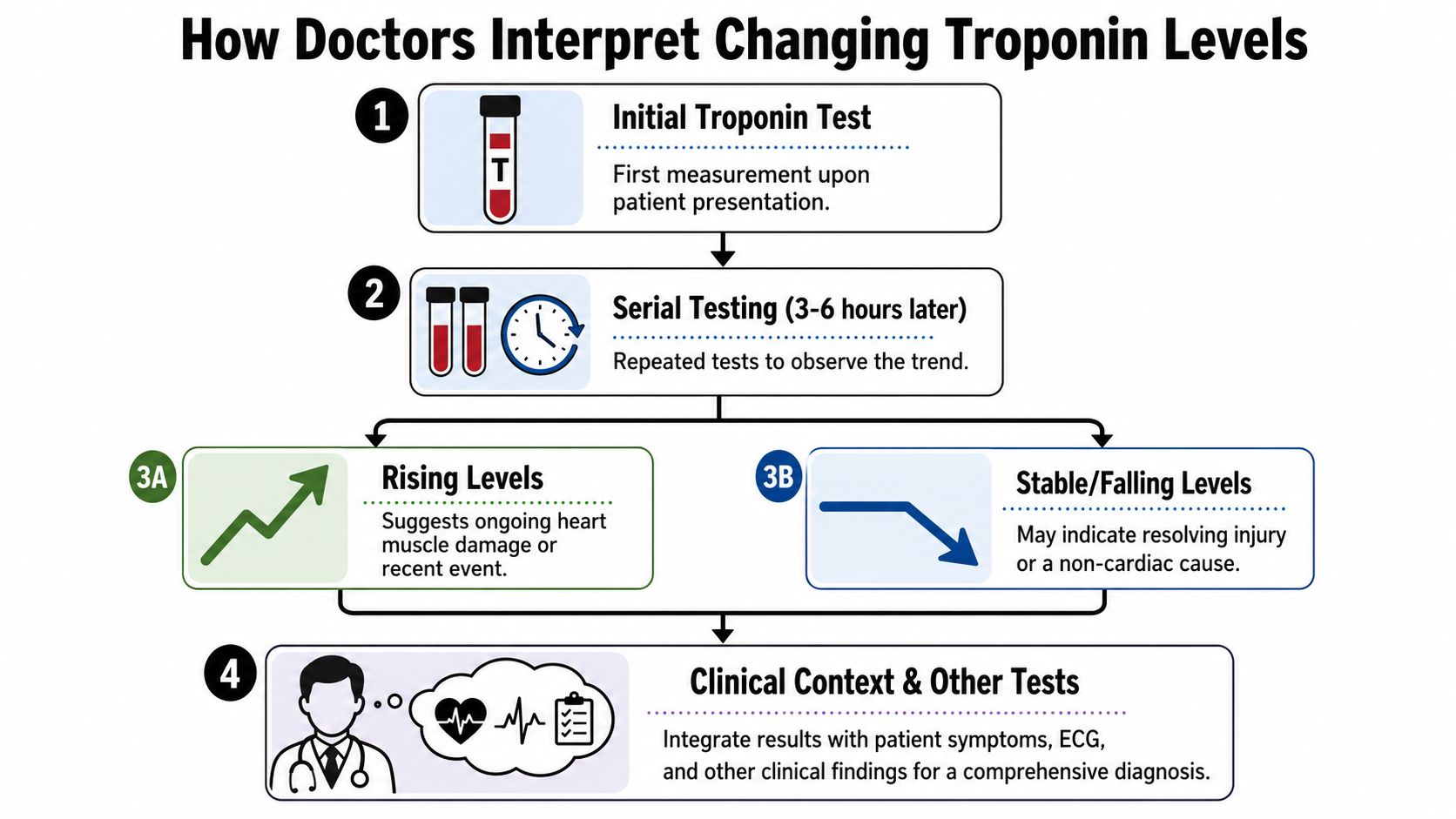
That approach is called serial testing. The idea is simple. Blood is drawn when you arrive, then repeated later to see whether the level is rising, falling, or staying about the same.
The pattern matters more than one isolated value
Clinical guidance stresses that timing is central to interpretation. Blood samples should be drawn at presentation and repeated 3 to 6 hours later, and a single high value does not diagnose myocardial infarction by itself. To support acute injury, clinicians look for a significant change of greater than 20% across serial measurements, while a change of less than 20% can suggest chronic myocardial injury rather than a new event (American College of Cardiology troponin guidance).
How clinicians think through it
A doctor is usually sorting your result into one of these broad patterns:
- Rising pattern
This can point toward a recent or ongoing acute injury. - Falling pattern
This may suggest the injury happened earlier and the level is now coming down. - Stable high pattern
This can fit better with chronic myocardial injury than a fresh heart attack.
Clinical clue: Doctors often care more about the direction of change than the emotional impact of one scary-looking number.
Why that should matter to you
If you've felt like the hospital was withholding clarity, this part can help rebuild trust. A careful clinician isn't ignoring your concern when they order repeat tests. They're trying to avoid two different mistakes at once: missing an acute event, or labeling a chronic elevation as a heart attack when it isn't one.
That also means you can ask better questions:
- Was my troponin rising, falling, or stable
- Which troponin test was used
- Did my ECG and symptoms match the blood test pattern
- What explanation fits the whole picture, not just the first lab value
Those questions are practical, calm, and hard to dismiss. They move the conversation from fear to interpretation.
What You Should Do Next and When to Seek Help
If you've been searching for how long does troponin stay raised, the most useful takeaway is this: the result is important, but it has to be read in context. Your symptoms, your ECG, the timing of the blood draws, and the trend across repeat tests all matter.
For day to day peace of mind, your wearable can still play a valuable role. It won't measure troponin, but it can help you document palpitations, rhythm changes, and symptom timing so you have something concrete to share with your clinician. That can be especially helpful after a recent ER visit or during a heart attack recovery timeline when you're paying closer attention to every sensation.
Keep your next step simple:
- Ask for the trend instead of focusing only on one number
- Write down symptoms including chest pressure, shortness of breath, dizziness, or racing heartbeat
- Save wearable ECG recordings if your device captures them
- Bring your questions to follow-up visits so the conversation stays specific
Seek emergency medical help right away if you have chest pain, chest pressure, shortness of breath, or discomfort spreading to the arms, back, neck, or jaw. Don't stay home trying to decode your labs if those symptoms are happening now.
Knowledge helps. Fast action saves lives.

Confused by your wearable ECG readings? Qaly reviews recordings from Apple Watch, Kardia, Fitbit, Samsung, and more



.png)
.png)