




Key Takeaways

User Profile
Hello Heart Hero.
You feel a flutter, a skipped beat, or a thump that seems louder than usual. You open your watch, record an ECG, and stare at the tracing on the screen. The lines are there, the labels are there, but the meaning still feels just out of reach.
That can be frustrating, especially if you've felt brushed off before or told to “just wait and see.” Wanting to understand your body better isn't overreacting. It's a smart response.
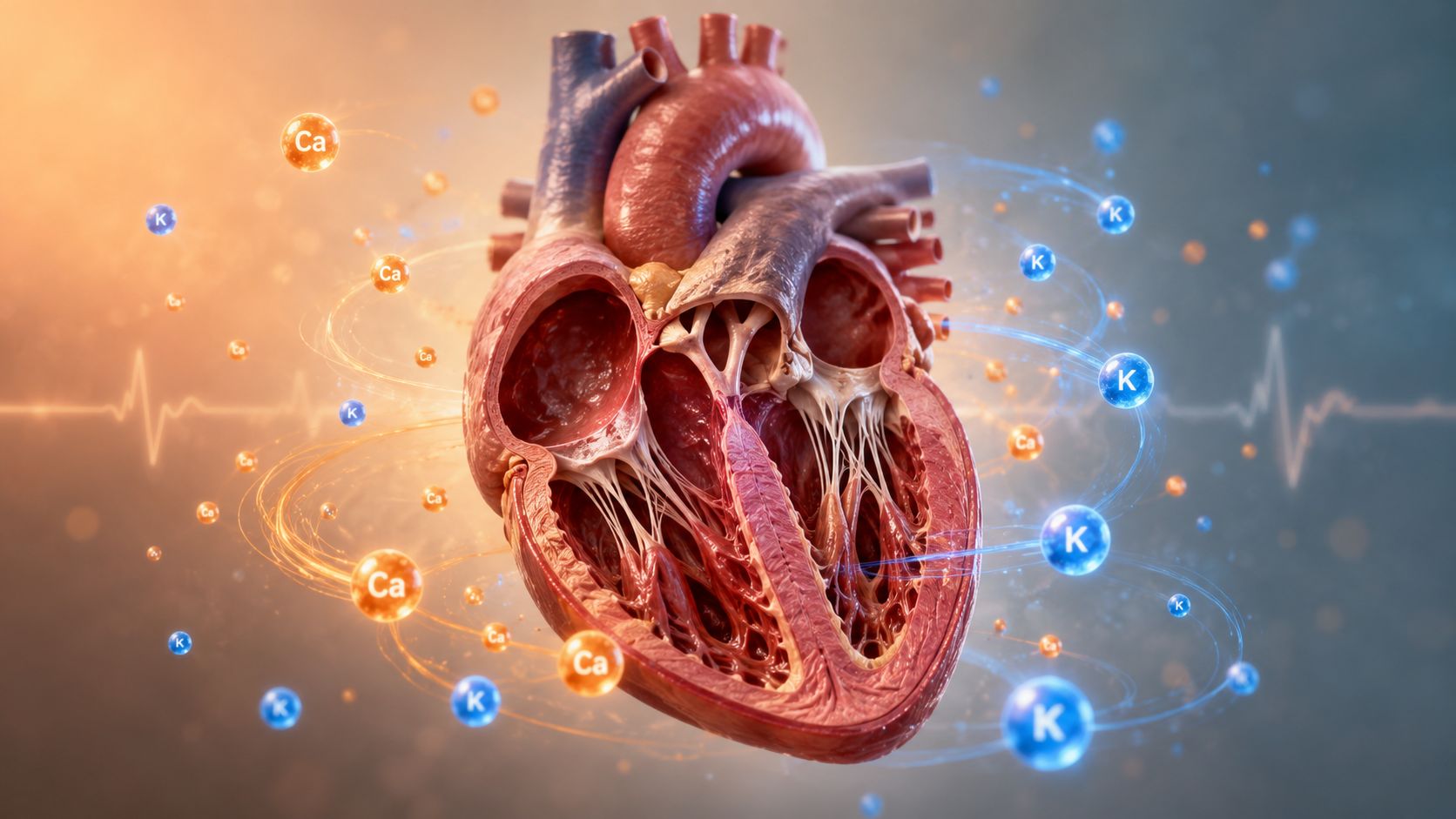
A lot of what you're seeing and feeling comes back to the calcium and potassium relationship. These two minerals help control how your heart starts each beat, carries the electrical signal forward, and resets for the next one. When they stay in balance, your heart's rhythm is more likely to stay smooth and steady. When they're off, even a little, your body may notice before you have words for it.
Your Heart's Unseen Partners Calcium and Potassium
Calcium and potassium can sound like chemistry class terms, but in real life they act more like teammates. Your heart depends on both of them, all day, every day.
Calcium helps heart muscle cells contract. You can think of it as the signal that says, “squeeze now.” Potassium helps those same cells relax and reset. It says, “recover, get ready, and keep the rhythm going.” Neither works well alone.
What they do outside the heart matters too
The calcium and potassium relationship doesn't only affect your heartbeat. It also shapes what happens in your kidneys and bones.
Harvard notes that a diet rich in potassium helps your body keep calcium stored in your bones, instead of losing it unnecessarily in urine, which supports both bone and heart health in a connected way through Harvard's potassium overview. That matters because your body is always trying to keep enough calcium available for nerve signals and muscle function.
Your watch can show you the electrical pattern. Your daily habits often influence the mineral balance behind that pattern.
Why this feels personal so quickly
When people read about electrolytes, they often assume the topic is only relevant in hospitals or after extreme dehydration. That's not true. These minerals affect ordinary symptoms people notice at home:
- Palpitations: a flip, flutter, or extra-hard beat
- Fatigue: especially when your heart rhythm feels “off”
- Cramping or weakness: which can happen alongside broader electrolyte shifts
- Anxiety from uncertainty: because physical sensations are real, even when they come and go
That last one matters. Many people aren't only worried about the sensation. They're worried about not knowing what it means.
A simpler way to think about it
Think of your heart like a room with automatic doors. Calcium is one of the signals that helps the room fill with action. Potassium helps clear the room and restore order before the next cycle starts. If one door opens too slowly, too fast, or at the wrong time, the whole flow changes.
That's why understanding the calcium and potassium relationship can bring real peace of mind. It gives you a way to connect what you feel in your chest with what you see on your watch.
The Cellular Dance That Powers Your Heartbeat
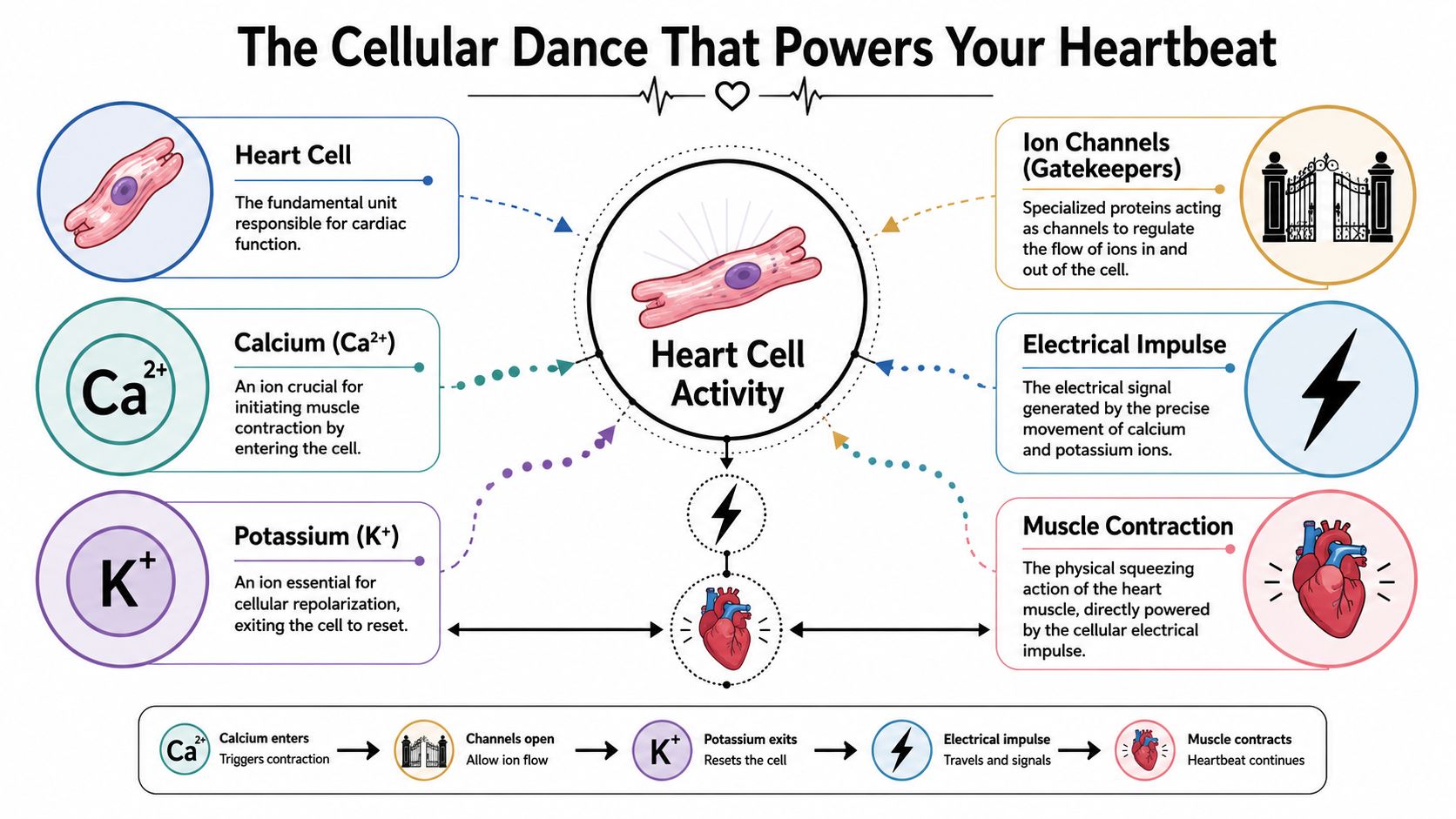
Inside each heart cell, tiny charged particles move in and out through specialized channels. These are often called ion channels, but it helps to picture them as gatekeepers. They decide when calcium and potassium can pass through the cell membrane.
A heartbeat starts as an electrical event before it becomes a mechanical squeeze. That electrical event is often called an action potential. You don't need the textbook version to understand it. A heart cell gets a signal, calcium moves in to help trigger contraction, and potassium moves out to help the cell recover.
The gatekeeper analogy
Think of a concert venue with two closely managed doors.
One door opens to let key performers in. That's like calcium entering the cell to help create contraction. The other door opens to guide people back out in an orderly way. That's like potassium leaving the cell so the cell can reset.
If the timing is tight, the performance runs smoothly. If the doors open too early, too late, or not enough, the rhythm gets messy.
Why tiny shifts can matter
This isn't just theory. In cardiac muscle, low blood potassium and high blood potassium can directly trigger abnormal rhythms, and normal serum calcium sits within 8.5–10.5 mg/dL according to this PubMed record on calcium-potassium interactions in excitability. The same source describes how small shifts in this balance help regulate each heartbeat.
That helps explain why symptoms can show up even when someone doesn't feel “sick” in the usual sense. A person may feel:
- A racing sensation: because the reset phase isn't happening normally
- Skipped beats: because cells become more irritable
- A pounding heartbeat: because contraction and recovery lose their usual smooth timing
Practical rule: Your heart doesn't need a huge electrolyte disaster to notice change. Small shifts can alter the timing of its electrical system.
Why potassium and calcium are linked, not separate
People often ask whether calcium is “for bones” and potassium is “for blood pressure.” That split is too simple. In the heart, they work as a pair.
Calcium helps produce the force of contraction. Potassium helps restore the electrical baseline so the next beat can happen cleanly. If calcium were the accelerator, potassium would be the brake and reset button together.
If you'd like a plain-language primer on the science of how heart electricity works, this short piece on cardiac electrophysiology gives useful context for what your wearable ECG is picking up.
What this means for symptoms you can feel
When this cellular choreography is balanced, you usually don't notice it. That's the goal. Your heart should feel boring most of the time.
When it isn't balanced, the signals can become too eager, too delayed, or uneven. That's when people notice fluttering, pauses, odd forceful beats, or sudden bursts of rapid rhythm. The watch tracing isn't replacing your body's signals. It's translating them.
How This Dance Appears on Your Watch ECG
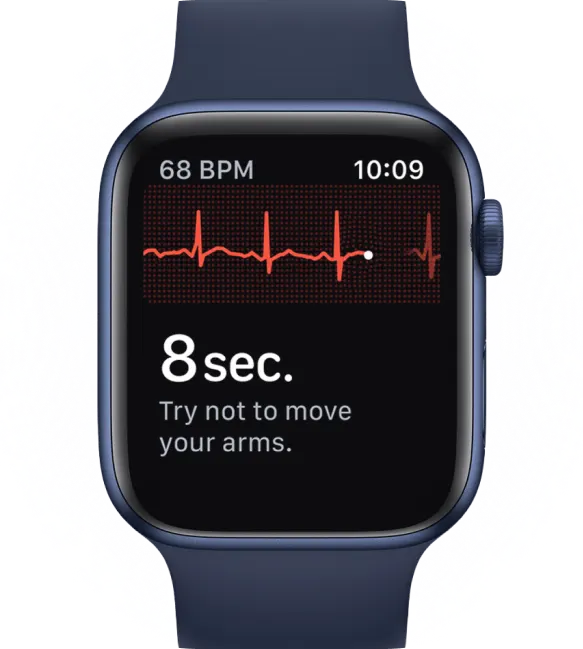
Your watch ECG takes the invisible electrical activity inside heart cells and turns it into a visible line. Once you know what the parts of that line mean, the reading becomes much less mysterious.
The basic idea is simple. The P wave reflects the upper chambers activating. The QRS complex reflects the main pumping chambers activating. The T wave reflects the recovery phase. Calcium and potassium help drive those phases in different ways.
Reading the tracing in plain language
Here is a practical way to look at the squiggles on your screen:
- P wave: the atria are getting electrically activated
- QRS complex: the ventricles are activating and preparing for the strong squeeze
- T wave: the ventricles are electrically recovering so they can beat again
That means your ECG isn't just showing a shape. It's showing timing.

What PR, QRS, and QTc really mean
People often get intimidated by interval labels. A clearer way to think about them is this:
- PR interval: how long it takes the signal to travel from the upper chambers into the lower chambers
- QRS duration: how quickly the ventricles activate
- QTc interval: how long the ventricles take to activate and then recover, adjusted for heart rate
If you're trying to connect electrolyte questions to ECG findings, this explainer on electrolyte imbalance and your ECG is a helpful bridge between body chemistry and wearable data.

Where people get confused
The common misunderstanding is thinking that one mineral equals one wave. Real heart physiology is more connected than that.
Calcium plays a major role in the activation and contraction side of the heartbeat. Potassium is essential in the recovery side. But the entire tracing reflects teamwork across multiple channels and tissues.
That matters if you've seen comments about magnesium too. Mineral balance is rarely a one-player story, which is why broader reading on balancing magnesium and calcium for health can be useful when you're trying to understand the bigger picture of rhythm stability.
When your watch shows PR, QRS, and QTc, it's showing the timing of your heart's electrical choreography, not random app jargon.
What your wearable can and can't tell you
A wearable ECG can show trends, timing, and rhythm patterns. It can help you connect symptoms with a recording taken in the moment. That's powerful.
It can't diagnose the exact mineral problem by itself. A tracing may suggest that something in the electrical system is behaving differently, but it can't confirm whether potassium, calcium, medication effects, dehydration, or another factor is responsible. That's why the best use of your watch is as a smart observer, not a solo diagnostician.
When Calcium and Potassium Levels Are Unbalanced
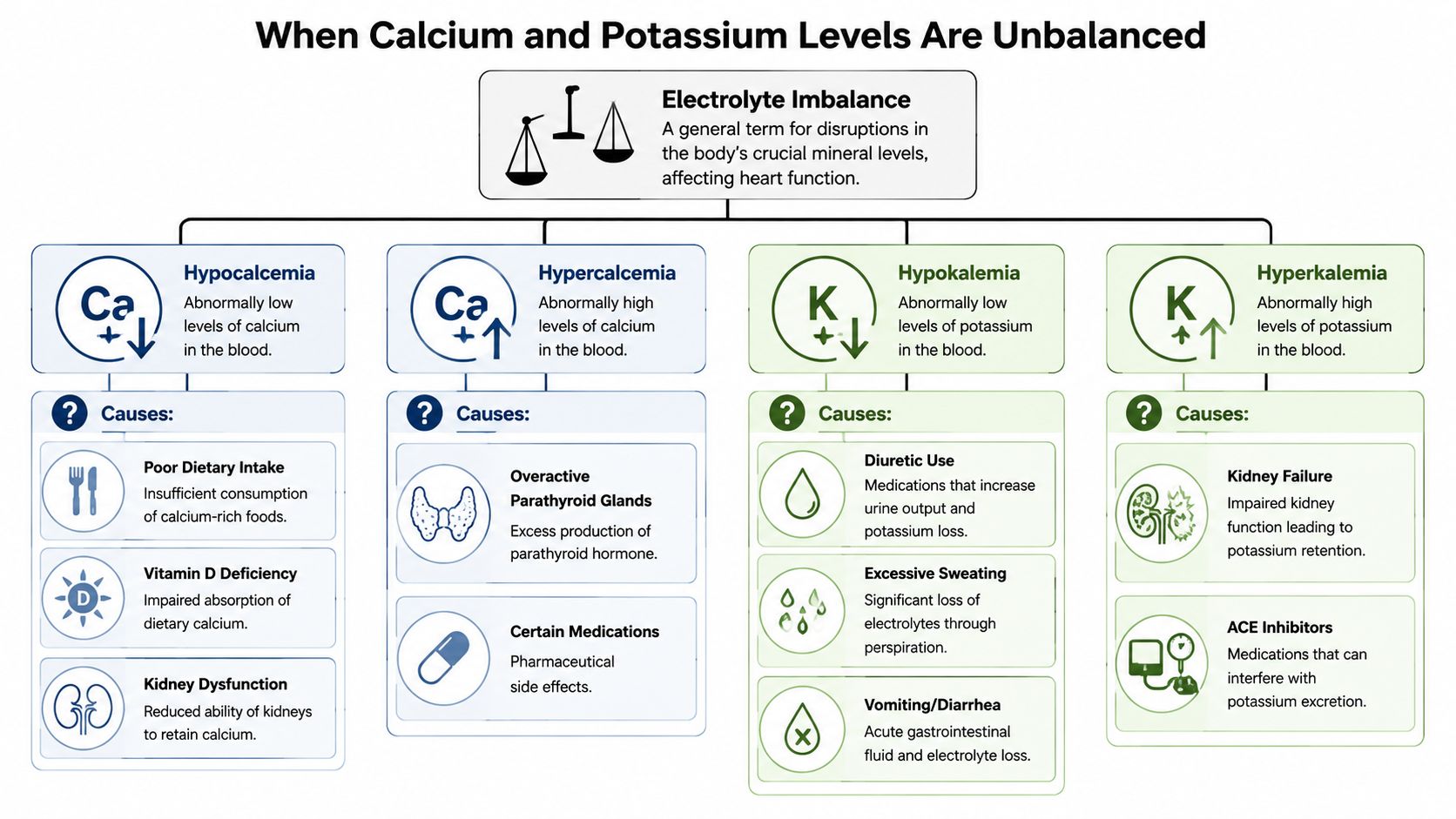
Electrolyte imbalance sounds dramatic, but many causes are ordinary. A few common ones are not eating enough potassium-rich foods, losing fluids through vomiting or diarrhea, taking diuretics, getting dehydrated, or having kidney problems that change how the body handles minerals.
Some calcium problems also come from issues such as low dietary intake, vitamin D problems, or medications. The key point is that the body doesn't handle calcium and potassium in isolation. Changes in one often affect the bigger rhythm environment.
Low potassium and high potassium
Hypokalemia means blood potassium is too low. This can make the heart more electrically irritable and may contribute to palpitations, cramps, weakness, or rhythm changes.
Hyperkalemia means blood potassium is too high. This can interfere with normal electrical conduction and may become dangerous, especially in people with kidney dysfunction or medication-related potassium retention.
For day-to-day prevention, potassium intake matters. The adequate intake is 3,400 mg/day for men and 2,600 mg/day for women, and inadequate intake of both calcium and potassium has been linked to hypertension affecting about 50 million Americans according to this review on potassium, calcium, and blood pressure.
Low calcium and high calcium
Low calcium can affect nerve and muscle signaling, including the heart's electrical behavior. High calcium can also alter conduction and change how the heart contracts and repolarizes.
It is challenging to recognize these states from symptoms alone, because sensations overlap. A person might feel fatigue, fluttering, weakness, or vague unease in several different mineral situations.
How this can show up on a watch ECG
A wearable ECG doesn't measure electrolytes directly, but it may show clues that support further questions.
- QRS changes: if conduction through the ventricles slows, the QRS may look wider
- QTc changes: if recovery timing is altered, the QTc may trend longer or shorter
- Rhythm irregularity: extra beats, brief runs, or a jumpy rhythm may appear alongside symptoms
If potassium is one of your main concerns, this plain-language review of potassium levels and heart rhythm can help you connect lab discussions with what you notice on your device.
A strange ECG on your watch doesn't automatically mean danger. It does mean the pattern deserves context.
The kidney stone and bone question people rarely hear answered well
Many people assume more potassium must always create more urinary mineral loss. However, the situation is more nuanced. Some readers also worry about kidney stones or bone thinning at the same time they worry about heart rhythm.
One important point is reassuring. The Office of Dietary Supplements notes that people consuming at least 4,042 mg of potassium per day had a 51% lower risk of kidney stones than those consuming 2,895 mg, with the benefit linked to higher citrate levels and more urine volume in the NIH potassium fact sheet. But there are still under-discussed questions in certain populations, especially where bone density or very low calcium intake complicate the picture.
Arrhythmias Medications and Clinical Consequences
For many people, this topic stops being abstract the moment an app flags a rhythm issue or a clinician mentions terms like PVCs, SVT, or atrial fibrillation. That's when the calcium and potassium relationship starts to feel personal.
A common pattern goes like this. Someone notices intermittent fluttering at rest, then a few stronger thumps after a poor night's sleep, dehydration, or a stomach bug. Their watch catches an odd rhythm strip. Nothing about that moment tells them exactly which electrolyte may be involved, but the event fits the bigger truth that heart rhythm is sensitive to internal chemistry.

Why arrhythmias can appear
When potassium is too low, heart cells may become easier to trigger at the wrong time. When potassium is too high, conduction can become impaired. Calcium disturbances can also change how quickly or forcefully the heart muscle responds to electrical signals.
That doesn't mean every palpitation equals a dangerous arrhythmia. It means mineral imbalance can be one contributor among several, along with stress, sleep loss, stimulants, illness, and structural heart issues.
The medication side of the story
At this point, many patients have an “oh, that makes sense” moment. A lot of heart medications work by influencing these same pathways.
Some medicines change how calcium moves through cells. Others indirectly affect potassium balance by changing how the kidneys handle fluid and electrolytes. That's one reason medication reviews matter so much when a rhythm suddenly changes.
If you've ever wondered why some prescriptions intentionally target these electrical pathways, this overview of calcium channel blockers explains the logic in very practical terms.
What the clinical consequences can look like
The outcomes vary widely.
Sometimes the consequence is mild but annoying, such as extra beats you feel mostly at night. Sometimes it looks like short bursts of rapid rhythm that stop on their own. In more serious situations, especially with significant potassium abnormalities, the concern shifts toward unstable rhythms that need urgent medical attention.
What matters most is context:
- Symptoms plus a pattern: a wearable trace during the event is more useful than a vague memory later
- Medication changes: new blood pressure medicines, diuretics, or supplements can matter
- Kidney function and hydration: both strongly influence potassium handling
- Repeated episodes: trends are often more informative than isolated moments
Don't assume every palpitation is harmless, and don't assume every palpitation is a crisis. Good care starts with pattern recognition and timing.
For skeptical patients, that balanced middle ground is important. You don't need to dismiss what you're feeling. You also don't need to jump to the worst-case conclusion. The most useful next step is usually better information.
Your Action Plan for Heart Health Monitoring
If you use a wearable ECG, your biggest advantage is timing. You can capture what your heart is doing while symptoms are happening, instead of trying to describe the feeling hours later in a clinic room.
That gives you a practical way to monitor the calcium and potassium relationship indirectly. Again, your watch isn't measuring minerals. It is measuring the electrical behavior that mineral balance can influence.
What to track on your device
Look for trends, not one-off panic moments.
- PR interval: notice if reports start showing a consistent shift from your usual pattern
- QRS duration: pay attention if the ventricular activation time seems to broaden over multiple recordings
- QTc interval: watch for changes in the full “fire and recharge” window, especially if symptoms or medication changes happen around the same time
- Rhythm labels: keep a record of when your device or interpretation service flags PVCs, AFib, or SVT-like events

How to make your notes more useful
A simple log can help your clinician much more than a general statement like “my heart's been weird lately.”
Write down:
- When it happened: morning, after exercise, during stress, after poor sleep
- What you felt: flutter, pause, racing, pounding, dizziness
- Anything that changed: illness, dehydration, diarrhea, a new medicine, a missed dose, a supplement, a hard workout
- What the ECG showed: especially if you have interval readings or a saved strip
If food tracking is part of your plan, PlateBird's nutrition label guide can help you read labels more confidently when you're trying to compare potassium-containing foods and overall dietary patterns.
Why small diet changes can matter
The body responds to steady habits. For every 1,000 mg of potassium you eat daily, your body conserves about 11 mg of calcium by reducing urinary loss, according to this Journal of Nutrition source on potassium and calcium conservation. That doesn't mean you should self-treat every palpitation with potassium. It does mean daily intake patterns can influence your broader mineral balance over time.
What to say to your doctor
If you've had trouble being heard before, going in with specifics can change the tone of the conversation.
Try language like this:
- “I've been tracking when the palpitations happen, and they seem to cluster when I'm dehydrated.”
- “I've noticed changes in my QTc trend on my wearable recordings.”
- “I started a new medication and then began seeing unusual rhythm episodes.”
- “Could we review whether electrolytes, kidney function, or medications might be contributing?”
That approach is calm, data-based, and collaborative.
When to seek immediate care
Use urgent or emergency care right away if a rhythm concern comes with red-flag symptoms such as:
- Chest pain
- Fainting or near-fainting
- Severe shortness of breath
- New confusion
- A sustained rapid or very irregular rhythm with worsening symptoms
If something feels dramatically different from your usual pattern, trust that signal from your body.
You don't need to become your own cardiologist. You just need to become a well-informed observer of your own patterns. That's often enough to turn fear into useful action.


Want expert eyes on your wearable ECG data? Qaly turns your recordings into human-reviewed reports with clear PR, QRS, and QTc readings.



.png)
.png)