


Key Takeaways

User Profile
Hello Heart Hero.
You might be reading this after your Apple Watch, Kardia, Fitbit, or Samsung device flagged something odd. Maybe you felt a thump in your chest, checked your wearable, and now you're stuck between two uncomfortable thoughts. One says, "It's probably nothing." The other says, "What if this is serious?"
That middle ground is hard. It's even harder when quick appointments, rushed answers, or generic advice leave you feeling like you have to do your own homework. If that's where you are, you're not overreacting. You're trying to understand your body.
Magnesium is one of those quiet, behind-the-scenes minerals that matters more than many people realize. It doesn't replace medical care, and it isn't a magic fix. But it does play a real role in heart rhythm stability, and that makes it worth understanding if you're dealing with palpitations, skipped beats, or wearable ECG alerts.
Welcome to Your Heart Rhythm Journey
Heart rhythm symptoms can make everyday life feel shaky. A few seconds of fluttering can send your mind racing for hours. Many people end up checking their pulse, replaying symptoms, and scrolling through conflicting advice late at night.
That anxiety makes sense. Your heart is personal. When it feels off, everything else fades into the background.
Why magnesium keeps coming up
Magnesium matters because your heart runs on electrical signals, not just muscle strength. If you've been exploring natural ways to support your body, magnesium is one of the more grounded topics to look into because it has a direct job in how heart cells behave.
Many people become confused. They hear "electrolytes" and think only about sports drinks or dehydration. But magnesium is part of the bigger electrical system that helps your heart beat in an organized way.
Your heart doesn't only need energy to beat. It also needs the right mineral balance to beat in sequence.
A calm, practical way to think about this
You don't need to become a cardiology expert to make sense of magnesium and heart rhythm. You just need a few clear ideas:
- Your heart uses electricity: Every beat starts with a signal.
- Magnesium helps control that signal: It supports steadiness, not speed.
- Low levels can matter: They may make the heart more irritable.
- Your wearable can be useful: It can help you notice patterns, especially when symptoms come and go.
If you're skeptical of one-size-fits-all healthcare, that's understandable. Still, the safest path isn't choosing between self-care and professional care. It's using both wisely. Learn what you can, notice what your body is doing, and bring better questions to your clinician.
How Magnesium Calms Your Heart's Electrical System
Your heart beats because billions of cells open and close tiny channels that move minerals in and out. Magnesium helps keep that traffic orderly. One of its biggest jobs is acting like a natural calcium blocker inside heart cells, which helps regulate how much calcium enters and influences heart rate and rhythm, as explained in this overview of magnesium's heart effects.
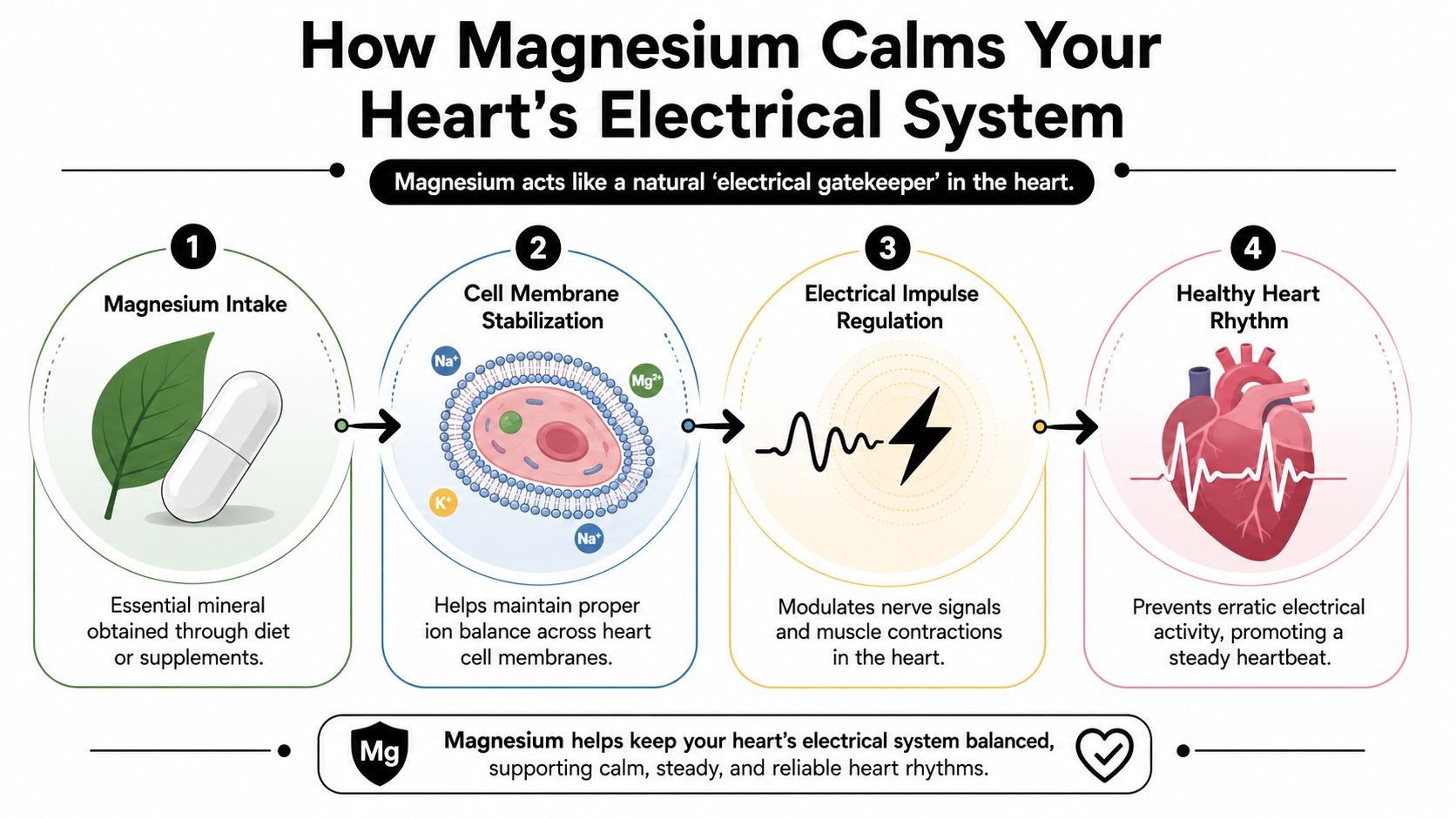
Think of magnesium as a gatekeeper
A simple analogy helps here. Think of each heart cell as a room with a guarded door. Calcium is one of the guests allowed in, and calcium has an exciting effect. It helps trigger contraction.
Magnesium stands at the door like a calm security guard. It doesn't block everything. It helps control how much calcium gets in and when. That balance helps heart cells fire and recover in a coordinated pattern.
When magnesium is too low, the guard gets weak. Too much calcium activity can slip through. Then the heart muscle can become more jumpy, contract too aggressively, and produce irregular beats or faster rhythms. That's one reason magnesium and heart rhythm are so closely linked.
Why this matters when you feel palpitations
Palpitations don't always mean danger. They can happen for many reasons, including stress, stimulants, poor sleep, illness, medication effects, or shifts in electrolytes. But if your heart cells are more irritable than usual, even small triggers can feel louder.
Here's the practical version:
- Steady magnesium levels help stability: Heart cells are less likely to overreact.
- Low magnesium can raise irritability: Extra beats or racing spells may feel more likely.
- Wearables can notice the result, not the cause: Your watch may catch the rhythm change, but not why it happened.
If you want a plain-language refresher on the specialists who study electrical rhythm problems, this article on cardiac electrophysiology is a helpful companion.
Practical rule: A wearable ECG can show that something happened. Magnesium helps explain one reason the heart may have been easier to trigger in the first place.
The sleep connection people often miss
Many people notice palpitations feel worse when they're run down. That's not surprising. Poor sleep can make you more aware of every heartbeat and can amplify the stress response that often travels with rhythm worries.
If sleep has become part of the cycle, some readers also look into magnesium for restful sleep because calming the body at night can support the bigger picture of symptom management. It won't diagnose an arrhythmia, but better rest can lower the background noise that makes every skipped beat feel enormous.
The Evidence on Magnesium for Arrhythmias
A lot of anxious readers reach this point with the same question. If magnesium really matters for heart rhythm, is that something doctors use, or is it just another internet promise?
There is real clinical evidence behind it. Magnesium has been studied in hospitals and emergency settings because rhythm problems are electrical problems, and electrolytes help shape how that electrical system behaves.
A 2018 meta-analysis of 22 clinical studies found that magnesium sulfate supplementation significantly reduced arrhythmia risk, lowering ventricular arrhythmias by 32% and supraventricular arrhythmias, including atrial arrhythmias, by 42%, according to this summary of the findings.
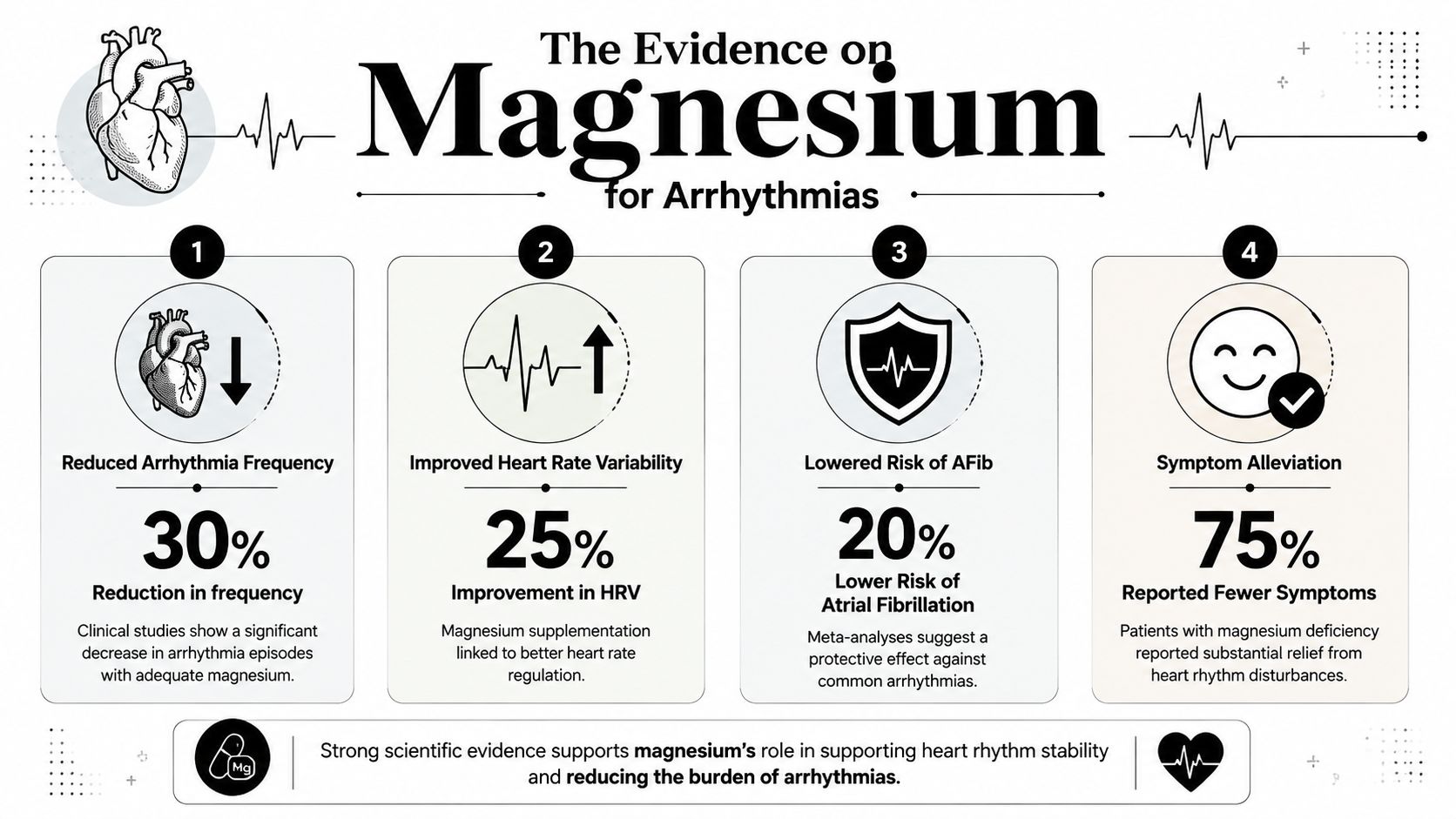
What that means in plain language
Your heart's electrical system works like a group of musicians trying to stay on tempo. Magnesium helps the timing stay steadier. In some situations, that can mean fewer rhythm disturbances or better control of a fast rhythm.
That does not mean magnesium will stop every skipped beat you feel. It also does not mean a new episode of palpitations is safe to manage on your own. The more accurate takeaway is narrower and more useful. Magnesium can support rhythm stability in certain settings, but it does not replace diagnosis, ECG review, or medical care.
Another clinically relevant finding comes from a review in American Family Physician, which reported that intravenous magnesium was more effective than placebo for slowing the ventricular response in atrial fibrillation, while not showing a clear improvement in converting atrial fibrillation back to a normal rhythm, based on its review of randomized trials in this evidence summary on magnesium for acute atrial fibrillation.
That distinction matters for anyone checking a wearable ECG after a racing episode. A supplement or IV treatment might help the heart slow down without fixing the underlying rhythm. Your watch may show fewer very fast rates, but the tracing can still need expert review to determine whether the rhythm was atrial fibrillation, frequent ectopy, or something else.
Why this matters if you use a wearable ECG
Wearables are useful at catching moments. They are much less useful at explaining why those moments happened.
If your device flags an irregular rhythm or you keep seeing unexplained fast heart rates, magnesium becomes part of the context, not the conclusion. Low magnesium, dehydration, illness, medications, and other electrolyte shifts can all change what shows up on an ECG. This guide to electrolyte imbalance and your ECG can help you connect those pieces.
Here are the practical takeaways:
- Magnesium has a legitimate medical role: It is used and studied in real clinical settings.
- It may help control speed more than reset rhythm: That is an important difference.
- Symptoms still need verification: A pounding or fluttering feeling does not tell you which rhythm was present.
- Wearable data is more useful with interpretation: If your watch records an episode, getting that tracing reviewed through a service like Qaly can help separate self-care questions from true arrhythmia concerns.
Magnesium fits best into a bigger rhythm picture that includes symptoms, ECG evidence, medications, and basic lab considerations.
Are You Getting Enough Magnesium
You feel a flutter, glance at your watch, and start replaying the day. Did I sleep badly? Drink too much coffee? Forget lunch? Magnesium often enters the conversation right here, because it is one of the nutrients people wonder about when palpitations keep showing up without a clear pattern.
A useful starting point is knowing what "enough" means. According to the National Institutes of Health Office of Dietary Supplements, the recommended dietary allowance for adults ages 19 to 51 is 400 to 420 mg per day for men and 310 to 320 mg per day for women.

That number helps, but it does not tell you whether you personally are falling short. Magnesium status can be a little tricky. Your body uses it behind the scenes for muscle function, nerve signaling, sleep, and the electrical timing that keeps the heartbeat organized.
Clues that deserve attention
Symptoms are clues, not proof. That distinction matters, especially if you already feel anxious when your heart skips or races.
Low magnesium can overlap with many everyday problems, so the goal is not self-diagnosis. The goal is noticing patterns you can bring to a clinician, especially if your wearable ECG keeps catching episodes and you are trying to figure out what else might be contributing.
Patterns that may justify a closer look include:
- Muscle twitches or cramps: Especially if they happen often and you cannot explain them with exercise or dehydration.
- Fatigue: The kind that sticks around and makes normal days feel harder.
- Feeling tense or on edge: Stress and palpitations can feed each other, which makes it easy to miss a nutrition piece.
- Poor sleep: A rough night can make both symptoms and watch alerts feel louder the next day.
A food and symptom log can help here. Wearables record moments. Your notes provide context. If a fluttering episode keeps happening on days when meals are irregular, sleep is short, or intake of magnesium-rich foods is low, that is useful information to pair with the ECG tracing.
Food first is a calm, safe place to start
For many people, the easiest first step is the grocery list.
Magnesium-rich foods include leafy greens, beans, lentils, nuts, seeds, whole grains, and dark chocolate. You do not need a perfect diet to make progress. Adding spinach to eggs, pumpkin seeds to yogurt, beans to soup, or almonds as a snack can move your intake in a better direction without turning the whole day into a nutrition project.
Some people also explore topical products to enhance sleep with magnesium oil, but food and medical guidance should stay at the center of any plan for heart rhythm concerns.
If you want a clearer overview of forms, safety points, and common questions, this guide to magnesium supplements for heart health can help you sort through the basics before you buy anything.
More is not always safer
That is especially true if you have kidney disease, take diuretics, use heart medications, or are already treating an arrhythmia.
It is easy to see a supplement bottle and assume magnesium is harmless because it is sold over the counter. In real life, dose, form, kidney function, and medication timing all matter. Loose stools, stomach upset, and drug interactions are common reasons to slow down and ask before starting.
If your watch records an irregular rhythm, magnesium should be part of the bigger picture, not the whole explanation. A nutrient question and an ECG question can exist at the same time, and both deserve careful attention.


A Practical Guide to Magnesium Supplementation
You feel your heart skip, your watch records something odd, and within ten minutes you are comparing magnesium bottles on your phone. That reaction makes sense. Palpitations can make small decisions feel urgent.
A supplement can be one part of a careful plan. It helps to treat it like choosing the right tool, not grabbing the biggest one on the shelf. The form matters because different types of magnesium behave differently in the gut and may be easier or harder to tolerate.
How common forms differ
Magnesium glycinate is often chosen by people who want a gentler option. It is commonly preferred if stomach upset is a concern, and some people like taking it later in the day because it feels less disruptive.
Magnesium citrate is easy to find and often less expensive. It can bother the digestive tract more, so a person who already has a sensitive stomach may notice loose stools sooner.
Magnesium oxide is sold almost everywhere, but many clinicians and shoppers look at other forms first if comfort and absorption are the main goals.
The best choice is the one you can take safely and consistently, with guidance that fits your medical history.
A safer way to approach it
Start low. Pay attention. Write things down.
The National Institutes of Health Office of Dietary Supplements notes that magnesium from supplements is more likely to cause diarrhea, nausea, and cramping, and it lists 350 mg per day as the tolerable upper intake level from supplements for adults unless a clinician advises otherwise in a specific medical setting. You can review those details in the NIH fact sheet on magnesium supplement safety and upper intake levels.
That does not mean every adult should take 350 mg. It means self-starting above that amount deserves more caution. Kidney function, food intake, the reason you want magnesium, and the medicines you take all change the picture.
Questions for your doctor or pharmacist can keep this simple:
- Does magnesium fit with my medications? This matters if you take antibiotics, diuretics, beta blockers, or rhythm drugs.
- Which form matches my stomach and symptoms? A bottle that looks popular online may still be a poor fit for you.
- When should I take it? Timing can matter because magnesium can interfere with how some medicines are absorbed.
- What should make me stop and ask? Diarrhea, cramping, or feeling worse are useful signals, not something to push through.
If you use an Apple Watch, Kardia, or another wearable ECG, keep one more habit in mind. Log when you start the supplement, what dose you took, and whether your symptoms changed. That kind of note helps you avoid guessing later. It also gives a clinician, or a review service like Qaly, better context if you want help comparing your symptoms with your ECG recordings.
If you want a broader overview before talking with your clinician, this guide to magnesium supplements for heart health can help you sort through forms, side effects, and common questions. And if sleep tension is part of the picture, some people also explore topics like enhance sleep with magnesium oil while keeping expectations realistic.
Magnesium works best as a measured experiment inside a real medical plan, especially if your wearable is already showing rhythm changes you do not fully understand.
Monitoring Your Heart with a Wearable ECG
You feel a flutter, your watch records something unfamiliar, and your mind jumps straight to worst case scenarios. That reaction is common. A wearable ECG can help, but it helps most when you treat it like a notebook for your heart rhythm, not a final answer.
Magnesium adds one more layer to that picture. As noted earlier, low magnesium can affect the heart's electrical system and sometimes shows up on ECGs with changes in repolarization or extra beats. The hard part is that a home device usually cannot tell you why a tracing looks different. Stress, poor sleep, dehydration, illness, medication changes, and electrolyte shifts can all create patterns that feel alarming.

What your wearable can and can't do
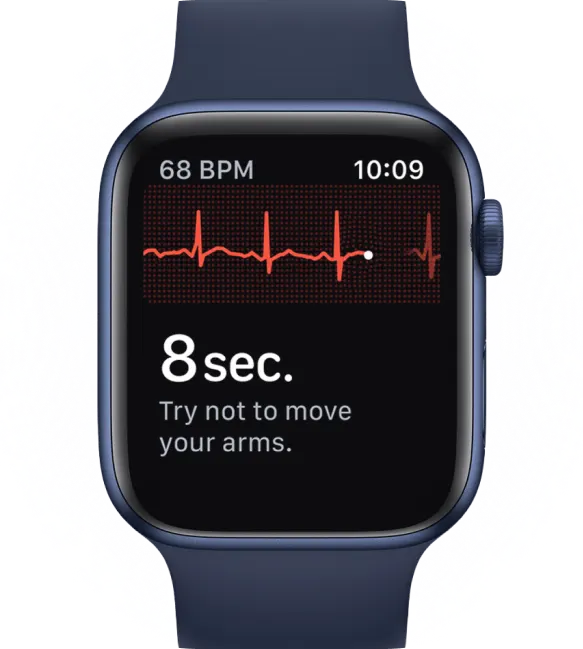
Your Apple Watch or Kardia is good at catching a moment in time. If palpitations happen at 9:14 p.m., the tracing can show the rhythm, the rate, and whether it looks regular or irregular. That is useful evidence, especially when symptoms come and go before you can reach a clinic.
A wearable does not measure the whole body context. It cannot confirm whether magnesium is part of the story. It also cannot reliably sort every tracing into a clear diagnosis.
That is why patterns matter more than isolated alerts. One recording may raise a question. Several recordings, matched with symptoms and timing, can tell a much clearer story. If you want a better sense of how repeated recordings fit together, this guide to continuous ECG monitoring with wearable devices explains the difference between one snapshot and a trend.
How to use your recordings without feeding anxiety
A calm routine works better than checking every few minutes.
Try this approach:
- Save one baseline tracing when you feel well and relaxed.
- Record symptom episodes with a short note about caffeine, sleep, stress, hydration, illness, or supplement changes.
- Look for repeated patterns instead of trying to explain one strange reading in the moment.
- Get a human review if the automated label does not match how you feel, or if the tracing keeps recurring.
This is the bridge many people need. Self-care questions, like whether magnesium might be worth discussing, belong on one side. Verified rhythm review belongs on the other. A service like Qaly can help connect those two worlds by reviewing wearable ECGs with more nuance than a generic app notification, so you are not left guessing whether a change is meaningful.
Some people who already track health with wearables also explore adjacent tools such as BionicGym's proven cardio technology. New devices can support awareness and habits. ECG interpretation still needs careful review.
A steadier mindset for wearable users
Ask your device to collect evidence.
That small mindset shift can lower a lot of fear. Instead of chasing certainty from every buzz or skipped beat, you are building a record that can be reviewed in context. For someone worried that magnesium, stress, or something else is affecting their rhythm, that is often the safest and most reassuring use of a wearable ECG.
Your Next Steps for a Steady Heart Rhythm
If you've made it this far, you already did something useful. You slowed down, looked past internet noise, and focused on one real piece of the heart rhythm puzzle.
Magnesium and heart rhythm are connected in a meaningful way. Magnesium helps regulate the electrical behavior of heart cells. Getting enough through food is the foundation. Supplements may help some people, but they should be chosen carefully and discussed with a healthcare professional.
Keep your plan simple
You don't need to overhaul your life overnight.
Start here:
- Check your intake: Compare your habits with the daily targets discussed earlier.
- Favor food first: Build meals around leafy greens, nuts, seeds, legumes, and other magnesium-rich foods.
- Use supplements carefully: Especially if you take heart medicines or have kidney concerns.
- Track wearable ECGs wisely: Save tracings, note symptoms, and look for patterns rather than perfection.
The most calming answer usually comes from combining self-observation, good data, and professional interpretation.
If your wearable ECGs are raising questions and you want expert eyes on the recordings, Qaly can help you get human-reviewed ECG analysis from your at-home or wearable device so you can track rhythm changes with more clarity and bring stronger information to your medical appointments.

Unsure if magnesium explains your ECG? Certified experts review your ECG within minutes.



.png)
.png)