





Key Takeaways

User Profile
Hello Heart Hero. You glance at your Apple Watch, Fitbit, or Kardia recording and see an irregular pattern. Your stomach drops a little. Maybe the app flagged an odd rhythm, or maybe you noticed that the small bumps before each heartbeat don't all look the same. That reaction is completely understandable.
A lot of wearable users end up in the same place. You want a straight answer, not hand-waving. You want to know whether this is a harmless quirk or something you shouldn't ignore. The reassuring part is that some irregular rhythms are much less alarming than they sound.
One of those is wandering atrial pacemaker. If you've been asking what is wandering atrial pacemaker, the short answer is this: it's a usually benign rhythm where the heart's electrical starting point shifts around a bit in the upper chambers, but the heart rate stays below 100 beats per minute. On a wearable ECG, that can look strange even when it isn't dangerous.
Your Heart's Natural Rhythm and Its Variations
Your heart has its own built-in electrical timing system. Most of the time, one small area called the SA node starts each beat in a steady, organized way. That's what people mean by a normal sinus rhythm.
When that starting point behaves consistently, the ECG usually has a repeating pattern. On a watch ECG, the little atrial signal before each big spike tends to look similar beat after beat. If you want a refresher on what a usual atrial rate looks like, this guide on normal atrial rate can help.
Why normal variation can still look strange
The part that throws people off is that a heart rhythm can be different without being dangerous. Breathing, relaxation, athletic conditioning, and shifts in nervous system tone can all change the rhythm slightly. A wearable device is sensitive enough to catch these changes, but it can't always explain them clearly.
That gap matters. If you're skeptical of quick, dismissive answers, you're not wrong to want more detail. A rhythm strip is real information. It deserves a real explanation.
Practical rule: An irregular watch ECG isn't automatically an emergency. The pattern matters more than the fact that it looks unfamiliar.
Why wearable users get confused
Single-lead devices only give you one viewing angle. That's useful, but it also means subtle rhythm distinctions can be harder to confirm than they are on a clinical ECG. So you might see something odd without getting enough context from the device itself.
That's exactly why wandering atrial pacemaker worries so many people. It can look unusual, yet in many cases it's just one of the heart's normal electrical variations.
Understanding Wandering Atrial Pacemaker
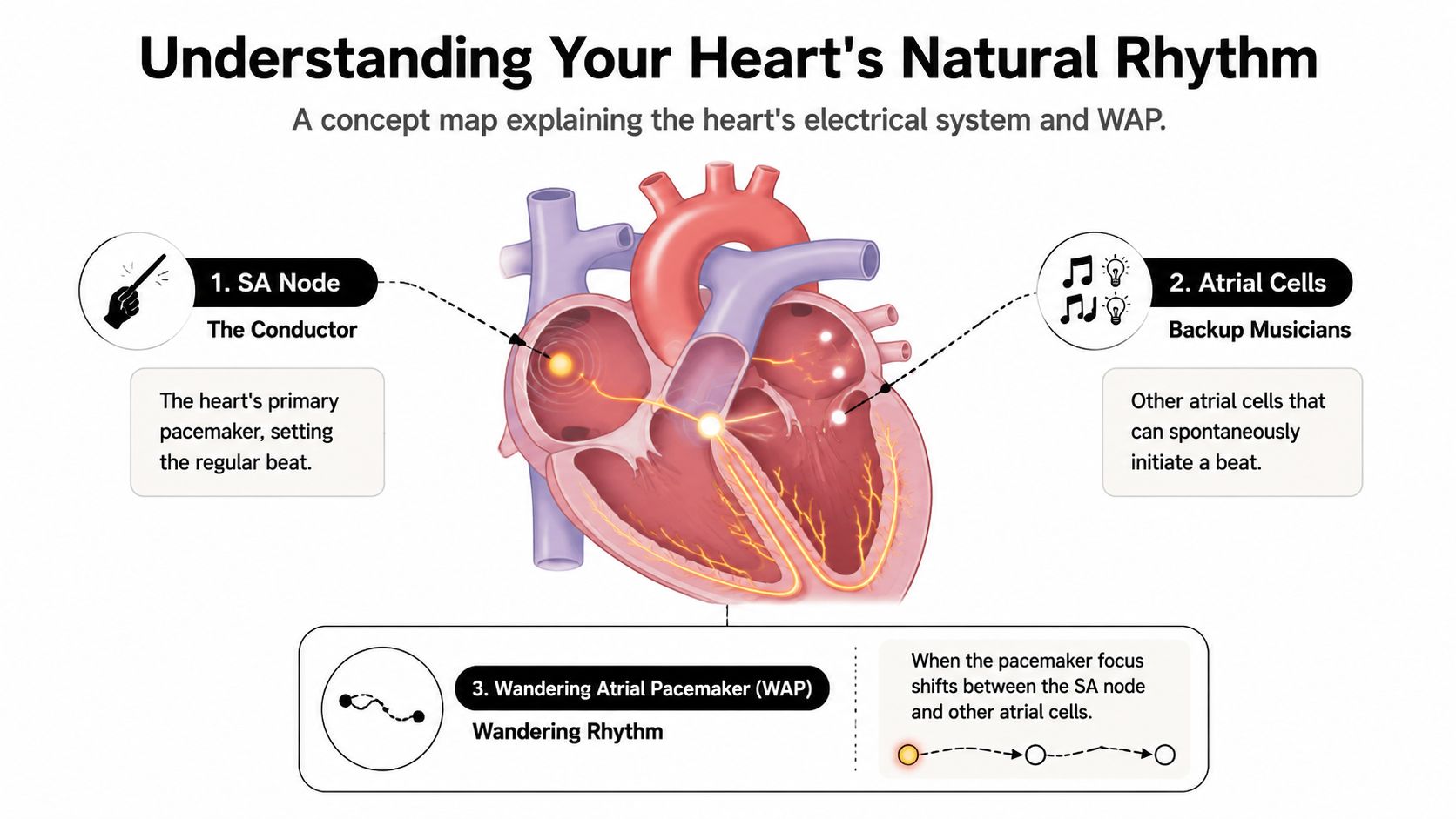
You check your watch, see an odd rhythm strip, and notice that the heartbeat looks organized but not perfectly repetitive. That is often the moment people worry that the heart is losing control. Wandering atrial pacemaker usually means something much less dramatic. The heartbeat is still being started in the atria, but the starting spot shifts slightly from beat to beat.
A simple way to picture it is a lead drummer who briefly lets nearby players tap the beat for a moment. The song continues. The timing stays coordinated. What changes is who starts each beat, and that small change alters the look of the atrial signal on the ECG.
What the name actually means
The word wandering sounds unsettling, but it does not mean the rhythm is chaotic. It means the pacemaker focus moves between the SA node, the heart's usual leader, and other nearby atrial cells that can also fire. The ventricles still receive the signal and produce a normal heartbeat. On a watch ECG, the main clue is that the small atrial bump before the big spike does not keep the same shape.
That changing bump is the P wave. If you want a quick visual refresher, this guide to what P waves look like in your watch ECG makes the pattern easier to spot.
Here is why the shape changes. When the electrical signal starts from a slightly different point in the atria, it travels in a slightly different direction. A single-lead watch records that direction change as a different-looking P wave. One beat may have a rounded P wave. The next may look flatter, smaller, or a little notched.
Why the heart rate matters
For wearable users, the reassuring part is the overall pace. Wandering atrial pacemaker is an atrial rhythm with shifting origins, but it is not a fast atrial rhythm. If the pattern of changing P waves appears while the rate stays under 100 beats per minute, that fits the usual definition of WAP rather than the faster rhythm doctors call multifocal atrial tachycardia, as explained in Manual of Medicine's ECG review.
That distinction matters because many watches label anything irregular in a broad, unhelpful way. A strip with visible atrial activity, changing P-wave shapes, and a non-fast rate can look strange while still being relatively benign.
A rhythm can be unusual without being dangerous. With WAP, the pattern is shifting, but the atria are still conducting in an organized way.
Why it often shows up in otherwise healthy hearts
Wandering atrial pacemaker often appears when the balance between rest and activity changes easily. You may see it in athletes, younger people, and older adults, especially when vagal tone is higher and the SA node slows a little. Nearby atrial pacemaker cells then step in briefly, and the lead role shifts back and forth.
So the best way to understand WAP is this. The electrical system is still doing its job. It is just using slightly different starting points within the atria, which can look odd on a single-lead recording without meaning the heart is in danger.
How to See Wandering Atrial Pacemaker on Your ECG
You check your watch after feeling a few odd beats, and the tracing looks unfamiliar. The good news is that wandering atrial pacemaker often looks stranger than it is. The key is knowing what to examine in the right order.
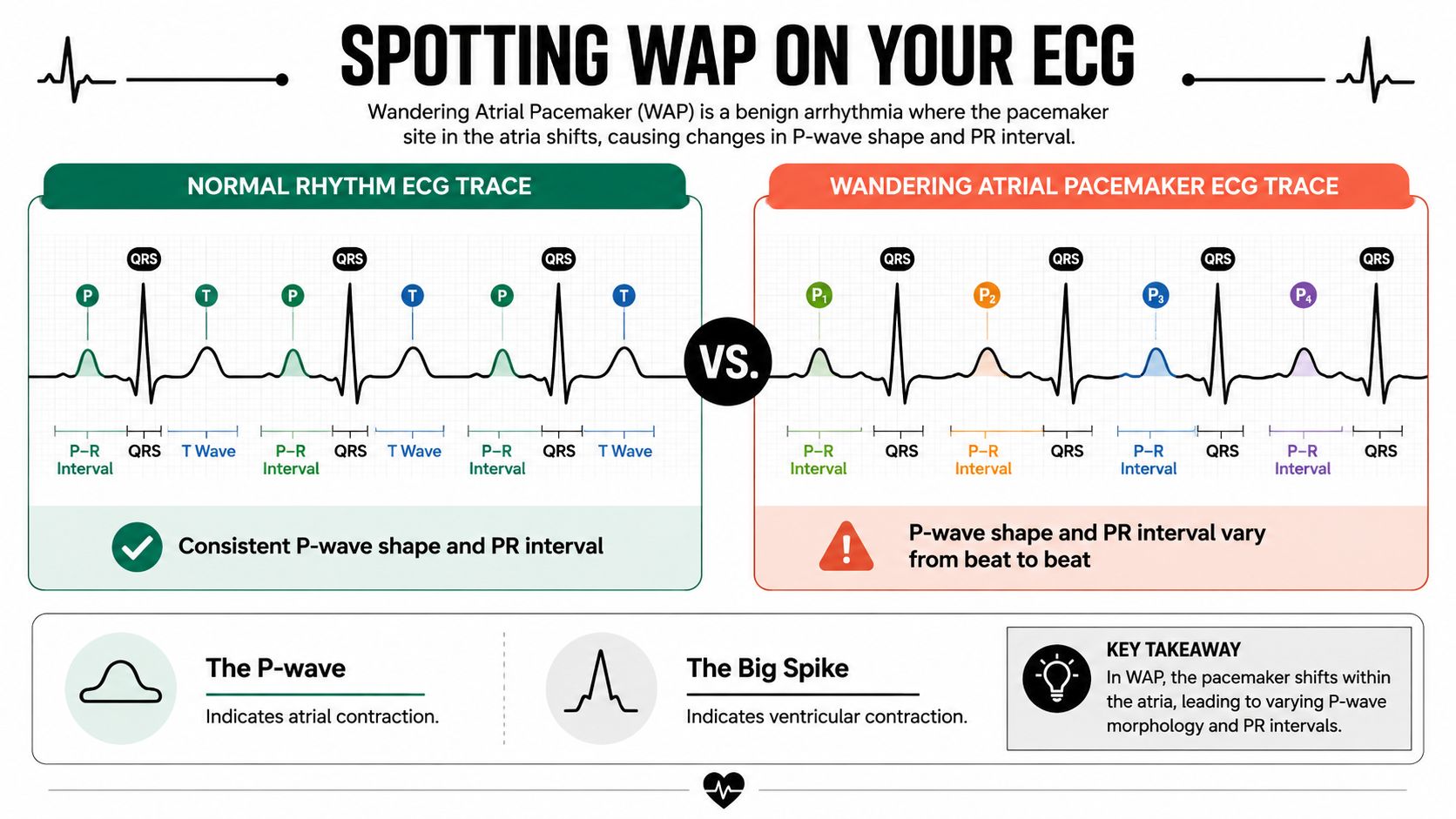
Start with the small bump before each tall spike. That small bump is the P wave, and it shows the atria starting the heartbeat. In a typical sinus rhythm, those P waves usually have the same general shape because the electrical signal begins from the same area each time.
What you're looking for on the strip
On an ECG, WAP is identified by a pattern rather than a single unusual beat. You are looking for visible P waves before the QRS complexes, but those P waves do not all match. Over the same recording, at least three P-wave shapes should look clearly different from one another, and the heart rate stays under 100 beats per minute.
On your watch ECG, that usually means:
- A P wave appears before each QRS complex. The rhythm still has an organized atrial start.
- The P waves change shape across the strip. One may look rounded, another flatter, another slightly up-and-down.
- You can spot at least three distinct P-wave appearances in the same recording.
- The rate is not fast. If the tracing is racing, clinicians start thinking about other rhythms.
If you want help spotting that first small bump, this guide to what P waves look like in your watch ECG can make the tracing much easier to read.
Why single-lead devices can be tricky
A watch records the heart from one viewing angle. That is useful, but it also means the P wave can be tiny, faint, or partly hidden. A slight change in wrist position, finger contact, muscle tension, or recording noise can make one beat look different even when the rhythm itself has not changed much.
That is why WAP can be hard to confirm on a wearable. A watch can suggest the pattern, but a fuzzy single-lead tracing can also create look-alikes. For an anxious wearable user, this is one of the most important points to remember. “Different-looking” does not automatically mean “dangerous.”
On a watch ECG, true WAP should show changing P waves with an organized rhythm, not a chaotic tracing.
A simple way to inspect your own tracing
Use a slow, repeatable approach.
- Find the tall spikes first. These are the QRS complexes.
- Look just before each spike. Check whether a small P wave is present.
- Compare several beats, not just one or two. WAP is a pattern across the strip.
- Mark the P-wave shapes mentally or with a screenshot. Ask whether you can separate them into three different appearances.
- Check the rate on the strip. If it stays under 100 and the P waves are still visible before each QRS, WAP becomes more plausible.
A simple analogy helps here. The atria are still handing off each beat in an orderly way, but the starting voice changes from beat to beat. On a watch, your job is to see whether the rhythm stays organized while the P-wave shape shifts. That combination is what makes WAP different from the more concerning rhythms wearable users often worry about.


WAP Compared to Other Heart Rhythms
Most of the fear around wearable ECGs comes from not knowing what belongs in the “probably okay” bucket and what belongs in the “get checked promptly” bucket. Wandering atrial pacemaker sits in the first bucket much more often than the second, but it does resemble a few other rhythms.

WAP versus multifocal atrial tachycardia
This is the closest cousin. The rhythm pattern can look very similar because both can show changing P-wave shapes.
The main divider is rate. Unlike multifocal atrial tachycardia (MAT), which shares the same morphological variability but presents with a heart rate exceeding 100 beats per minute, WAP is characterized by a ventricular rate strictly below 100 bpm, as summarized in this overview of MAT and WAP.
If the strip has multiple P-wave shapes and the heart rate is fast, clinicians think about MAT instead.
WAP versus atrial fibrillation
This comparison matters because a lot of wearable users worry most about AFib. WAP can be irregular, and that irregularity can create confusion.
The major distinction is organization. In WAP, you can still find distinct P waves before every QRS complex. In atrial fibrillation, the atrial activity is chaotic, so you don't see that same organized P-before-QRS pattern. The rhythm may look messy in both, but one is structured and the other is not.
WAP versus sinus arrhythmia
Sinus arrhythmia is another benign rhythm that often shows up with breathing. The timing changes, but the P waves stay uniform because the signal still starts in the same place every time.
That's the cleanest visual difference:
- Sinus arrhythmia has changing spacing with similar-looking P waves.
- WAP has changing P-wave shapes because the starting point shifts.
If this distinction trips you up, this breakdown of sinus rhythm vs ectopic atrial rhythm on your watch ECG can make the pattern easier to recognize.
If the rhythm is irregular but every beat still has a visible, changing P wave, that's a different picture from AFib.
Causes and Clinical Significance of WAP
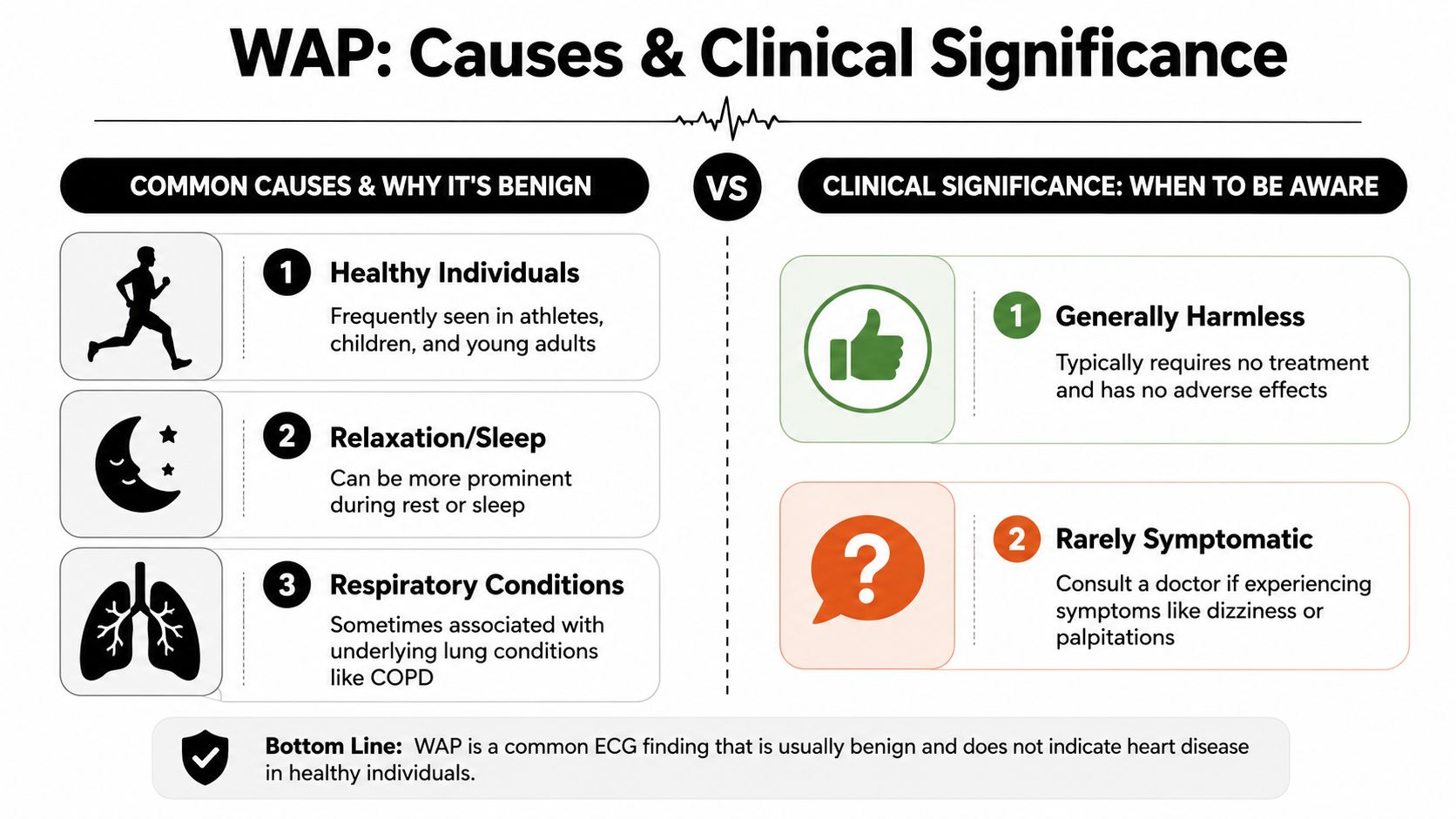
Here's the reassurance that is important to hear plainly. WAP is clinically classified as a benign, often asymptomatic arrhythmia typically observed in young individuals, older adults, and athletes, with no specific treatment required unless driven by an underlying condition such as sick sinus syndrome, according to Cleveland Clinic's overview.
That means the rhythm itself usually isn't the problem. It's often just a sign that the pacemaker site is shifting in a way that the ECG happens to capture.
Common reasons it shows up
In healthy people, wandering atrial pacemaker often appears when vagal tone is high. That's the part of the nervous system associated with rest, recovery, and relaxation. Athletes often have strong vagal tone, which is one reason this rhythm can show up on their recordings without meaning anything dangerous.
Historical data also tie WAP to heavy respiratory effort. One landmark study reported that 50% of French hornists developed WAP, a finding linked to the breathing demands of the instrument, as noted in this PubMed-indexed report.
It can also appear in the setting of non-cardiac problems, especially lung disease, respiratory decompensation, low oxygen states, or electrolyte problems such as low potassium or magnesium. Drug toxicity, including theophylline and digoxin, has also been associated with it.
When it matters more
Benign doesn't mean meaningless. Sometimes WAP is a clue rather than a diagnosis. It may show up alongside pulmonary disease, metabolic disturbance, or sick sinus syndrome. In rare situations, it can precede more concerning rhythms such as atrial fibrillation.
That doesn't mean every person with WAP is headed toward a serious arrhythmia. Most aren't. It means the ECG should be interpreted in context.
What usually gets treated
The rhythm itself usually doesn't need anti-arrhythmic treatment. When clinicians take action, they focus on the underlying issue instead.
That may mean looking at:
- Breathing status if the rhythm appeared during illness or shortness of breath
- Electrolytes if symptoms or medical history suggest imbalance
- Medication effects if someone takes drugs known to increase atrial irritability
- Symptoms over time if there's concern for sinus node dysfunction
Your recording is useful evidence. If a clinician brushes off your symptoms without looking at the strip, it's reasonable to ask for a more careful review.
What to Do If You See WAP on Your Watch
You open your watch ECG after an irregular rhythm alert and the tracing does not look like the neat, repeated pattern you expect. That moment can make your mind jump straight to AFib. In many cases, though, the right next step is slower and simpler. Save the strip, look at the pattern carefully, and get enough context before you assume the worst.
A watch records one electrical viewpoint, like looking at the heart through one window instead of twelve. That is still useful. WAP often leaves small clues on a single-lead tracing, especially if the strip is clean and the P waves are visible.
A practical action plan
Save the recording. Export the PDF or take a screenshot while the time and date are visible.
Write down what was happening. Note whether you were resting, walking, anxious, sick, short of breath, dehydrated, or feeling completely normal. A rhythm strip makes more sense when paired with symptoms and timing.
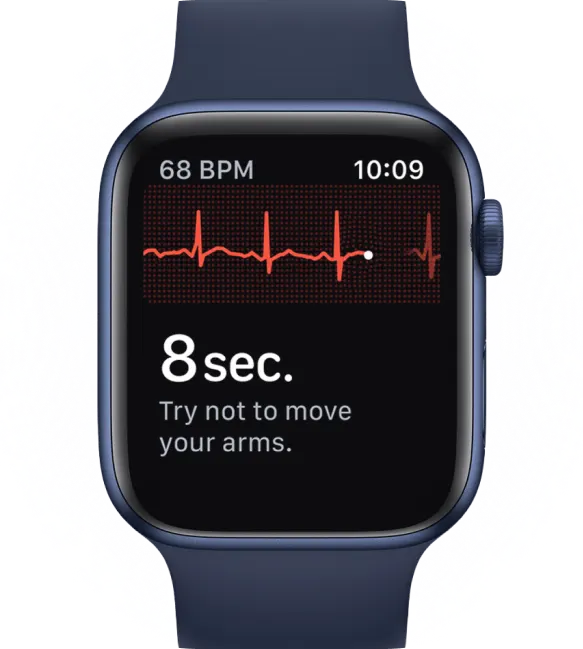
Repeat the ECG with better technique. Rest your arms, stay still, and make good skin contact so the small atrial signals are easier to see. If you use an Apple Watch, this guide on how to take an ECG with your Apple Watch can help improve the tracing.
Look for organization. With WAP, the rhythm is usually a little irregular but still organized. You can often spot a P wave before each QRS, even if the P-wave shape changes from beat to beat. AFib is different. It usually has no consistent P waves at all and looks more chaotic.
Check the heart rate. WAP is usually slower than multifocal atrial tachycardia. If the strip is irregular but the rate is not fast, that leans away from the more urgent atrial rhythms people worry about.
Ask for review if the pattern is unclear. Single-lead ECGs can show WAP, but they can also be fooled by motion, poor contact, or tiny P waves that are hard to see on a watch screen.
One recording rarely tells the whole story. A short series of strips taken at different times, especially with notes about symptoms, is often more helpful than staring at one confusing tracing for half an hour.
Get urgent medical care if you have chest pain, fainting, severe shortness of breath, or you feel acutely unwell.
For day-to-day wearable ECG questions, a human-reviewed interpretation service like Qaly can help you sort out whether your strip looks more like wandering atrial pacemaker, sinus rhythm with breathing-related variation, or a rhythm that needs faster follow-up. A clear written review can also make the conversation with your clinician much easier.

Unsure if it's WAP? Certified experts review your ECG within minutes.



.png)
.png)