


Key Takeaways

User Profile
You feel a flutter in your chest. Maybe it lasts two seconds. Maybe it comes in a burst that makes you stop what you're doing and check your Apple Watch, Fitbit, or Kardia recording right away. You stare at the tracing, see spikes and bumps, and then the questions start. Is this normal? Is this dangerous? Am I overreacting, or am I missing something important?
That uncertainty is exhausting. A lot of people turn to wearable ECGs because they want more control, more clarity, and fewer vague answers. That makes sense. If your body is sending a signal, you want to understand it.
One of the most useful things to learn is your normal atrial rate. Not because it turns you into your own cardiologist, but because it helps you translate what your wearable shows into something meaningful. Once you understand what the atria are supposed to be doing, you can ask better questions, notice more useful patterns, and bring more specific information to your doctor.
Your Guide to Atrial Rate
A common scene goes like this. You're sitting on the couch, walking up the stairs, or trying to fall asleep, and your heart suddenly feels strange. Not always painful. Just off. Maybe a skipped beat, a flutter, a quick racing spell, or that sinking feeling that makes you check your pulse.
Then you open your wearable ECG app and get a strip full of tiny hills and sharp spikes. The device might give you a heart rate number, but it often doesn't tell you the part you really want to know. What are the upper chambers of my heart doing, and does this look normal?
That's where atrial rate comes in. It sounds technical, but it's really just the rhythm of the heart's upper chambers, called the atria. If you've ever felt frustrated that your device gives you data without much explanation, you're not alone. A lot of people can capture a rhythm strip. Far fewer feel confident interpreting it.
Why this matters in real life
Knowing your normal atrial rate helps you do three practical things:
- Spot context: A number on a screen means more when you know the normal resting range for adults.
- Notice patterns: A steady rhythm feels different on an ECG than a chaotic or unusually fast one.
- Talk to your doctor more clearly: “I had palpitations” is useful. “I recorded an ECG and noticed a regular pattern with visible P waves” is even more useful.
You don't need to diagnose yourself. You just need enough understanding to recognize when a tracing looks ordinary, when it looks different, and when it deserves another set of eyes.
If you've felt brushed off before, or if you're tired of being told to “just monitor it” without being shown how, this is a good place to start. Atrial rate is one of the simplest bridges between what your watch shows and what your heart may be doing.
Understanding Your Heart's Natural Pacemaker
Your heart has its own timing system. The usual starting point is the sinoatrial node, often shortened to SA node. It sits in the right atrium and acts like the conductor of an orchestra. It doesn't play every instrument itself. It sets the tempo so the whole group stays coordinated.
When the SA node fires, the atria contract first. That electrical signal then travels onward, leading the lower chambers to contract. In a smooth, normal rhythm, this sequence repeats in an organized way.
What a normal atrial rate means
For a resting adult in normal sinus rhythm, the atrial rate is 60 to 100 beats per minute, and in that normal setting the atrial rate matches the ventricular rate. That's the basic benchmark many clinicians and ECG readers use.
People often compare the ECG they see on a wearable with the pulse they feel in their wrist or neck. In a normal rhythm, those should line up. The atria signal. The ventricles follow. The pulse reflects that follow-through.
A simple way to picture it
Think of a well-run train schedule:
- SA node: the dispatcher sending out each departure signal
- Atria: the first cars leaving the station
- Ventricles: the main engine pulling the system forward
- Pulse: the movement you can feel
If the dispatcher is steady, the whole system usually looks and feels steady.
Where people get confused
Many wearable users assume “heart rate” and “atrial rate” are always the same thing. Sometimes they are. Sometimes they aren't. Your wearable usually highlights the easiest part of the signal to count, not necessarily the upper-chamber rhythm you're trying to understand.
That's why the normal atrial rate matters as a concept, not just as a number. It helps you understand whether your ECG appears organized, whether each upper-chamber signal seems to lead to a full heartbeat, and whether the pattern fits what we expect from sinus rhythm.
If you've been told your natural pacemaker may not be behaving normally, this overview of SA node dysfunction can help put that idea into plain language.
Practical rule: A normal atrial rate is not just about speed. It's also about order. The heart can be fast, slow, regular, or chaotic. Rate is only one piece of the story.
Atrial Rate in Normal Rhythm vs Arrhythmias
A normal rhythm has a clean, coordinated feel on an ECG. The upper chambers fire in order. The lower chambers respond in order. The pattern repeats.
Arrhythmias change that picture. Some make the atria fire too fast. Some make the rhythm disorganized. Others can create a regular pattern that is still abnormal.
Normal sinus rhythm
In normal sinus rhythm, the atria are doing what they're supposed to do. The signal starts from the SA node, the rhythm is organized, and the upper and lower chambers stay in sync.

On a wearable ECG, that often looks like a repeating pattern with a small bump before the bigger spike. That small bump is the clue that the atria are leading the beat in the usual way.
Atrial fibrillation
Atrial fibrillation, or AFib, is very different. The atria don't contract in a calm, coordinated pattern. They quiver in a chaotic way. In the verified data provided for this article, atrial fibrillation is described as having an atrial rate over 350 bpm in one source and 300 to 600 bpm in another verified summary, which helps show how sharply it differs from normal sinus rhythm.
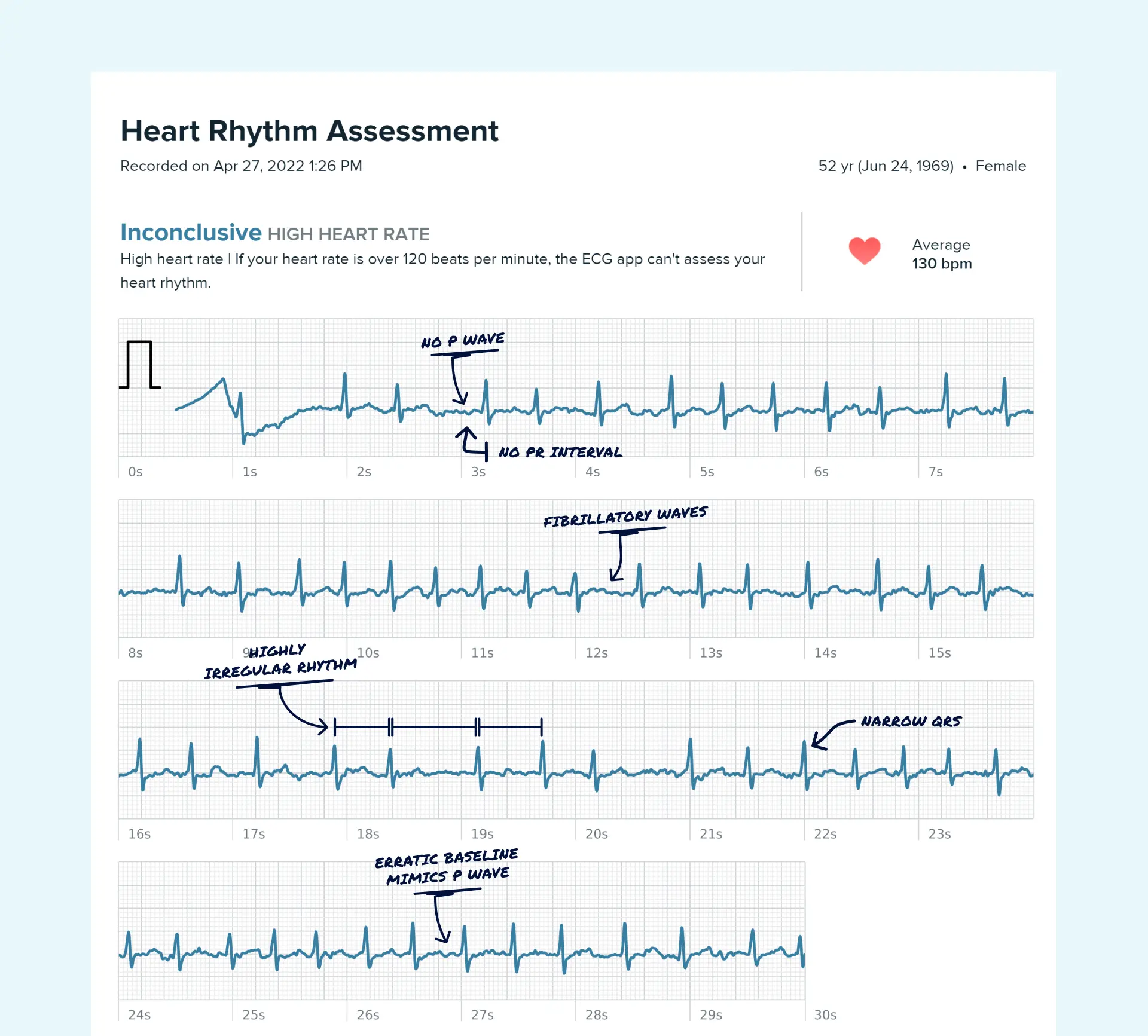
For many wearable users, the key visual clue isn't just speed. It's the loss of neat, clearly marching atrial activity. Instead of a conductor-led orchestra, it can look like everyone started playing at once.
Guidelines also make an important distinction between atrial rhythm and the heart rate doctors try to control in people who already have AFib. A review of guideline-based AFib rate control notes that a resting heart rate target of below 100 to 110 bpm is commonly recommended, and that this approach was shaped by the AFib rate-control evidence summarized here. That target is about managing AFib, not defining a normal atrial rate.
Atrial flutter and other fast rhythms
Atrial flutter tends to be more organized than AFib, but still abnormally fast. The verified data places atrial flutter at 250 to 350 bpm. Many people describe flutter episodes as a sudden machine-like rhythm. Fast. Repetitive. Hard to ignore.
.webp)
Then there are other rhythms from above the ventricles, often grouped under supraventricular tachycardia or SVT. Your wearable may capture a run of fast, regular beats without making it obvious where the rhythm started. That's one reason interpretation can get tricky with single-lead devices.
What this means for your wearable
When your watch says “high heart rate,” it isn't always telling you what the atria are doing. It may be counting the lower-chamber response, not the upper-chamber source.
That's why side-by-side pattern recognition matters:
- Normal sinus rhythm: organized and steady
- AFib: irregular and chaotic
- Atrial flutter: very fast but often more patterned
- SVT: fast and often regular, but not always easy to classify from a wearable alone
If you want a visual example of what one common abnormal rhythm can look like on a wearable tracing, this guide to what atrial fibrillation looks like on your watch ECG is a useful next step.
_apple.webp)
How to See Atrial Rate on Your Watch ECG
Most wearable users don't need a deep textbook lesson. You need a practical way to look at your tracing and say, “I think I see what the atria are doing,” or “I can't tell, and that's okay too.”
First find the P wave
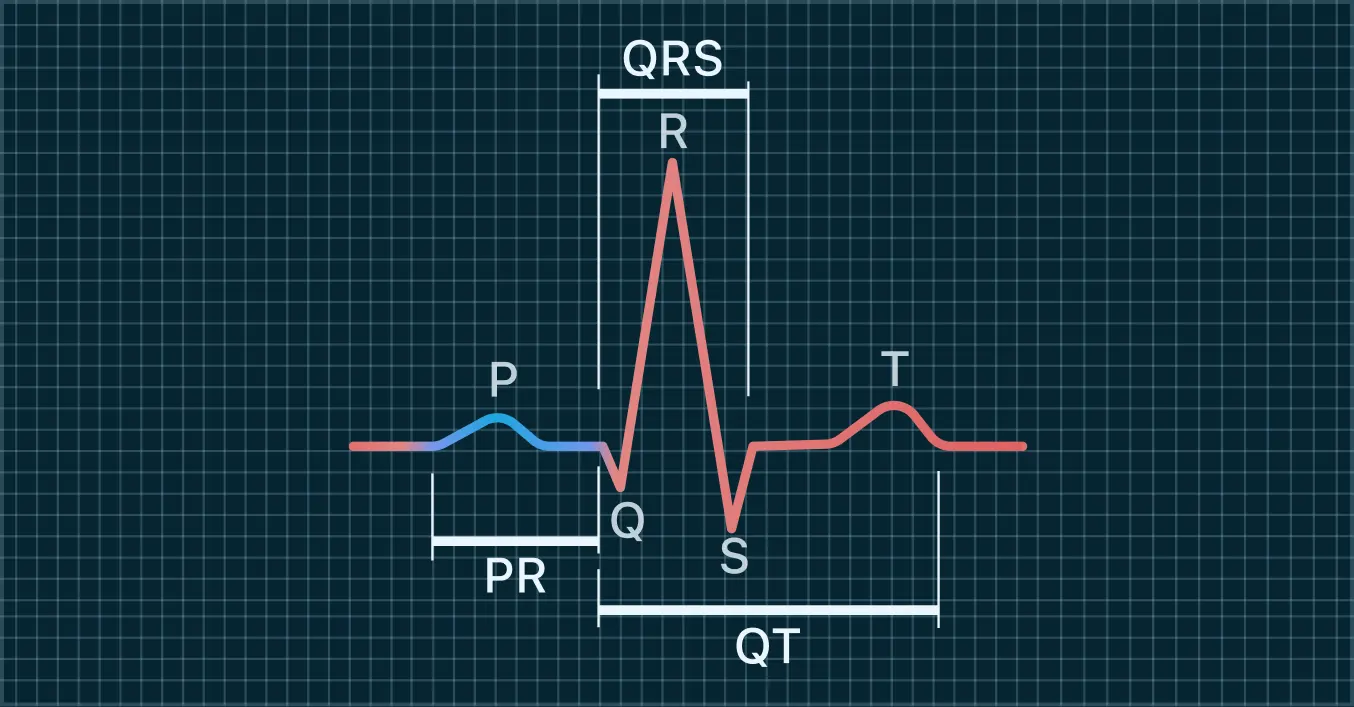
The P wave is the small bump before the large spike in a normal beat. It represents atrial depolarization, which is the electrical signal moving through the atria.
On a clean tracing, you may notice this pattern:
- A small rounded bump
- A larger sharp spike
- A return to baseline
- Then the cycle repeats
If you can find one clear P wave before each big spike, that supports the idea that the atria are setting the pace in an organized way.
Use the 6 second strip method
The verified guidance for wearable ECG users gives a simple technique. Count the number of identifiable P waves over a 6-second segment and multiply by 10 to estimate the atrial rate. That method is described in Qaly's article on how to calculate atrial rate.
Here's how to use it without overthinking it:
- Pick a clean segment: Choose a part of the recording with the least motion or noise.
- Count only what you can clearly identify: If you aren't sure whether a bump is a P wave, don't force it.
- Multiply by 10: That gives you a rough beats-per-minute estimate.
- Look at consistency: A neat repeated pattern matters as much as the final number.
A quick example
If you count 8 clear P waves in a 6-second strip, the estimated atrial rate is 80 beats per minute. If you can't find clear P waves at all, that observation itself can be useful. It may mean the tracing needs expert review, especially if the rhythm feels irregular or your symptoms are new.
Reading a watch ECG is a skill, not a personality trait. If it feels hard at first, that's normal.
A few cautions matter here:
- Single-lead limitations: Watches and portable devices don't show the heart from every angle.
- Motion artifact: Shaky hands, poor contact, or muscle tension can blur small waves.
- No self-diagnosis: This method is for awareness and better conversations, not for ruling conditions in or out on your own.
Symptoms and Signs of an Abnormal Atrial Rate
A strange rhythm on a screen usually gets your attention because your body got there first. The typical reaction isn't to think, “I wonder what my atrial rate is.” It's to feel something unsettling.
One person describes it as a flip-flop in the chest. Another says it feels like a bird trapped under the ribs. Someone else notices a sudden rush in the throat, then fatigue for the rest of the afternoon. These descriptions vary, but the anxiety is often the same. When your heartbeat feels unfamiliar, it's hard not to assume the worst.
What people commonly feel
Symptoms linked with an abnormal atrial rate or rhythm can include:
- Palpitations: a pounding, fluttering, skipping, or racing sensation
- Lightheadedness: that brief floaty feeling, especially when standing or moving around
- Shortness of breath: feeling like you can't quite get a satisfying breath
- Fatigue: sometimes the rhythm settles, but you still feel wiped out afterward
- Chest awareness: not always pain, but a sense that your heartbeat is suddenly impossible to ignore
Some people also notice patterns around stress, sleep loss, dehydration, illness, alcohol, or stimulant use. If you take medications that can affect heart rate, this FindMyScript guide for ADHD patients offers a helpful plain-language look at how stimulant treatment can relate to heart rate changes.


The hard part is that symptoms aren't perfect clues
A strong sensation doesn't always mean a dangerous rhythm. A subtle sensation doesn't always mean a harmless one. That mismatch is one reason people feel so stuck.
You might have:
- a dramatic thump from a rhythm that ends quickly
- a fast episode that feels surprisingly mild
- an abnormal rhythm with almost no noticeable symptoms at all
That last group matters. Some rhythm changes are easy to miss unless you capture them on a wearable recording.
Some of the most useful ECGs are taken when a person says, “I didn't feel much, but something looked different.”
When your body and your device disagree
This happens all the time. Your watch says one thing. Your chest says another. Or the sensation has stopped before you can record it.
That doesn't mean you imagined it. It means rhythm monitoring is often about collecting pieces of a puzzle over time. One symptom, one ECG strip, one timestamp, and one repeated pattern can become much more useful together than they are alone.
When to Seek Care and How Monitoring Helps
The most important question is usually not “Was that beat weird?” It's “What should I do next?”
Some situations need urgent attention. If you have severe chest pain, fainting, major shortness of breath, or symptoms that feel intense and are not settling, seek emergency care right away. A wearable ECG is helpful information, but it should not delay emergency evaluation.
When a scheduled medical visit makes sense
If the episode passed but keeps happening, or if your recordings repeatedly look unusual, it's reasonable to book an appointment and bring your data. A clinician can do more with a clear timeline than with a vague memory.
Useful notes include:
- When it happened: time of day and what you were doing
- How it felt: fluttering, pounding, racing, skipped beats, dizziness
- What the wearable showed: regular, irregular, fast, missing visible P waves, or unclear
- How long it lasted: even a rough estimate helps
Why monitoring can reduce confusion
Good monitoring turns “I felt something weird a few times” into a record. That record can help separate isolated blips from patterns worth investigating.
If you want a plain-language overview of how this process works, this article on cardiac monitoring is a useful starting point. One option people use is Qaly, which reviews wearable and at-home ECG recordings through certified cardiographic technicians and provides interval and rhythm information that you can share with your clinician.
The goal of monitoring isn't to obsess over every beat. It's to replace guesswork with better evidence.
That shift matters, especially if you've felt dismissed before. When you can show a doctor a timestamped tracing and describe the symptom that went with it, the conversation often becomes more specific and more productive.
Frequently Asked Questions About Atrial Rate
Can stress or coffee raise atrial rate
They can affect how your heart feels and how fast it beats. A single higher reading doesn't automatically mean something is wrong. Context matters. So does whether the pattern is organized or irregular.
Is a slow atrial rate always a problem
No. Some people naturally run slower, especially at rest or with good conditioning. A slower rate matters more when it comes with symptoms such as dizziness, weakness, or fainting, or when the ECG pattern itself looks abnormal.
Is atrial rate the same as the heart rate on my watch
Not always. Your watch usually reports the rate it can detect most easily. That may reflect the lower chambers more directly than the atria. In a normal rhythm they often match, but in some arrhythmias they can differ.
What if I can't see any P waves
That doesn't mean you failed. P waves can be small, hidden by noise, or absent in certain abnormal rhythms. If your tracing looks chaotic or hard to interpret, that's a good reason to get it reviewed rather than trying to force an answer.
Should I keep checking every sensation
Use your wearable thoughtfully, not constantly. Record when symptoms happen, when a pattern repeats, or when your device alerts you. Repeated useful recordings help more than anxious checking every few minutes.

Need help making sense of your wearable ECG? Qaly offers human-reviewed analysis of at-home recordings.



.png)
.png)