


Key Takeaways

User Profile
Hello Heart Hero.
You took ashwagandha because you wanted less stress, better sleep, or a steadier mood. Then your chest did something strange. Maybe it felt like a flip, a flutter, a thump, or a burst of fast beats that made you freeze and think, “Wait, is this from the supplement?”
That reaction makes sense. When something meant to help you feel calmer seems tied to a heart sensation, it’s unsettling. It’s also the kind of moment that sends people searching late at night, trying to sort out the difference between a harmless blip and something that deserves attention.
A lot of health advice on this topic is too simple. It either says ashwagandha is harmless for everyone or treats every palpitation like a crisis. Real life usually sits in the middle. If you’ve been looking for a grounded explanation that respects your concern and gives you practical ways to understand what your body is doing, this guide is for you.
Your Guide to Ashwagandha and Heart Health
A common story goes like this. Someone starts ashwagandha to take the edge off a stressful season. For a few days or weeks, nothing seems unusual. Then one afternoon, maybe after taking a capsule or gummy, they notice a sudden skipped beat sensation or a brief racing feeling.
That doesn’t automatically mean the supplement harmed the heart. It does mean your body is sending a signal worth paying attention to.
People often get stuck on one question. Can ashwagandha cause heart palpitations? The honest answer is nuanced. Some people seem to notice palpitations after taking it, but that doesn’t mean it causes a broad heart risk for everyone. It may matter far more who’s taking it, what else they’re taking, and whether they have an underlying thyroid issue.
If you’ve felt brushed off before by “just stop worrying” advice, you’re not alone. Palpitations are real sensations. Anxiety can amplify them, but that doesn’t mean you imagined them. It’s reasonable to want a clearer picture before deciding whether to stop a supplement, change your routine, or ask for testing.
A grounded way to think about it: your goal isn’t to prove yourself right or wrong. Your goal is to gather enough evidence from your own symptoms to make a calm decision.
If you’re already exploring natural products, it can help to keep the bigger supplement picture in mind too. Qaly has a helpful overview of supplements for heart health, especially if you’re trying to separate marketing claims from what’s useful in daily life.
What The Evidence Says About Palpitations
A lot of readers get stuck between two unsatisfying answers. One source says ashwagandha is harmless because it is "natural." Another makes one scary story sound like proof that it will upset your heart. The evidence sits in the middle.
What larger studies have and haven’t shown
According to this Business Insider report on supplements and arrhythmia concerns, ashwagandha has been studied in many human trials and research papers, but researchers have not established a clear direct causal link between ashwagandha and broad heart rhythm problems in the general population.
That distinction matters. Large studies are better at catching side effects that show up often across many different people. If ashwagandha regularly triggered palpitations in a predictable way, researchers would be more likely to see that pattern.
At the same time, "not established in large studies" does not mean "impossible in your case."
Why case reports still deserve attention
The same report describes a case involving an older woman with thyroid disease who developed supraventricular tachycardia after long-term ashwagandha use, and her symptoms improved after she stopped. A case report works like a warning light on a car dashboard. One light does not tell you the whole engine is failing. It does tell you something happened that should be checked, especially if the person had other risk factors.
This is often the confusing part for people with symptoms. Population-level evidence answers, "Does this seem to happen broadly?" A case report answers, "Can this happen under certain conditions?" Those are different questions.
Both matter.
The balanced takeaway
The current evidence supports a cautious middle view:
- Large studies have not shown that ashwagandha commonly causes heart palpitations across the general population.
- Individual reports suggest that some people may notice rhythm symptoms after taking it.
- Those reports often involve other factors in the background, rather than a simple supplement-only explanation.
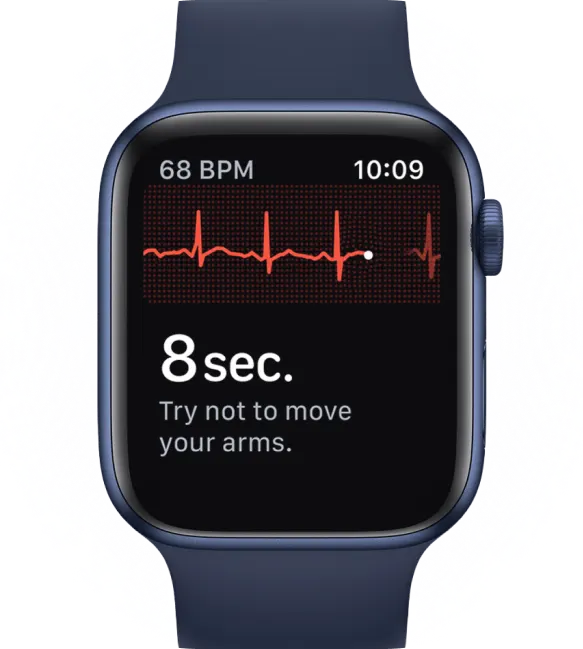
That middle view is more useful than guessing. It also points to a practical next step. If you feel fluttering, pounding, or skipped beats after starting ashwagandha, try to capture what your heart is doing instead of relying on memory alone. A wearable ECG from an Apple Watch or Kardia can sometimes record the rhythm in the moment, and a clinician review service like Qaly can help you understand whether the tracing shows a true rhythm change or a benign sensation.
If you want context before you record anything, Qaly also has a clear guide on common causes of heart palpitations.
How Ashwagandha Might Affect Your Heart Rhythm
When people hear “palpitations,” they usually assume the heart is the starting point. In this case, the heart may be more like the messenger than the source.
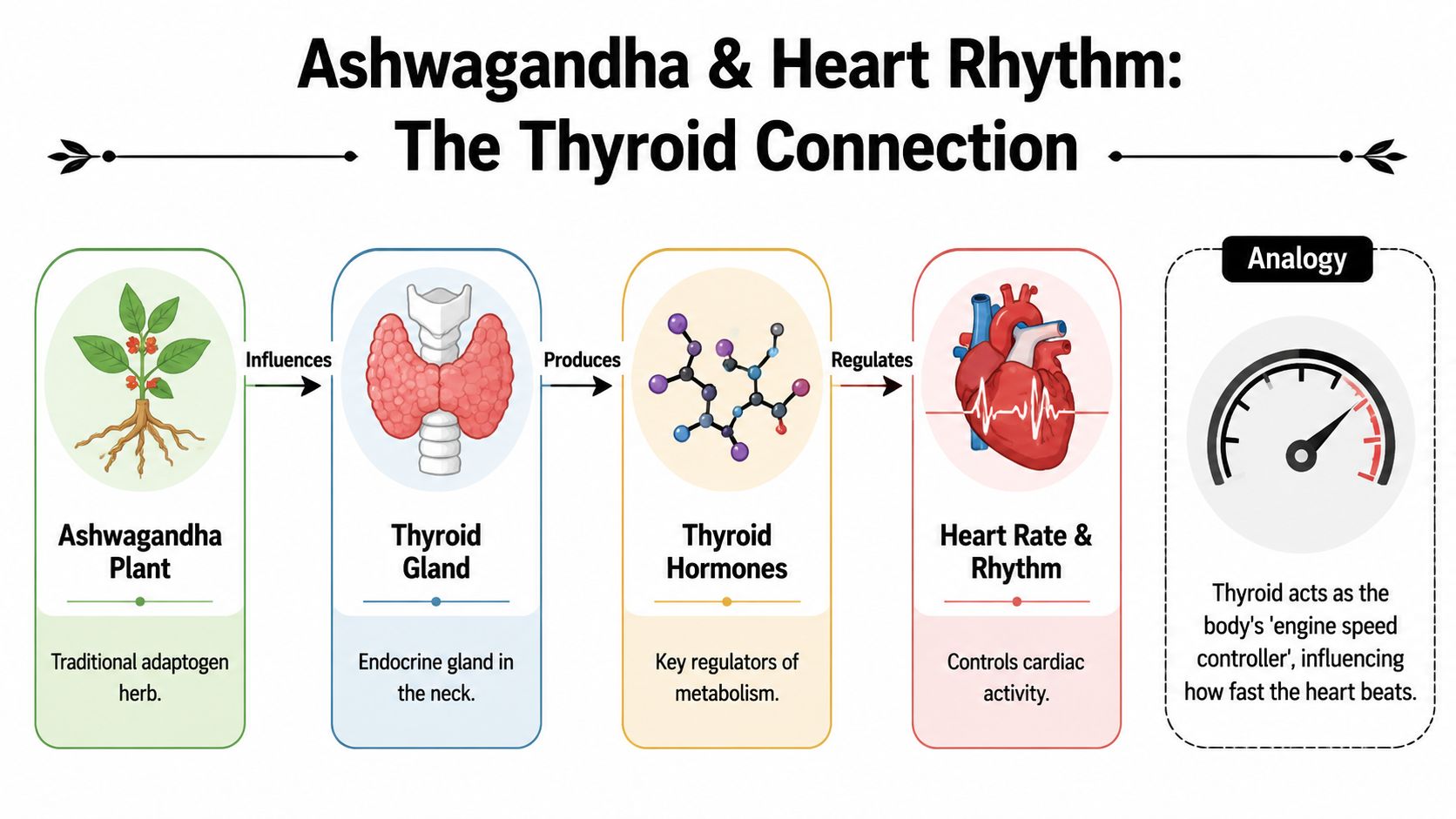
Think of the thyroid as your body’s speed controller
A simple analogy helps here. Think of your thyroid as your body’s engine speed controller. It helps set the pace for metabolism, energy use, and how “revved up” different systems feel.
If that controller turns up too high, your body can start acting like the engine is idling too fast. You may feel shaky, warmer than usual, wired, or aware of your heartbeat.
The most plausible mechanism is not that ashwagandha directly irritates the heart muscle. The more likely pathway is that it may stimulate the thyroid in some people.
The domino effect
The explanation summarized in this thyroid and tachycardia review is that ashwagandha may increase thyroid hormone activity, particularly thyroxine (T4). In some situations, that can contribute to thyrotoxicosis, which means there’s too much thyroid hormone activity in the body.
Once that happens, the next domino can fall: the heart responds to the extra stimulation.
That can show up as:
- A faster heartbeat
- A pounding feeling in the chest
- Short bursts of rapid rhythm
- Irregular sensations that feel like fluttering
The same review notes that thyrotoxicosis can present with supraventricular tachycardia, which is one reason this topic gets attention. Not every flutter is SVT, but thyroid-driven overactivation can push the rhythm in that direction.
Practical image: if your thyroid acts like the gas pedal and ashwagandha nudges that pedal in the wrong person, the heart may simply be responding to the extra fuel.
Why this matters for real-life symptoms
This thyroid pathway helps explain why some people feel completely fine on ashwagandha while others notice something quickly.
It also explains why timing can feel confusing. You may blame the heart because that’s the sensation you notice first, while the underlying change may be happening upstream in your hormone balance.
If you already know you have a thyroid issue, this connection is especially relevant. Qaly has a readable breakdown of the link between thyroid disorders and your heart, which can make these symptoms feel much less mysterious.
Understanding Your Personal Risk Factors
Not everyone who takes ashwagandha needs to panic about palpitations. Some people do need to be more cautious.
The group that deserves the most caution
Based on the case literature and the thyroid mechanism described earlier, the highest-risk group appears to be people with pre-existing thyroid disorders.
That includes people who have been told they have:
- Hypothyroidism
- Hashimoto’s disease
- Subclinical thyroid dysfunction
- A history of thyroid hormone instability
The reason is straightforward. If ashwagandha can push thyroid hormone activity upward, even modestly, someone with a thyroid system that’s already delicate may feel the effect faster.
Medication can change the picture
If you take levothyroxine or another thyroid medication, caution matters even more. The concern isn’t just the supplement by itself. It’s the possibility that the combination could act like too much thyroid stimulation at once.
That kind of overlap may feel less like “I took a calming herb” and more like “Why is my body suddenly on fast-forward?”
Watch for patterns like these:
- Palpitations after starting the supplement
- A new racing heartbeat after a dose increase
- Feeling more jittery than calm
- Episodes that seem worse on days you take both your thyroid medication and ashwagandha
A simple self-check list
You don’t need to diagnose yourself. You just need a clear lens.
Ask yourself:
- Do I already have a thyroid condition?
If yes, be more careful about assuming this supplement is neutral for you. - Am I taking thyroid medication?
If yes, interactions deserve real attention. - Did the palpitations begin after I started ashwagandha or changed the dose?
Timing doesn’t prove causation, but it’s useful evidence. - Do I have other symptoms that feel “revved up”?
Things like shakiness, heat intolerance, or an unusually fast pulse can matter.
If your body changed soon after a new supplement entered the picture, it’s reasonable to treat that as a clue, not a coincidence to ignore.
Even if you prefer natural approaches, this is one of those moments where personal history really matters. The same capsule can feel uneventful for one person and overstimulating for another.
How to Monitor Palpitations With Your Watch ECG
You can replace guesswork with actual data.
A lot of articles stop at “talk to your doctor if concerned.” That’s not wrong, but it doesn’t help much in the moment when your heart suddenly flutters for ten seconds and then goes back to normal before anyone can test it.
Why wearable ECGs are useful here
If you have an Apple Watch, Kardia, or another device that can capture a single-lead ECG, you have a practical way to investigate what’s happening during an episode.
_apple.webp)
That doesn’t replace a medical evaluation. It does give you something far better than memory.
Instead of saying, “It felt weird around lunch,” you can say:
- I took ashwagandha at this time
- I felt symptoms at this time
- I captured an ECG during the episode
- Here’s what the tracing looked like
That’s a completely different level of clarity.
What to do during a palpitation episode
Keep the process simple:
- Sit down if you can
This helps you focus and reduces motion artifact on the ECG. - Start the ECG as soon as symptoms begin
The useful recording is the one captured during the sensation, not five minutes later when everything feels normal again. - Note the timing
Write down when you took the supplement, when symptoms started, and whether you had caffeine, poor sleep, stress, or exercise that day. - Repeat if the pattern happens again
A trend across several episodes is often more useful than a single isolated event.


What the ECG may help distinguish
The key value of a wearable ECG is that it can help separate common rhythm experiences that feel similar but mean different things.
The verified guidance for this topic notes a major gap in public advice: people are told palpitations can happen, but they’re rarely shown how to use consumer wearables to look into them. That same guidance explains that wearable users can capture single-lead ECGs during symptoms to help distinguish benign palpitations like PVCs from more significant rhythms like SVT, which can be linked to thyroid imbalance.

That distinction matters emotionally as much as medically. A skipped beat pattern and a sudden fast regular rhythm can feel equally alarming in your chest, even though they’re not the same thing.
A wearable ECG turns “something scary happened” into “this is the rhythm my heart was in at that moment.”
Where expert review can help
Interpreting your own tracing isn’t always easy. That’s where a review service can be useful as one option.
Qaly’s ECG app for Apple Watch is built for this kind of situation. The service provides CCT-certified analysis of watch ECGs within minutes and can help users sort out whether a captured episode looks more like a benign pattern such as PVCs or a rhythm that deserves follow-up, as described in the verified guidance based on this side effects overview.
If your symptoms happen in bursts, this can be especially valuable. By the time you get an office appointment, the event may be gone. A saved ECG gives you something concrete to bring into that conversation.
A good monitoring mindset
Use your watch like a notebook with electrodes.
You’re not trying to obsess over every heartbeat. You’re trying to answer a practical question: Is there a consistent rhythm change tied to my symptoms and the timing of this supplement?
That’s a much calmer and more useful frame than doom-scrolling symptom lists.
Your Action Plan for Peace of Mind
If you think ashwagandha may be connected to your palpitations, keep your next steps simple and steady.
First, consider pausing the supplement and watching what happens. If the palpitations settle after stopping, that’s useful information. It doesn’t prove the full mechanism, but it does help narrow the field.
Second, track the pattern. Write down when symptoms happen, what they feel like, and whether you captured an ECG on your wearable. If you have a known thyroid issue or take thyroid medication, ask your clinician whether thyroid function testing makes sense.
Third, pay attention to the situations where you should move faster.
Get urgent medical care if palpitations come with:
- Chest pain
- Fainting or near-fainting
- Shortness of breath
- Severe dizziness
- A sustained fast rhythm that doesn’t settle
Most palpitations are not a catastrophe. But symptoms like those deserve prompt evaluation.
The bigger takeaway is reassuring. You don’t have to choose between ignoring your symptoms and panicking over them. You can observe them carefully, collect real data, and make a better decision from there.
That’s not being overly anxious. That’s being informed.

Upload your ECGs to Qaly for human review - track episodes, understand your rhythm patterns, and walk into your next appointment with answers.



.png)
.png)