


Key Takeaways

User Profile
Hello Heart Hero.
You're probably here because your heart did something that got your attention. A flutter in the grocery line. A sudden burst of pounding while sitting still. A skipped beat that made you check your pulse and wonder if your watch was telling the truth. That moment can feel small and huge at the same time.
A lot of people end up here after getting vague answers, mixed messages, or long waits. That frustration makes sense. If you're trying to understand palpitations, it helps to have data you can trust instead of more guessing.
That's where heart rate monitors with chest strap can help. They aren't magic, and they aren't a replacement for medical care. But they can give you cleaner, more dependable heart rate data during exercise, symptom tracking, and recovery from a heart event. For people who want a better record of what their body is doing, that's a strong place to start.
If you're active, you may also care about how heart data fits into training, not just health. Coaches and athletes often use structured endurance data to track team progress with Vanta Sports, which shows how heart-related metrics can become more useful when they're placed in context.
If you've been wondering whether continuous wearable tracking is even worth it, this overview of continuous monitoring and how it works is a helpful companion to what you'll read here.
Your Guide to Understanding Your Heartbeat
A chest strap can feel old-school compared with a sleek smartwatch. But there's a reason many technicians, rehab teams, athletes, and careful self-trackers still rely on it. When people tell me, “My heart feels weird, but my watch seems inconsistent,” the first thing I think about is signal quality.
The problem isn't just getting a number. The problem is getting a number that means something.
Why better data matters when you're worried
When you feel a palpitation, you want answers to simple questions:
- Was my heart racing
- Did the rhythm change
- Was the reading thrown off by movement
- Is this something I should bring to a clinician
A weak signal can turn all four questions into confusion. A stronger signal gives you a better chance of separating a real event from noise.
If your symptoms are real but your data is messy, you can end up doubting yourself instead of learning from the pattern.
That's why chest straps matter. They're built for direct measurement of the heart's electrical activity during movement. For someone trying to understand episodes of pounding, fluttering, or exercise-related symptoms, that difference can be reassuring.
What this tool can and can't do
A chest strap can help you spot patterns. It can show whether your heart rate climbs smoothly, spikes suddenly, or behaves differently during certain activities. It can be useful if you're monitoring how your body responds to a workout, stress, caffeine, or a medication change.
It can't diagnose every rhythm issue on its own. It won't replace a clinician's judgment. And if you have chest pain, fainting, severe shortness of breath, or a sustained fast rhythm that feels dangerous, you shouldn't wait for a gadget to sort it out.
How Chest Straps Accurately Measure Your Heartbeat
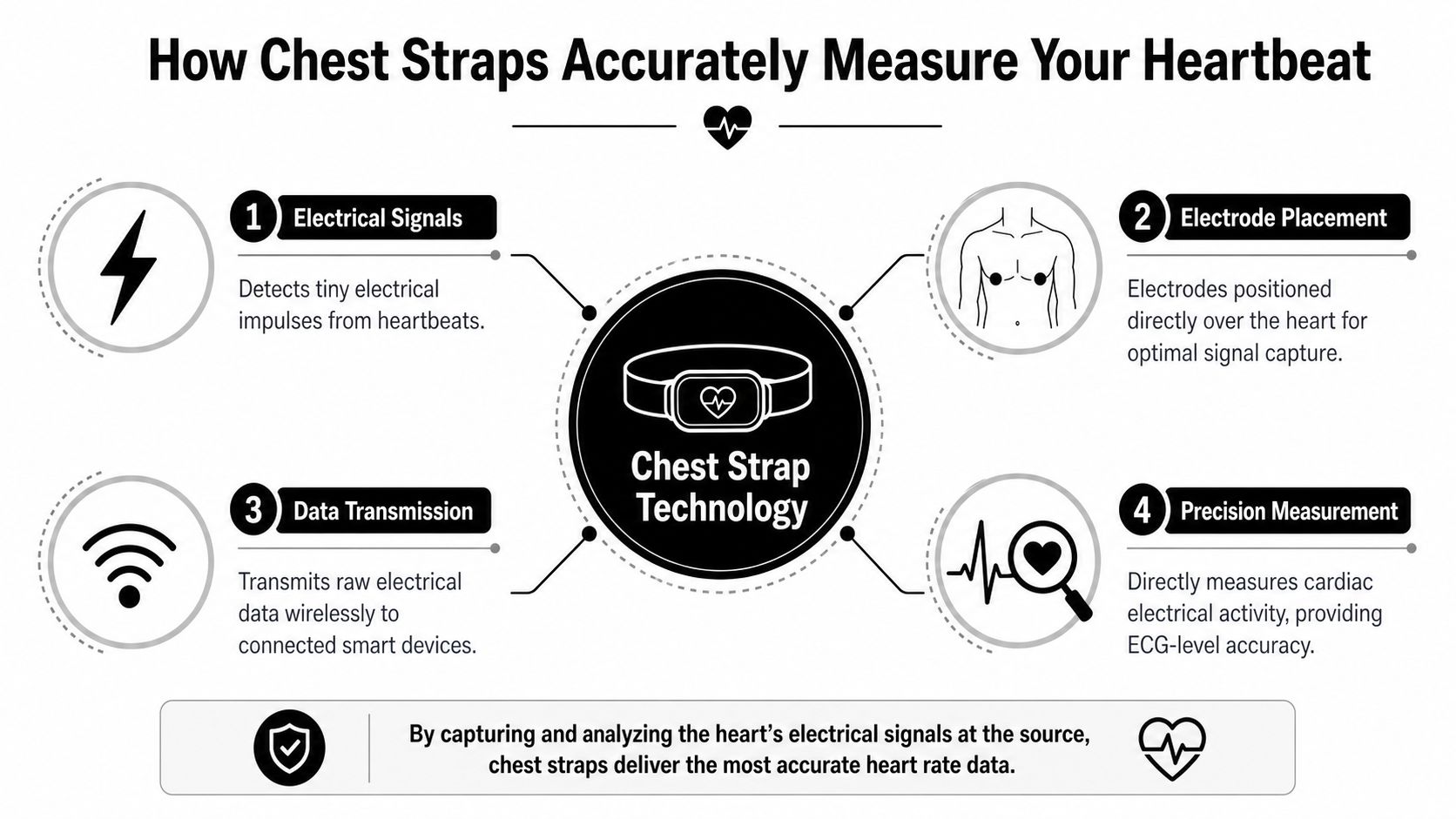
The reason chest straps are respected comes down to how they measure your heartbeat.
A wrist device usually uses light. It shines light into the skin and estimates pulse from changes in blood flow. That can work well enough for casual tracking, but it's still an indirect method. It's a little like watching tree branches move and guessing how strong the wind is.
A chest strap works more like a small ECG. It detects the electrical signal that tells the heart muscle to beat.
The simple version of the technology
Think of your heart as a drummer in another room.
A wrist sensor listens through the wall and tries to count the rhythm from muffled vibrations. A chest strap puts the microphone right near the drum. That closer signal is why the reading is usually cleaner, especially when you're moving.
Researchers reported that chest straps achieve electrocardiography accuracy by measuring the electrical impulses that trigger each heartbeat, the same mechanism used by hospital ECGs, and that this method reached 99.6% correlation with clinical ECG results even during intense exercise in the cited study on the Polar H10 and wearable ECG accuracy.
What the electrodes are doing
The strap sits across the chest with sensors touching the skin. Those sensors pick up tiny electrical changes that happen each time the heart contracts. The monitor then sends that data to a watch, phone, bike computer, or app.
This direct-contact setup is why fit matters. If the strap is too loose, too dry, or twisted, the signal can get noisy. When it's placed correctly, the device can capture beat-to-beat timing with much more confidence than a wrist sensor during activity.
Why that matters for palpitations
If you're trying to understand a symptom, timing matters. A reading that lags, smooths over changes, or drops out can miss the moment you care about. A cleaner electrical signal helps you see whether the heart rate change was gradual, sudden, or irregular.
Practical rule: If the question is “How hard am I working?” a wrist sensor may be enough. If the question is “What exactly did my heart do when I felt that flutter?” a chest strap is the better tool.
Chest Strap vs Wrist Sensor The Accuracy Difference
Convenience and accuracy are not the same thing.
Wrist wearables win on comfort. You put one on in the morning and forget about it. That's useful for general wellness. But if you need dependable exercise data or you're trying to understand symptoms that happen during movement, the gap gets more important.

What the research shows
In a comparison against ECG, chest strap heart rate monitors showed near-perfect agreement at about 0.996, while wrist-worn optical monitors ranged from 0.67 to 0.92 depending on the device and activity in the American College of Cardiology summary of wrist versus chest monitor accuracy.
That same source noted a practical problem many people notice in real life. During bicycling or elliptical exercise, wrist devices produced errors ranging from ±15 to ±34 beats per minute, while chest strap readings stayed closely aligned with ECG across treadmill, elliptical, and stationary bike sessions.
If you've ever looked down at your watch during a hard workout and thought, “That can't be right,” this is usually why.
Why wrist sensors drift
Optical sensors are sensitive to real-world messiness. A few common issues can throw them off:
- Movement artifact means your wrist is bouncing, flexing, or rotating, and the sensor has trouble separating motion from pulse.
- Sweat and fit can break clean contact with the skin.
- Exercise type matters because gripping handlebars or using an elliptical changes wrist position and muscle tension.
- Irregular rhythm can be harder for a wrist sensor to interpret because it's estimating from blood flow rather than reading the heart's electrical trigger.
For someone who just wants rough training zones on an easy walk, those limits may be acceptable. For someone tracking pounding episodes, they may not be.
A useful way to choose
Pick the device based on the question you're trying to answer.
If your question is, “Did I get some activity today?” a wrist wearable is convenient. If your question is, “Was that a genuine spike or a bad reading while I was cycling?” a chest strap gives you stronger evidence.
You can even think of them as different shoes for different jobs. A casual band on the wrist is for everyday wear. If comfort and style are part of your wearable setup, a guide to premium watch straps can help you make that side of the system more usable. But changing the wristband doesn't change the core sensor limits.
If you're specifically comparing Apple Watch ECG use with more direct heart monitoring, this breakdown of how accurate the ECG is on your Apple Watch helps clarify where a watch is strong and where chest-based monitoring still has an edge.
Wrist devices are great companions. They just shouldn't always be the final word when the data really matters.
Who Truly Benefits from a Chest Strap Monitor
This tool isn't just for competitive runners. Some of the people who benefit most are the ones trying to make sense of symptoms.
If you feel palpitations during workouts, a chest strap can help you tell the difference between a fast but steady rise and something that feels abrupt or out of pattern. If you've had a cardiac event and you're returning to activity, cleaner heart rate data can make exercise feel less like guesswork. If you recently started or changed a medication, more dependable trend data can help you notice whether your heart rate response looks different than usual.
People with diagnosed heart concerns
At this point, the difference stops being mostly about fitness and starts becoming more clinically meaningful.
In cardiac rehabilitation settings involving patients with cardiovascular disease, electrode-containing chest strap monitors were reported as the only tested devices capable of providing accurate heart rate measurements, while wrist-based optical monitors consistently underestimated heart rate and produced spurious values in the study on heart rate monitor validity in cardiovascular disease rehabilitation.
That matters if you've been told to stay under a certain exertion level. It matters if you're trying to build confidence after a scare. And it matters if your symptoms tend to show up when your heart rate changes quickly.
People with unexplained flutters and pounding
A chest strap won't label a rhythm for you. But it can help you gather better clues.
Pay attention to questions like these:
- Did the change start suddenly or gradually
- Did the rate settle quickly or stay high
- Did it happen only during exercise, or also at rest
- Did the reading stay stable enough to trust
Those details make conversations with a clinician more productive. They also help you avoid overreacting to every odd reading on a wrist device.
People who want less guessing
Many readers in this space are skeptical for a reason. They've been brushed off before, or told “it's probably anxiety” without anyone seeing what happened. Better home data doesn't solve everything, but it helps you show up with a clearer record of your own body.
This brings clarity. It turns “I think something happened” into “Here's when it happened, what I was doing, and what the signal looked like.”


Key Technical Features That Actually Matter
Shopping for a chest strap can get weirdly technical fast. Brand pages love jargon. Most of it doesn't matter as much as people think.
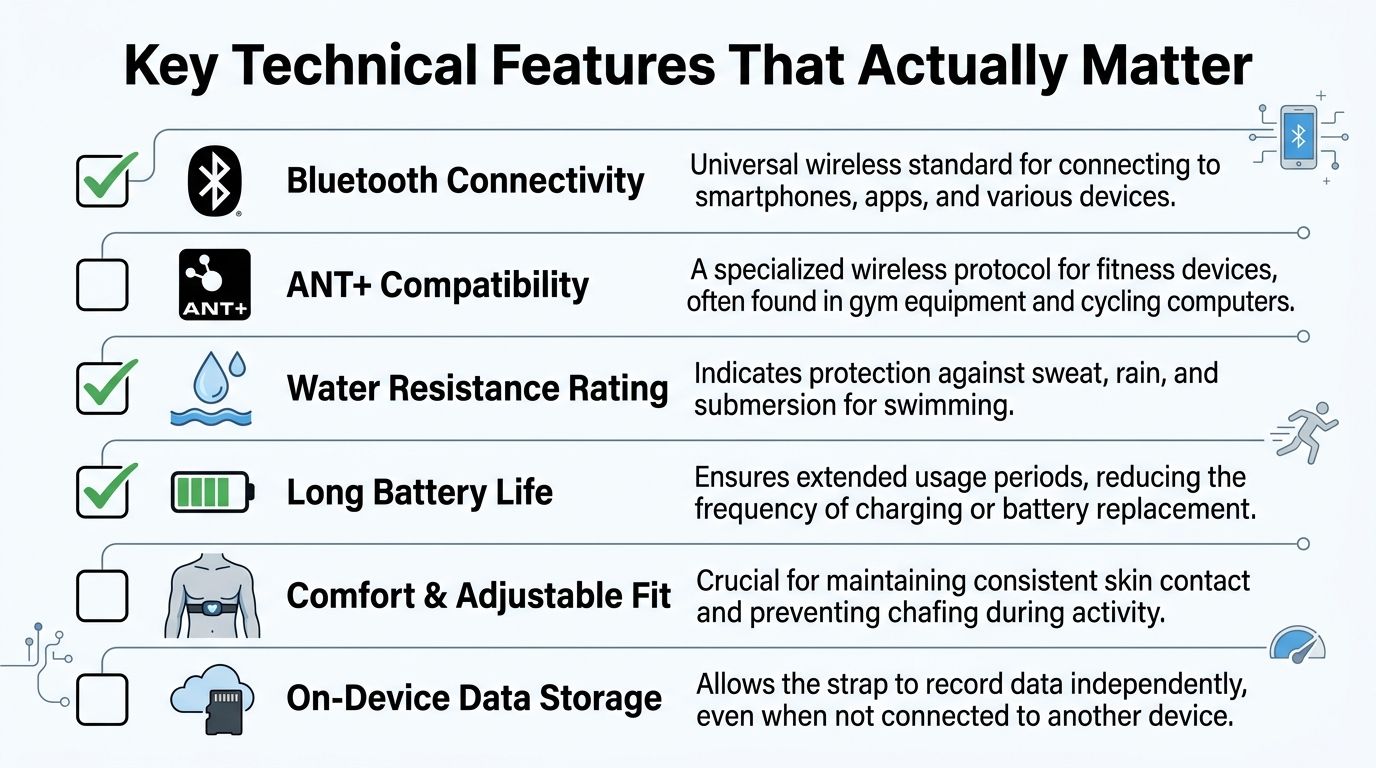
What matters is whether the monitor fits your life, connects to your devices, and captures data cleanly when your symptoms happen.
Features that deserve your attention
Bluetooth compatibility helps you pair with a phone, tablet, or many modern fitness devices. If you use apps regularly, this is usually the first thing to check.
ANT+ support is handy if you use gym cardio machines, cycling computers, or a multi-device training setup. Some people never need it. Cyclists and endurance athletes often do.
On-device storage matters more than most buyers realize. If your strap can record without your phone nearby, you're less likely to miss data during a run, ride, or symptom episode.
Comfort and fit aren't cosmetic. A strap that slides, twists, or chafes will create bad data and make you stop wearing it.
Water resistance matters if you sweat heavily, train outside, or want less stress around cleaning and moisture.
Why memory and signal quality matter
Some people think of chest straps as simple heart rate counters. The better ones can do more than that because they capture beat timing in a way that's useful for trend analysis.
In a study of endurance athletes, electrical chest-strap monitors captured extreme heart rate peaks in 1.0% of all sessions, with paroxysmal spikes making up 28.1% of those cases, as reported in the British Journal of Cardiology article on chest straps and rhythm event detection. That doesn't mean every spike is dangerous. It does show that a good chest strap can catch events worth a closer look.
Don't get distracted by fluff
A practical buyer usually does well with this short checklist:
- Will it connect to my phone or watch
- Can I wear it comfortably for the activities I do
- Can it store data if I don't carry my phone
- Will I use it when symptoms happen
If you're browsing options and want a broader consumer overview, this roundup of heart rate monitors in the USA can help you compare what matters without getting lost in spec-sheet clutter.
The best chest strap isn't the one with the longest feature list. It's the one you'll wear correctly when you need trustworthy data.
Getting Reliable Data from Your Chest Strap
A great device can still give bad readings if you wear it poorly. Most problems people blame on the monitor come from setup.
Start simple. Put the strap directly against the skin, usually just below the chest muscles. It should feel snug, not restrictive. If it's loose enough to shift around when you move, the signal can get noisy.
A clean setup routine
Use this routine before a workout or a symptom-tracking session:
- Moisten the contact areas if your strap uses electrode pads that work better with slight moisture.
- Center the sensor so both contact points sit flat against the skin.
- Check the app or watch connection before you start moving.
- Stay still for a moment first so you can see whether the baseline reading makes sense.
If the reading jumps wildly before you even begin, fix the contact issue first. Don't push through and hope it sorts itself out.
Pairing without frustration
Most chest straps connect to phones, watches, cycling computers, and some gym equipment. The easiest path is usually pairing through the device you trust most for reviewing data later.
If you care about heart rhythm context, don't only save the headline number. Save the timing, the activity, and what you felt. A short note like “flutter climbing stairs” or “hard pounding after coffee” often becomes more useful than the heart rate value alone.
For people exploring beat-to-beat patterns and recovery trends, this overview of a heart rate variability app is worth reading alongside your chest strap setup.
What to record when symptoms happen
When you feel something odd, jot down:
- What you were doing
- Whether it started suddenly
- How long it seemed to last
- Any other symptoms like dizziness or breathlessness
That kind of logging turns raw sensor data into a story you can use. It also keeps you from scrolling back later and trying to guess what was happening from a graph alone.
Care Troubleshooting and When to Talk to a Doctor
Chest straps are sturdy, but they do need basic care. Rinse the strap after sweaty sessions if the manufacturer recommends it. Let it dry fully before storing it. Keep the sensor contacts clean so skin oils and dried sweat don't interfere with the signal.
If readings become erratic, start with the boring fixes first. Tighten the fit a little. Check the battery if your model uses one. Make sure the electrodes sit flat. Skin irritation can happen too, especially if the strap stays damp too long, so washing and drying the band matters.
Common problems that have simple fixes
Users often ask about wearing straps over clothing or in wet conditions. Advice commonly includes wetting a shirt or wearing the strap externally, but the article discussing those questions also notes a lack of data on performance in these non-ideal conditions, which is a good reason to favor standard wear for the best results in this Runner's World discussion of chest strap use in wet conditions and over clothing.
If you want the cleanest reading, skin contact is still the safest approach.
Your chest strap should lower uncertainty, not create more of it. If you keep adjusting around clothing, moisture, or loose fit, the data becomes harder to trust.
When to bring the data to a clinician
Talk to a doctor promptly if your episodes are paired with fainting, chest pain, severe shortness of breath, or if a fast rhythm stays sustained and feels unwell. Also bring your data in if you keep seeing unusual patterns that repeat under similar conditions.
The goal isn't to self-diagnose. It's to show up prepared.
A good chest strap helps you gather cleaner evidence. A good clinician helps you interpret what that evidence means for your health.
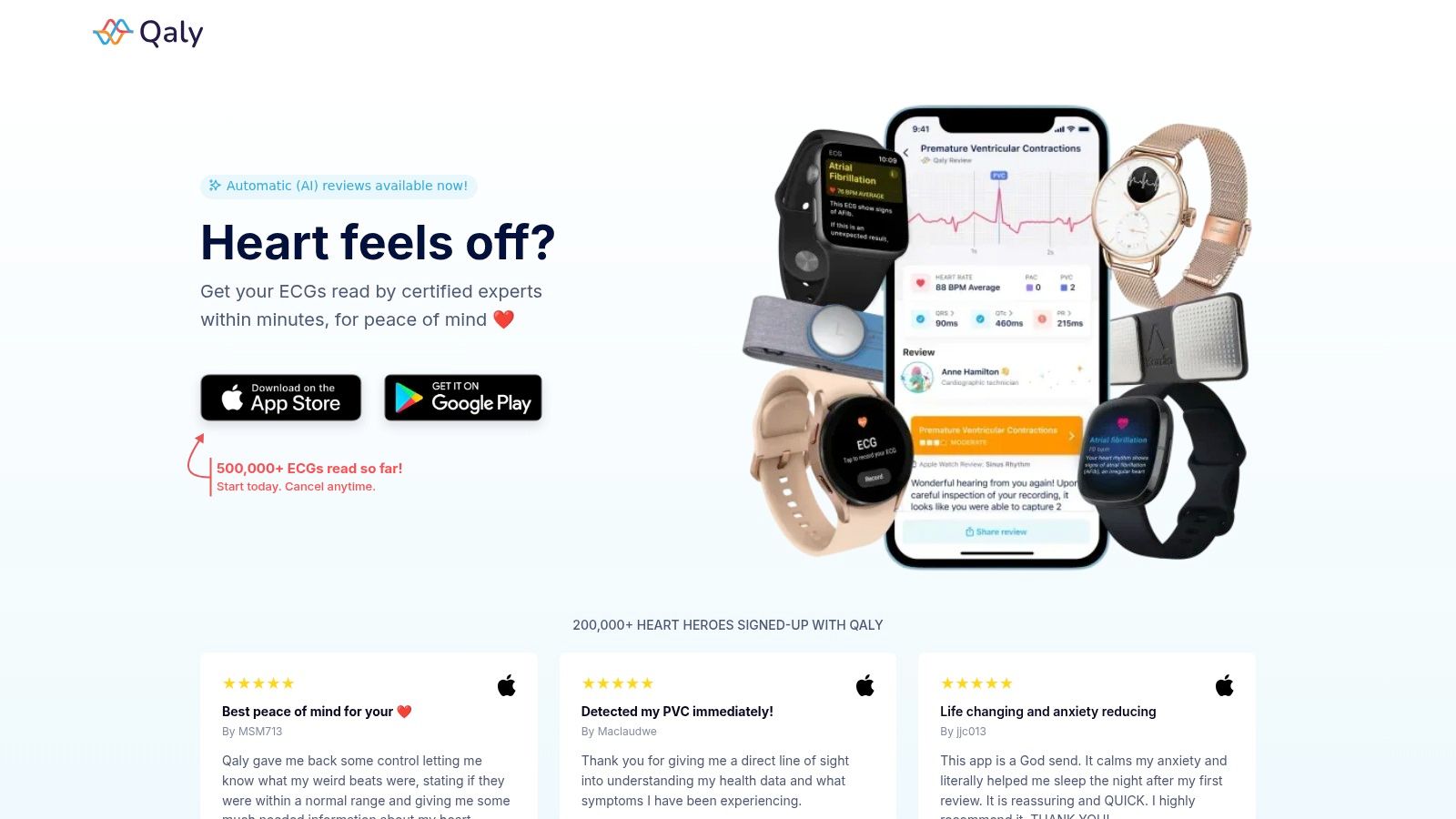
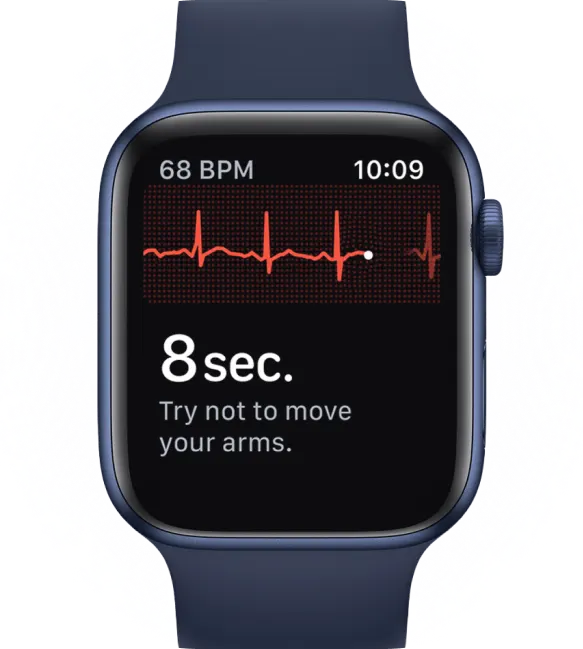
If you're using wearable heart data because you feel palpitations, notice irregular rhythms, or want a clearer record before a medical visit, the next step is getting human eyes on the signal. Qaly lets you upload wearable ECG recordings for review by certified cardiographic technicians, with support for major consumer devices and detailed rhythm insights through the Qaly app and ECG review service.

Unsure what your ECG shows? Certified experts review it within minutes.



.png)
.png)