


Key Takeaways

User Profile
Hello Heart Hero.
You're probably here because your Apple Watch, Fitbit, Garmin, Kardia, or another wearable gave you a number that didn't quite make sense. Maybe your workout app says your peak effort was too low. Maybe your heart rate jumped higher than expected during a run, and now you're wondering if that was fitness, stress, or an arrhythmia. If you've ever felt like the standard advice was too generic for your actual body, your instinct is good.
Maximum heart rate is the highest number of times your heart can beat in one minute during all-out exercise. That sounds simple. The confusing part is that direct measurement is not typical. Instead, it's estimated. And for wearable ECG users, especially people who notice palpitations, skipped beats, or odd spikes, that estimate can get messy fast.
A good maximum heart rate calculation should help you train smarter and feel safer. It shouldn't make you second-guess every alert on your wrist.
Hello Heart Hero and Your True Maximum Heart Rate
A familiar scene goes like this. You finish a hard workout, glance at your watch, and see a peak heart rate that seems too high for your age. Then you search online, plug your age into a formula, and get a different answer. Now you're stuck between your body, your wearable, and advice that feels detached from real life.
That disconnect is why this topic matters.
Your true maximum heart rate is not a motivational target. It's not the number you “should” hit because an app says so. It's a personal physiological limit that shows up during very intense effort. For one person, that number fits the usual estimate pretty well. For another, it doesn't.
If you already use a wearable to keep an eye on your rhythm, trends, or exercise response, you're doing something smart. Tools that support continuous heart monitoring concepts can help you notice patterns that a rushed appointment might miss. That doesn't mean every spike is dangerous. It means context matters.
Why this feels so personal
If you've had palpitations during a workout, you already know the emotional side of this. A high reading can feel like proof that something is wrong. A low reading can make you wonder if your watch is broken or if your heart isn't responding normally.
Both reactions are common.
Your wearable gives you data. It doesn't automatically give you interpretation.
That's the heart of the issue. A maximum heart rate calculation is useful only when it reflects your body closely enough to guide decisions. If it's too low, your training zones may be wrong. If it's inflated by an irregular rhythm, you may think you can safely train harder than you should.
A more grounded way to think about it
Try thinking of max HR as a reference point, not a verdict. It helps you judge effort, structure training, and compare what your watch says with how you feel.
That approach is especially helpful if the traditional healthcare system has left you feeling brushed off. You don't need to accept vague reassurance or blind trust in app defaults. You can learn what the number means, test it more carefully, and bring better data into any future conversation with a clinician.
The Old Formulas and Why They Often Fall Short
You check your watch after a hard climb and see 174 bpm. Your app says your age-based max should be 162. That gap can make you wonder which one is wrong: the device, the formula, or your heart.
For many Qaly users, that question is not academic. If you have palpitations, skipped beats, or a known arrhythmia, a generic max heart rate number can distort your training zones and your sense of safety.
The best-known formula is 220 minus age. It spread because it is simple and easy to remember. Simplicity, though, is not the same thing as accuracy for an individual person.

Why the classic formula can feel so off
A formula like 220 minus age treats age as the main driver of your top heart rate. Age does matter. It just is not the whole story.
Real maximum heart rate also varies with genetics, fitness history, medications, autonomic response, and the type of exercise you are doing. A cyclist and a runner of the same age may hit different peaks. So can two people with the same diagnosis. For a wearable ECG user, this is a key detail because your device records what your body did, not what a population average predicted.
That mismatch becomes even more confusing if you have an irregular rhythm. A watch may capture a brief rapid burst from atrial fibrillation, SVT, frequent ectopy, or motion artifact. The screen shows a big number, but that number may not represent your true exercise max in any useful training sense. It may reflect rhythm noise, not cardiovascular capacity.
So the old formula has two problems. It can underestimate or overestimate your true ceiling. It also gives you no help in deciding whether a high reading was normal exertion or an arrhythmia event.
Newer formulas are better, but they still work like averages
Researchers later proposed updated equations, including 208 − 0.7 × age, to better match measured results across larger groups. That is a step in the right direction. It still gives you an estimate, not a fingerprint.
Here is how that can look in practice:
- Age 40 using 220 minus age: 180 bpm
- Age 40 using 208 − 0.7 × age: 180 bpm
- Age 60 using 220 minus age: 160 bpm
- Age 60 using 208 − 0.7 × age: 166 bpm
Those differences matter once training zones are built on top of them. If your max is set too low, routine workouts can look dangerously intense on your watch. If it is set too high, your app may reassure you when your body is already working harder than it should.
For women, formulas such as 206 − 0.88 × age may fit better than the old default in some cases. Even then, the same caution applies. These equations work like sizing charts. They can get you close, but they do not tailor the number to your exact heart.
Practical rule: If your wearable's age-based max HR does not match your real exertion, the formula may be the weak link.
What this means for wearable ECG users
Use formula-based max HR as a draft setting. Then pressure-test it against real workouts, symptoms, and rhythm data.
Accuracy matters more at higher effort, where wrist sensors are more likely to struggle with motion and poor contact. If you want cleaner exercise readings, heart rate monitors with chest straps usually give more reliable peak heart rate data than wrist-only tracking.
The reassuring part is this. A mismatch between your app and your body does not automatically mean something is wrong with your heart. It means your starting estimate may be too generic for the heart you have.
A Practical Guide to Estimating Your Own Max HR
Your watch says 182. Your body says, "I was working hard, but that did not feel like my absolute limit." That gap is exactly why a field test can help. For a Qaly user, the goal is not to chase the biggest number possible. The goal is to find a peak you can trust enough to use for training, symptom tracking, and rhythm review.
One practical option is the 4-minute interval protocol described by the NTNU HRmax guide. After a full warm-up, you complete two hard 4-minute intervals with 3 minutes of active recovery between them. Then you start a third interval and increase the pace after 2 minutes until you cannot continue. The highest heart rate reached during that final effort becomes your working HRmax estimate.

How to do it safely
This test is best for people who are already exercising regularly and have no red-flag symptoms. If you have had chest pain, fainting, severe shortness of breath, or an unstable heart condition, pause here and get medical guidance before trying a maximal test.
If you are cleared for exercise, keep the setup boring and repeatable. That is a good thing.
Choose a controlled setup
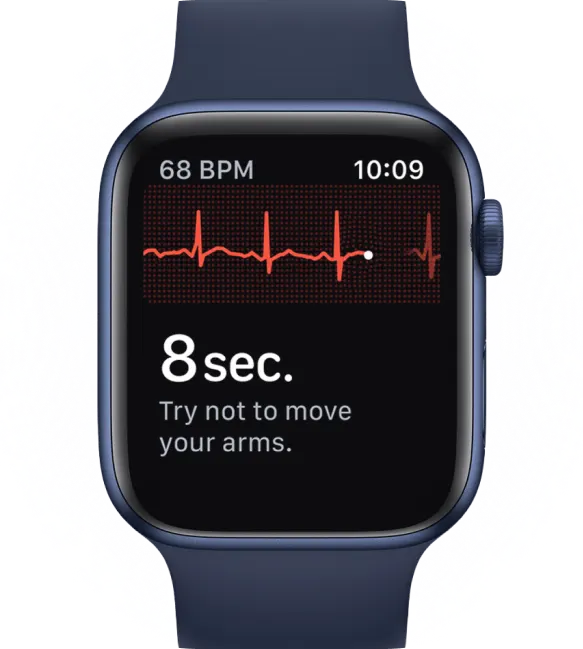
Use a treadmill, stationary bike, hill, or track where you can raise effort step by step. Wear a monitor that stays accurate during motion. If you want a second layer of rhythm review, an ECG app for Apple Watch can help you check whether a strange peak matched a rhythm event or just looked dramatic on the summary screen.Warm up like it counts
A rushed warm-up can leave your peak artificially low. Build gradually until your breathing and legs feel ready for hard work.Make the final interval hard, not chaotic
You are trying to reach your ceiling in a controlled way. Sprinting too early is like flooring a car before merging onto the highway. You may feel a lot of strain without getting the cleanest result.Save the peak right away
Record the highest number your device captures during the final push. Do not wait and count your pulse afterward. Heart rate starts dropping quickly once you stop.
Where wearable users get misled
A common mistake is stopping at "very uncomfortable" instead of "maximal." Those are not the same. If you back off early because your watch flashes a scary number, you may end up with a max HR that is too low, which then skews every training zone built from it.
Arrhythmias add another layer. A PVC run, brief burst of fast beats, or noisy optical reading can create a peak that looks impressive but does not reflect your real exercise limit. For wearable ECG users, the best question is not "What was my highest number?" It is "Did that number happen during a smooth rise in effort, or during a rhythm blip, signal dropout, or panicky slowdown?"
That is why context beats a single top-line metric.
Safety guardrails for people who like data
- Stop for warning symptoms. Chest pain, severe dizziness, faintness, or a strong sense that something is wrong means the test is over.
- Skip bad test days. Illness, dehydration, poor sleep, unusual stress, and heavy fatigue can distort both the number and how safe the effort feels.
- Have another person nearby if you feel uneasy. A spotter can make the session safer and less stressful.
- Repeat on a different day if the effort was clearly limited. One controlled retest is better than forcing extra maximal attempts in the same session.
Recovery data helps here too. If your resting trends, sleep quality, or overnight heart rate suggest you are under-recovered, that can explain why a test underperforms. Some athletes use tools that improve performance through recovery data to decide whether a max effort day makes sense.
If your watch number and your body story do not match, treat that mismatch as useful information.
That approach is especially helpful if you live with palpitations or intermittent arrhythmias. A formula gives you a rough starting line. A careful field test, paired with your wearable data and symptom awareness, gives you something closer to your own cardiac reality.


Using Your Wearable ECG to Refine Your Results
Wearable users have an advantage. They're not just guessing. They're collecting a time-stamped record of what happened during effort.
A good setup helps. Wear the device snugly, start the workout mode before the hard interval begins, and review the graph afterward rather than focusing only on the single top number. The shape of the rise and recovery often tells you as much as the peak.
When a high peak may not be a true max
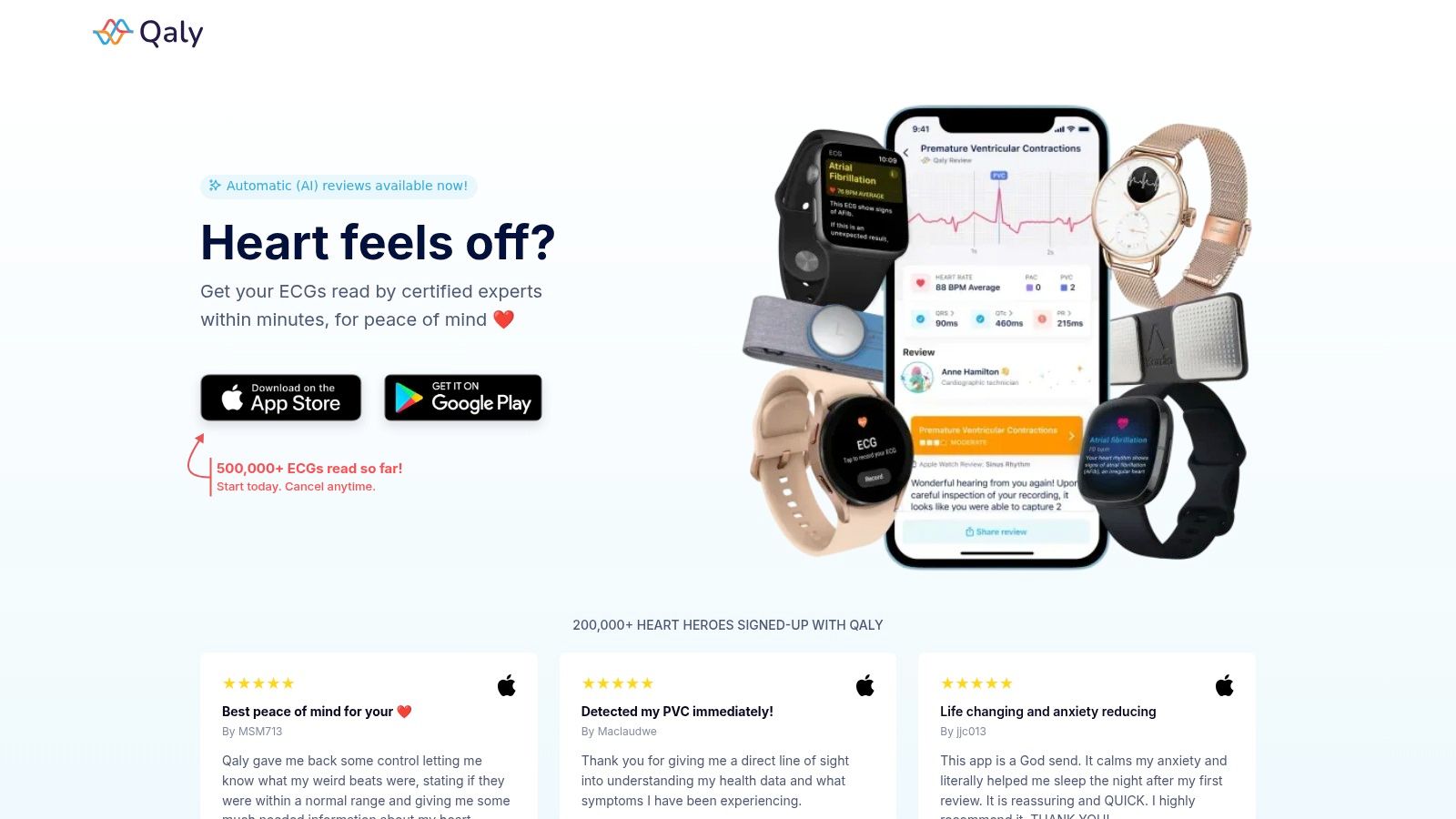
If you get PVCs, runs of fast beats, or intermittent rhythm irregularity, your watch may show a number that looks like a breakthrough effort when it's really a measurement problem or a rhythm event.
Clinical data described by Cleveland Clinic's heart rate reserve resource shows that ectopic beats can cause wearable sensors to overestimate peak HR by 8 to 12 bpm during exertion. The same source notes that users with intermittent arrhythmias can experience false max HR spikes during stress tests, which age-based formulas can't correct.
That's a big deal if you use your wearable to decide whether you trained hard enough, whether your zones are set correctly, or whether a scary spike was “normal.”
How to read your data more intelligently
A single peak doesn't tell the whole story. Look for context:
- Smooth climb: A steady rise during intervals usually makes more physiological sense than a sudden isolated jump.
- Symptoms: If the number spiked exactly when you felt fluttering, pounding, or skipped beats, that matters.
- Sensor behavior: Wrist sensors can struggle when movement is intense or contact is poor.
Recovery trends matter too. If you're trying to improve performance through recovery data, it helps to compare hard-session peaks with what your body does afterward, especially overnight and the next morning.
A wearable can capture the moment. The harder part is deciding whether that moment reflects exertion, signal noise, or an arrhythmia.
If you use an Apple Watch for rhythm review, this overview of an ECG app for Apple Watch explains how people use wearable ECG tools to add more context when symptoms and heart rate trends don't line up.
For people with palpitations, this is often the missing piece. You don't just want a number. You want to know whether the number means what the app thinks it means.
Putting Your Max HR to Work with Training Zones
You finish a run, glance at your watch, and see a tidy set of zones. That looks precise, but the zones are only as good as the max heart rate behind them. If your max HR estimate is too low, your watch can label an ordinary workout as “very hard.” If it is too high, you may spend weeks training easier than you think.

Training zones are percentage bands based on your own maximum. They work like speed limits built from your engine size. Get the engine size wrong, and every limit sign is off.
The five common zones in plain English
For day-to-day training, many coaches and apps break effort into five zones:
Zone 1
Very easy. Recovery pace. Good for warm-ups, cool-downs, and easy movement days.Zone 2
Easy to steady. You can usually hold a conversation. Many people build aerobic endurance in this zone.Zone 3
Moderate. Breathing is more noticeable, but you still feel in control.Zone 4
Hard. Talking becomes brief. This is often where threshold-style work lives.Zone 5
Very hard. Short efforts close to your upper limit.
A worked example
If your more believable max HR is 180 bpm, your rough zones from the infographic example would be:
- 50 to 60% = 90 to 108 bpm
- 60 to 70% = 108 to 126 bpm
- 70 to 80% = 126 to 144 bpm
- 80 to 90% = 144 to 162 bpm
- 90 to 100% = 162 to 180 bpm
That gives you something practical to use during workouts, especially if you want more than a generic calorie-burn score.
This precision is valuable because small errors in max HR can shift every zone. For a Qaly user, that is not just a performance issue. If you have palpitations, AFib, SVT, PVCs, or unexplained spikes on your wearable, a bad zone setup can make an abnormal rhythm look like hard training, or make normal exertion look alarming.
Use zones as guides, not handcuffs
Zones work best when the number on the screen matches your breathing, effort, and rhythm pattern.
A few cues help:
- If you can chat easily, you are probably in a lower zone.
- If talking gets clipped, you are likely moving into harder work.
- If your watch says Zone 2 but it feels punishing, revisit your max HR estimate and check whether rhythm irregularity could be skewing the reading.
- If your heart rate jumps suddenly without a matching rise in effort, treat that as a signal to review the session, not proof that you reached a new fitness level.
Wearable ECG users have an advantage. You are not limited to one summary number after a workout. You can compare the heart rate trend, symptoms, and any available ECG capture to ask a better question: “Was I working harder, or was my rhythm different?”
For longer-distance goals, heart rate awareness works best alongside pacing, hydration, and gear planning. If you are building toward an endurance event, this marathon training essentials guide is a useful companion resource.
If you want a clearer breakdown of how these ranges are used in real workouts, Qaly also explains how to understand heart rate zones in practical training.
When Your Numbers and Feelings Dont Align
Sometimes the data and your body tell the same story. Sometimes they don't.
That mismatch deserves respect.
If your watch says you hit an impressive peak but you felt dizzy, tight-chested, unusually breathless, or close to fainting, don't treat that as a training win. If your device repeatedly shows irregular rhythm patterns that worry you, don't brush that off just because an app labels the workout as productive.
When a clinical test makes more sense
The most accurate way to determine maximum heart rate is direct measurement through a graded exercise test to maximal exertion, typically on a treadmill or cycle ergometer in a clinical setting. Age-based formulas remain estimates with inherent variability and can't replace direct measurement for clinical precision, according to the Folia Cardiologica review.
That matters most if you have:
- Concerning symptoms during exertion
- Known heart disease or rhythm issues
- Medication effects that change heart rate response
- Repeated confusing wearable data that doesn't fit how you feel
Bring your data with you
If you've ever felt dismissed in a healthcare visit, self-monitoring can help. Showing up with workout logs, screenshots, time stamps, ECG recordings, and notes about symptoms often leads to a more grounded conversation.
Bring patterns, not just panic.
You don't need to argue with a clinician. You need to give them a clearer picture.
A good appointment becomes easier when you can say, “Here's when the spike happened, here's what I felt, and here's what my wearable recorded.” That's very different from trying to recall one scary workout from memory.
Your job isn't to diagnose yourself. Your job is to notice, document, and act early when something doesn't fit.
If your maximum heart rate calculation feels confusing because of palpitations, skipped beats, or odd spikes on your wearable, getting human review can make the data more useful. Qaly helps people interpret wearable ECG recordings and rhythm events with expert analysis, so you can track what's happening and walk into care conversations with more clarity.

Unsure if a workout ECG is meaningful? Certified experts review it within minutes.



.png)
.png)