





Key Takeaways

User Profile
Hello Heart Hero.
You feel a flutter in your chest. Then a pause. Then a harder beat that seems to land out of nowhere. You open your Apple Watch, Kardia, Fitbit, or Samsung ECG app and stare at the tracing, trying to decide whether what you felt was dangerous, normal, or something in between.
That moment is common. It's also frustrating, because wearable ECGs can show you that something happened without always explaining why it happened.
One of the most useful concepts for making sense of palpitations is the cardiac refractory period. It sounds technical, but the idea is simple. After each heartbeat, heart cells need a short reset window before they can respond properly again. That reset window shapes whether an early beat gets ignored, gets through, or triggers a more organized rhythm problem.
If you've ever wondered why one skipped beat feels harmless while another feels sharp and alarming, this is often part of the answer. Understanding the cardiac refractory period won't turn your watch into a full electrophysiology lab, but it can help you read your symptoms with more clarity and less fear.
Your Heart's Built-In Safety Switch
A lot of people I talk to describe the same sequence. First comes the sensation. A flip, a drop, a brief hollowness in the chest, or a sudden thump. Then comes the instinct to check the wearable. You zoom in on the tracing, see a beat that arrived early or looked a little off, and your mind jumps straight to worst-case scenarios.
That reaction makes sense. Your heart has your full attention when it behaves differently.
The reassuring part is this. Your heart isn't just firing randomly. It has electrical rules built into it, and one of the most important is the refractory period. You can think of it as a built-in safety switch that briefly limits how soon the next signal can take hold.
Why this matters when you feel a skipped beat
When a beat comes too early, the result depends on timing. If heart tissue is still in its reset window, that early signal may not spread normally. Sometimes nothing obvious happens except a pause before the next beat. Sometimes the next beat feels extra strong because the heart had a little more time to fill.
That can feel dramatic, even when the event itself is not.
Practical rule: A strange sensation doesn't always mean a dangerous rhythm. Often, it means timing changed for a beat or two.
What your wearable can and can't tell you
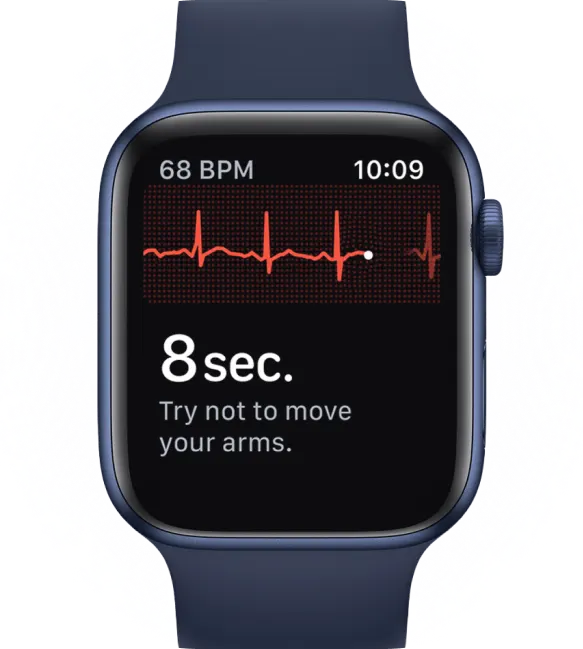
A smartwatch ECG is helpful because it captures rhythm patterns in real life, right when symptoms happen. But it doesn't directly show the refractory period itself. It shows the consequences of it. That's why two recordings can both involve an early beat, yet feel completely different in your body.
If you've been trying to connect symptoms, ECG lines, and physiology, this is the missing bridge for many people.
What Is the Cardiac Refractory Period
You might record an early beat on your wearable ECG and wonder why it sometimes shows up as a clear extra blip, while other times you only feel a flutter or a pause. A big part of that answer is the cardiac refractory period.
The cardiac refractory period is the brief reset window after a heart cell has activated, when it cannot respond normally to another signal yet. That reset is part of healthy heart function. It keeps one beat from running straight into the next.
The basic idea
Each heartbeat starts with an electrical impulse that travels through the heart and triggers contraction. After a cell fires, it needs a short recovery period before it can take part in another well-organized beat. If a new impulse arrives too soon, that tissue may ignore it or conduct it poorly.
A practical way to picture it is a reset button after each beat. The heart is active, then briefly unavailable, then gradually ready again.
That timing protects two things at once:
- Mechanical function. The chambers need a moment to relax and refill with blood before the next squeeze.
- Electrical order. Heart tissue needs limits on how quickly signals can repeat, or rhythms could become unstable.
Why this matters clinically
You may hear clinicians use the term effective refractory period, or ERP. That refers to the span when a new impulse does not produce a normally propagated beat because the cell has not recovered enough to respond in the usual way. If you want the cell-level background, this overview of cardiac electrophysiology basics explains the electrical reset process in more detail.
For someone checking their own rhythm strips, this is the bridge between textbook language and real-life symptoms. An early impulse is not enough by itself. Timing decides whether that impulse spreads, fizzles out, gets delayed, or sets up a more noticeable rhythm change.
That is one reason palpitations can feel inconsistent. Two premature beats can happen on different days and feel completely different, because they hit the heart at different points in its recovery window.
It is not one single pause everywhere
The refractory period is also not identical across the whole heart. The atria, ventricles, and AV node recover on different schedules, and those differences shape what rhythms can and cannot occur.
So if your wearable shows a pause after an early beat, a dropped-looking beat, or a short burst of fast rhythm, you are often seeing the result of these timing rules rather than random electrical behavior. That can be reassuring. The heart has built-in limits, and those limits explain a lot of what people notice on their ECG traces and in their chest.
The Science Behind Your Heart's Recharge
A wearable ECG can show an early blip, a pause, or a strange-looking beat. What it cannot show directly is the split-second recovery process inside each heart cell that decides whether that impulse dies out or turns into a beat you feel in your chest.
At the cell level, each heartbeat depends on an action potential. That is the wave of electrical change created as charged particles move through tiny channels in the cell membrane. Sodium is the fast starter. Potassium helps the cell reset. If you want a clearer primer on that cell-level reset, this guide to cardiac electrophysiology basics lays out the sequence in plain language.
The key point is recovery takes time. Right after a cell fires, its fast sodium channels are temporarily unavailable. Until enough of those channels recover, the cell cannot respond normally to the next impulse.
The hard no phase
This early recovery window is the absolute refractory period. During this phase, the cell is not ready for another normal propagated beat. You can picture a camera flash that needs a moment to recharge before it can fire again. Pressing the button during that reset time does not produce a second flash.
For someone checking their own rhythm strips, that explains a common source of worry. An early electrical impulse may happen, but if it arrives during this locked-out period, it may not create a visible extra beat or a normally conducted one. The timing was wrong, not the heart "forgetting" how to beat.
The maybe phase
After that comes the relative refractory period. Recovery is underway, but it is incomplete. Some cells are ready enough to respond. Others are still lagging behind.
That uneven recovery matters. An impulse that arrives in this window may get through, but it may travel more slowly or unevenly because different areas of tissue are at different stages of reset. On an ECG, that can contribute to a beat that looks different from the surrounding beats. In your body, it can feel like a thump, a flutter, or a skipped beat followed by a stronger beat.
A simple way to frame it:
- Absolute refractory period: the door is closed
- Relative refractory period: the door is partly open
- Fully recovered state: normal signals pass through normally
Why medications affect this window
Many rhythm medicines work by changing how long heart tissue stays unready after a beat. Some slow recovery. Some prolong repolarization. The practical result is the same. They change the timing rules.
Why does that matter to a wearable ECG user? Because many arrhythmias depend on an impulse finding tissue that is recovered enough to conduct, but not recovered evenly. If a medication keeps that tissue refractory a little longer, an early impulse has less chance to catch the heart in that vulnerable in-between state.
So when a clinician says a drug may "stabilize the rhythm," part of that often means it changes when heart cells can fire again. Two people can have a similar heart rate on a watch tracing and still have very different rhythm behavior because the hidden recovery timing between beats is different.
Seeing the Refractory Period on Your ECG
You can't point to a single line on your watch ECG and say, "There is the refractory period." It's not drawn as its own wave. But its effects are all over the tracing.
The easiest way to understand this is to connect the reset process to the parts of the ECG you already recognize. If you've seen a P wave, QRS complex, and T wave before, you're already most of the way there.
Where the vulnerable timing lives
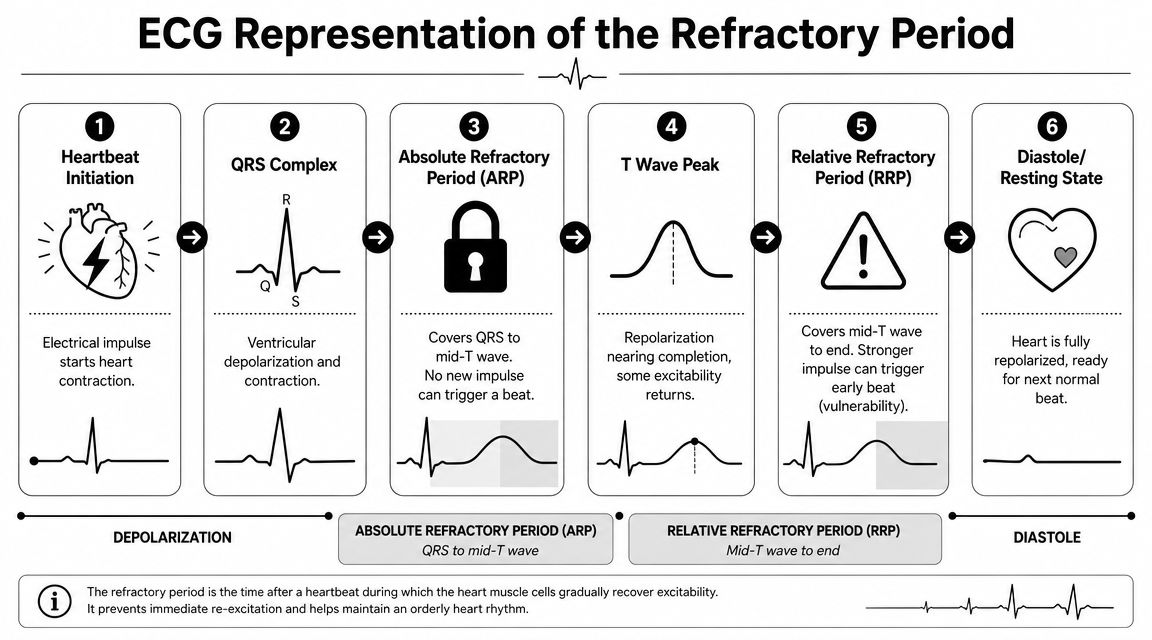
For the ventricles, the absolute refractory period generally spans the QRS complex and extends into the early part of the T wave. Later in the T wave, the heart moves into the relative refractory period.
Educational and clinical references often describe the ventricular absolute refractory period as roughly 0.25 to 0.30 seconds, with the atrial refractory period being shorter at about 0.15 seconds, as summarized in this educational review on refractory timing and ECG behavior.
That chamber difference helps explain why atrial rhythms can reach faster rates than ventricular rhythms and why atrial and ventricular events can look so different on a tracing.
Why one early beat gets ignored and another gets through
Let's say a premature beat tries to happen very early. If it lands during the absolute refractory period, the surrounding tissue may not respond in a way that creates a new propagated beat. From your perspective, that may feel like a pause or an odd interruption rather than a clear extra beat.
If the premature signal lands later, during the relative refractory period, some tissue may respond while some doesn't. That can produce an abnormal-looking beat, especially if conduction through the ventricles is uneven.
This is one reason the downslope of the T wave matters. It's a transition zone. The heart is not fully locked and not fully ready.


What this means for wearable users
If you've captured a strange rhythm and wondered whether timing in the AV node could be part of the story, it helps to understand how the AV node regulates electrical conduction. The AV node has its own refractory behavior, and that influences whether atrial impulses reach the ventricles.
For practical symptom tracking, keep these ideas in mind:
- A pause after an early beat can reflect a mistimed impulse that didn't conduct normally.
- A hard thump may be the beat after the pause, which can feel stronger because filling changed.
- A bizarre-looking early beat often reflects partial recovery, not random chaos.
People often expect every abnormal sensation to have one clean ECG explanation. Real rhythm strips are messier than that. Timing, location, and recovery all matter.
Why It Matters for Arrhythmias
The cardiac refractory period protects you, but arrhythmias often exploit its edges. The most important concept here is reentry. That means an electrical impulse keeps circling through tissue instead of dying out after one pass.
For reentry to continue, the impulse has to come back to tissue that has recovered enough to be excited again. If the tissue is still refractory, the loop breaks. If recovery happens soon enough, the loop can continue.
Rate changes alter the risk landscape
This timing isn't fixed. In a classic human study, atrial effective refractory period shortened as pacing became faster, with a mean slope of +0.155, as reported in the 1968 Circulation study on rate-dependent refractory behavior. That paper helped establish a major physiologic principle. Refractory periods change with heart rate, and different tissues don't all respond the same way.
For someone using a wearable ECG, this matters because a rhythm that appears during stress, exertion, or a burst of adrenaline isn't just "faster." The underlying recovery timing may also be changing.
A simple way to picture reentry
Think of an electrical impulse moving around a loop. If it returns to tissue that's still unavailable, the circuit stops. If it returns after that tissue has recovered, it may keep going.
That is one reason premature beats sometimes matter more when they occur at just the wrong moment. The issue isn't merely that a beat was early. The issue is that it was early relative to recovery.
An arrhythmia often depends less on a single rogue beat and more on whether the surrounding tissue was ready for that beat.
This is why two people can both have premature atrial beats or premature ventricular beats, yet only one develops a sustained run. The setup matters. The refractory timing, conduction pattern, and tissue properties all shape what happens next.
How Drugs and Pacing Use This Knowledge
Once you understand refractoriness, a lot of rhythm treatment starts to make more sense. Doctors aren't only trying to slow the heart down or suppress extra beats. Often, they're trying to alter when heart tissue can be activated again.
Drugs work by changing electrical timing
Some antiarrhythmic drugs lengthen the effective refractory period. In practical terms, they increase the heart's non-capturable window after each beat, which can make it harder for an ectopic impulse to trigger a continuing arrhythmia. That principle is especially important in rhythms driven by reentry.
If you've ever looked up side effects and felt uneasy, that's understandable. Rhythm drugs can help, but they can also affect conduction and interval timing in ways that need monitoring. That's why a balanced explanation like this guide to antiarrhythmic drug side effects can be useful when you're trying to understand what your medication is doing.
Pacing respects the refractory window
Pacemakers and pacing strategies also depend on this timing. A pacing impulse only works if the tissue is ready to respond. If it's delivered during an unrecoverable window, it won't capture the heart in the usual way.
There is also an interesting exception that proves the rule. Some modern therapies, such as cardiac contractility modulation, deliver non-excitatory electrical signals during the absolute refractory period, as described in this PubMed-indexed report on CCM therapy. That shows the refractory period isn't merely "dead time." It can be used therapeutically without triggering a new beat.
This surprises many people, especially wearable users who assume nothing meaningful can happen during refractoriness. In reality, timing is everything in electrophysiology.
Practical Takeaways for Your Wearable ECG
If you monitor your rhythm at home, the cardiac refractory period gives you a better lens for interpreting what you feel and what your device records. It doesn't replace a clinician, but it does help you ask better questions.
What to pay attention to
A single odd beat can feel huge. That doesn't automatically make it dangerous. What matters more is whether there are patterns, repeated runs, symptom changes, or context such as exercise, poor sleep, alcohol, illness, dehydration, or stimulants.
If you're also trying to understand broader rhythm context, not just ECG strips, MedEq Fitness's heart rate guide is a useful companion resource because it helps separate heart rate trends from rhythm interpretation.
Here are the most useful habits I recommend to wearable users:
- Track clusters, not just single beats. A lone PAC or PVC may be less important than repeated bursts or a clear change from your usual pattern.
- Match symptoms to tracings. Note whether you felt fluttering, pounding, dizziness, chest discomfort, or nothing at all when the ECG was recorded.
- Use timing context. Write down whether it happened at rest, after caffeine, during exercise, after a poor night's sleep, or during illness.
- Know your device's limits. A smartwatch can capture valuable rhythm data, but it can't map regional refractory differences deep inside the heart.
- Bring questions, not conclusions. A good goal is, "I noticed this pattern and symptom," not "I diagnosed my arrhythmia from my watch."
Why expert interpretation still matters
In some conditions such as Brugada syndrome, small differences in refractory period between different parts of the right ventricle can matter a lot for risk. One study found that a right-ventricular refractory period difference between the outflow tract and apex of more than 60 ms improved risk stratification, and risk began rising at about 20 ms, according to this Europace study on regional refractory heterogeneity.
That is far beyond what a wearable ECG alone can sort out. It shows why refractory behavior is not one simple number and why expert review still matters even when you have good home data.
If you want a practical framework for making sense of your own recordings, this cardiologist's guide to the smartwatch ECG is a solid next read.
Your wearable gives you access. Interpretation gives you meaning.

Confused by your ECG readings? Qaly connects you with certified cardiographic technicians for a real human review.



.png)
.png)