




Key Takeaways

User Profile
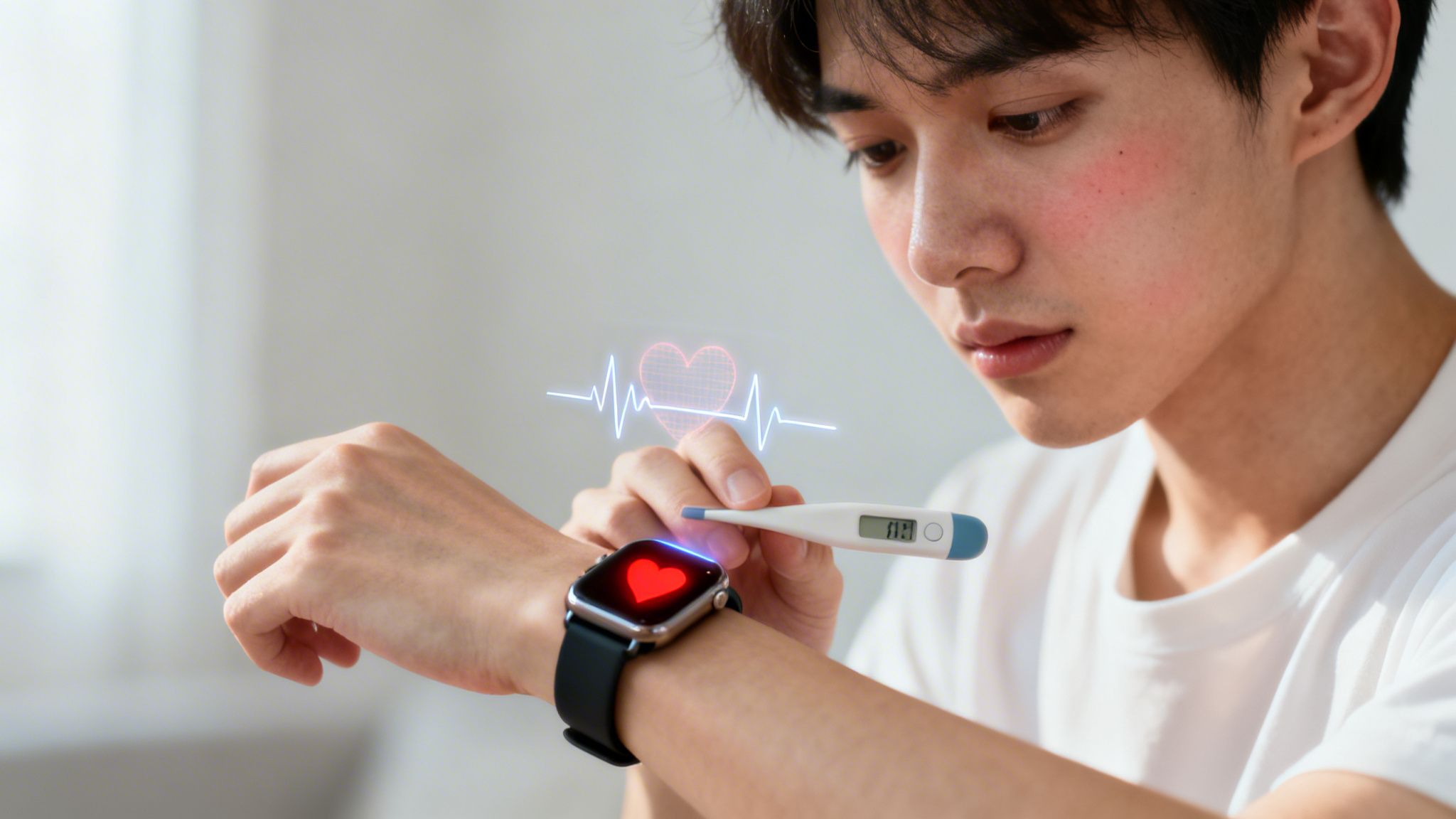
Hello Heart Hero. Seeing a fever high heart rate on your wearable can be alarming, but it’s often just your body’s natural response to fighting off an illness. It happens because your body is working overtime to get you healthy again, and understanding why is the first step toward peace of mind.
Your Guide to Fever and a Racing Heart
When you see a fast heart rate on your smartwatch during a fever, it’s easy to feel a surge of anxiety. We get it. This guide is here to walk you through what those numbers on your wrist really mean, without the confusing medical jargon.
Think of your body as a dedicated team working to defeat an invader, like a virus or bacteria. Your immune system is smart, and it has a powerful, two-part strategy to win the battle.
Why Your Body Ramps Up
First, your body’s internal thermostat intentionally raises your temperature. This creates a hostile, feverish environment where germs struggle to survive and multiply. It’s a brilliant defense mechanism, even if it makes you feel miserable for a little while.
Second, to support this fight, your heart starts pumping faster. This increased heart rate isn’t a sign of trouble; it’s a sign of action. Your body needs to deliver reinforcements, and fast.
A higher heart rate during a fever is your body’s way of rushing oxygen and immune cells to the front lines. It’s a natural and effective part of the healing process, showing that your system is actively fighting back.
This accelerated delivery service ensures that every part of your body gets what it needs to combat the infection. Your heart is simply responding to the increased demand, much like it does when you exercise. For every degree Celsius your temperature rises, your heart rate can increase by about 10 beats per minute.
What This Means for You
Understanding this connection is crucial, especially when you're looking at data from your wearable. That high number isn't just a random spike; it's a reflection of your body's hard work. So, what’s the main takeaway?
- Fever creates demand: A higher body temperature increases your metabolic rate, which requires more oxygen.
- Your heart responds: To meet this demand, your heart beats faster to circulate oxygen-rich blood more quickly.
- It’s a team effort: The fever and high heart rate work together as a coordinated response to illness.
By learning what's happening inside your body, you can turn that feeling of uncertainty into confidence. You're not just passively watching a number on a screen; you're gaining insight into your body's incredible ability to protect itself. This knowledge empowers you to stay calm and make informed decisions about your health, putting you back in control.
Why Your Heart Beats Faster With a Fever
When you’re down with a fever, feeling your heart thumping away faster than usual can be unsettling. But what if that racing pulse is actually a sign that your body's defense system is firing on all cylinders, just as it should? Let’s get into the science behind the fever-and-heart-rate connection.
It all starts in your brain, in a tiny but mighty command center called the hypothalamus. You can think of it as your body’s internal thermostat. When your body senses an unwelcome visitor, like a virus or bacteria, the hypothalamus gets the signal to crank up the heat, and that's what triggers a fever.
This jump in temperature isn't a glitch; it's a deliberate defense tactic. A warmer body is a terrible place for germs to multiply, and it also helps your immune cells work much more efficiently. But to make this happen, your body has to kick its entire operation into a higher gear.
Your Metabolism on Overdrive
A fever revs up your metabolic rate, the speed at which your body burns fuel for energy. As your metabolism accelerates, your cells start chugging through oxygen and energy way faster than they do at a normal temperature.
This creates a brand-new demand. Every part of your body, from your brain down to your muscles, is suddenly screaming for more oxygen to keep up with this high-energy fight. So how does your body answer the call? It tells your heart to pick up the pace.
Think of it as a simple supply-and-demand situation. Your body's higher metabolic rate demands more oxygen, and a faster heart rate is how it gets delivered. Your heart naturally speeds up to pump more oxygen-rich blood everywhere it’s needed.
Your heart is simply responding to the body’s orders to support the immune system. That faster beat ensures that your hard-working immune cells get to the "battlefield" quickly and have all the oxygen they need to do their job right.
The Predictable Rise in Heart Rate
The relationship between fever and heart rate is so consistent, it’s practically a formula. This isn't just a vague feeling; there's a measurable pattern between your temperature and your pulse.
This connection is a well-known clinical observation. For instance, a major 2019 analysis looking at millions of emergency department visits found a clear trend. The data showed that for every 1°C (or 1.8°F) increase in body temperature, an adult’s heart rate goes up by an average of about 7 beats per minute (bpm). This means that a heart rate that feels alarmingly fast is often just a standard physiological response to being sick. You can read more about it in this study on emergency department data.
This predictable increase is what we call sinus tachycardia. It might sound like a complicated medical term, but it just means your heart is beating faster than usual while keeping a perfectly normal, steady rhythm. It’s like your heart's natural pacemaker just turned up the tempo. If you want to dive deeper, check out our guide on what sinus tachycardia on your watch ECG means.

So, when you see a fast but regular rhythm on your watch’s ECG during a fever, you’re most likely seeing your body's powerful and efficient defense mechanism in action. Understanding this is the key to making sense of your device's data, helping you tell the difference between a normal biological response and something that’s a real cause for concern.
Normal Tachycardia Versus Worrisome Arrhythmia
A fast heartbeat during a fever can feel strange and unnerving. How do you know if it’s just your body’s normal response or something more serious? Let’s help you tell the difference between a benign fast rhythm, known as sinus tachycardia, and a potentially problematic irregular one, called an arrhythmia.
Think of your heart’s rhythm like music. Sinus tachycardia is like your favorite song playing much faster, but the beat is still steady, predictable, and correct. Every note is hit right on time, just sped up. This is what typically happens with a fever high heart rate.
An arrhythmia, on the other hand, is like the band suddenly falling out of sync. The drummer might miss a beat, the guitarist could play an extra, jarring note, or the tempo might become completely chaotic and unpredictable. The rhythm is no longer steady and reliable.
How Each Rhythm Feels
Understanding the physical sensations of each can provide valuable clues. While everyone's experience is a bit different, there are some common patterns you can learn to recognize.
Sinus tachycardia usually feels:
- Fast but regular: Your heart feels like it's racing, but the thumping is consistent and even.
- A strong, steady pulse: You can feel your pulse in your neck or wrist, and it’s rapid but has a dependable rhythm.
A worrisome arrhythmia might feel like:
- Fluttering or quivering: A sensation like a bird flapping its wings inside your chest.
- Skipped beats or pauses: A noticeable feeling that your heart missed a beat, often followed by a hard thump.
- Chaotic thumping: An irregular, disorganized pounding that feels completely out of sync.
If you are trying to understand the difference on your watch's ECG, learning how to tell apart rhythms like sinus tachycardia and atrial fibrillation can give you a lot more clarity. You might be interested in our guide that compares sinus tachycardia vs. atrial fibrillation on your watch ECG.
What Your Wearable ECG Might Show
When you have a fever, you might also notice some subtle changes on your wearable's ECG tracing beyond just a faster rate. These are often temporary and part of your body's normal response to the stress of illness.
Imagine you're hit with a sudden fever from a respiratory infection, and your smartwatch starts buzzing with alerts about a racing heart. This isn't just a coincidence; it's a well-documented physiological response. In fact, a study from decades ago found that for every 1°C rise in temperature, heart rate surged by an average of 8.5 beats per minute, even during sleep. This study also highlighted that a fever can shorten specific parts of your ECG, like the PR and QT intervals, while sometimes triggering extra heartbeats. You can discover more insights about these cardiac findings during fever.
When your heart rate increases due to a fever, the electrical signals that create your heartbeat naturally speed up. This can cause temporary and often harmless changes to the different waves and intervals you see on your ECG.
For instance, the PR interval (the time it takes for the electrical signal to travel from the top to the bottom chambers of your heart) and the QT interval (the time it takes for your heart's lower chambers to contract and then reset) often get shorter. This is simply a reflection of your heart working more quickly.

While seeing these changes might seem alarming, they are typically a normal part of the fever response. The key is to focus on the overall rhythm. As long as it remains fast but regular, it’s most likely benign sinus tachycardia. If the rhythm becomes chaotic or filled with irregular beats, that’s when it’s time to pay closer attention and seek another opinion.
Heart Rate and Fever Guides for Different Ages
Seeing a high heart rate on your child's wearable during a fever can be alarming for any parent. But understanding what to expect is the key to navigating these moments with confidence. Your body’s response to a fever changes quite a bit from infancy to adulthood, and knowing what's normal is half the battle.
It’s completely natural to feel a jolt of concern when you see a high number pop up on a device. This is where having some age-specific context becomes so important. What’s considered a typical heart rate for a sick toddler is very different from what’s normal for a teenager or an adult.
The Rule of Thumb for Children
For children, there's a well-established rule of thumb that can offer a lot of reassurance. It’s widely observed that a child’s heart rate will increase by about 10 to 12 beats per minute (bpm) for every 1°C (or 1.8°F) rise in their body temperature.
This predictable increase is a sign that your child’s body is doing exactly what it’s supposed to. The fever ramps up their metabolism, and the heart beats faster to deliver the oxygen and immune cells needed to fight off the illness. Knowing this benchmark helps you make sense of the data you're seeing on a smartwatch or monitor.
This isn't just an old wives' tale; it's backed by solid science. A massive 2022 study involving over 235,000 patient visits found that for every 1°C increase in temperature, heart rate rose by an average of 12.3 bpm. This connection held true even after accounting for other factors like age and oxygen levels, confirming just how reliable this relationship is. You can explore the full findings of this extensive study on heart rate and temperature.
Normal Heart Rate Ranges by Age
To give you more specific guidance, it helps to know the typical resting heart rate ranges for different age groups. When a fever hits, you can expect the heart rate to rise above these baseline numbers, but it should still maintain a regular, steady rhythm.
Here are some general guidelines for normal resting heart rates:
- Newborns (0-1 month): 100 to 205 bpm
- Infants (1-12 months): 100 to 190 bpm
- Toddlers (1-2 years): 98 to 140 bpm
- Preschoolers (3-5 years): 80 to 120 bpm
- School-Aged Children (6-11 years): 75 to 118 bpm
- Adolescents (12+ years) and Adults: 60 to 100 bpm
If you want to dive deeper into this, our guide on a normal cardiac rate provides even more detail.
By knowing the expected increase and your family member's baseline heart rate, you gain a powerful tool. You can use your wearable to monitor them with a greater sense of calm, knowing that a fever high heart rate often falls within a predictable and normal range.
This knowledge transforms your wearable from a source of anxiety into a source of reassurance, empowering you to care for your loved ones with clarity and peace of mind.
Urgent Warning Signs to Watch For
We get it. A fast heartbeat during a fever can be unsettling, but it’s usually just your body kicking its immune response into high gear. The key is knowing the difference between a normal reaction and a real red flag.
Think of it like this: your body is sending you signals. Most of the time, a fast but steady heart rate is just a sign it's fighting hard. But sometimes, the signals point to something more serious. Let's walk through what to look for.
When a High Heart Rate Is a Red Flag
A racing heart during a fever is one thing, but certain signs suggest it's more than just the illness. It’s not just about how fast your heart is beating, but how it's beating and what other symptoms are showing up.
Here are the specific warning signs to pay close attention to:
- A heart rate that stays high: Your heart rate should generally track your fever. As your temperature comes down, your pulse should slow down with it. If your heart rate stays elevated, say above 140 to 150 bpm in an adult, even after the fever breaks, that’s a signal to get it checked.
- A chaotic or irregular rhythm: As we’ve covered, a fast but steady rhythm is typical. But if your heart feels like it's fluttering, skipping beats, or pounding in a disorganized, chaotic way, you're no longer in the territory of simple sinus tachycardia.
- A cluster of other serious symptoms: A high heart rate is much more concerning when it doesn't show up alone. When paired with other severe symptoms, it's a clear sign your body is under serious stress.
The most critical thing to remember is to look at the whole picture. A high heart rate combined with other alarming symptoms isn't a typical reaction to a simple fever. It's a clear signal from your body that it needs immediate medical support.
Benign Fever Response vs Urgent Warning Signs
To make it even clearer, here’s a quick guide to help you tell the difference between what’s generally expected with a fever and what needs a doctor’s immediate attention.
What’s a potential warning sign?
- For Heart Rate: Stays very high (over 140 to 150 bpm) after fever drops; feels chaotic or irregular.
- For Breathing: Significant shortness of breath or difficulty catching your breath while resting.
- For Mental State: Confusion, disorientation, or extreme drowsiness.
- For Pain: Severe, sharp, or crushing chest pain or pressure.
- For Balance: Severe dizziness, lightheadedness, or actually fainting.
What's usually normal during a fever?
- For Heart Rate: A fast but steady rhythm that slows down as the fever subsides.
- For Breathing: It may be slightly faster than usual.
- For Mental State: Feeling tired and weak, but being coherent and aware.
- For Pain: General body aches and headaches.
- For Balance: You may feel slightly weak or unsteady when standing.
This guide is a great starting point, but it's no substitute for professional medical advice. When in doubt, always err on the side of caution.
Symptoms That Demand Immediate Action
If you or a loved one has a fever and a high heart rate along with any of the following symptoms, it's time to call a doctor or head to an emergency room right away. Don’t try to wait it out.
Pay close attention to:
- Severe chest pain or pressure: This is never something to ignore, especially when your heart is already racing.
- Significant shortness of breath: Feeling winded while just sitting or struggling to breathe is a serious warning sign.
- Confusion or disorientation: If you or someone else seems confused, unusually sleepy, or can't think clearly, it could signal a major problem.
- Dizziness, lightheadedness, or fainting: These symptoms suggest your brain might not be getting enough oxygen, which requires urgent evaluation.
It’s also important to understand when to worry about fever in general, as there are different red flags for different age groups. Above all, trust your gut. You know your body better than anyone. If something feels seriously wrong, it probably is, and getting it checked out quickly can make all the difference.
How to Use Your Wearable ECG for Reassurance
When you're sick with a fever, that feeling of a racing heart can be unnerving. Your wearable device, whether it's an Apple Watch, Fitbit, or KardiaMobile, is more than just a step counter in these moments. It can be a valuable window into your heart’s rhythm, offering some much-needed reassurance.
But getting a clean, useful ECG isn't always as easy as just hitting a button, especially when you feel weak or shivery. A few simple tricks can make all the difference in what you capture.


Capturing a Clear ECG When You Have a Fever
To get a good look at your heart's activity, you need to cut down on the "noise" or interference that can mess up the reading. This can be tricky when a fever has you feeling shaky.
Here’s a quick rundown for getting the best possible ECG:
- Sit Down and Settle: Find a comfortable chair and just sit quietly for a few minutes before you start. Let your body and breathing calm down as much as possible.
- Rest Your Arms: Put the arm with your watch, or your hands holding the ECG device, on a steady surface like a table or your lap. This is key to stopping muscle tremors from showing up on your reading.
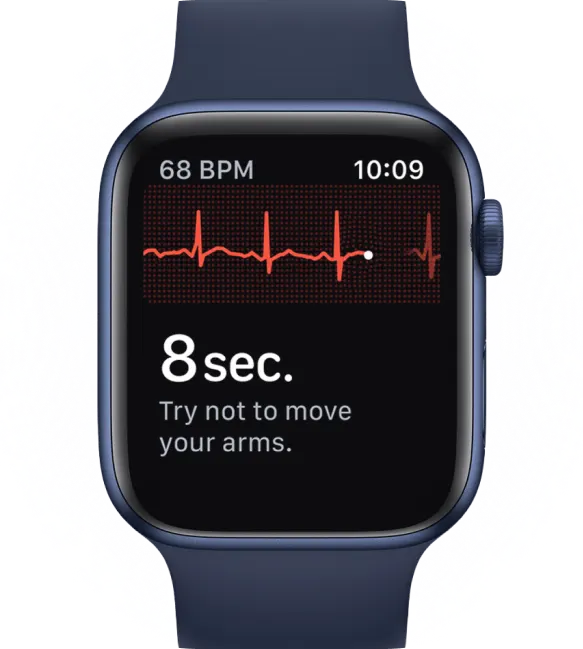
- Stay Still and Silent: For the whole 30-second recording, try not to talk or move. Even small movements can create "artifacts" that make the ECG hard to read.
Following these steps helps make sure the tracing is clean and shows your actual heart rhythm, not just muscle noise from shivering. A clear recording is crucial for figuring out if you're dealing with a normal fever high heart rate or something more.
Understanding Your ECG Data and Its Limits
So, you've got the recording. What are you actually looking at? When your heart speeds up from a fever, a normal ECG will show a rhythm that's fast, but still regular. The P-QRS-T waves that make up each heartbeat will be squished closer together, but their basic shape and order should look the same.
This is called sinus tachycardia, and it’s exactly what we expect to see. The problem is, your watch's built-in software might not be smart enough to figure this out, especially when your heart rate gets really high. It might just throw its hands up and give you an "Inconclusive" or "Unclassified" result, which can cause more anxiety than it relieves.
Your wearable is great at gathering the data, but it often stops right before giving you a confident answer. This is where you might feel stuck, holding a strip of squiggly lines with no clear interpretation.
This is the exact spot where people often feel let down. You bought the tech for answers, but now you have more questions. For instance, your device can’t tell you for sure if your PR, QRS, and QTc intervals are shortening normally with the fast rhythm, or if it's a hint of another problem. You can learn more about how experts figure out heart rate from an ECG to see what goes into it.
This is where a human expert bridges the gap. By sending the ECG from your watch to a service like Qaly, you can have a certified cardiographic technician review it in minutes, any time of day. They look at the nitty-gritty details, like the intervals, and give you a human-verified analysis that tells the difference between benign tachycardia and a real arrhythmia. This gives you the peace of mind you were looking for, with an analysis you can trust and even share with your doctor.
Answering Your Questions About Fever and Heart Rate
We've covered a lot of ground, but it's completely normal to have a few more questions rattling around. This last section is all about giving you quick, clear answers to the most common concerns about a fever high heart rate, so you can have that extra bit of peace of mind.
Can Dehydration From a Fever Cause a High Heart Rate?
Yes, it's one of the biggest culprits. When you have a fever, your body works overtime to cool down, which usually means a lot of sweating. All that lost fluid can quickly lead to dehydration, which lowers the total volume of blood circulating in your system.
Your heart has to compensate for that lower volume. To get the same amount of oxygen-rich blood to your organs, it has to pump faster. This is why staying on top of your fluids is one of the most critical things you can do when you're sick. Sometimes, a racing heart has more to do with needing a glass of water than the fever itself.
My Heart Rate Is Still High After My Fever Broke. Is This Normal?
It can be. Your body just went through an intense fight to get rid of an infection, and it needs time to wind down and recover. Think of it like the cooldown period after a really tough workout; your systems don't just flip a switch and go back to resting mode instantly.
It’s pretty common for your heart rate to stay a bit elevated for a day or two after your temperature is back to normal. However, if your heart rate stays significantly high (say, over 100 to 110 bpm) while you're resting for more than a couple of days, or if it comes with palpitations, dizziness, or shortness of breath, it's a good time to capture an ECG for some clarity.
Your body is in recovery mode, and some systems, including your heart rate, take longer to return to baseline. Listen to your body, but don't hesitate to seek clarity if a high rate persists without a clear reason.
What Is a Dangerously High Heart Rate for an Adult With a Fever?
There's no single magic number that spells "danger" for everyone, since it's all relative to your age, fitness, and overall health. As a general rule of thumb, though, if your resting heart rate is consistently staying above 140 beats per minute, it’s a good reason to seek medical advice.
What's far more important is how you feel. A number on a watch is just one piece of the puzzle. If that fast heart rate is paired with other serious symptoms like severe chest pain, major trouble breathing, fainting, or confusion, that's a signal to seek emergency medical care right away.
Can Over-The-Counter Cold Medicines Affect My Heart Rate?
They absolutely can, and it's something to be aware of. Many popular "cold and flu" remedies contain decongestants like pseudoephedrine or phenylephrine. These ingredients are stimulants; their job is to shrink swollen blood vessels in your nose, but they can also rev up your heart rate and blood pressure as a side effect.
When your heart rate is already high from a fever, adding a stimulant on top of it can cause a very noticeable jump. If you have a known heart condition or are prone to palpitations, it’s always a good idea to read the labels carefully and maybe ask your pharmacist about stimulant-free alternatives.
Knowing what’s causing the fever in the first place is also helpful. While you should always consult a doctor, understanding the general differences between bacterial vs viral infection symptoms can give you some initial context for your body’s response.

When the data on your wearable leaves you with more questions than answers, Qaly provides the clarity you need. Get your ECGs interpreted by certified human experts in minutes, 24/7.



.png)
.png)