


Key Takeaways

User Profile
Hello Heart Hero.
You may be reading this after a sudden burst of pounding, chaotic heartbeats. Maybe your Apple Watch or Kardia tracing looked strange, maybe the app summary felt too vague, and maybe you left the experience with more questions than answers.
That reaction makes sense. Pre excited atrial fibrillation sounds technical and alarming because it is both unusual and important. But unusual doesn't mean unknowable. Once you understand the basic wiring problem, the rhythm starts to make a lot more sense.
Many people in this position feel caught between two frustrations. On one side, their symptoms feel real and urgent. On the other, the healthcare system can feel rushed, inconsistent, or hard to access in the moment. If that has been your experience, you are not overreacting. You are trying to understand your own data and protect your health.
If you want a plain language foundation first, this overview of a heart rhythm disorder can help frame the bigger picture.
Welcome to Your Guide on a Confusing Rhythm
A common scenario goes like this. You're sitting on the couch, walking up stairs, or waking in the middle of the night, and suddenly your heart doesn't just race. It feels disorganized. Fast, yes, but also uneven and wild.
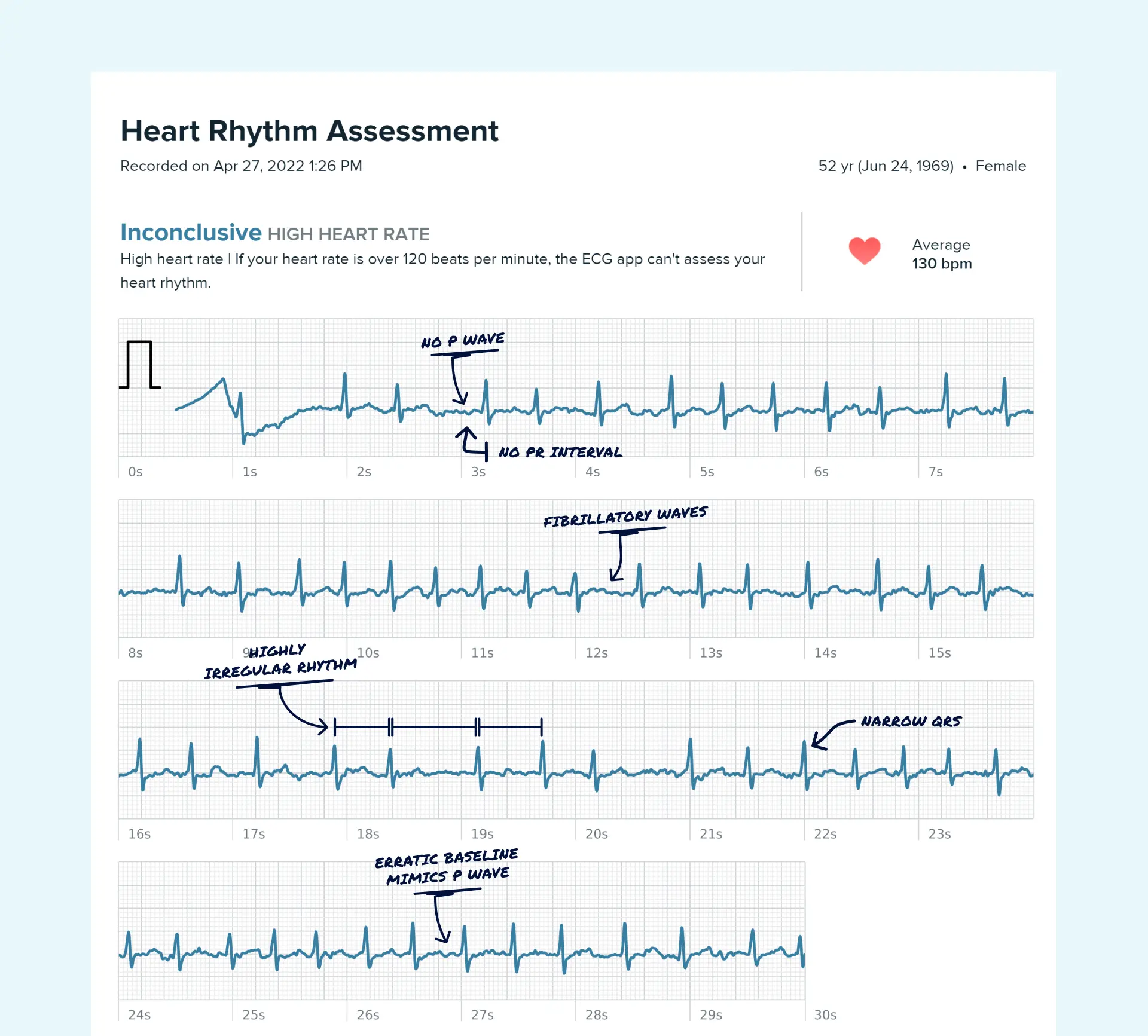
You record an ECG on your wearable. The tracing looks messy. Maybe the beats are spaced oddly. Maybe the waveforms look wider than usual. Maybe the device labels it inconclusive, high heart rate, or possible AFib, but the whole thing doesn't look like the examples you've seen before.
Why this feels so unsettling
Part of the fear comes from mismatch. You expect one problem, but your body gives you another. People often know that atrial fibrillation can cause an irregular heartbeat. What they don't know is that in some people, AFib can interact with an extra electrical pathway in the heart and create a more dangerous pattern.
That is the piece this article is here to untangle.
You don't need to become a cardiologist to protect yourself. You do need a clear mental model for what your device may be showing you.
What you need most right now
You need three things:
- A simple explanation of what pre excited atrial fibrillation is
- A practical way to spot red flags on a wearable ECG
- Confidence about when to seek urgent help and what treatment usually looks like
You do not need panic. You do not need internet myths. And you do not need to ignore your symptoms because someone once told you it was “just anxiety.”
This rhythm can happen in people who otherwise feel healthy. It can also hide behind confusing watch tracings, especially when the tracing is only one lead and the episode comes and goes. That's why pattern recognition matters so much.
What Pre Excited Atrial Fibrillation Actually Means
Your heart’s electrical system has one normal gate between the upper chambers and lower chambers. That gate is the AV node. Its job is to slow incoming signals so the ventricles do not get flooded with every impulse coming from the atria.
Some people are born with an extra connection between those chambers. This is called an accessory pathway. In Wolff-Parkinson-White syndrome, or WPW, that pathway can let signals reach the ventricles without passing through the AV node first.
.webp)
The normal route and the shortcut
During normal rhythm, electrical activity starts in the atria and then funnels through the AV node in an orderly way. During atrial fibrillation, the atria start firing rapidly and irregularly. In many people, the AV node acts as a partial filter, so the ventricles are protected from the full storm above them.
With an accessory pathway, some of those chaotic atrial impulses can bypass that filter. They reach the ventricles by the shortcut. That is what doctors mean by pre excited. The ventricles are being activated earlier, and less safely, through a route that should not be carrying that kind of traffic.
If you want a wearable-focused explanation of how this extra pathway can show up before AFib enters the picture, this guide to Wolff-Parkinson-White syndrome on your watch ECG gives a helpful foundation.
What makes pre excited AFib different
Pre excited atrial fibrillation means AFib is happening in a heart that has an accessory pathway able to conduct impulses to the ventricles. The key problem is not just that the rhythm is irregular. The problem is that the heart’s usual braking system is being partly bypassed.
That can produce a rhythm with three features clinicians watch for:
- Very fast ventricular rates
- Marked irregularity
- Wide, changing beat shapes on ECG
Those changing shapes matter. On an ECG, the ventricles may be activated partly through the normal system and partly through the accessory pathway, so the tracing can look uneven from beat to beat. On a watch ECG, that may show up as a strip that looks faster, messier, and wider than ordinary AFib examples online.
A simple way to picture it is this. AFib creates a rapid shower of electrical signals in the atria. The AV node usually works like a gatekeeper that blocks many of them. The accessory pathway behaves more like an open side entrance. More signals get through, and the ventricles can be pushed into a dangerously fast response.
Practical rule: Typical AFib may be irregular. Pre excited AFib is irregular, unusually fast, and often has abnormal-looking ventricular beats.
This is why your own device data can be so useful. A wearable cannot confirm the diagnosis by itself, especially with a single lead tracing, but it can capture the pattern, the timing, and the heart rate during symptoms. That record can give your clinician a much better starting point than a memory of “my heart was racing,” and in some cases it helps human ECG review services flag a pattern that needs urgent medical attention.
Recognizing Pre Excited AFib on Your Watch ECG
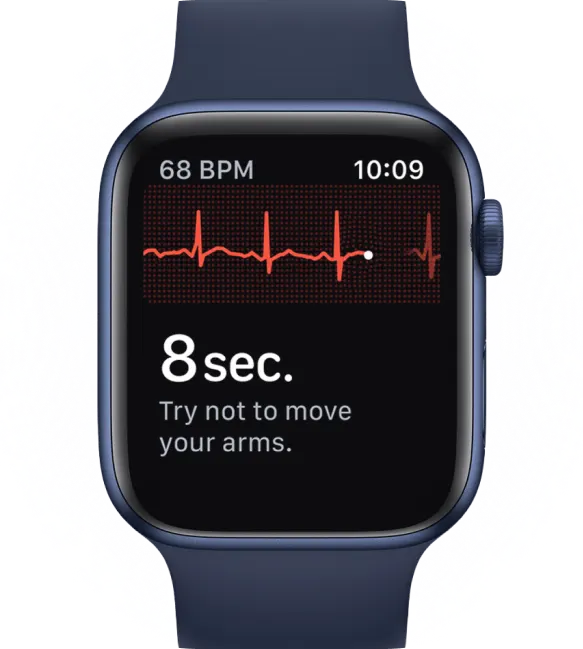
Most wearable users don't have a 12 lead ECG in their pocket. They have a single lead tracing from a device like an Apple Watch, Fitbit-compatible ECG feature, or Kardia. That means you won't diagnose yourself with certainty from one strip, but you can absolutely learn to notice warning patterns.
The three most useful clues are speed, irregularity, and beat shape.
Sign one is that the rate looks far too fast
With pre excited AFib, ventricular rates can exceed 200 to 300 bpm in high risk cases. On a wearable, you may not trust the exact number, but you can often tell the rhythm is beyond what is commonly considered ordinary palpitations.
The strip may look compressed because the beats are packed so tightly together. If you've seen your own normal rhythm before, the contrast is usually obvious.
Sign two is complete irregularity
This isn't a steady rapid rhythm. The spaces between beats jump around chaotically. There is no repeating pattern you can count on.
That matters because some other fast rhythms are rapid but regular. Pre excited AFib is fast and disordered at the same time.
If you want a baseline visual comparison, this article on what atrial fibrillation looks like on your watch ECG helps show how wearable AFib tracings can differ.
Sign three is wide or changing QRS appearance
This is the subtle clue that often gets missed. In ordinary AFib, the ventricular beats are often narrow because the impulses still travel through the normal conduction system. In pre excited AFib, the ventricular complexes can look wide and can even change shape from beat to beat.
Why would they change? Because conduction can vary between the usual pathway and the accessory pathway. On a single lead wearable tracing, that may look like one beat is broader, the next is different, and the overall strip looks bizarre or unstable.
Clinicians also use a high risk marker called the shortest pre-excited R-R interval, or SPERRI. If the time between the two fastest consecutive beats is less than 250 milliseconds, it signals a very high risk accessory pathway, as described in the QJM report on pre-excited AF.
What confuses people most
People often assume a watch ECG should neatly label the rhythm for them. But consumer devices are not perfect at recognizing unusual wide-complex irregular tachycardias.
Watch for these practical clues:
- Much faster than your usual episodes
If prior palpitations were manageable and this one feels dramatically faster, take that seriously. - Irregular and ugly-looking
A tracing that looks chaotic and morphs in appearance deserves more attention than a simple regular rapid rhythm. - Symptoms match the strip
If you feel faint, breathless, or intensely unwell during the recording, the clinical picture matters as much as the image.
If your watch says “inconclusive,” that doesn't mean “safe.” It may simply mean the rhythm falls outside what the algorithm handles well.
The Real Risks and When to Seek Immediate Care
This is the part where honesty matters. The danger in pre excited atrial fibrillation isn't just discomfort. The rhythm can deteriorate into ventricular fibrillation, a life threatening rhythm where the heart no longer pumps blood effectively.
That sounds scary because it is serious. But knowing that risk helps you act early instead of freezing.

When symptoms mean don't wait
Get urgent medical help if a very fast irregular rhythm comes with any sign that your body isn't tolerating it well.
Those warning signs include:
- Fainting or nearly fainting
If you black out or feel like you're about to, treat that as an emergency. - Severe dizziness or sudden weakness
This can mean the heart isn't maintaining stable blood flow. - Chest pain or chest pressure
Your heart is under stress. You need evaluation, not watchful waiting. - Shortness of breath that feels significant
Trouble breathing during a very rapid rhythm deserves immediate attention.
A helpful general reference on dangerous heart rates with AFib can support your decision making, but if you feel unstable, don't spend time comparing articles.
Why acting fast matters
In pre excited AFib, the accessory pathway can allow very short intervals between beats. Some pathways conduct so quickly that the ventricles are exposed to electrical chaos they can't handle well.
Doctors pay extra attention when the history includes syncope, younger age, a history of symptomatic tachycardia, multiple accessory pathways, or very short pre excited intervals. Those features can raise concern about malignant arrhythmias.
If a rhythm feels dramatically different from your usual palpitations and your symptoms are escalating, going to the ER is a strong decision, not an overreaction.
A calm rule to remember
If you are stable, alert, breathing comfortably, and symptoms are easing, you can still seek same-day clinical advice. But if you are unstable, or think you might become unstable, emergency services are the right move.
Trust the whole picture. The tracing matters. Your symptoms matter too.
Emergency and Long Term Treatment Explained
A useful way to understand treatment is to picture the heart's electrical system like traffic at a busy intersection. In ordinary AFib, doctors often slow the main gate between the upper and lower chambers. In pre excited AFib, there is an extra side road. If you close the main gate without recognizing that shortcut, more impulses may rush down the wrong path.
That is why the first treatment decision is simple and urgent. Is the person stable, or is the rhythm already hurting blood flow?
What happens in the emergency setting
If someone is unstable, doctors usually treat the rhythm with synchronized DC cardioversion. This is a timed electrical shock that resets the heartbeat so the heart can pump in a more organized way again.
If the person is stable, doctors may choose medicines such as IV procainamide or ibutilide. The goal is to slow conduction through the accessory pathway and calm the rhythm without pushing more electrical traffic toward the ventricles.
Pre excited AFib follows a different rulebook than typical AFib. Correct recognition matters because the safest treatment path can change fast.
Drugs that can make it worse
Some medications that are commonly used for other fast rhythms can be dangerous here. They slow the AV node, which can leave the accessory pathway as the easier route for electrical impulses.
That is the setup doctors try to avoid.
Medications that are generally contraindicated in suspected pre excited AFib include:
- Adenosine
- Beta-blockers
- Digoxin
- Calcium channel blockers
If you have a wearable ECG strip that raised concern for pre excitation, save it on your phone and mention that concern clearly in urgent care or the ER. A single recording does not diagnose the whole problem, but it can help the clinical team ask the right question early.
The long term fix doctors often recommend
Long term treatment often focuses on catheter ablation. An electrophysiologist threads thin catheters into the heart, maps the extra pathway, and applies energy to stop that shortcut from conducting.
This approach treats the wiring problem itself, not just the fast rhythm that shows up during an episode. For people with confirmed accessory pathways and high risk rhythms, ablation is often considered the definitive strategy.
Many patients find that reassuring. The goal shifts from repeated emergency control to removing the trigger that allowed the dangerous pattern in the first place.
Why your own recordings still matter after the acute episode
A hospital team may only see a short snapshot of the rhythm. Your watch ECGs, symptom notes, and the timing of episodes can fill in the rest of the story. That record can support referral to an electrophysiologist and make follow-up visits more productive.
If your wearable has captured signs of pre excitation during normal rhythm, such as a short PR interval or a slurred early upstroke of the QRS, bring those strips to your appointment. Human review can be especially helpful here because intermittent pre excitation may be easy to miss when an episode has already passed.
How to Monitor Your Heart and Partner with Your Doctor
Living with a rhythm that may come and go can make you feel powerless. The good news is that modern wearables can turn fleeting symptoms into something visible and shareable. That changes the clinical conversation.
Your Apple Watch, Kardia, Fitbit-compatible ECG feature, or other home ECG device won't replace a cardiologist. But it can capture the moment that your memory alone can't fully describe.

What to save during an episode
When symptoms happen, try to gather a few practical details:
- The ECG strip itself
Save the recording, screenshot it, and note the exact time. - What you felt
Write down whether you felt pounding, chest pressure, near-fainting, breathlessness, or only awareness of a fast rhythm. - What you were doing
Resting, exercising, startled awake, drinking caffeine, or recovering from illness can all provide useful context. - How the episode started and stopped
Sudden onset and abrupt ending can help a clinician think through the likely rhythm.
Why interpretation support matters
Single lead ECGs are useful, but they can also be confusing. Pre excited rhythms may be intermittent. Some strips may show obvious abnormalities, while others look nearly normal between episodes.
That is where human review can be more helpful than an automated label alone. A trained reviewer can look at the tracing itself, the intervals, the beat shapes, and the symptom story. That creates a better starting point for a doctor visit than saying, “My watch went weird once.”
How to have a stronger doctor conversation
Bring organized evidence, not just anxiety. That doesn't mean hiding your worry. It means pairing it with specifics.
A strong appointment summary might include:
- The date and time of each event
- Saved ECGs from your device
- A short symptom log
- Any previous ECG reports mentioning pre excitation, WPW, delta waves, or a short PR interval
- Questions about electrophysiology referral and ablation candidacy
If your clinician seems dismissive, stay focused on the data. Ask direct questions. Is this possibly pre excited AFib? Do these strips suggest an accessory pathway? Should I see an electrophysiologist? What should I do if it happens again?
The goal isn't to challenge your doctor. It's to give them the clearest evidence possible so they can make the right call faster.
You deserve careful interpretation, especially if your symptoms are episodic and your device captured the event outside the clinic.


Worried about your ECG reading? Get expert eyes on it. Qaly's certified cardiographic technicians review recordings from Apple Watch, Kardia, Fitbit, Samsung, and more.



.png)
.png)