




Key Takeaways

User Profile
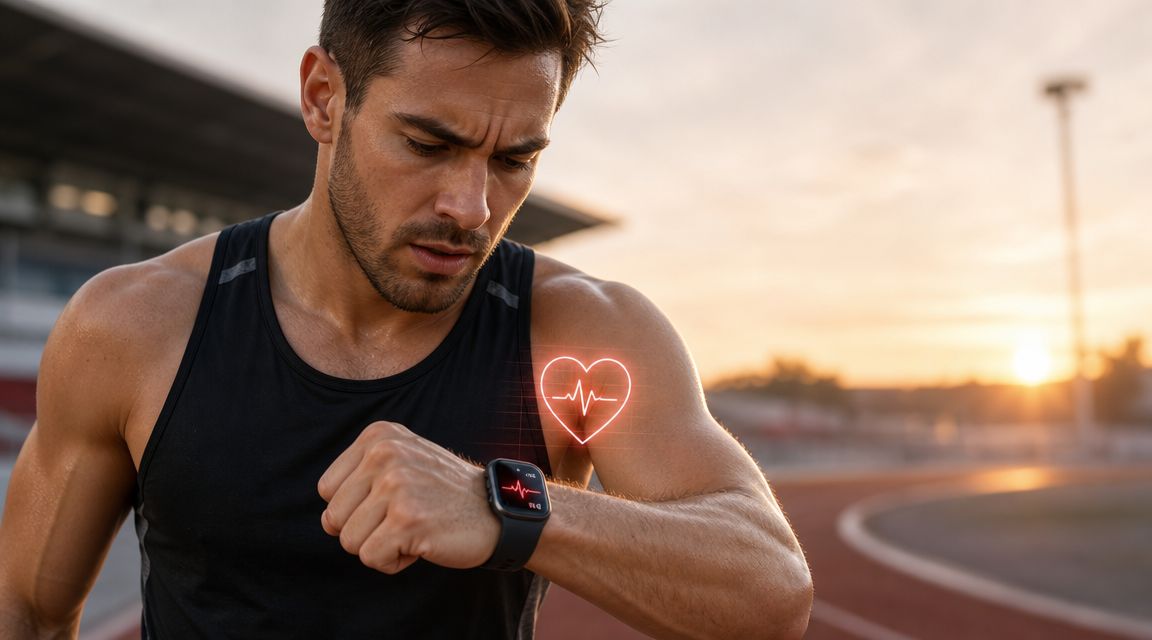
Hello Heart Hero. You're midway through a walk, run, ride, or gym session when your chest suddenly feels off. Maybe it's a flip-flop. Maybe a hard thump after a pause. Maybe your watch flags an irregular rhythm right when your brain starts spiraling. You wonder if you should stop, push through, sit down, or head to urgent care.
That moment can feel oddly lonely. You know your body felt something real, but getting a clear answer can be frustrating. Symptoms can vanish before you get seen. A clinic ECG can look normal. A smartwatch alert can feel helpful one minute and maddening the next.
An exercise induced arrhythmia sits right in that uncomfortable space between sensation and proof. The good news is that this topic is understandable. And if you use a wearable, you already have a tool that can help turn a scary moment into useful information.
That Unsettling Flutter During Your Workout
A lot of people first notice this during a workout that was supposed to feel good. You settle into your pace, your breathing is fine, your legs are working, and then your heartbeat suddenly feels different from the effort you're making. Not just faster. Strange.
Some people describe it as a bird flapping in the chest. Others call it a skipped beat, a drop, a bang, or a brief burst of chaos. If that sounds familiar, you're not overreacting. Those sensations can be extremely unsettling, especially when they happen during exercise, when you expect your heart to feel strong and steady. If you want a better vocabulary for what you felt, this guide on what heart palpitations can feel like can help put words to the experience.
Why this feels so scary
Exercise already raises your heart rate. That makes it harder to tell the difference between normal exertion and something electrical. Many people think, “Maybe I'm just noticing my heartbeat more.” Others go straight to, “What if this is dangerous?”
Both reactions are understandable.
Your body can feel a rhythm change before anyone else can measure it. That doesn't make you dramatic. It makes you observant.
What people often do next
Usually one of three things happens:
- Push through it: You hope it's nothing and keep going.
- Stop immediately: You pause, check your watch, and try to calm down.
- Start searching online: You look for answers because the healthcare system can feel slow, rushed, or dismissive.
That search for answers is reasonable. The trick is to move from fear to pattern recognition. What were you doing when it started? Sprinting uphill? Lifting heavy? Recovering after a hard interval? Those details matter more than is often recognized.
What Is an Exercise Induced Arrhythmia
Essentially, an arrhythmia is a heart rhythm that isn't following its usual timing. Your heart runs on electricity. This electrical system operates much like a house with carefully timed wiring. Most of the time, the signal starts in the right place, travels in the right direction, and tells the heart chambers when to squeeze. That coordinated timing is what gives you a smooth heartbeat.
An exercise induced arrhythmia happens when that rhythm becomes abnormal during physical activity or shortly after it.

The simple version
Not every rhythm change means the same thing. A single early beat is different from a sustained fast rhythm.
Here's a practical way to understand it:
- Premature beats: These are early beats that can come from the upper chambers or lower chambers. People often feel them as a skip or thump. They can feel dramatic even when they're brief.
- Fast organized rhythms: These can feel like your heart suddenly “takes off” and races in a more sustained way.
- Irregular rhythms: These may feel uneven, chaotic, or hard to predict beat to beat.
_fitbit_2.webp)
Why the names matter
Common labels you may hear include PACs (premature atrial contractions), PVCs (premature ventricular contractions), SVT (supraventricular tachycardia), and AFib (atrial fibrillation). You do not need to memorize all of that to be informed.
What matters is this:
- A brief extra beat can feel huge and still be just one isolated event.
- A rhythm that stays fast, irregular, or keeps coming back deserves more attention.
- The symptom alone doesn't always tell you which rhythm it is.
-samsung.webp)
Why wearables help, but don't tell the whole story
Your watch or handheld ECG device can catch a rhythm strip in the moment. That's useful because it gives you more than a vague description like “my chest felt weird.” But a wearable is still just one snapshot. It works best when you combine the tracing with context, such as:
- what activity you were doing
- whether symptoms began during exercise or recovery
- how long the sensation lasted
- whether you had dizziness, chest pressure, or near-fainting
Practical rule: A weird heartbeat during exercise is a clue, not a verdict.
That's an important mindset. The goal isn't to self-diagnose from one sensation. The goal is to understand what kind of rhythm problem might be happening, how often it happens, and whether it behaves in a pattern.
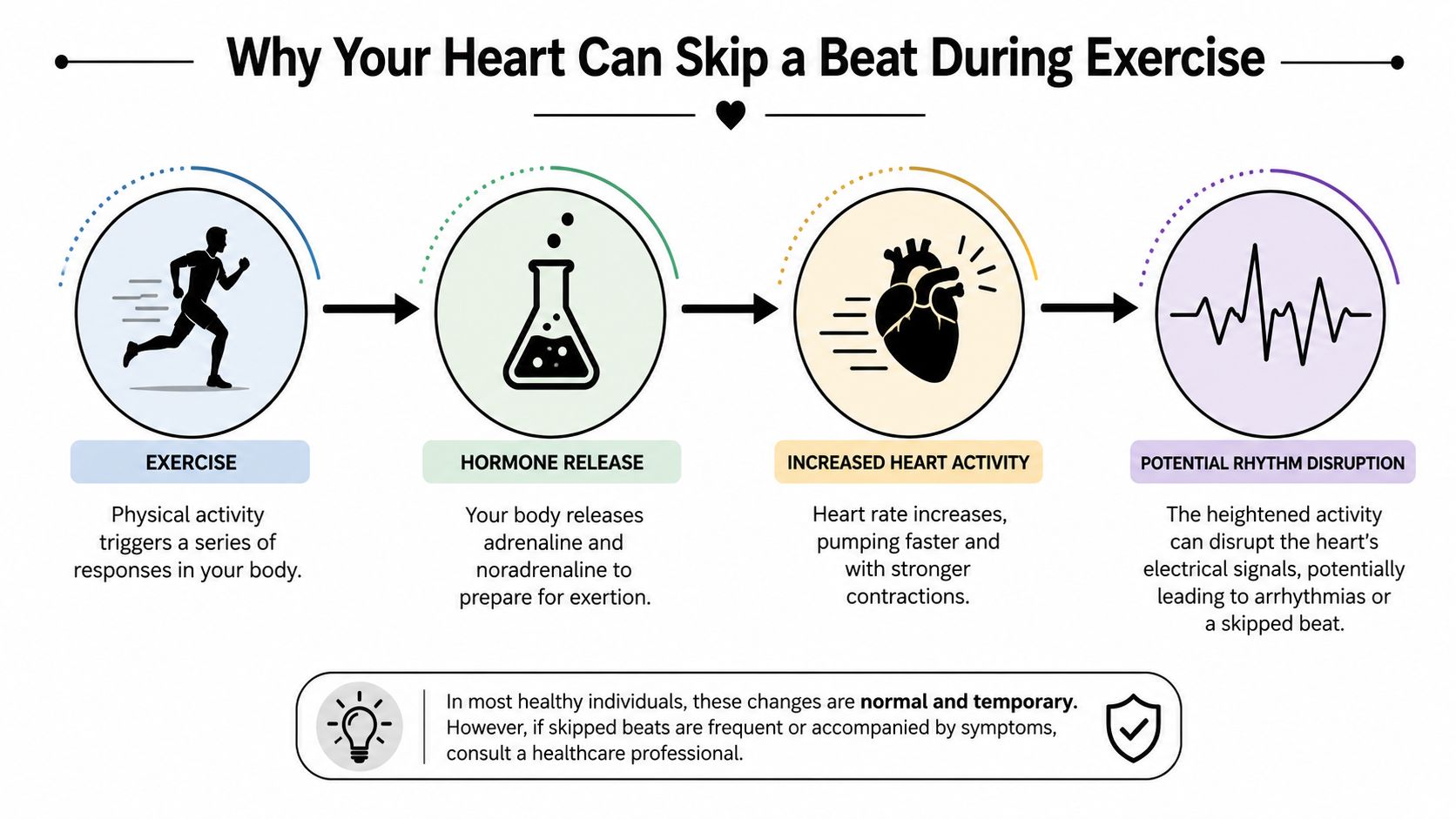
Why Your Heart Can Skip a Beat During Exercise
Exercise is usually good for the heart, which is why rhythm symptoms during exercise feel so confusing. But a healthy thing can still change your body in ways that uncover an electrical weak spot.
When you exercise, your body releases stress hormones called catecholamines, including adrenaline-like signals. Those signals raise your heart rate and shorten the time heart tissue has to reset between beats. In a susceptible heart, that can promote abnormal automaticity, triggered activity, and re-entry, which are different ways an arrhythmia can start. In people with coronary artery disease, exercise-related ischemia can also change conduction and refractoriness, creating a pathway to more serious ventricular rhythms rather than a simple benign blip, as described in this review of exercise-induced arrhythmia mechanisms.
What that means in plain language
Your heart during exercise is not failing. It is adapting. It beats faster, squeezes harder, and resets faster between beats.
That's efficient. But if the electrical system is a little irritable, those same changes can make an extra beat or short run of arrhythmia easier to trigger.
Imagine tapping the gas pedal on a car with a touchy ignition. Most of the time the engine responds normally. Sometimes it sputters for a moment under load.
Why one workout triggers symptoms and another doesn't
Not all exercise stresses the heart in the same way. Sudden effort and progressive effort can provoke different rhythm patterns. In a study of 2,329 participants, 1,225 participants (53%) had some type of arrhythmia in one or both exercise procedures, and 216 subjects (9%) had arrhythmias only on the sudden test and not on the progressive test. Arrhythmias were also more common in people with known or suspected disease than in apparently healthy individuals, 72% vs 48%, and the authors concluded the two exercise types can provide complementary clinical information in this exercise testing study.
That helps explain a common mystery. Your symptoms may show up during a sprint, a stair climb, or a hard interval, but not during a steady jog or easy bike ride.
Other factors that can make the heart more irritable
Some triggers are electrical amplifiers rather than root causes.
- Dehydration or heavy sweating: Fluid shifts can make symptoms easier to notice.
- Poor recovery: Fatigue can lower your tolerance for physiologic stress.
- Stimulants: Pre-workout products, energy drinks, or high caffeine intake can make a sensitive rhythm more noticeable.
- Electrolyte shifts: If you've ever wondered whether minerals matter, this explanation of electrolyte imbalance and your ECG gives helpful background.
A rhythm change during exercise is often the result of stress on the electrical system, not damage happening in real time.
That distinction matters. It lowers the panic while still respecting the symptom.
Listening to Your Body for Symptoms and Red Flags
Symptoms are where understanding often becomes a hurdle. You feel something real, but the feeling itself can be hard to classify. The key is to notice both the rhythm sensation and the company it keeps.


Common symptoms people notice
Exercise-related rhythm issues often feel like one of these:
- Fluttering in the chest: A brief flicker, buzzing, or wing-beat feeling.
- A skipped beat followed by a thump: Often described as a pause and then a stronger catch-up beat.
- Sudden racing: Your heart seems to jump to a speed that feels out of proportion to the workout.
- Erratic pounding: The rhythm feels uneven, not just fast.
- Symptoms in recovery: Some people feel fine during the effort and then notice the rhythm shift when they stop.
That last point is easy to miss. Not every exercise induced arrhythmia happens at peak effort. Some happen during the transition back toward rest.
Why activity context matters
If your symptoms only happen during sharp bursts of effort, note that. If they appear during a cooldown, note that too. The details can help explain why an office ECG or even a routine stress test may miss the problem.
Your own notes are useful here. Write down the activity, the timing, the symptom, and what your wearable showed, if anything.
Red flags that mean stop and seek care
Some symptoms need immediate respect. Stop exercising and get medical care right away if the rhythm sensation comes with any of the following:
- Chest pain or chest pressure
- Severe shortness of breath
- Dizziness that feels significant
- Near-fainting or actual fainting
- A sense that you may pass out
These symptoms raise the level of concern because they suggest the rhythm may be affecting blood flow or may be occurring alongside another important heart problem.
If a palpitation is paired with chest pain, fainting, or severe breathlessness, don't troubleshoot it mid-workout. Stop and get help.
One more reason not to dismiss symptoms
Exercise-triggered rhythm disturbances are not rare in testing situations. In the same research discussed earlier, sudden and progressive exercise brought out different arrhythmias in different people. That means “it didn't happen on the treadmill test” doesn't always settle the question. Your real-life trigger still matters, especially if your episodes cluster around one specific kind of effort.
From Feeling to Fact Finding Your Diagnostic Path
The hardest part of an exercise induced arrhythmia is often the gap between the event and the appointment. By the time you sit in a clinic room, your rhythm is normal, your watch screenshot is buried, and the story sounds less convincing than it felt.
That's why your job is not just to remember the symptom. It's to capture the moment as clearly as you can.
What traditional testing can and can't do
Doctors may use tools like a Holter monitor, an event monitor, or an exercise stress test. Those are standard for good reason. They can reveal patterns, frequency, and whether exertion reproduces the rhythm.
But intermittent symptoms can still slip through. If your arrhythmia shows up only during one kind of workout, one recovery phase, or one specific intensity, a short monitoring window may miss it.
That's not a failure on your part. It's a known challenge in rhythm medicine.
How to use your wearable well
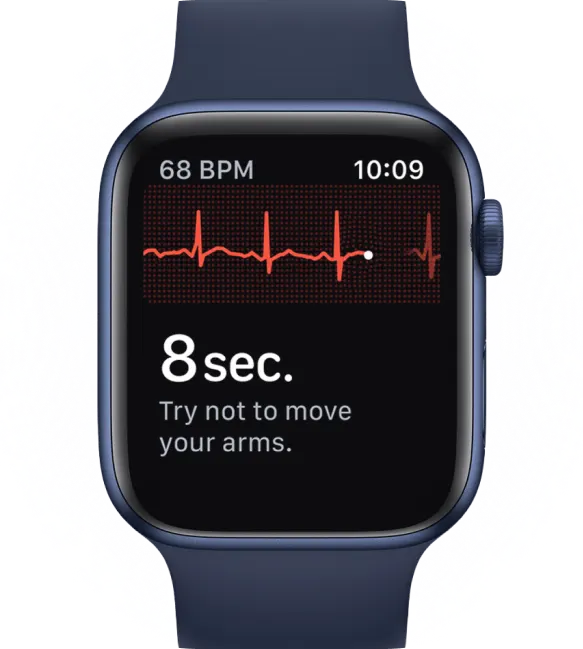
If you have an Apple Watch, Samsung watch, Fitbit-compatible ECG device, Kardia, or similar tool, timing matters.
When symptoms start:
- Stop safely
- Record an ECG as soon as possible
- Note what you were doing
- Record whether it happened during exercise or recovery
- Write down any associated symptoms
Those details can turn a vague complaint into a clinical clue.
A wearable rhythm strip during symptoms can be especially useful because it captures the electrical pattern at the exact time your body feels off. This explainer on ECG changes during exercise and recovery can help you understand why the timing of the recording matters.
Turning the data into something usable
An ECG tracing only helps if someone interprets it correctly. Device algorithms can be helpful, but they're limited. They may miss certain arrhythmias, overcall noise, or label a recording “inconclusive.”
One option is Qaly, which lets people submit wearable and at-home ECGs for review by certified cardiographic technicians and receive rhythm interpretation, interval measurements, and a narrative report they can share with their clinician.
The best recording is the one taken during symptoms, with a note about what your body was doing at that exact moment.
Questions worth answering after an episode
Instead of asking only “Was this dangerous?”, try asking:
- Was the rhythm regular or irregular?
- Did it start suddenly or fade in?
- Did it stop quickly or linger?
- Did it happen during hard effort or after stopping?
- Did I have red-flag symptoms with it?
Those questions help move you from fear to pattern recognition. And patterns are what make doctor visits more productive.
Understanding Your Personal Risk and Next Steps
Not every exercise-related rhythm issue carries the same meaning. Risk depends on the rhythm itself, your symptoms, your age, your training history, and whether there's any known structural heart disease, scar, ischemia, or prior cardiac problem.
For many otherwise healthy people, occasional exercise-related ectopy can happen without meaning there's a major heart disorder. A classic study of 543 people undergoing maximal exercise testing found exercise-induced ventricular arrhythmias on the first test in 30% of men aged 25 to 34, 32% of men aged 35 to 44, and 36% of men aged 45 to 54. On repeat testing, those rates rose to 36%, 38%, and 42%. Reproducibility in the same person on a second test was only 55%, 58%, and 62%, which led the authors to conclude that the variability in healthy people limited the usefulness of a single exercise test as a marker of future cardiovascular disease in this foundational study.
What that means for you
A single captured episode during exercise can matter, but it may not tell the whole story. Rhythm findings during exertion can be common and not perfectly repeatable. That's one reason repeated symptom capture is often more helpful than one isolated recording.
If you use a wearable, this is reassuring in a practical way. One odd tracing doesn't automatically define your heart. But repeated recordings showing the same pattern deserve attention.
Endurance athletes have a different set of questions
For long-term endurance athletes, the conversation shifts a bit. High-volume training has been linked to atrial fibrillation rates about 2 to 10 times higher than controls, and one estimate found that each 10 years of regular endurance exercise raised AFib risk by about 16% and atrial flutter risk by 42% in this review of exercise and arrhythmias in athletes.
That doesn't mean exercise is bad. It means very high lifetime training loads may change the atria in ways that increase rhythm vulnerability in some people.
Clues that deserve a deeper look
Doctors tend to investigate more aggressively when palpitations occur with:
- Syncope or near-syncope
- Chest discomfort
- Known coronary disease or prior heart damage
- A family history that raises concern
- Complex or repeated ventricular ectopy
- A recent change in symptom pattern
If that's your situation, the next step may be more detailed monitoring, imaging, or exercise-based testing under supervision.
How to Exercise Safely and Confidently
Staying active is still a common goal. A rhythm symptom doesn't automatically mean you should stop exercising. More often, it means you should exercise more thoughtfully.
The big picture is more balanced than the internet often makes it sound. The relationship between exercise and atrial fibrillation often follows a U-shaped curve. Intense long-term endurance training can be a risk factor because of atrial remodeling, while moderate exercise remains beneficial and protective for heart health, as described in this review of exercise load and atrial fibrillation risk.
A steadier way to train
If you're sorting through rhythm symptoms, these habits usually help:
- Warm up gradually: Sudden jumps in intensity can be a trigger for some people.
- Cool down on purpose: Some arrhythmias show up in recovery, so don't go from all-out to fully stopped.
- Track patterns, not just panic moments: Note the kind of workout, how hard it was, and whether symptoms happened during or after effort.
- Keep your wearable comfortable: If you rely on a smartwatch for symptom capture, secure fit matters.
- Think moderate before maximal: If high-intensity sessions keep provoking symptoms, there's nothing weak about dialing back while you gather more information.
If you want broader prevention habits, this guide on how to prevent arrhythmia is a useful next read.
A short visual refresher can help if you learn best by watching.
Confidence comes from a plan
The most reassuring approach is simple. Know your red flags. Capture symptoms when they happen. Respect patterns. Keep moving in a way your body tolerates well.
You do not need perfect certainty before taking sensible steps. You need observation, context, and a plan that helps you stay active without ignoring important signals.

Wondering if it's Atrial Fibrillation? On the Qaly app, human experts will interpret your ECGs for Atrial Fibrillation within minutes. Get started today.



.png)
.png)