




Key Takeaways

User Profile
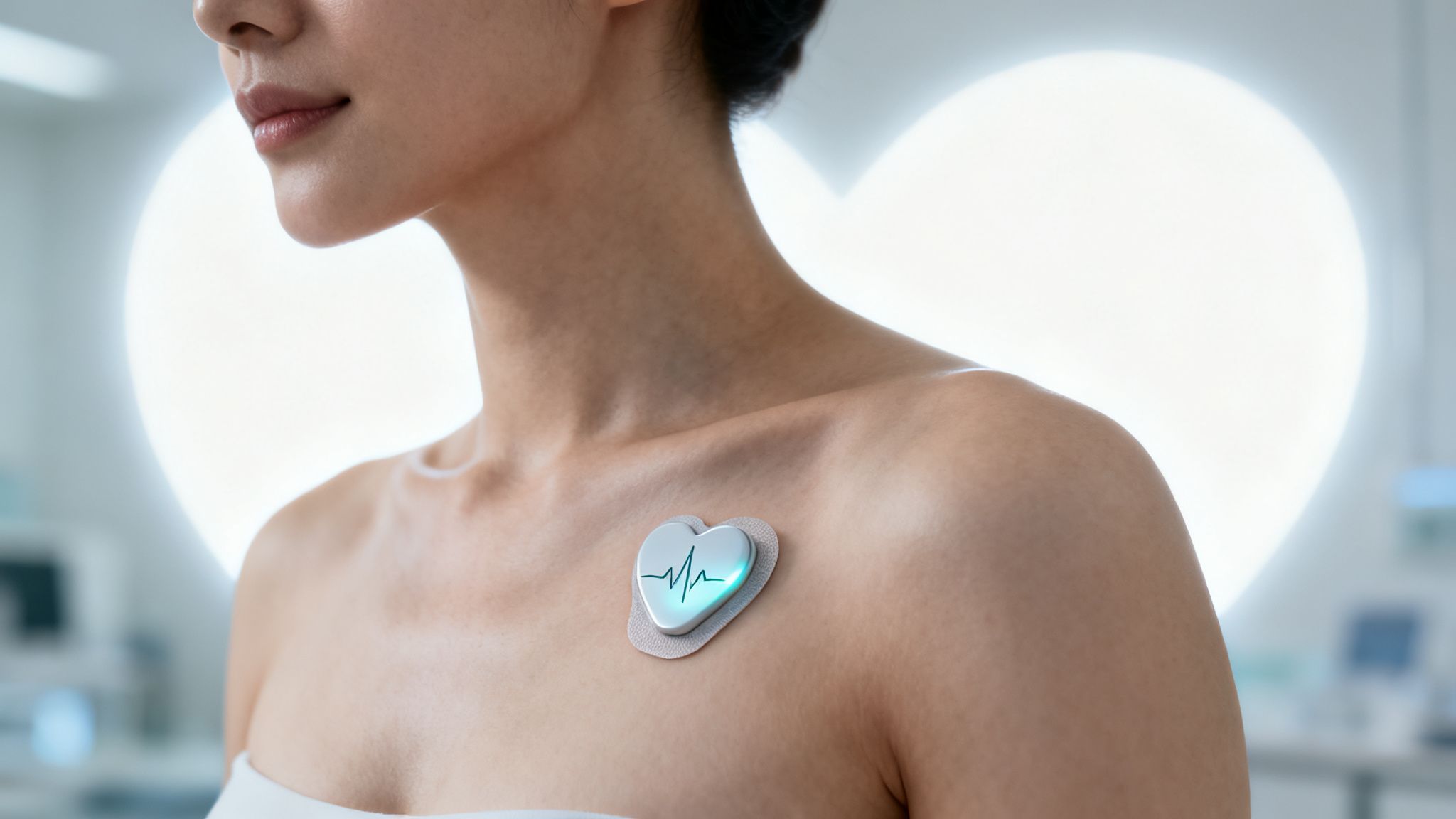
Hello Heart Hero. If you've ever felt a flutter, a skip, or a racing beat and wondered what on earth it means, you've come to the right place. A heart patch monitor is a small, adhesive device you wear on your chest. Its job is simple but critical: it continuously records your heart's electrical activity, giving you and your doctor a clear picture of what's going on, even when you don't feel a thing.
Your Guide to Understanding Heart Patch Monitors

Living with an unpredictable heart rhythm can be incredibly unsettling. It's even more frustrating when routine checkups just can't seem to catch the problem in the act. You might feel like you're chasing a ghost, trying to explain a sensation that vanishes the moment you step into a doctor's office. This guide is for you, the person looking for real answers about their health.
We’re going to break down everything you need to know about the heart patch monitor, but in simple, easy-to-understand terms. Think of this as a conversation where we pull back the curtain on the technology, explain what it does without the confusing jargon, and show you how it can deliver the peace of mind you deserve. We get the frustration of a slow-moving healthcare system, and our mission is to empower you with knowledge about a tool that helps you take charge of your heart health journey.
Why Continuous Monitoring Matters
Imagine trying to describe an entire movie when you only saw a ten-second clip. That's often what a standard in-office ECG feels like. It’s just a brief snapshot of your heart's activity. If your strange flutter or dizzy spell doesn't happen during that tiny window, it’s completely missed.
A heart patch monitor, on the other hand, is like watching the whole film from start to finish. It records your heart’s electrical signals day and night, sometimes for days or even weeks.
This extended recording period is the key, because it helps capture:
- Infrequent Arrhythmias that might only pop up a few times a week.
- Symptom Correlation by letting you log when you feel that flutter or shortness of breath, so doctors can see precisely what your heart was doing at that exact moment.
- A Complete Picture of how your heart behaves during all your daily activities, whether you're sleeping, working, or exercising.
Putting You Back in Control
Feeling dismissed or unheard when you describe your symptoms is a common, and deeply disheartening, experience. The data from a heart patch monitor changes the conversation. It provides concrete, objective evidence that turns your subjective feelings into medical facts that can finally lead to a clear diagnosis.
This technology is designed to catch what other tests miss. By continuously listening to your heart, a heart patch monitor ensures that even the most elusive symptoms are recorded, providing the definitive answers you and your doctor need.
This guide will walk you through how this simple yet powerful device works, who it's for, and what to expect when you use one. It’s all about giving you the confidence to have more informed conversations with your healthcare provider and feel more in command of your own health story. You are not alone on this journey.
What Is a Heart Patch Monitor and How Does It Work
Imagine a small, smart sticker that listens to your heart 24/7. That, in a nutshell, is a heart patch monitor. If you're tired of dealing with bulky, wired devices, this is a breath of fresh air. It's a small, lightweight adhesive patch you wear directly on your chest, designed to be comfortable and completely discreet.
This simple design means you can go about your life, work, sleep, even exercise, without annoying interruptions while it silently does its job. It’s a far cry from older monitors that could feel restrictive and awkward.
The Heart's Dedicated Detective
Think of a heart patch monitor as a dedicated detective assigned to your case. Its mission? To continuously record every single beat, making sure it catches any sporadic culprits like arrhythmias that might be causing your symptoms. These devices are especially good at finding heart rhythm issues that only show up now and then.
A standard ECG at your doctor's office is just a quick snapshot. A heart patch monitor, on the other hand, creates a feature-length film of your heart's activity over several days or even weeks. This long-term view is what makes it so powerful. You can learn more about different approaches in our guide to cardiac monitoring.
As awareness of heart health increases, continuous recording is becoming increasingly important. The global cardiac patch monitor market has experienced significant growth, reflecting the demand for improved solutions.
How the Technology Captures Your Heartbeat
So, how does this little patch pull off such a big job? It's simpler than you might think. With every beat, your heart generates its own tiny electrical signals. This electrical activity is what makes the heart muscle contract and pump blood.
A heart patch monitor has built-in sensors called electrodes that are incredibly sensitive. When you place the patch on your chest, these electrodes pick up your heart's electrical signals right through your skin.
It works by translating your heart's electrical language into a visual waveform called an electrocardiogram, or ECG. The patch records this ECG data continuously, storing every beat in its internal memory.
This process creates a complete, uninterrupted record of your heart rhythm from start to finish.
Correlating Symptoms with Data
One of the most powerful features of a heart patch monitor is its ability to connect how you feel with what your heart is actually doing. Most patches have a simple button you can press whenever you notice a symptom.
- Felt a flutter? Press the button.
- Had a moment of dizziness? Press the button.
- Felt a sudden shortness of breath? Press the button.
Each press creates a digital bookmark in the data. When your doctor reviews the report, they can jump directly to that exact moment and see the ECG recording. This correlation provides the clear, objective evidence needed to understand your symptoms and finally get a solid diagnosis.
Comparing Heart Patches to Other ECG Devices
Navigating the world of heart monitoring can feel like a lot, especially when you're already worried about strange flutters or dizzy spells. With so many options out there, from smartwatches to the more traditional Holter monitors, it’s easy to get confused about which one is right for your situation.
We get it. Let’s cut through the noise and break down the key differences in a way that actually makes sense, looking at these devices through the lens of what they’re really designed to do.
Heart Patches vs. Traditional Holter Monitors
If you’ve had heart monitoring before, you might have been hooked up to a Holter monitor. Think of it as the original detective on the scene. It's a small, portable box connected by a tangle of wires to electrodes stuck on your chest. It gets the job done, but many people find the wires clunky and uncomfortable, making it tough to sleep or exercise normally.
A heart patch monitor is the modern, streamlined version of that same idea. It performs the exact same function of continuous recording, but without the messy wires. It’s just a single, self-contained patch that sticks right to your skin, giving you much more freedom and comfort.
A Holter Monitor is a reliable but often bulky device with multiple wires, typically worn for 24 to 48 hours.
A Heart Patch Monitor is a discreet, wire-free patch designed for comfort over longer periods, often up to 14 days or more.
The main takeaway? Both are prescribed for continuous monitoring, but the patch offers a far more user-friendly experience. That’s a big reason why it's quickly becoming the go-to choice for patients and doctors alike.
The Snapshot vs. The Documentary
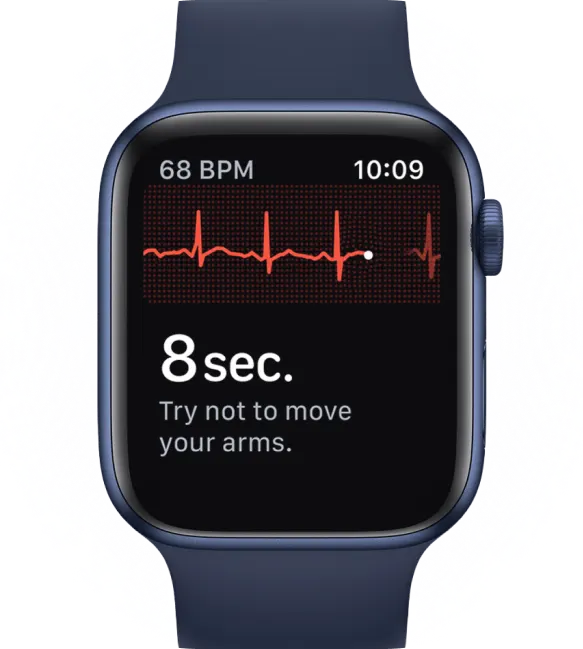
Now, what about the ECG feature on your Apple Watch or Fitbit? These wearables are fantastic tools for grabbing a quick "snapshot" of your heart rhythm the very moment you feel a symptom. If you feel a palpitation, you can instantly take a reading and capture that specific event.
But here’s the thing: many arrhythmias are sneaky. They can pop up while you're asleep or during moments when you don’t feel anything at all. This is where a heart patch monitor really shines.
Think of it this way: a smartwatch ECG is like taking a single photo, while a heart patch monitor is like filming a full-length documentary of your heart. The patch captures the entire story, including the crucial moments you might otherwise miss.
This continuous "documentary" approach is vital for diagnosing infrequent but potentially serious arrhythmias that a spot-check would likely fail to catch. You can learn more about different types of devices in our guide to portable electrocardiogram monitors.
The Role of Event Monitors
Another device you might hear about is an event monitor. It’s something of a hybrid. Some types are worn continuously but only record when you manually press a button during a symptom. Others try to automatically record if they detect an abnormal rhythm.
The problem is, they might not record events you don't feel or that don't meet the device's narrow criteria for what an "event" is. A heart patch monitor takes the guesswork out of the equation by recording everything, giving your doctor a complete and unbiased set of data to work with.
The comfort and precision of these patches are significantly influencing arrhythmia detection. ECG patches are preferred in their market segment mainly due to their ease of continuous wear. With atrial fibrillation affecting over 50 million people globally, the need for reliable diagnostic tools is increasingly crucial.
Ultimately, picking the right device comes down to your specific symptoms and what your doctor is trying to find. But for catching those tricky, on-and-off heart rhythm issues, the heart patch monitor delivers a powerful combination of comfort, convenience, and comprehensive data that other devices just can't match.
Who Benefits Most from a Heart Patch Monitor

If you've ever felt a strange flutter in your chest, a moment of dizziness out of nowhere, or a sudden shortness of breath, you know how unsettling it can be. It’s even more frustrating when you try to explain these feelings to a doctor, only for them to vanish during your appointment. We hear you, and a heart patch monitor can be a true game-changer in these exact situations.
This simple device is designed for people who are tired of uncertainty and ready for clear answers. It provides the continuous, detailed data needed to finally connect your symptoms to what your heart is actually doing.
When Your Symptoms Are Elusive
One of the most common reasons a doctor will suggest a heart patch monitor is when you're experiencing unexplained symptoms that come and go. These are often the hardest to diagnose because they are so unpredictable.
A patch is an ideal tool if you have experienced any of the following:
- Unexplained Palpitations: That feeling of a skipped beat, a flutter, or a racing heart that seems to have no cause.
- Dizziness or Lightheadedness: Moments where you feel faint or unsteady for no apparent reason.
- Shortness of Breath: Episodes of breathlessness that aren't linked to heavy exertion.
- Unexplained Fainting (Syncope): If you've ever fainted and doctors are trying to determine if a heart rhythm issue was the cause.
Because the patch records every single heartbeat over many days, it has a much higher chance of capturing these fleeting events than a quick in-office ECG ever could.
Bridging the Gap Between Wearables and Clinical Diagnosis
Your smartwatch can be an incredible ally for your health. If your watch has ever flagged an irregular rhythm, you know that mix of alarm and validation. But a single ECG from a wearable is often just the first clue, not the final answer.
This is where a heart patch monitor serves as the perfect next step. It acts as a powerful bridge between consumer tech and a formal medical diagnosis. Your doctor can use the alert from your watch as a starting point and prescribe a patch to gather the continuous, clinical-grade data needed to confirm or rule out an arrhythmia.
A heart patch monitor provides the robust, uninterrupted evidence that doctors require for a definitive diagnosis. It turns the initial alert from your watch into actionable medical insight.
This process helps ensure that a potentially serious issue isn't overlooked while also preventing unnecessary anxiety if the alert was a one-off event. It gives your doctor the context needed for a confident diagnosis.
Monitoring After a Cardiac Event or Treatment Change
A heart patch monitor isn't just for finding new problems; it's also incredibly useful for managing existing conditions. For example, individuals in a comprehensive cardiac care program for heart failure treatment often benefit from the continuous monitoring these devices offer.
They're also frequently used in other specific scenarios:
- Post-Stroke Evaluation: To check for underlying atrial fibrillation (AFib), a common but often hidden cause of strokes.
- Recovery After a Heart Procedure: To monitor your heart's rhythm and ensure your recovery is on track after an ablation or other cardiac intervention.
- Tracking Medication Effects: When you start a new heart medication, a patch can show your doctor precisely how your body is responding.
This need for reliable, at-home monitoring is growing fast. In North America, where cardiovascular diseases claim over 700,000 lives annually in the US alone, the market for these devices is expanding. For those needing even longer-term monitoring, you might be interested in our article about the internal loop recorder.
How to Understand Your Heart Patch Monitor Data
Getting a report from your doctor filled with terms like 'PVCs,' 'SVT,' 'PR interval,' or 'QTc' can feel like trying to read a foreign language. It's totally normal to feel a bit overwhelmed or even intimidated by all the medical jargon. But we believe understanding your own health data is a huge step toward feeling empowered and in control of your health.
Think of this section as your friendly translator. We're going to break down what your heart patch monitor is actually looking for and explain the common findings in simple, clear language. The goal is to help you see the patterns in your heart’s rhythm, turning that confusion into confidence.
Decoding Common Arrhythmias
Your heart patch monitor is like a detective, constantly searching for clues about your heart's electrical rhythm. When it spots something out of the ordinary, it gets flagged in your report. These flags often point to common arrhythmias, which are really just irregular heartbeats.
Here are a few terms you're likely to see:
- Atrial Fibrillation (AFib): Imagine your heart's upper chambers (the atria) are just quivering chaotically instead of beating in a steady, organized way. That's AFib. It’s important to catch because it can increase the risk of other health problems if it goes untreated.
- Premature Ventricular Contractions (PVCs): This is that classic "skipped beat" or "fluttering" sensation many people feel. It happens when one of your heart's lower chambers (the ventricles) decides to beat a little too early. This creates a brief, noticeable pause followed by a stronger beat. While they’re often harmless, frequent PVCs are definitely worth a chat with your doctor.
- Supraventricular Tachycardia (SVT): This term describes a very fast heartbeat that originates in the upper chambers of the heart. It can feel like a sudden, racing pulse that might leave you dizzy or short of breath.
Seeing these terms on a report isn't a reason to panic. It’s simply the data your doctor needs to have a productive conversation about what's going on with your heart.
Understanding ECG Intervals and What They Mean
Beyond just flagging arrhythmias, your report might also mention specific "intervals" like PR, QRS, or QTc. These are precise measurements of the different parts of your heartbeat's electrical signal.
Think of your ECG as a sentence that tells the story of one single heartbeat. The intervals are like the words and punctuation that make up that sentence. Doctors read these intervals to see if the story is flowing correctly.
For instance, the PR interval measures the time it takes for an electrical signal to get from the top of your heart to the bottom. If that journey is too long or too short, it gives your doctor valuable clues about how your heart's electrical wiring is functioning. If you're curious to learn more, you can read our guide on Demystifying PQRST Intervals on the ECG.

Getting Your Results Faster with Expert Help
One of the most frustrating parts of any medical test is the waiting game. After you’ve worn a heart patch monitor for days, you could be stuck waiting for weeks to get the data analyzed and then even longer for a follow-up appointment. That limbo period can be filled with anxiety.
This is where a service like Qaly can be an invaluable partner. Instead of waiting, you can get expert analysis of ECGs from your patch or wearable device, often within minutes. Qaly's human-certified technicians provide a clear interpretation, helping you make sense of your heart's activity right away.
This kind of immediate feedback can offer incredible peace of mind. It also means you're much better prepared for a more informed and productive conversation when you finally sit down with your doctor. The rich data from heart patch monitors can also be fed into advanced clinical decision support systems, which help your healthcare team make the best possible decisions for your care.
A Practical Guide to Using a Heart Patch Monitor

So, your doctor has recommended a heart patch monitor. It’s natural to have questions about what to expect day-to-day. How does this thing actually work in real life?
Let's walk through the whole process together. The goal here is to take the mystery out of it, giving you a clear roadmap from getting the patch put on to sending it back when you're done. We'll also tackle the big questions around cost and insurance so you feel completely prepared.


Preparing for Application and Daily Life
Getting the monitor applied is the easy part. It’s a quick trip to your doctor's office. The key is to make sure the patch gets a good, solid stick. Just show up with a clean, dry chest, and try to skip any lotions or oils that day.
Once it's on, you can pretty much forget it's there and go about your life. These devices are built for the real world.
- You can shower. Most patches are water-resistant, so a quick shower is no problem.
- You can exercise. The adhesive is strong enough to keep it secure, even if you get sweaty.
- You can sleep comfortably. It's small, wireless, and designed to not get in the way.
You’ll typically wear the patch for anywhere from a few days up to two weeks. During this time, it quietly records every single heartbeat. If your specific model has a button, your doctor will ask you to press it any time you feel a symptom, like a flutter, dizziness, or shortness of breath. This "marks" the recording so they know exactly what was happening at that moment.
Navigating Cost and Insurance Coverage
The cost question is always front and center, and for good reason. The good news? When a heart patch monitor is prescribed by a doctor to figure out a potential heart issue, it’s usually covered by most insurance plans, including Medicare.
Still, insurance can be a maze. We always recommend taking a few proactive steps to avoid surprises:
- Confirm Coverage Beforehand: A quick call to your insurance provider can confirm that ambulatory cardiac monitoring is covered under your plan.
- Ask About Deductibles: Find out if you need to meet a deductible first and what your potential out-of-pocket costs might look like.
- Check on Pre-authorization: Some plans require pre-authorization. Your doctor's office often handles this, but it never hurts to ask and make sure it’s been done.
Being your own best advocate is key. A few phone calls upfront can prevent a lot of headaches and unexpected bills down the line.
Troubleshooting Common Issues and Returning the Device
For the most part, wearing a heart patch is a smooth ride. But occasionally, minor issues can pop up.
If you get a little skin irritation, keeping the area dry usually helps. If you notice the edges of the patch starting to peel up, you can often secure them with a bit of medical tape from your clinic. Should the patch fall off completely, just call your doctor's office right away, and they'll tell you what to do next.
When your recording period is over, the final step is sending the device back. Your provider will give you a pre-paid mailer. All you have to do is pop the monitor inside, seal it up, and drop it off. It’s designed to be as simple and hassle-free as possible.
Frequently Asked Questions About Heart Patch Monitors
Whenever you’re dealing with new health technology, it's natural to have a lot of questions. We get it. Let’s walk through some of the most common things people wonder about when their doctor mentions a heart patch monitor, so you can feel more comfortable and in control of the process.
Is Wearing a Heart Patch Monitor Uncomfortable or Painful?
This is probably the number one question we hear, and the answer is almost always no. These patches are designed to be as unobtrusive as possible. They’re thin, lightweight, and flexible. Honestly, most people say they forget they're even wearing one after the first day or so.
You can sleep, work out, and do pretty much everything you normally would. The adhesive is medical-grade and made for skin contact. If your skin is extra sensitive, you might feel a little irritation, but your doctor can give you some simple tips on how to prep your skin to avoid that.
Can a Heart Patch Monitor Detect a Heart Attack?
This is a really important distinction. A heart patch monitor is a fantastic tool for finding problems with your heart's rhythm, its electrical system. A heart attack, on the other hand, is a circulation problem where blood flow to the heart muscle gets blocked.
They’re two different issues, and a patch monitor isn't designed to spot a heart attack as it's happening. The symptoms are completely different, too.
If you ever have symptoms like chest pain, trouble breathing, or pain spreading to your arm or jaw, that’s an emergency. Don't rely on a monitor. Call 911 immediately.
How Do I Get My Results and What Do I Do with Them?
Once your monitoring period is over, you’ll just mail the patch back using a prepaid package they provide. From there, the data gets downloaded and reviewed by technicians, who then send a full report over to your doctor. The downside? This can sometimes take a few weeks, which can feel like a lifetime when you're waiting for answers.
This frustrating wait is exactly where a service like Qaly can make a huge difference. You can often get copies of the ECG strips from your monitor and upload them to the Qaly app. Within minutes, a certified expert will give you an interpretation. This gives you immediate insight into what your heart was doing, empowering you to have a much more productive conversation with your doctor once the official report finally arrives. It puts you back in the driver's seat, without the long, anxious wait.

Ready to get expert interpretations of your ECGs from your heart patch monitor or wearable device in minutes? Qaly provides human-certified analysis to give you the answers and peace of mind you deserve.



.png)
.png)