


Key Takeaways

User Profile
Hello Heart Hero. If you're staring at a new prescription and wondering whether you should take an ACE inhibitor or an ARB, you're not being difficult. You're doing the sensible thing, because these medicines sound similar, they're used for overlapping problems, and the difference often gets explained too quickly in a rushed visit.
A lot of people land here after one of three moments. A clinician has just changed a blood pressure medicine. A dry cough has started and won't leave. Or a blood pressure reading, a kidney test, or a hospital discharge note has made the whole thing feel more urgent than it did before.
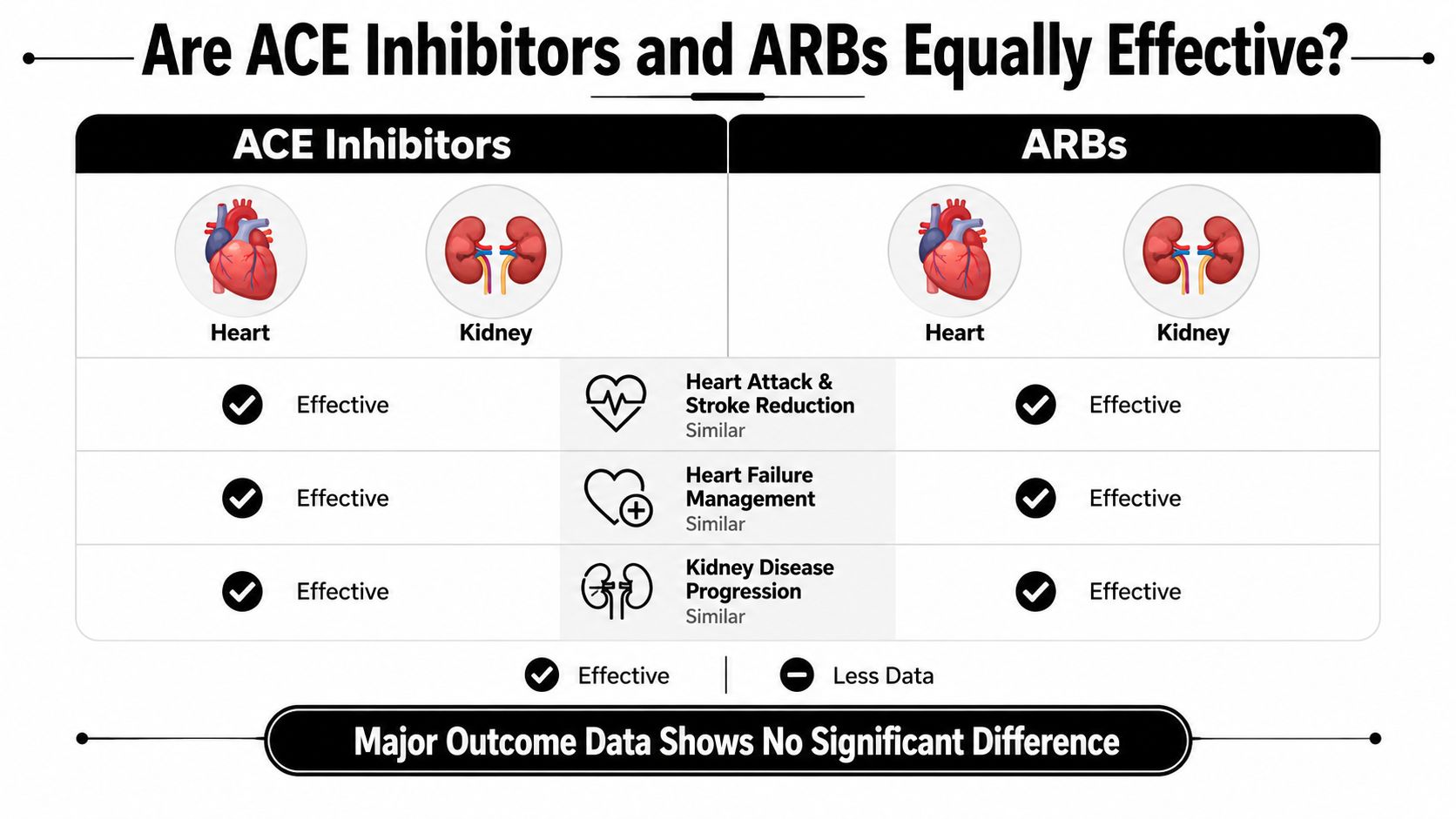
The honest answer is simpler than most articles make it sound. For many people, ACE inhibitors and ARBs protect the heart and kidneys in broadly similar ways, and the decision often comes down to tolerability, history, and day-to-day life, not some dramatic winner-takes-all contest. A clear, calm choice matters because the medication you can stay on is usually the one that helps you most.
| Question | ACE Inhibitor | ARB |
|---|---|---|
| Main job | Lowers blood pressure and helps protect the heart and kidneys | Lowers blood pressure and helps protect the heart and kidneys |
| Main difference | More likely to cause cough and some other side effects | Usually better tolerated, especially if cough becomes a problem |
| Major outcome results | Similar to ARBs in large comparisons | Similar to ACE inhibitors in large comparisons |
| Common reason to switch | Dry cough or angioedema history | Need for a better-tolerated option |
A Warm Welcome to Your Heart Health Questions
You're probably not looking for a lecture. You want to know whether the pill on your chart is the right one, whether the side effects are normal, and whether there's a safer or easier alternative if this one starts making life annoying.
That's a fair ask. Blood pressure treatment often gets handed out like it's a simple number problem, but the lived experience matters just as much. A medicine can look great on paper and still be a bad fit if it leaves you coughing, dizzy, or worried every time you swallow it.
A useful way to think about ACE or ARB is this, the question isn't only “Which lowers pressure?” It's also “Which one fits my body, my risks, and my routine?” That's why this article focuses on what these drugs do, how well they work, what side effects matter, who should avoid them, and what to ask about around surgery or acute illness.
You'll also see where the evidence is reassuring. In major comparisons, these two classes look much more alike than different on big outcomes. That means the next best question is usually not “Which is universally superior?” It's “Which is the better fit for me?”
What ACE Inhibitors and ARBs Actually Do
Both drug classes act on the renin-angiotensin system, which helps control blood pressure and how tightly blood vessels squeeze. A simple way to picture it is a chain of messengers. One message tells your body to tighten blood vessels, hold onto salt and water, and make the heart work harder. ACE inhibitors interrupt that chain early, and ARBs block the message at a later step.
That difference sounds technical, but the practical result is familiar. Blood vessels relax, pressure falls, and the heart doesn't have to push as hard. That's why these medicines show up not just for hypertension, but also for heart failure, kidney protection, and post-heart-attack care.
The Kidney Foundation notes that ACE inhibitors and ARBs also have kidney and heart benefits beyond blood pressure alone, including lowering uACR in albuminuria, slowing glomerular damage in kidney disease, slowing heart muscle damage in heart failure, and lowering the risk of heart attack or stroke, especially in people who've already had one before. The Kidney Foundation's overview of ACE inhibitors and ARBs is a helpful plain-language reference for that broader role.
Practical rule: If your clinician recommends one of these medicines, it's often because they want both blood pressure control and organ protection, not just a prettier reading on the cuff.
That's why the next question matters so much. If both classes are trying to do the same broad job, does one work better?
Are They Equally Effective for Heart and Kidney Protection
For the big outcomes that matter most to patients, ACE inhibitors and ARBs are usually close enough that the choice often comes down to fit, not a clear winner. A Cochrane review found no evidence of a difference in total mortality, total cardiovascular events, or cardiovascular mortality between the two classes, and a large multinational cohort across more than 3 million patients in 8 databases also found no statistically significant difference in AMI, heart failure, stroke, or composite cardiovascular events. That comparative analysis is one of the clearest reasons clinicians do not treat this as a dramatic efficacy contest.
Why the older signal does not change the practical answer
There is one nuance people sometimes notice when they look more closely. A meta-analysis of 158,998 patients found a modest mortality edge for ACE inhibitors, with 20.4 versus 24.2 deaths per 1,000 patient-years and an HR of 0.90. That result matters as part of the history, but later and larger comparisons made the overall picture less one-sided for everyday care. The AHA journal review explains how the evidence shifted over time.
The practical takeaway is reassuring. If survival benefit were the only thing on the table, the decision would still mostly come down to your medical history and how you tolerate the medicine, not a large gap in effectiveness. That is why many clinicians talk about these drugs as a class choice shaped by the person in front of them.
A second comparison, summarized by the American Academy of Family Physicians, found no meaningful difference in total mortality, total cardiovascular events, or cardiovascular mortality, while ARBs caused fewer treatment stoppages because of adverse effects, with a relative risk of 0.83 and a number needed to treat of 55 over 4.1 years. AAFP's summary points in the same direction.

The heart and kidney question also connects to the day-to-day work patients are already doing. If you are trying to support your numbers through lifestyle changes, this inflammation diet and exercise plan may be a useful companion resource to review with your clinician.
For heart failure, medication choice still has to fit the rest of the treatment plan. A practical heart failure medication guide can help you see where ACE inhibitors and ARBs sit among the other drugs commonly used for that condition.
The big picture is simple. For major cardiovascular protection, ACE inhibitors and ARBs are usually close enough that your personal fit matters more than a theoretical winner.
Side Effects That Actually Change Your Day
The difference is not in a lab report. It's in the day-to-day stuff, the cough that keeps you awake, the dizziness that makes you hesitate when standing up, or the uneasy feeling that comes from a new symptom you weren't expecting.
The symptoms that matter most
ACE inhibitors are the class more famously linked to a dry, persistent cough. That cough can be maddening because it's often not a “sick” cough. It's just there, day after day, and people sometimes don't connect it to the medicine right away.
ARBs were developed as a better-tolerated alternative, and in the comparative data they do produce fewer treatment stoppages because of side effects. The AAFP summary noted fewer discontinuations with ARBs, which is why many clinicians switch a patient over when cough becomes a problem. That same summary is often the practical reason ARBs come up in clinic.
A few other symptoms deserve attention too:
- Dizziness or lightheadedness: This can happen if the blood pressure drop is a little too strong, especially when you first start.
- Potassium elevation: Both classes can raise potassium, which is why blood tests matter.
- Angioedema: This is the rare but serious swelling of the face, lips, or tongue. It's more common with ACE inhibitors and needs urgent medical attention.
What switching often looks like in real life
If a clinician thinks the cough is from an ACE inhibitor, they'll usually stop that drug and choose an ARB instead. The cough can take time to settle, so patients sometimes need a little patience after the switch. If you're trying to figure out whether a symptom is medication-related or something else, the pattern matters, especially whether it started after the drug change and whether it improves after stopping the medicine under medical guidance.
Call urgently for face, lip, or tongue swelling. Don't wait to see if it passes.
For a plain-language companion on common medication reactions, this blood pressure medication side effects guide can help you sort through what's routine and what isn't.


Who Should Avoid Each Drug
Some situations change the choice fast enough that the usual ACE-versus-ARB discussion barely applies. Pregnancy is one of them. Both ACE inhibitors and ARBs are avoided in pregnancy because they can harm a developing baby, especially later in pregnancy. If pregnancy is possible or planned, the conversation should happen early, not after the first positive test.
When the answer changes quickly
A few other situations matter because these drugs affect how the kidneys handle pressure inside the filtering units:
- Bilateral renal artery stenosis: Blocking the renin-angiotensin system can reduce kidney perfusion too much and trigger kidney injury.
- Severe potassium problems: If potassium is already a concern, either class needs very careful monitoring.
- Past ACE-inhibitor angioedema: That history usually pushes clinicians toward an ARB instead of retrying the same class.
The reason is straightforward. These drugs are helpful when the kidney and heart can tolerate them, but the same mechanism that protects some people can stress others. That doesn't make them bad drugs. It means the body's starting point matters.
If you're a woman of childbearing potential, ask about contraception and what the plan is if pregnancy becomes a possibility. If you have known renal artery disease, a single functioning kidney, or a history of potassium trouble, don't assume the usual starting dose is automatically safe for you. Those details change the risk calculation.
For people outside these special situations, both classes remain very usable options with appropriate monitoring. The goal isn't to scare you off treatment. It's to make sure the drug matches the body it's going into.
Monitoring, Rhythm Symptoms, and What to Know Around Surgery
These medicines are common, but they're not set-and-forget forever. Clinicians usually keep an eye on blood pressure, kidney function, and potassium, because those are the places where ACE inhibitors and ARBs can drift from helpful to too much. That's especially true soon after starting a drug or after a dose change.
Why the checks matter
If the pressure drops too far, you can feel washed out or dizzy. If kidney function shifts, the change may show up first in a lab before you feel anything obvious. If potassium rises, that can matter for heart rhythm and muscle function, which is why your clinician may ask for repeat blood work rather than just trusting how you feel.
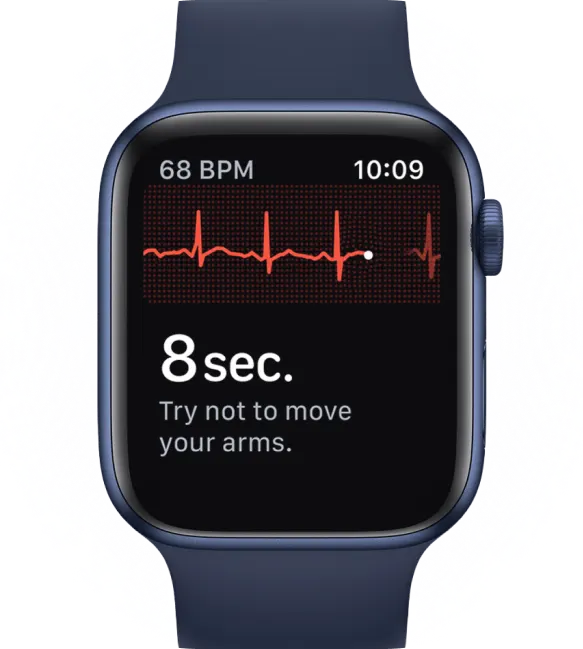
If you notice palpitations, skipped beats, or other rhythm changes after starting one of these medicines, don't assume the blood pressure drug is the only explanation. Those symptoms may or may not be related. A wearable ECG strip from an Apple Watch, Fitbit, Kardia, or a similar device can give your clinician a real rhythm snapshot instead of a vague description of “my heart felt weird.”
Qaly is one option for reviewing single-lead wearable ECG recordings and sharing them before an appointment, especially if the symptom is hard to catch in the office. A recording doesn't replace medical care, but it can make the conversation more concrete.
Surgery and acute care are different conversations
The surgery question gets skipped too often. Recent guidance has moved away from routinely stopping these drugs before noncardiac surgery, but the 2024 KDIGO CKD guideline still includes a practice point supporting planned discontinuation before elective surgery for some patients. Cleveland Clinic Journal of Medicine's review captures that real-world ambiguity well.
That means the right plan may depend on your blood pressure stability, your kidney function, and the type of procedure. Ask your surgeon and cardiologist, or the clinician managing your blood pressure, whether you should hold the dose the morning of surgery and when to restart it afterward.
The same logic applies during acute illness, especially if you're dehydrated or not eating and drinking normally. That's not a universal stop signal, but it is the kind of day when a medication review is worth a phone call.
A practical companion if you're also trying to keep potassium in a safe range is this potassium and heart rhythm guide. It's useful when your clinician is watching labs closely.
Bring the timing question up early. The best plan is the one everyone understands before the procedure, not the one scrambled together on the morning of surgery.
How to Choose the Right One for You
For many people, the answer to ACE or ARB is really a question of fit. If you've had a stubborn dry cough on an ACE inhibitor, an ARB is often the more comfortable next move. If you've had angioedema, that history makes the discussion more careful and usually changes the direction. If pregnancy is possible, the whole plan needs to change, not just the brand name on the bottle.
A simple decision framework
- If cough was the problem: An ARB usually makes more sense.
- If kidney or heart protection is the goal: Either class may fit, with monitoring.
- If pregnancy is planned or possible: Ask about a different blood pressure strategy.
- If potassium or kidney function has been unstable: The monitoring plan matters as much as the drug choice itself.
The best conversations are specific. Bring a short list of what you've felt on past medicines, what worries you most, and what you need the drug to do in daily life. Then ask, “What would you choose if this were your own family member?” That question usually gets you out of abstract jargon and into the trade-offs.
This is also where consistency matters more than theory. If one option is technically fine but you won't take it because it makes you miserable, the “best” medicine isn't best for you. The one you can live with, monitor, and trust tends to win in actual life.
If you want a broader plain-language refresher on blood pressure care before your next appointment, this blood pressure overview can help you organize your questions.
Real Questions Patients Ask About ACE or ARB
Can I switch between them safely? Usually, yes, with clinician guidance. People commonly move from an ACE inhibitor to an ARB when cough or swelling becomes an issue. The reverse switch can happen too, but the reason for switching should be clear.
What if I miss a dose? Take it when you remember unless it's close to the next scheduled dose. Don't double up without checking with your clinician or pharmacist. The goal is steady blood pressure control, not catching up aggressively.
Can I take ibuprofen with one of these medicines? It's worth asking before you use it often, especially if you have kidney disease, dehydration, or other blood pressure medicines on board. Occasional use may be handled differently than regular use, so this is a good pharmacist question.
What about potassium supplements or salt substitutes? Be careful. Because both classes can raise potassium, adding extra potassium without a plan can push levels too high. That includes supplements and some potassium-containing salt substitutes.
Do these interact with wearable rhythm concerns? They don't usually cause rhythm problems directly, but if you're feeling palpitations or odd beats while starting treatment, a wearable ECG can help show whether the symptom matches a rhythm change or just a short-lived sensation.
If you're unsure whether a symptom is urgent, don't guess alone. Face swelling, fainting, severe dizziness, and trouble breathing deserve prompt medical attention. For everything else, a quick message to your clinician is often enough to sort out the next step.
If you're deciding between an ACE inhibitor and an ARB right now, bring your side-effect history, kidney and potassium concerns, and any pregnancy or surgery plans to your next visit, and ask for a clear monitoring schedule. If you're tracking palpitations at home, save the ECG recording and review it with your clinician before the appointment, so the conversation starts with real data instead of guesswork.

Not sure about palpitations? Certified experts review your ECG within minutes.



.png)
.png)