





Key Takeaways

User Profile
Hello Heart Hero.
You may be reading this because something unsettling has started happening. You're in the middle of a sentence, a work task, or a conversation, and then there's a strange blank patch. Maybe your partner says, “You just stared off for a few seconds,” but you have no memory of it. Maybe you've wondered if you're exhausted, distracted, anxious, or being brushed off too quickly by people who assume it's “just stress.”
That reaction can feel lonely. It can also make you skeptical of the whole process of getting help, especially if your symptoms are subtle and easy for others to dismiss.
The good news is this. Absence seizures in adults are real, they can be recognized, and they can usually be managed well. They are much less common in adults than in children, and adult onset is rare compared with the usual childhood onset, which helps explain why they're often overlooked or mislabeled as daydreaming or attention problems according to Medscape's overview of absence seizures.
This guide is here to help you make sense of those blank spells in plain language. You'll learn what an adult absence seizure can feel like, why it can still happen later in life, how it differs from heart-related fainting or rhythm problems, and how to document what's happening so a doctor has something concrete to work with. That last part matters more than is often realized.
Welcome to Your Guide on Understanding Blank Spells
Some adults describe these episodes as “losing a few seconds.” Others say it feels like their brain briefly slips offline. A common pattern is that life seems normal from the inside until someone else points out the pause.

Why these spells can be so hard to trust
If you've been told you're zoning out, not listening, or overthinking things, it's understandable if you've started doubting yourself. Brief neurological events often don't leave dramatic evidence behind. There's no long recovery, no obvious shaking in many cases, and no easy way to “prove” the episode happened unless someone saw it.
That doesn't mean your concern is exaggerated. It means the symptom is subtle.
Absence seizures in adults are often misunderstood because they don't match the public image of a seizure. Many people picture a person falling, shaking, or needing a long recovery afterward. But a classic absence seizure can look more like a pause than a collapse.
Practical rule: If a blank spell is sudden, repetitive, and leaves you with missing seconds you can't explain, it deserves a real medical workup.
Why adults often get brushed off
Adults are in a strange position with this symptom. Since absence seizures are usually associated with childhood, people may assume an adult can't possibly be having one. That misunderstanding can delay diagnosis.
The episodes themselves also add to the confusion. They are brief, they may happen during ordinary activities, and they often end so cleanly that everyone moves on. A coworker might think you stopped paying attention. A family member might think you're fatigued. You might wonder if it's anxiety, poor sleep, or a concentration problem.
Here's the reassuring part. Understanding the pattern gives you an advantage. Once you know what to notice, what to record, and what questions to ask, you're no longer walking into an appointment empty-handed. You're showing up with observations that can move the conversation forward.
What an Adult Absence Seizure Actually Feels Like
An adult absence seizure is usually not dramatic from the outside, and it may be even less obvious from the inside. The best analogy is a screen that freezes for a moment and then resumes without a loading symbol. The system doesn't fully shut down. It just drops out briefly.
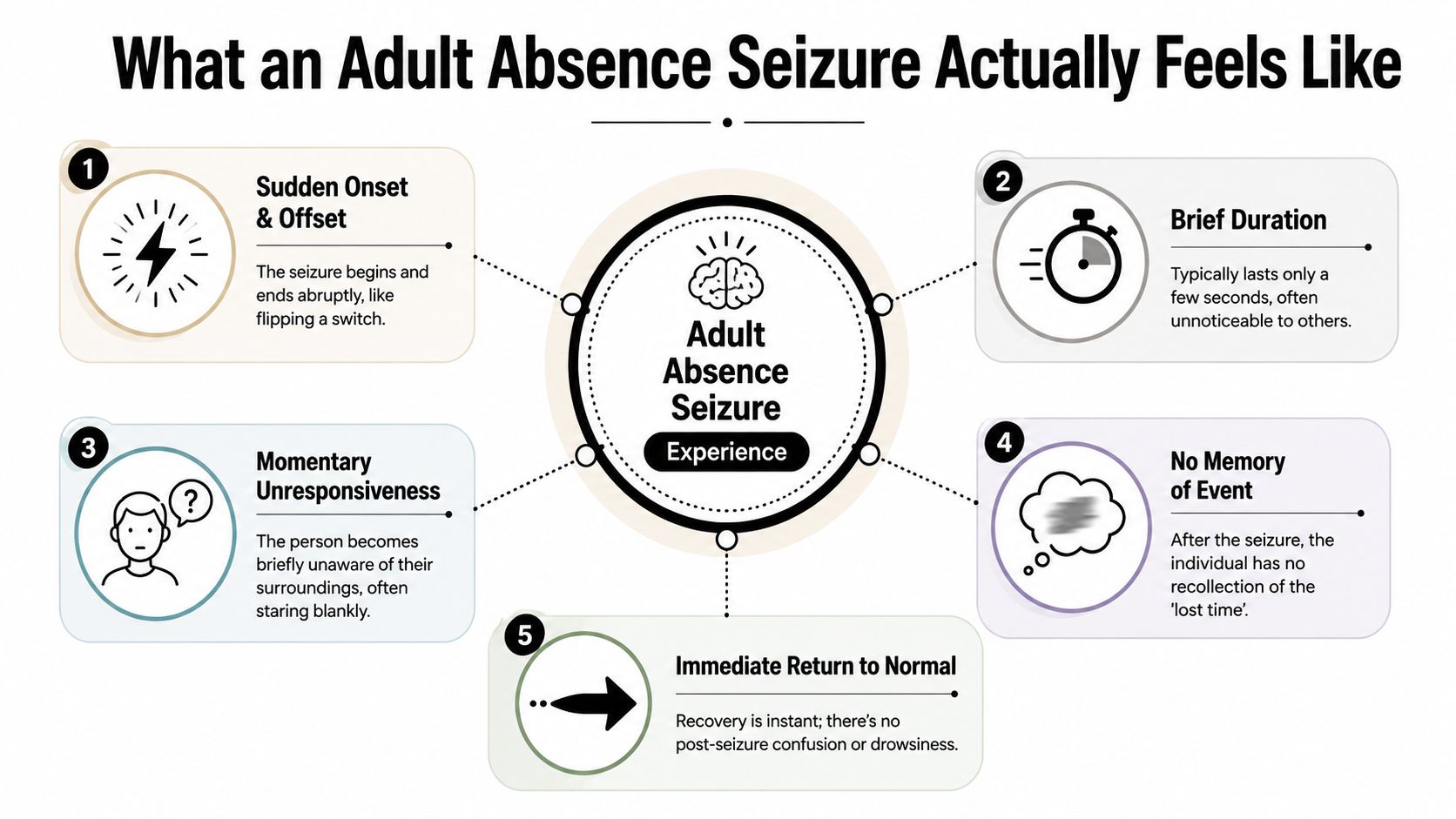
What it looks like from the outside
A witness may notice that you:
- Stop mid-action and pause while talking, typing, chewing, or walking
- Stare blankly for a few seconds without responding
- Show tiny movements such as eyelid fluttering or lip movements
- Resume immediately as if nothing happened
These episodes are brief. Absence seizures in adults typically last between 3 and 15 seconds on average, with most ending spontaneously within 10 to 20 seconds, and the person usually has no confusion or memory of the event immediately after it ends according to Cleveland Clinic's description of absence seizures.
What it can feel like from the inside
Many people don't feel a warning. There may be no dizziness, no spinning sensation, and no awareness that an event is beginning. The main clue is often what happens afterward. Someone tells you there was a pause, but to you, time seems uninterrupted.
That “no memory” detail matters. It's one reason absence seizures can be confused with distraction while remaining very different from ordinary daydreaming.
If you're trying to compare this with heart symptoms, it may help to separately learn what heart palpitations can feel like in daily life. Palpitations often create a felt body sensation in the chest. Absence seizures usually do not.
A true absence spell often leaves no emotional or physical “aftertaste.” You simply return to baseline.
The feature that confuses people most
People often expect a seizure to leave confusion. Typical absence seizures usually don't. The return is immediate. You don't wake up groggy. You don't need a minute to reorient. You just continue.
That can make the event seem too minor to matter. But if these spells happen repeatedly, they can interfere with work, conversations, safety, and trust in your own awareness. Subtle doesn't mean harmless.
Why Absence Seizures Can Happen in Adulthood
A lot of adults get stuck on one question: “How can this be happening now if absence seizures are a childhood condition?” That question makes sense, but the childhood-only story is incomplete.
The childhood myth isn't the full picture
Some adults who have absence seizures have a history connected to epilepsy syndromes such as juvenile absence epilepsy or juvenile myoclonic epilepsy, where the tendency toward these seizures can persist into adult life. Others may have symptoms that weren't recognized earlier, especially if the episodes were mistaken for inattention or stress.
There's also a genetic side to this story. Adults can experience persistent or late-onset absence epilepsy linked to genetic variants, which pushes back against the common belief that this is only a childhood issue, as discussed in Medical News Today's overview of adult causes and triggers.
Adult triggers can be surprisingly ordinary
In adults, patterns often show up around life pressure and routine disruption. Triggers may include:
- Stress that pushes your nervous system into a more vulnerable state
- Sleep deprivation after late nights, shift work, parenting demands, or travel
- Medication withdrawal if a relevant medicine was stopped or changed
- Alcohol for some people, especially when paired with poor sleep
If you also use wearable heart tracking, it's worth remembering that not every strange body sensation points to the brain alone. Sleep loss, dehydration, and metabolic shifts can affect the heart as well. This is one reason some people look into how electrolyte imbalance can affect ECG patterns while sorting through episodes that feel hard to categorize.
Why this matters emotionally
When you understand that adult absence seizures can have a real neurological basis, the experience often becomes less mystifying. You stop framing every event as a personal failure of attention or willpower.
That shift matters. It helps you look for patterns instead of blaming yourself.
Distinguishing Seizures from Heart Rhythm Issues
A brief blank spell can raise two very different questions. Is this a brain event, such as an absence seizure? Or is this a heart-related event, such as fainting from an abnormal rhythm or a sudden drop in blood pressure?
Those possibilities matter because the next steps are different.
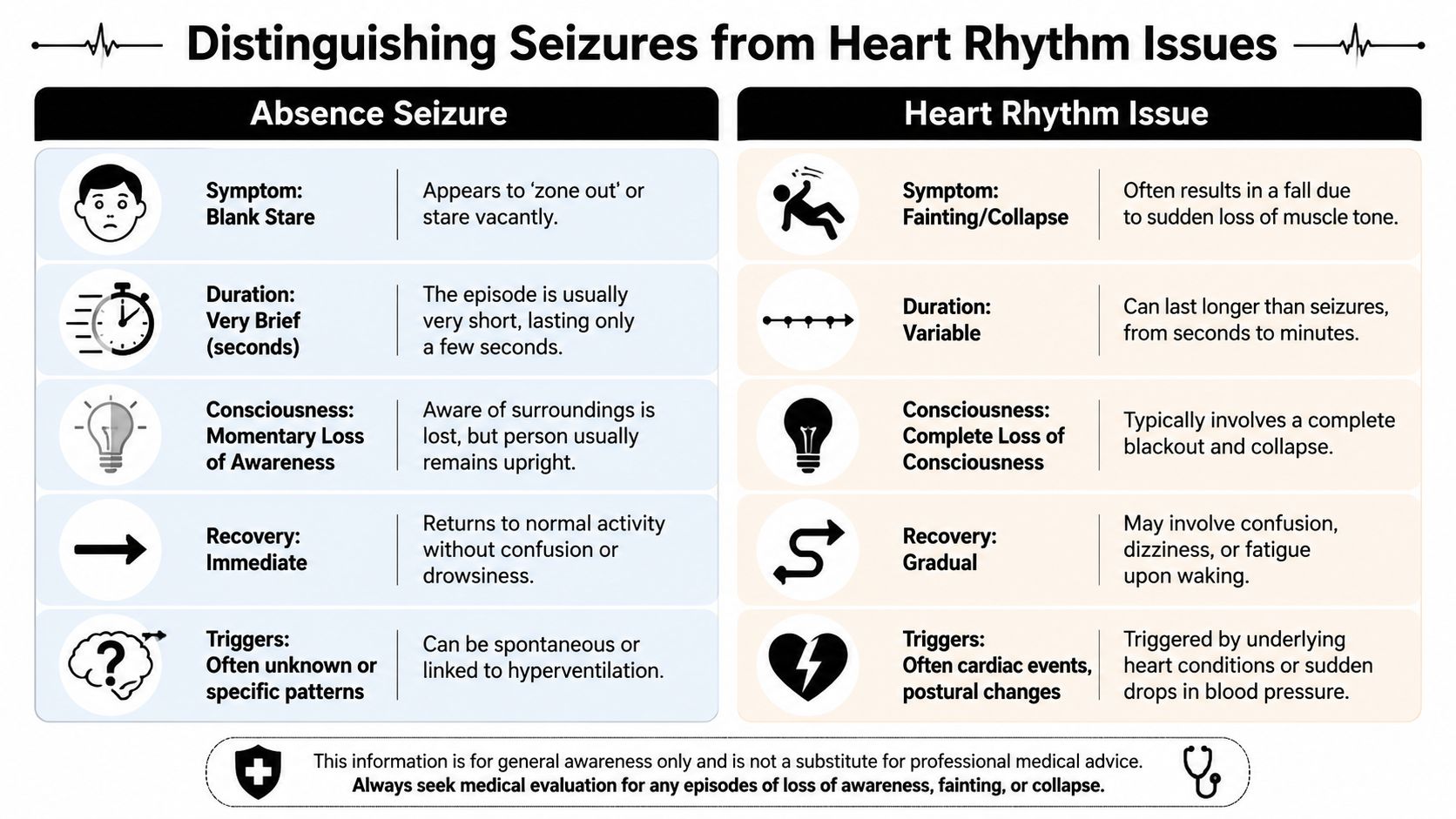
Clues that point more toward an absence seizure
Typical absence seizures have a very specific pattern. They are defined by generalized 3-Hz spike-and-wave discharges on EEG, with abrupt behavioral arrest and loss of responsiveness, and they occur without post-ictal confusion according to Mayo Clinic's seizure overview.
In everyday terms, that often means:
- No warning sign before the event
- Very short duration
- Blank staring or a sudden pause
- Immediate return to normal
- No lingering grogginess or headache afterward
A person may stay upright during the episode. They may stop and then continue.
Clues that point more toward a heart rhythm problem or syncope
A heart-related event often follows a different script. A person may feel palpitations, chest discomfort, lightheadedness, or a wave of weakness before losing consciousness. They may slump, fall, or fully black out. Recovery can be slower, with lingering shakiness, fatigue, or disorientation.
That doesn't mean the line is always obvious. Some heart rhythm issues are brief. Some neurological events are subtle. That's why doctors sometimes investigate both systems.
If you're new to this area, a plain-language explainer on what a heart rhythm disorder is can help you understand why heart testing may still be relevant even when seizures are on the table.
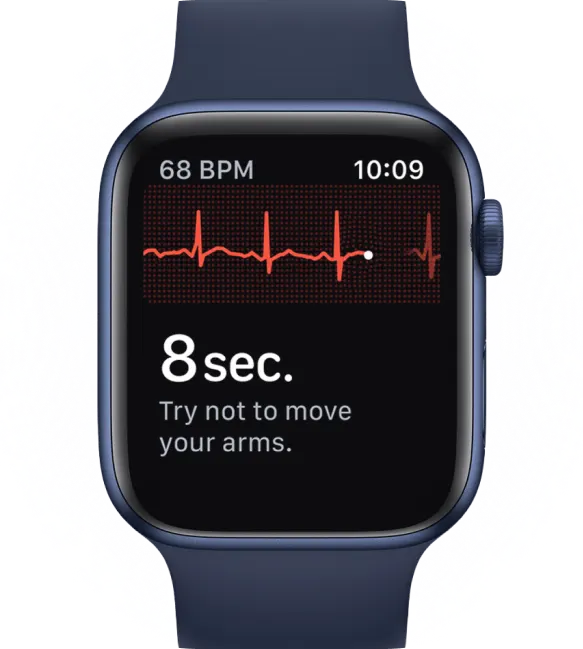
If a wearable ECG shows a normal rhythm during a spell, that doesn't diagnose a seizure. But it can be a useful clue that points away from a cardiac cause.
Why wearable ECG data can help
Wearables can't diagnose absence seizures. They don't replace an EEG. But they can contribute to the bigger picture.
Here's how that helps in real life:
- During symptoms, a normal recorded rhythm may make a major arrhythmia less likely
- During symptoms, an abnormal rhythm may point the workup in a different direction
- Repeated symptom-rhythm comparisons can help a clinician see whether “blank spells” match heart changes or happen independently
That's especially useful for adults who are trying to sort out whether they're having a neurological lapse, a fainting tendency, or a rhythm problem that deserves urgent cardiac attention.


How Doctors Confirm an Absence Seizure Diagnosis
If you've had frustrating healthcare experiences, this part can feel intimidating. The process is less mysterious once you know what doctors are looking for.

The test that usually matters most
The definitive diagnosis of absence epilepsy depends on two things being present together: the clinical event and a characteristic EEG finding. Diagnosis requires behavioral arrest plus generalized 3-Hz spike-and-wave discharges on EEG, or 3 to 4 Hz in juvenile absence epilepsy, with abrupt start and end, as outlined in the NCBI Bookshelf review of absence seizure diagnosis.
An EEG, or electroencephalogram, is a test that records the brain's electrical activity through sensors placed on the scalp. It doesn't shock you. It listens.
During testing, the team may ask you to breathe fully and quickly for a short period. Hyperventilation can sometimes bring out the seizure pattern in a controlled setting, which gives the neurologist something concrete to analyze.
The evidence you can collect yourself
You hold more diagnostic influence than many people realize. Adults with absence seizures are often misdiagnosed as daydreaming, and one major reason is that the episodes are so short and easy to dismiss. A practical review from Webmatter argues that recording a seizure episode may be the single most effective diagnostic tool available because video can provide the “diagnostic gold” that words alone often can't in their discussion of adult diagnostic gaps.
If someone is with you when an episode happens, ask them to safely record it.
What makes a useful video:
- Start early if possible so the lead-up is visible
- Capture your face and upper body so staring, blinking, or subtle movements can be seen
- Have the witness speak and say your name during the event to show lack of response
- Keep filming briefly after so the immediate recovery is visible
Bring the video, a symptom log, and any wearable recordings to the same appointment. One piece of evidence is helpful. A packet of evidence is stronger.
When heart monitoring fits into the workup
Sometimes the doctor also wants to rule out a heart-related explanation for transient loss of awareness. In that setting, ambulatory monitoring can be useful. If you've never heard the term before, a plain-language guide to a cardiac event monitor can help you understand why a clinician might order one alongside neurological testing.
That doesn't mean the doctor thinks your symptoms are “just anxiety” or that they don't believe you. It means they're trying to sort out whether the source is electrical activity in the brain, electrical activity in the heart, or something else entirely.
Effective Treatment and Long Term Management
A diagnosis of absence seizures in adults can sound heavy at first. It often becomes much less frightening once treatment starts and the pattern makes sense.
Why the outlook is often reassuring
Treatment response is generally excellent, with 80% to 90% of patients achieving seizure control when treated with appropriate antiseizure medications, and long-term outcomes are favorable for most. These seizures do not cause brain damage, according to MedLink's review of typical absences.
That matters emotionally as much as medically. Many people hear the word “seizure” and immediately imagine permanent injury or a rapidly worsening condition. Typical absence seizures don't fit that picture.
Medications doctors commonly use
Common first-line options include ethosuximide and valproic acid, with lamotrigine also used in some situations. A review on PubMed notes that ethosuximide and valproic acid both achieve about 75% seizure control efficacy in monotherapy for absence-only cases, and it also emphasizes that carbamazepine, phenytoin, and gabapentin can worsen absence seizures in this setting in this pharmacotherapy review.
The medication choice depends on the bigger clinical picture. Some adults have absence seizures alone. Others also have myoclonic or generalized tonic-clonic seizures, and that changes what drug may fit best.
Daily habits that support seizure control
Medication is only part of management. The pattern in your day-to-day life matters too.
Helpful habits often include:
- Protecting sleep with a regular schedule
- Reducing avoidable stress loads where possible
- Watching for trigger patterns around alcohol or medication changes
- Taking medicine consistently instead of stopping abruptly
The goal isn't to make your life smaller. It's to make the brain's rhythm steadier. It's comparable to keeping a sensitive electrical system on stable power.
Practical Guidance for Driving Safety and Daily Life
Safety can feel like the hardest part because it touches independence. The key is to think in terms of planning, not punishment.
Driving with blank spells
If you've had episodes that affect awareness, don't guess your way through driving decisions. Laws and medical standards vary by location, and they often depend on whether you've been seizure-free for a period of time. Your neurologist can help you understand what applies where you live.
For broader everyday thinking about what can happen when a driver suddenly becomes unresponsive, this piece on A-1 Driving School safety guidance is a useful reminder that impaired awareness behind the wheel is a real safety issue, whatever the cause.
Other situations worth planning for
A few practical adjustments can protect your freedom rather than limit it:
- Swimming is safer with supervision until your seizures are controlled
- Heights and ladders deserve extra caution if awareness can suddenly pause
- Machinery and power tools may need to wait until your doctor says control is reliable
- Trusted people should know what your episodes look like and how to document them
Safety works best when it's specific. “Be careful” is vague. “Don't swim alone until the diagnosis is clear” is useful.
When urgent care is appropriate
Most typical absence seizures are brief and not medical emergencies. Still, seek urgent help if an event leads to injury, happens in dangerous circumstances like water or traffic, lasts unusually long, or if the person doesn't return to their normal baseline the way they usually do.
You don't need to live in fear. You do need a plan.
If your blank spells come with palpitations, near-fainting, or uncertainty about whether the heart might be involved, wearable ECG data can add valuable context. Qaly helps people review at-home and wearable ECG recordings with certified cardiographic technicians, so you can bring clearer rhythm information to your medical appointments while you and your clinician sort out the full picture.

Unsure if your ECG fits the picture? Certified experts review it within minutes.



.png)
.png)