




Key Takeaways

User Profile
Hello Heart Hero.
You feel a flutter in your chest. Then a pause. Then a stronger beat that makes you wonder if something serious is happening. You open your watch or grab a small ECG device because waiting days for an appointment feels impossible when your body is asking for attention right now.
That urge makes sense. Many people feel stuck between two frustrating options: ignore symptoms and worry, or enter a healthcare process that can feel slow, expensive, or dismissive. Home ECG machines sit in the middle. They give you a way to capture what your heart is doing in the moment, from your couch, your desk, or your car before the feeling disappears.
Used well, these devices can be calming and useful. Used the wrong way, they can also create confusion. Value comes from understanding both sides at once: what a home ECG can show you, and what it cannot.
Your Guide to Understanding Home ECG Machines
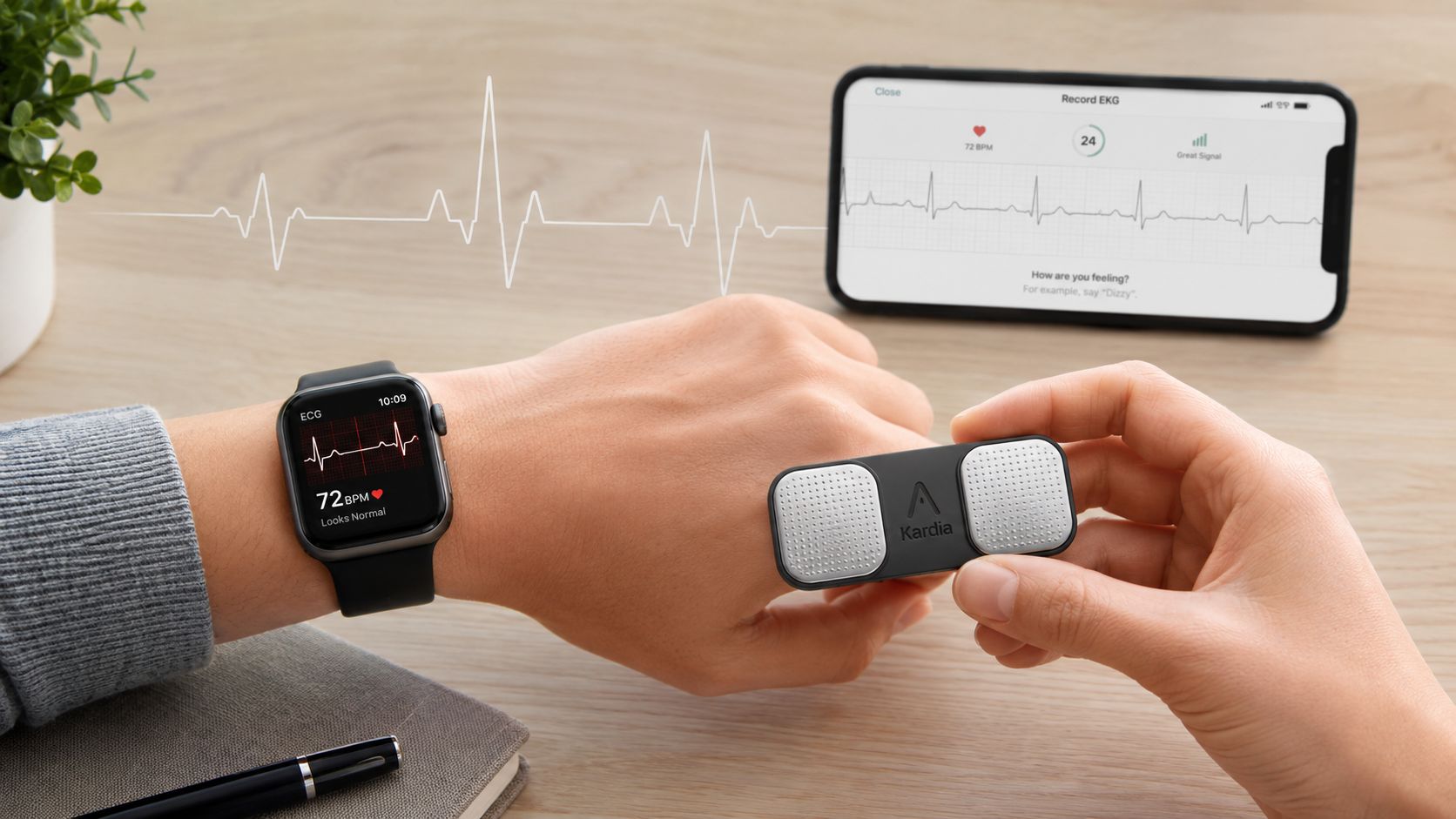
A home ECG machine is a small device that records the electrical activity of your heart. Some are built into wearables like the Apple Watch, Samsung Watch, or Fitbit. Others are dedicated devices, such as Kardia models, that you hold with your fingers to take a reading.
For many people, the first experience is personal. You notice pounding after coffee. A skipped beat while lying in bed. A strange rhythm after a workout. By the time you think about going to urgent care, the feeling is gone. That's where home ECG machines help. They let you capture a rhythm strip during the episode instead of trying to describe it later from memory.
Why people reach for them
A love for gadgets isn't the driving force behind the purchase. Instead, it's acquired due to a need for answers.
A home ECG can help you:
- Capture symptoms in real time when palpitations happen suddenly
- Track patterns over time if episodes come and go
- Share recordings with a clinician instead of saying “I think something happened”
- Feel more involved in your care when the usual system feels distant
A home ECG is most useful when it turns a vague symptom into something visible.
That said, these devices are tools, not verdicts. A reading can be helpful without being complete. That difference matters more than most product pages admit.
Understanding Your Heart's Electrical Story
Your heart runs on electricity. Every heartbeat begins with a tiny signal that starts in the heart's natural pacemaker, moves through the upper chambers, pauses briefly, and then travels into the lower chambers so they squeeze in a coordinated way.
An ECG, or electrocardiogram, records that electrical movement. It doesn't show blood flow directly. It shows the signal that tells the heart muscle when to contract.

The heartbeat as a sequence
One simple way to understand an ECG is to think of it as your heart's timing sheet.
The signal starts
Your heart's natural pacemaker fires.The top chambers respond
The atria contract and move blood forward.There's a short pause
The signal slows briefly so the ventricles can fill.The bottom chambers contract
The ventricles pump blood out to the lungs and body.The cycle resets
The heart gets ready for the next beat.
Those lines on a screen are not random scribbles. They're a map of timing, order, and rhythm.
What your home device is actually hearing
Most home ECG machines are single-lead devices. That means they record the heart's electrical activity from one main angle. According to GoodRx's explanation of home ECG monitors, home devices typically operate as 1-lead systems, while a standard clinical ECG uses 10 electrodes across 12 distinct vectors. That's a big difference in perspective.
A useful analogy is this: a hospital ECG is like placing multiple microphones around a stage. A home ECG machine is like listening from one seat in the audience. You can still hear the rhythm. You just can't tell where every instrument is coming from.
That single view is why home devices are often good at spotting rhythm problems, especially irregular rhythms, but less helpful for more complex questions. A rhythm can look ordinary from one angle and still be abnormal when viewed from several angles.
Why this confuses so many people
People often assume “ECG” means complete heart check. It doesn't.
Your watch or handheld device can record an important clue, but it's still a narrow slice of information. If your reading says normal, that usually means the rhythm looked normal during that recording. It does not mean every possible heart problem has been ruled out.
Practical rule: Think of a home ECG as a rhythm snapshot, not a full cardiac workup.
That mindset lowers anxiety in a healthier way. You're not using the device to prove your heart is perfect. You're using it to collect useful evidence.
The Different Types of Home ECG Devices
When people say “home ECG,” they may be talking about very different tools. The biggest differences are how you wear them, when you use them, and how much detail they collect.
Wearables you already have on your wrist
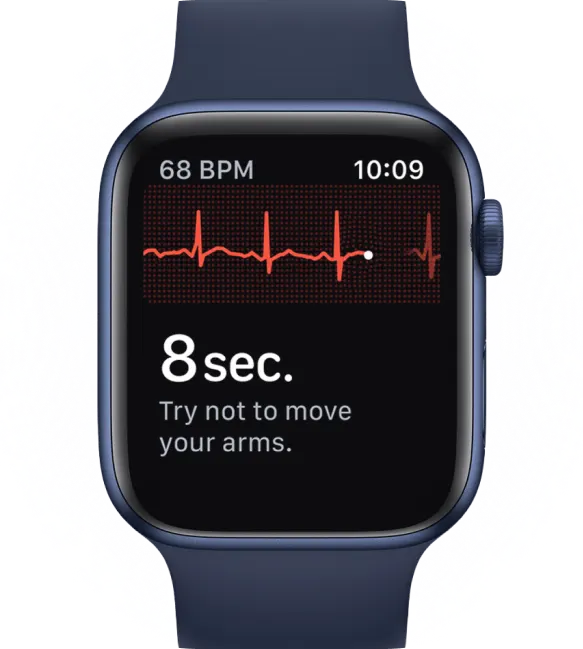
Smartwatches are the most familiar option. Apple Watch, Samsung Watch, and some Fitbit models let you take an ECG when symptoms hit. That convenience matters. If your palpitations last only a short time, the best device is often the one already attached to you.
Wearables work well for quick checks, especially when your symptoms are brief and unpredictable. They're also easy to use repeatedly, which helps if you're trying to notice patterns rather than chase one isolated event.
Handheld portable devices
Portable devices such as Kardia are separate from your watch and phone, though they usually connect to an app. You touch sensors with your fingers, and some models offer more than one lead. That can give a slightly broader view than a typical watch tracing.
If you want to compare options, this guide to a portable electrocardiogram monitor walks through the practical differences in a consumer-friendly way.
Handheld devices can be a good fit if you:
- Want a dedicated heart tool rather than another watch feature
- Prefer clear finger placement over wrist-based recording
- Need a device that can be shared with a family member at home
- Like exporting recordings for later review
Patch monitors and longer recordings
Patch monitors are different. You wear them on your chest for longer stretches to catch symptoms that don't happen often. They're useful when episodes are too rare for spot checks, but they're not the same as the on-demand devices typically implied when discussing home ECG machines.
For day-to-day consumer use, common choices are between a smartwatch and a portable handheld recorder.
The best device isn't the most advanced one. It's the one you'll actually use when symptoms happen.
A Realistic Look at Accuracy and Limitations
Here, people need honesty most.
Yes, home ECG machines can be accurate. But accuracy depends on what question you're asking. They are not universal heart scanners. They are much better at some tasks than others.
Where they perform well
For atrial fibrillation, often shortened to AF or AFib, some home devices perform very well. A study summarized in PubMed found that home ECG devices like Withings and Kardia 6L showed very high accuracy for AF detection, with the Withings algorithm showing 100% sensitivity and specificity in classified ECGs, while Kardia 6L achieved 97% specificity.
That's meaningful if your device flags AF. It means the result deserves attention, not dismissal.
This visual sums up the balance well:

If you're specifically wondering about a smartwatch result, this article on how accurate the ECG is on your Apple Watch gives practical context for what those readings can and can't tell you.
The false reassurance problem
The bigger issue is what happens when the reading looks normal.
Harvard Medical School warns in its review of home ECGs and pulse monitors that “a normal ECG tracing does not mean the heart is healthy” and specifically warns about false reassurance. That matters because many people use these devices for peace of mind, then accidentally treat a normal tracing like an all-clear for everything.
The same Harvard piece notes that in a smartwatch screening study of 293,944 people, only 0.015% were found to have new AF. It also explains that the US Preventive Services Task Force and the American College of Cardiology advise against routine home ECG use for the general population because the overall benefit is doubtful.
So if you feel chest pain, severe shortness of breath, faintness, or a strong sense that something is wrong, a normal watch tracing should not talk you out of getting care.
The angle problem
The limitation is partly physical. As covered earlier, a home device usually looks from one main direction. A hospital ECG looks from many. That means a home ECG may miss issues outside its narrow view, including certain patterns a full clinical ECG is better equipped to detect.
It can also struggle with rhythm problems that don't fit neatly into the algorithm's main categories. A result may say “normal,” “inconclusive,” or “possible AF” even when the underlying rhythm deserves a trained human look.
A useful home ECG result is not the same thing as a complete diagnosis.
That's the anxiety gap. The device gives data, but not always context.
Common Reasons to Use a Home ECG Machine
Home ECG machines are typically used because something happens that's hard to catch in a clinic. The reading becomes a way to preserve the moment.
When your heart flips or pounds
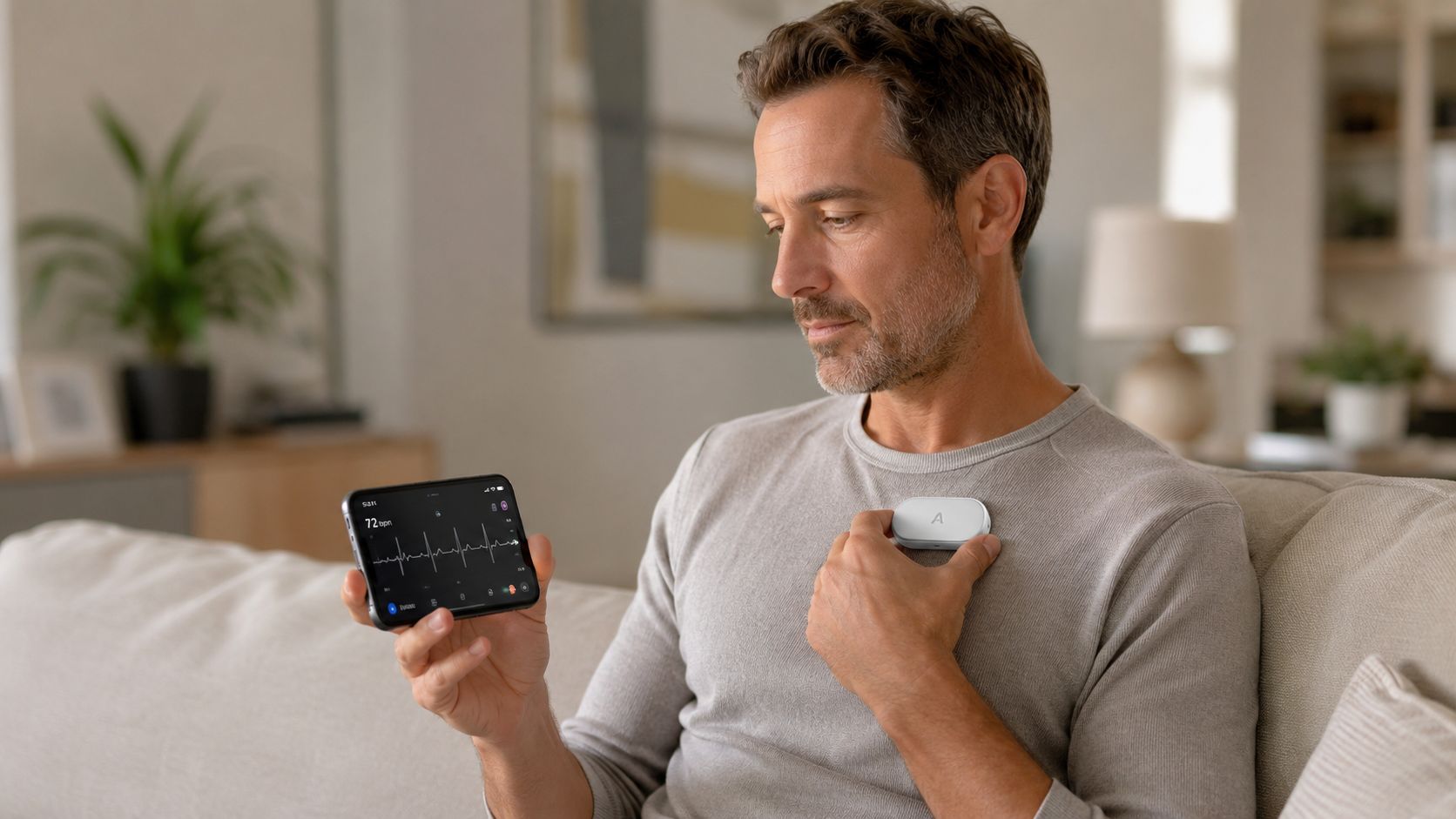
Palpitations are one of the most common reasons people buy these devices. The sensation might be a flutter, a skipped beat, a racing burst, or a thump in the throat. It often vanishes before you can get help.
That's where a quick recording matters. A pooled analysis in PubMed found that single-lead handheld ECG devices used at home had 89% sensitivity in community settings, 92% sensitivity in hospital settings, and 99% specificity in communities for AF detection. In plain language, these devices can be effective at catching real rhythm issues when symptoms occur.
If your symptom happens for only a short window, a saved tracing is often far more useful than a perfect description.
When you've been told to keep an eye on things
Some people use a home ECG after a known diagnosis or after a change in treatment. They may want to watch for rhythm changes after a procedure, while starting a new medication, or during recovery from a heart-related event.
In that setting, the device becomes less about surprise and more about pattern tracking. You can note what your rhythm looked like on a calm day, a stressful day, or after exercise, then bring those examples to a clinician.
When the problem is uncertainty itself
There's another group of users people don't talk about enough. These are people whose main symptom is uncertainty.
They don't want to overreact. They also don't want to miss something important. A home ECG can help them replace spiraling thoughts with a real recording. That's useful, as long as the recording is interpreted with care.
You might consider a wearable or app-based option instead of a longer monitor if:
- Your symptoms are brief and episodic
- You want to record them the moment they happen
- You need something easier than a clinic-based test
- You're looking for a Holter-style alternative for certain situations, which this article on a Holter monitor alternative explains in practical terms
A symptom diary plus a saved ECG is often more helpful than memory alone.


How to Choose and Use Your Device Effectively
Choosing a device is less about chasing the fanciest feature and more about matching the tool to your real life. If a device is awkward, buried in a drawer, or difficult to export from, it won't help much when you need it.
How to choose the right fit
Start with your habits.
If you already wear an Apple Watch or Samsung Watch every day, the easiest option may be the one on your wrist. If you don't like wearing a watch while sleeping, a handheld device may suit you better. If a family member may also need to use it, a shared portable device can make more sense than a personal wearable.
Look for a few practical details:
Phone compatibility
Make sure the app works smoothly with your device.Easy sharing
Check whether you can save a PDF or image of the tracing.Simple recording steps
The best home ECG machines are the ones you can use correctly when you're nervous.Clear labels
You want a device that stores date, time, and result in an organized way.
How to get a clean recording
Technique matters more than many people realize. Movement, talking, poor contact, and tense muscles can make a tracing messy or inconclusive.
Try this routine:
Sit down first
Resting reduces body movement.Place your arms on a table
This helps keep the signal steady.Relax your shoulders and hands
Tension can create noise in the tracing.Stay quiet for the full recording
Talking and shifting can distort the line.Save the recording immediately
Add a note about symptoms, time, and what you were doing.
When not to rely on the device
This may be the most important use tip of all.
If you have chest pain, fainting, severe dizziness, significant shortness of breath, or you feel acutely unwell, don't wait for the perfect ECG strip. Seek urgent medical care. A home ECG is a support tool. It is not emergency treatment, and it should never delay it.
Beyond the Algorithm The Power of Human Analysis
A device message can be oddly unsatisfying. “Possible AF.” “Inconclusive.” “Sinus rhythm.” Those labels sound firm, but they often leave out the very thing you want to know: what was happening when you felt that symptom?
Why algorithms leave gaps
Academic research in JMIR Cardio notes that these devices are mainly intended for detecting arrhythmias, more specifically AF, and that there are no devices intended for detection of cardiac ischemic disorders. The same review highlights a wider problem for people with non-AF symptoms. Many important rhythms outside the device's narrow target can't be reliably diagnosed by algorithm alone.
That includes the situations that worry many users most. You feel a sudden racing episode. Or repeated skipped beats. Or a strange rhythm that doesn't match the app's limited categories. The software may not know what to call it, even if the strip contains useful information.
What human review adds
When physicians manually interpret at-home ECG traces labeled “Possible AF,” they reduce false positives significantly, and patients whose physicians confirmed AF had approximately 1.5 times higher risk of AF recurrence within one year, according to this PMC study. That finding supports something patients often sense instinctively: a trained human reader adds value beyond the automated label.
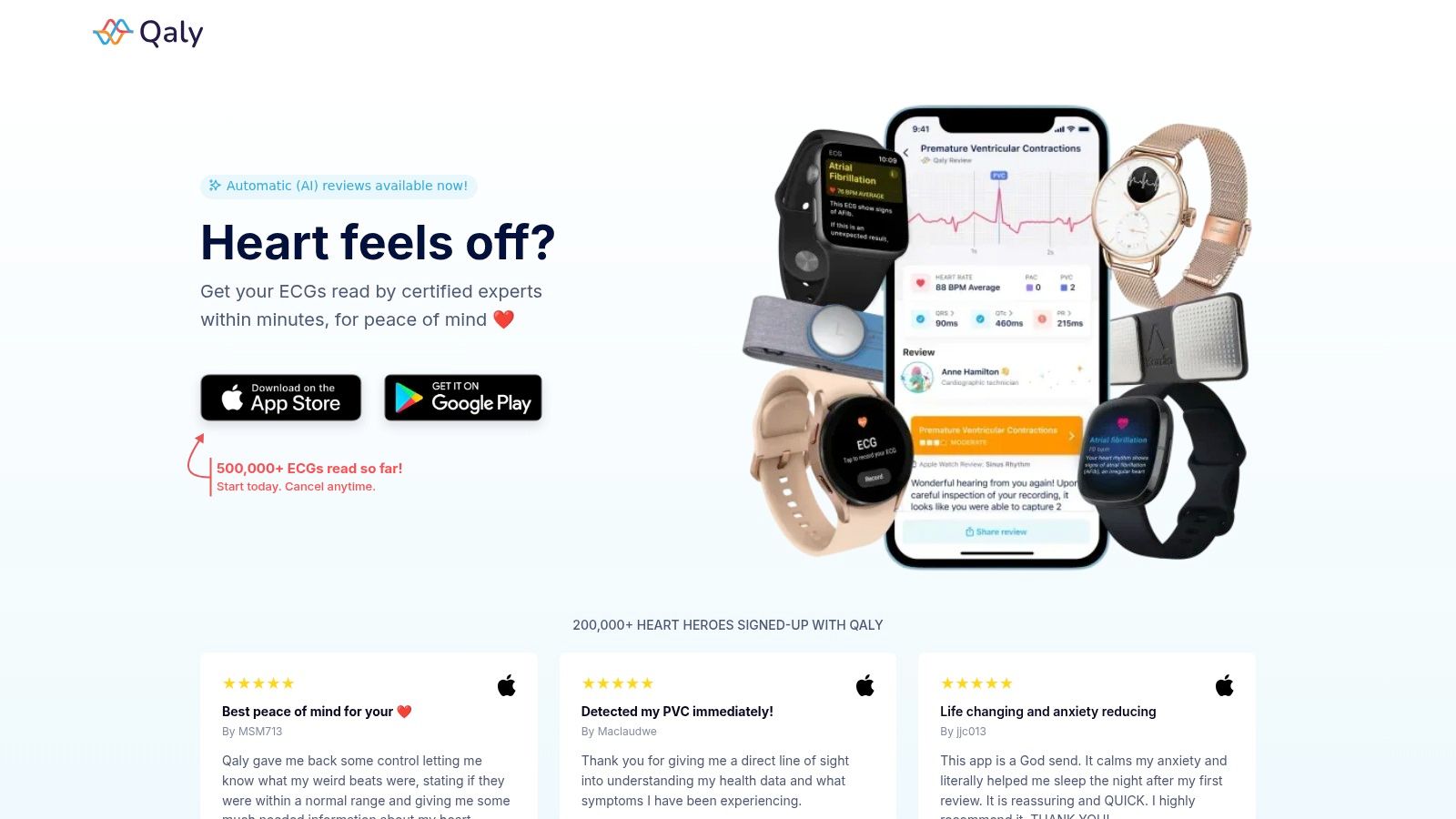
A human-reviewed service can look at the actual tracing, not just the app's summary. One example is Qaly, which lets users submit wearable and at-home ECG recordings for review by certified cardiographic technicians and also provides interval measurements and narrative reports. If you want to understand what trained readers look for on a tracing, this guide on how to read an ECG gives helpful background.
Why this matters emotionally, not just medically
The anxiety gap isn't only about missed diagnoses. It's also about being left alone with unclear results.
A machine can tell you something may be off. A trained reviewer can tell you whether the strip looks like AF, a premature beat pattern, a faster regular rhythm, noise from movement, or a tracing that needs more formal evaluation. That kind of explanation doesn't replace a doctor, but it can make your next step clearer and more grounded.
Human review turns a scary notification into something you can discuss, save, and act on calmly.
Home ECG machines can be a valuable part of your health toolkit. They're often useful for catching rhythm events, especially brief ones. But the smartest way to use them is with realistic expectations. Let the device collect the signal. Then, when the result is confusing or important, let a qualified human help interpret the story.
If your heart symptoms keep raising questions, use your device to document the moment, write down what you felt, and bring both the recording and the symptom notes into a conversation with a qualified clinician. That combination is often where clarity starts.

Unsure what your home ECG shows? Certified experts review your ECG within minutes.



.png)
.png)