




Key Takeaways

User Profile
Hello Heart Hero.
You're probably here because you took an ECG on your watch, stared at the tracing, and noticed one small stretch that didn't look as flat or calm as you expected. Maybe the spikes looked normal, but that middle section seemed lifted, dipped, or just different from another reading. That moment can be unsettling, especially when your device gives you data without much explanation.
If that's where you are, your concern makes sense. A wearable can help you pay attention to your heart, but it can also leave you alone with a waveform and a lot of questions. Many people feel stuck between “it's probably nothing” and “what if I'm missing something important?”
Welcome to Understanding Your Heart's ECG
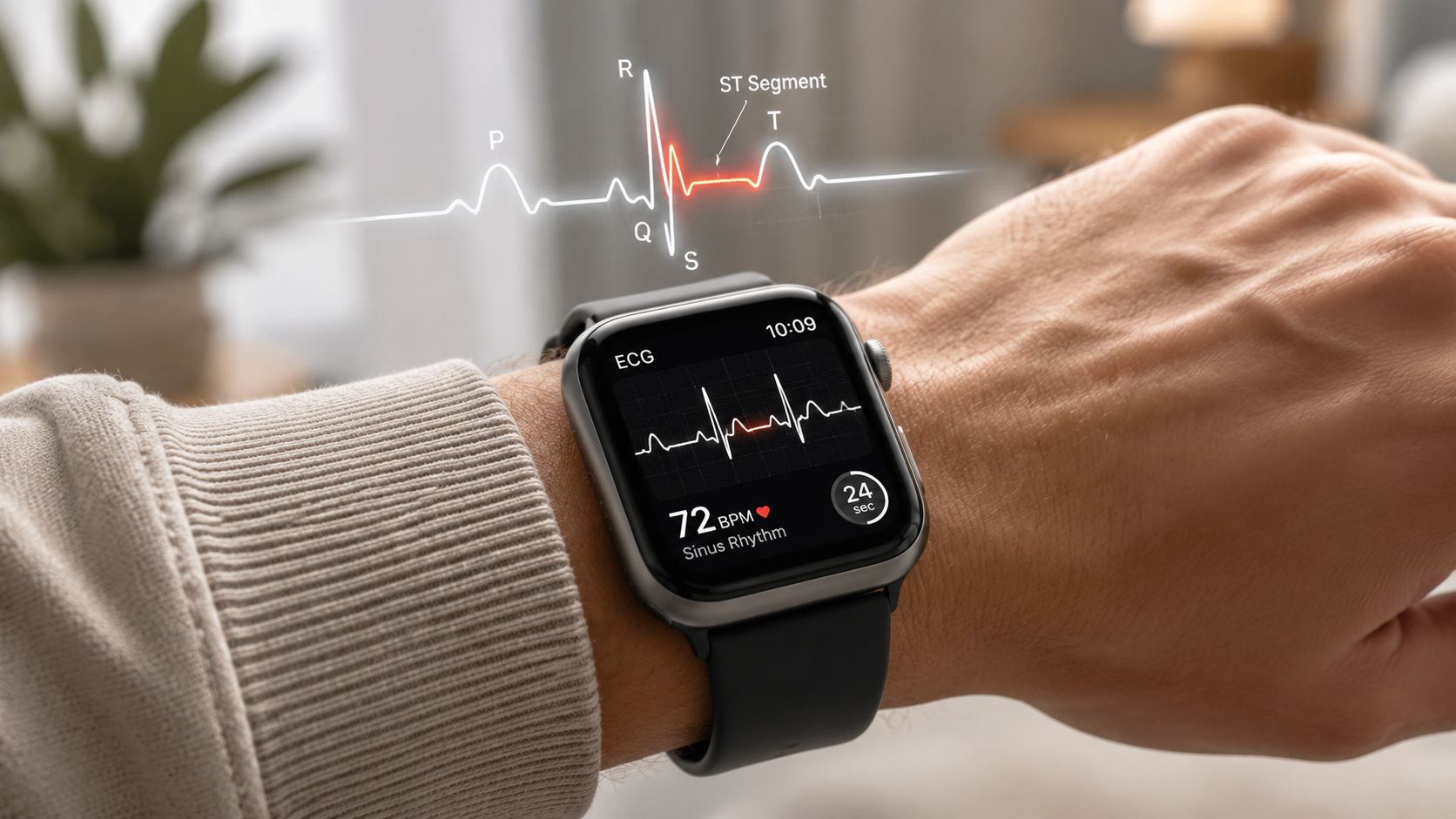
A watch ECG can feel a bit like checking the sky through one window. You can see something real, but you can't always tell the full weather pattern from that single view. That's especially true with the ST segment, a small part of the ECG that doctors pay close attention to because it can reflect stress or injury in the heart muscle.
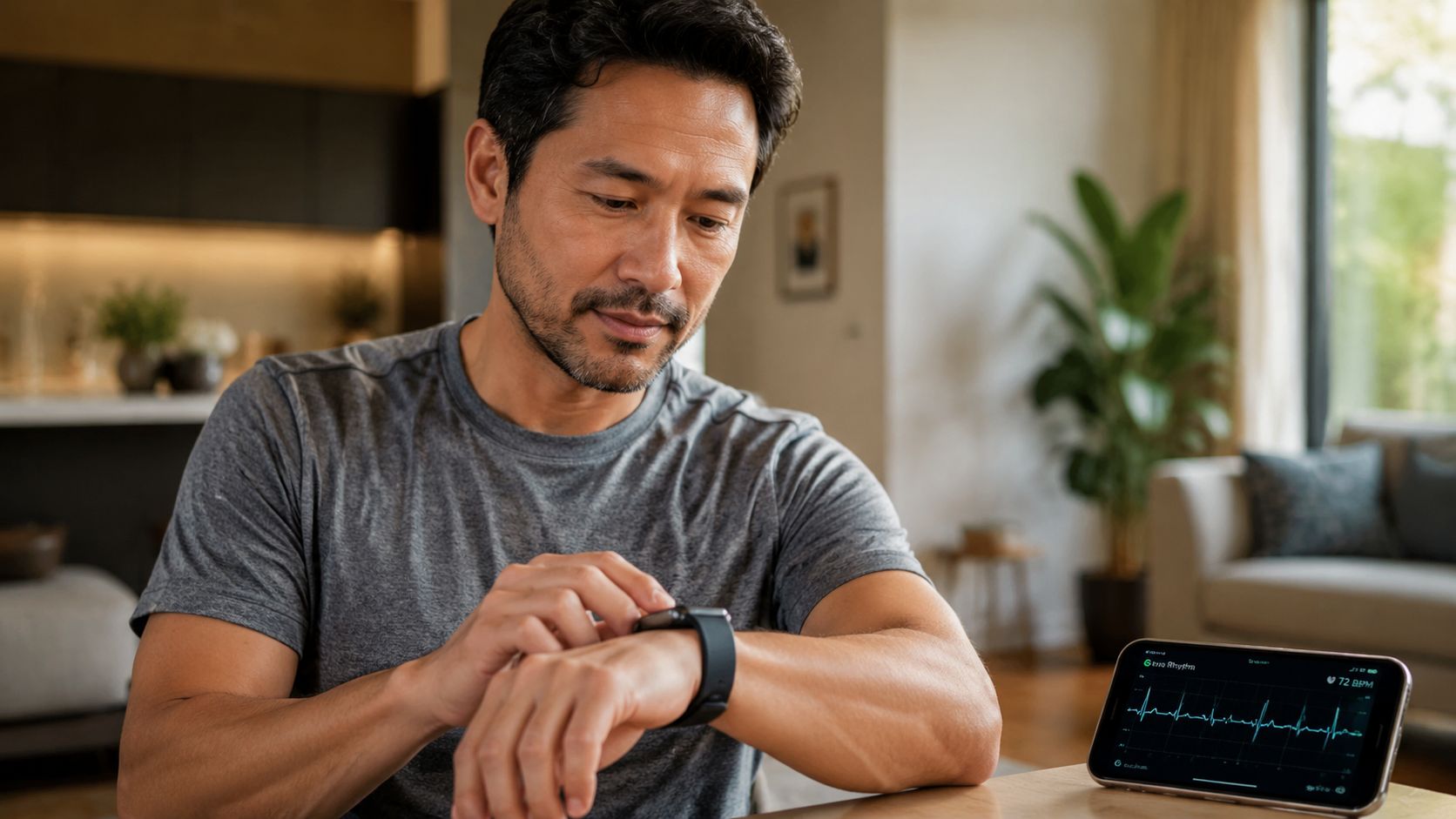
In clinical settings, patients showing ST changes had a 5.7-fold increased risk of major cardiac events compared to those without in a study of continuous monitoring, which is why this part of the tracing matters so much (JACC study on continuous ST-segment monitoring00370-8)). That doesn't mean every strange-looking line on your watch is dangerous. It means this is a signal worth understanding carefully.
If you like grounding yourself in basics, Natomy's comprehensive anatomy resource can be a helpful refresher on how the heart is built before you dive deeper into ECG patterns.
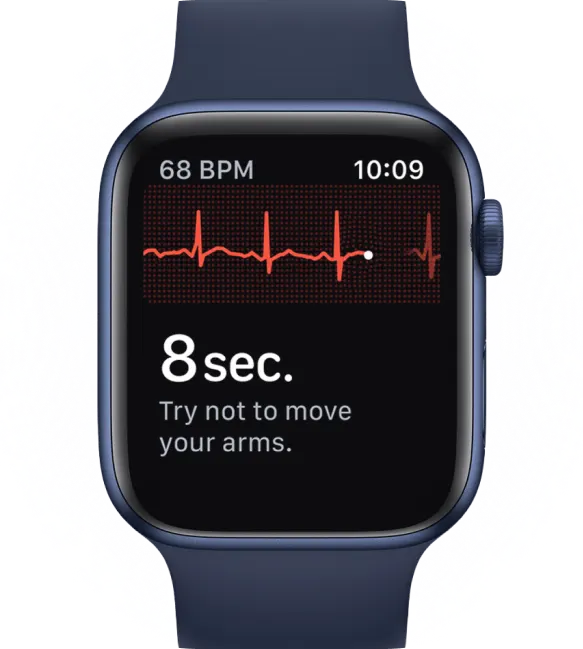
A lot of wearable users also want context on what their Apple Watch is recording, and this guide to ECGs on the Apple Watch can help connect the tracing on your screen to what's happening in your body.
Practical rule: Your watch can raise a question. It usually can't answer it by itself.
You don't need to become a cardiologist to make good use of your ECG. You just need a calm framework. Start with what the ST segment is, what changes can mean, and where wearable data stops being enough on its own.
The ST Segment Explained Your Heart's Recharging Phase
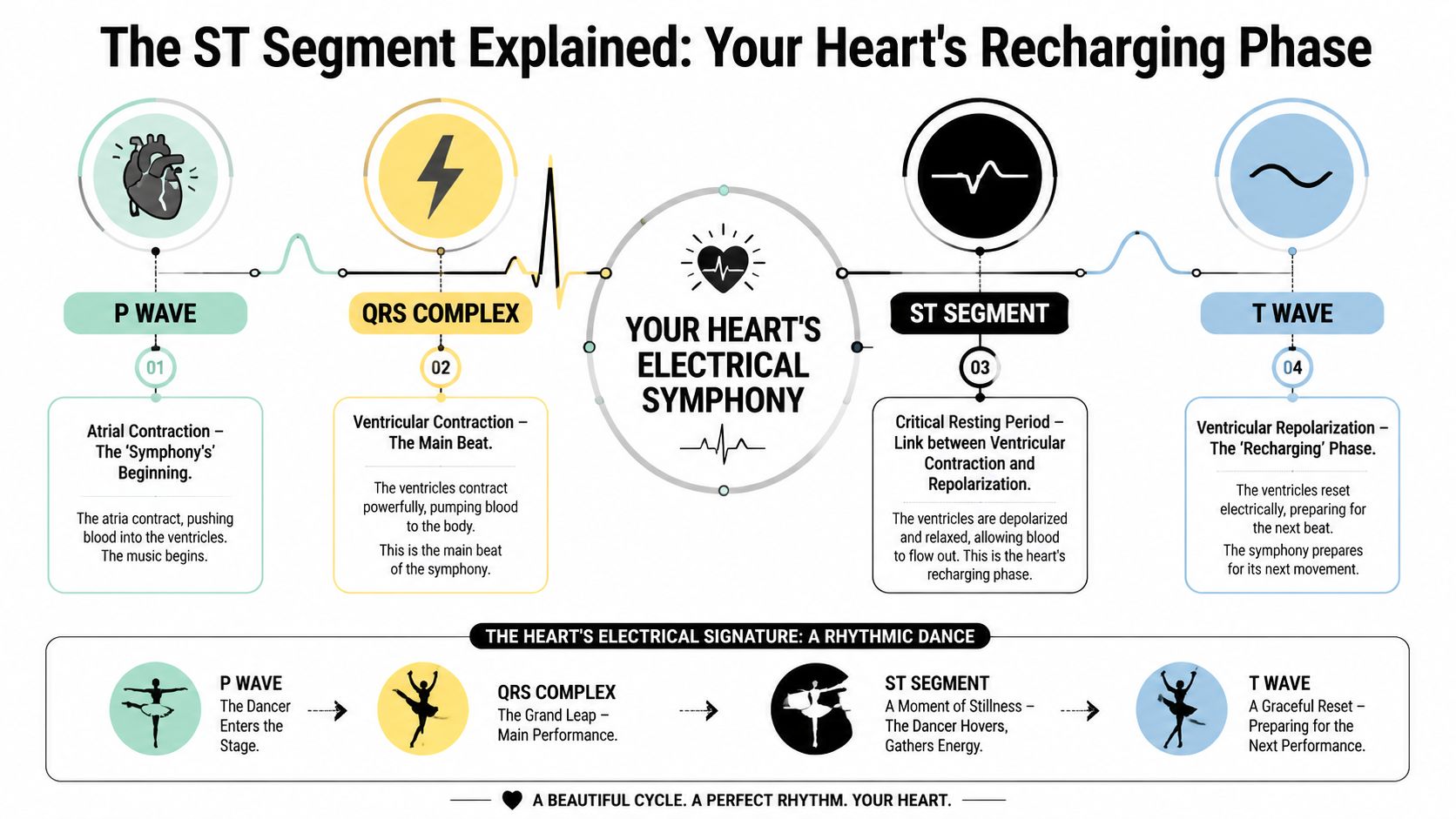
An ECG is the electrical signature of one heartbeat. The bumps and spikes aren't random. Each part reflects a different phase of the heart's electrical activity.
The heartbeat in simple terms
Think of a heartbeat like a short dance routine:
- P wave shows the upper chambers getting their cue.
- QRS complex is the big move, when the main pumping chambers activate.
- T wave shows recovery for the next beat.
The ST segment sits between the QRS complex and the T wave. On many ECGs, it looks relatively flat. That's why people often notice it when it doesn't look flat.
Where people get confused
Many wearable users assume the tallest spike is the most important part and everything after it is just leftover noise. It isn't. The ST segment is a real part of the electrical pattern, and clinicians examine it closely because shifts there can matter.
A clinically significant ST segment change is typically defined as a deviation greater than 1 mm (0.1 mV) from baseline, measured 60 milliseconds after the J point, which is where the QRS complex ends (GE HealthCare quick guide to 12-lead ST monitoring). That measurement detail matters because it helps separate a true change from a messy or uneven tracing.
If the phrase “recovery phase” interests you, the cardiac refractory period is closely related and gives more background on why the heart needs a precise reset between beats.
The ST segment is small, but it isn't minor. Small ECG features often carry big meaning when they change in the right pattern.
What a normal-looking ST segment usually means on a watch
On a watch ECG, you're usually looking for a segment that returns near the baseline after the QRS spike instead of staying visibly raised or depressed. The problem is that watches are sensitive to motion, skin contact, and posture. So a segment that looks “off” may reflect your body position, a shaky finger, dry skin, or signal filtering instead of a heart problem.
That's why it helps to compare clean recordings taken under similar conditions. One odd-looking tracing in isolation is much less useful than a repeated pattern.
What ST Segment Depression and Elevation Can Mean
When people talk about ST changes, they usually mean one of two things. The line looks lower than expected, called ST depression, or higher than expected, called ST elevation.
Neither one is a diagnosis by itself. They're clues.
A simple way to picture it
Think of blood flow to the heart like water through a garden hose.
If the hose is partly squeezed, less water gets through. That's similar to ischemia, when part of the heart muscle isn't getting enough oxygen-rich blood. In some situations, that can show up as ST depression.
If blood flow is severely disrupted and heart muscle is being injured, the tracing may show ST elevation. That pattern gets a lot of attention because it can reflect a more urgent process.
Why your watch can't name the cause
Many people feel frustrated with healthcare information online because articles often jump straight from “ST elevation” to “heart attack” or from “ST depression” to “ischemia” without pausing to say what a home user needs to know.
What you need to know is simpler and more useful:
- A raised segment is not automatically a diagnosis
- A dipped segment is not automatically benign
- Single-lead tracings can miss the bigger pattern
- Symptoms still matter
If you want a plain-language overview of reduced blood flow to the heart, this explanation of heart ischemia is a good companion to what you're reading now.
When to take a reading more seriously
A wearable ECG deserves more attention when the ST segment looks different and one of these is also true:
- You feel symptoms like chest pressure, unusual shortness of breath, sweating, nausea, or a sudden drop in exercise tolerance.
- The pattern repeats on multiple clean recordings taken in similar conditions.
- The tracing changed from your usual baseline rather than always looking that way.
- You recently had a cardiac event or medication change and you're monitoring closely for changes.
A watch ECG is more like a smoke alarm than a full fire investigation. You don't ignore it, but you also don't diagnose the wiring from the beep alone.
For skeptical readers, this matters. You don't have to blindly trust an app interpretation, and you also don't have to dismiss the data. The useful middle ground is to treat ST changes as prompts for better review, not as final answers.


Your Watch ECG vs a Clinical 12-Lead ECG
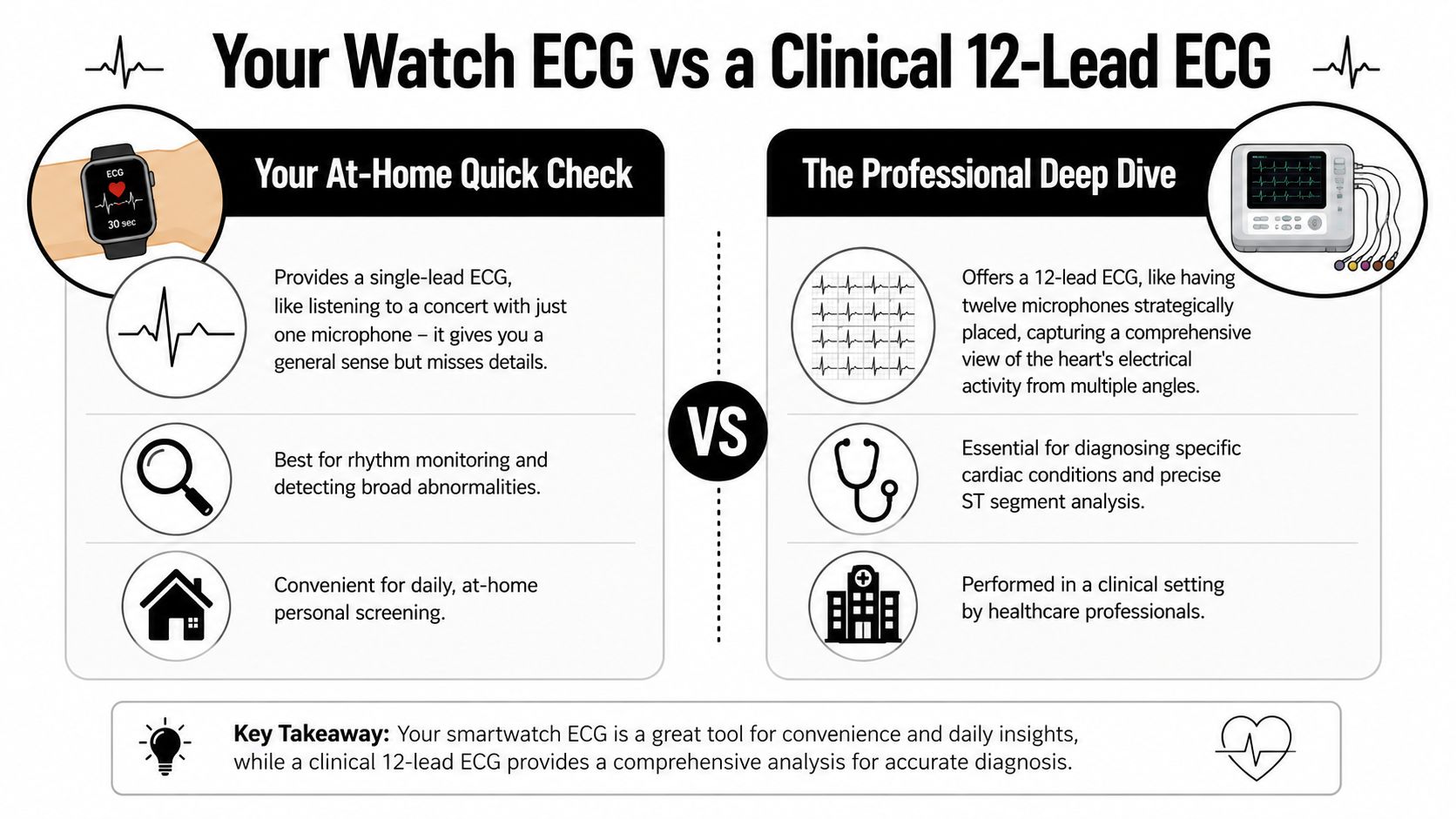
Your watch gives you a real ECG, but it gives you a single view. A hospital 12-lead ECG gives twelve views at the same time. That difference is the whole story regarding ST segment monitoring.
One window versus walking around the house
Looking at the heart with one lead is like standing at the front door of a house and trying to decide whether there's damage on the side wall, the roof, or the back. You might spot something obvious. You might also miss the main issue completely.
A clinical 12-lead ECG looks at the heart from multiple angles. That matters because ST changes can appear in some leads and not others. A pattern that looks concerning in one view may be less meaningful when seen in context. The reverse is also true.
This is why clinical guidelines rely on multi-lead ECGs, while 90% of consumer wearables use only 1 to 2 leads, and there's no medical consensus that ST deviations on those single-lead devices are clinically meaningful on their own (GE HealthCare white paper on ST monitoring benefits and barriers).
If you've wondered whether your device is “accurate enough,” this review of Apple Watch ECG accuracy helps separate rhythm tracking strengths from ST-segment limitations.
What your watch does well
A single-lead wearable is still useful. It can help you:
- Capture symptoms in the moment when a clinic ECG isn't available
- Track rhythm changes over time
- Create a record you can share with a clinician or reviewer
- Notice that something looks different from your baseline
That's not trivial. A home ECG can be the reason someone seeks help sooner instead of waiting.
What your watch can't do well
For ST segment monitoring, a watch struggles with three big problems:
Limited angle
One lead can't map the full heart.Signal noise
Tiny shifts from finger pressure, wrist position, and movement can reshape the baseline.Lack of context
A watch algorithm can't see your full lead pattern, examine reciprocal changes, or compare specialized lead behavior the way a clinical setup can.
So if your watch flags an odd-looking ST segment, the honest answer isn't “ignore it” or “panic.” It's “get help interpreting what this single view can and can't show.”
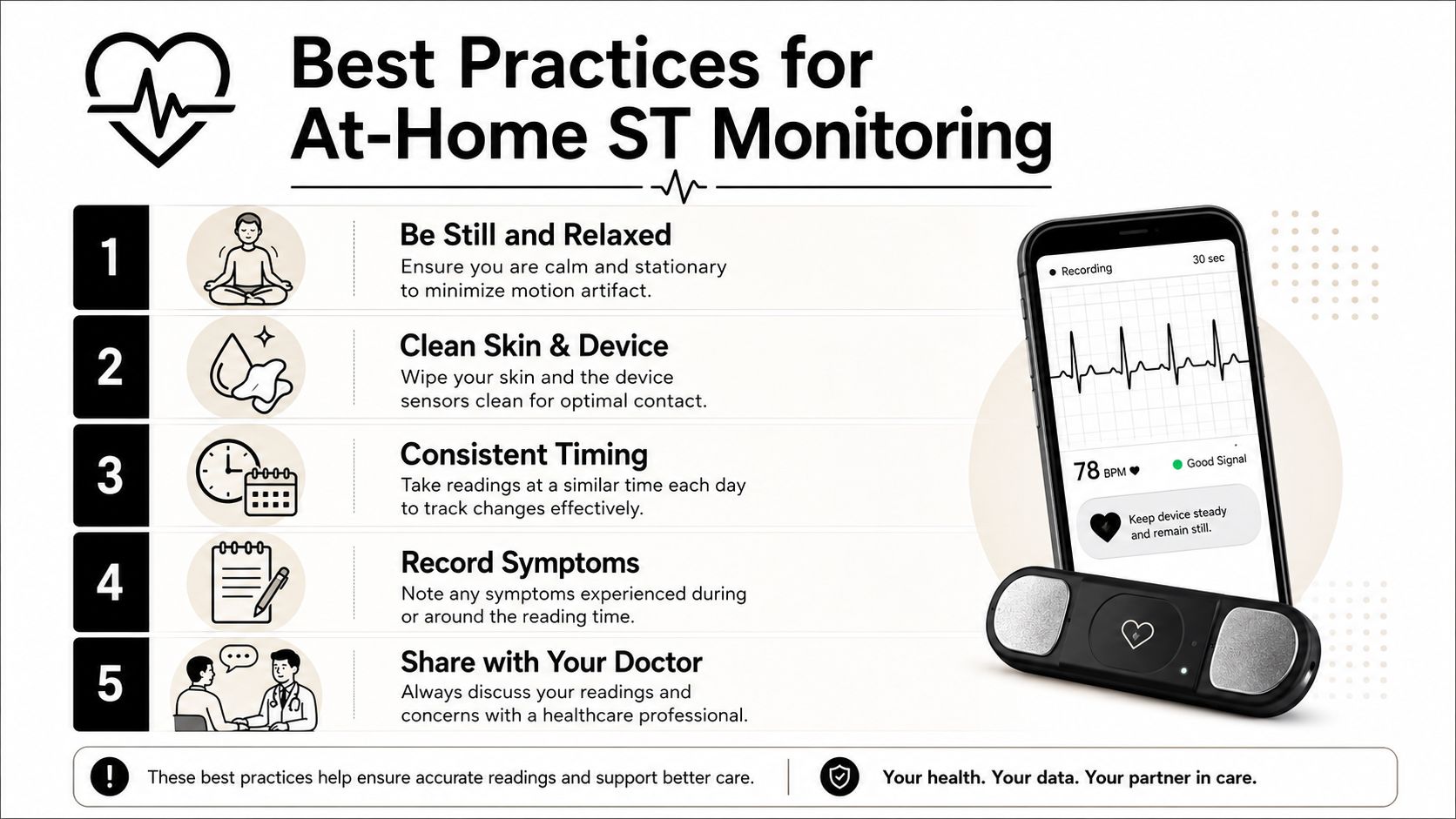
Best Practices for At-Home ST Monitoring
Good st segment monitoring at home starts with one goal. Reduce noise so the tracing reflects your heart, not your setup.
A cleaner tracing starts before you press record
Most bad ECGs aren't caused by the heart. They're caused by tension, motion, poor contact, or inconsistent technique.
Try this routine:
- Sit and settle first for a couple of minutes before recording.
- Rest your arm on a stable surface so your wrist and finger stay relaxed.
- Make sure your skin and sensor are clean because poor contact can distort the line.
- Use the same body position each time when you're comparing tracings.
- Record symptoms beside the tracing if you felt chest discomfort, palpitations, breathlessness, or dizziness.
Duration matters more than many users realize
A brief wobble or one strange beat can look dramatic on a tiny phone screen. That doesn't make it clinically meaningful.
For an ST-segment change to be considered clinically significant, it typically must last for at least one minute, which helps filter out brief noise or artifact (Nursing Critical Care review on ST monitoring duration thresholds).
What to remember at home: A fleeting blip is different from a sustained change that keeps showing up in clean recordings.
A practical home framework
If you're trying to make sense of a wearable tracing, use this simple sequence:
Check the recording quality
Was your hand steady? Was the baseline wavy or noisy? If yes, repeat it.Repeat under similar conditions
Same position, same device, calm breathing.Compare with your own prior clean tracings
Your baseline matters more than a generic internet example.Pair the ECG with how you feel
Symptoms raise the importance of any questionable pattern.Escalate when needed
If symptoms are concerning or the pattern is repeated and sustained, seek clinical guidance promptly.
This approach won't turn your watch into a hospital monitor. It will help you avoid two common mistakes. Overreacting to artifact and underreacting to a real change.
How Human Review Can Help You and Your Doctor
Many wearable users often encounter a significant limitation. The device gives you a waveform, maybe an automated label, and then leaves you to figure out whether a subtle ST change is noise, posture, baseline variation, or something more meaningful.
That gap is real. Clinical ST monitoring depends on details that a single-lead algorithm can't reproduce well. In hospital settings, alarm thresholds are adjusted with lead-specific and physiological nuance, including higher thresholds for men in leads V2 and V3 to reduce false positives, a level of judgment that a single-lead automated device can't replicate (AACN guidance on accurate ST-segment monitoring).
What human review adds
A trained reviewer can look beyond the raw tracing and ask better questions:
- Is this recording clean enough to interpret at all?
- Does the baseline look stable or distorted by artifact?
- Is the suspected ST shift consistent across repeated recordings?
- Does the pattern fit the user's symptoms and history?
- Would this be better treated as a prompt for urgent in-person care?
That doesn't replace your doctor. It helps you bring your doctor a clearer story.
One practical option for wearable users
One option is Qaly, which allows users to upload wearable ECGs for review by certified cardiographic technicians and receive a written interpretation they can share with their clinician. In a topic like ST segment monitoring, where single-lead limitations are severe and self-interpretation can go sideways fast, that kind of human review can help separate obvious artifact from a pattern worth escalating.
Good review doesn't promise certainty from a single lead. It gives you a more informed next step.
A better conversation with your clinician
If you've ever felt brushed off because you brought in “just a watch tracing,” you're not alone. A clean set of recordings, symptom notes, and a human-reviewed summary can make that visit more productive.
Bring these three things:
- Your best-quality ECGs rather than every noisy recording
- A short symptom log with time, activity, and what you felt
- Any interpretation report that explains what was seen and what remains uncertain
That last part matters. Uncertainty handled properly is better than false reassurance or algorithm-driven panic.
You're allowed to take your wearable data seriously. You're also allowed to expect nuance. ST segment monitoring is important, but on a watch it lives in a gray zone where context, pattern recognition, and human judgment matter a lot. That's not a flaw in your effort. It's the nature of the tool.
If your watch ECG shows a possible ST change, don't try to force a diagnosis from one tracing. Get a clean repeat recording, note your symptoms, and seek timely review when the pattern persists or you feel unwell.

Unsure about an ST change? Certified experts review your ECG within minutes.



.png)
.png)