


Key Takeaways

User Profile
Hello Heart Hero. If you've recently started taking creatine and noticed a flutter, skip, or racing feeling in your chest, you're definitely not alone. It’s a common concern, and it's completely understandable to feel worried.
So, let's get right to it: for the vast majority of healthy people, there is no strong scientific evidence that directly links creatine to heart palpitations.
Your Guide to Creatine and Heart Flutters
Feeling that unexpected thump-thump in your chest can be unnerving, so it's absolutely smart to look for answers. It’s easy to connect the dots and blame the new supplement in your routine. We understand that you might be skeptical of quick medical dismissals and want a real, in-depth explanation of why this might be happening, not just to be told it’s nothing.
This guide is for you. We'll walk through the evidence together, cut through the online noise, and give you a clear, honest roadmap. We'll also explore the far more likely culprits that often fly under the radar but can have a big impact on your heart’s rhythm.
What We'll Uncover Together
Think of this as a troubleshooting manual for your body. Instead of getting fixated on just one piece of the puzzle (creatine), we’re going to look at the whole picture to help you find the true source of those heart flutters.
We'll investigate factors like:
- Dehydration: Even minor fluid loss can stress your heart. This is a very common cause of palpitations, and creatine can affect your body's hydration needs.
- Stimulants: Are you taking a pre-workout? High doses of caffeine and other stimulants are a primary trigger for a racing or irregular heart.
- Intense Exercise: The physical stress of a tough workout itself is enough to cause your heart to beat out of its normal rhythm sometimes.
The idea that creatine causes heart palpitations mostly comes from personal stories online. But when you look closer, these experiences are often complicated by other factors. When researchers dig into the data, a direct link just isn't there.
For instance, multiple reviews and expert analyses confirm the lack of a direct cause. One study on bodybuilders found no significant difference in heart rate between those using creatine and those who weren't. Resting heart rates were 69.63 bpm for creatine users versus 71.5 bpm for the control group.
Our goal is to give you the knowledge to understand your body better. By exploring how all these different elements interact, you can feel more in control of your health and make informed decisions that are right for you. Let's get started.
How Creatine Fuels Your Body and Heart Muscle
To get to the bottom of the creatine and heart palpitations question, we first need to understand what creatine actually does in your body. Don’t worry, we’ll skip the dense science lecture and keep it simple.
Think of your cells, especially your muscle cells, as running on tiny, rechargeable batteries. The direct power source for these batteries is a molecule called adenosine triphosphate (ATP). It’s the fundamental energy currency for just about everything you do, from blinking your eyes to hitting a new personal record on the squat rack.
During short, intense bursts of effort, like a sprint or a heavy set of lifts, your muscles burn through their ATP supply incredibly fast. Once the battery is drained, your performance drops. This is where creatine enters the picture.
The Ultimate Battery Recharger
Think of creatine as a rapid-recharging power bank for your cells. Its main job is to help quickly rebuild your ATP supply. It does this by donating a high-energy molecule to "used" ATP, instantly converting it back into a fully charged power source.
This super-fast recharging process allows your muscles to sustain high-intensity effort for longer. It's the reason you can push out that one extra rep or maintain your speed in the final seconds of a race. This core function is all about energy support, not electrical stimulation.
This distinction is crucial when we talk about creatine and heart palpitations. Creatine's primary role is to refuel your muscles. It doesn't act like a stimulant, such as caffeine, which directly speeds up your central nervous system and, consequently, your heart rate.
Key Takeaway: Creatine works by replenishing your cells' primary energy source (ATP). Its job is to improve energy availability for short, powerful movements. It is not designed to interfere with your heart's electrical system.
Your Heart Is a Muscle Too
It's easy to forget, but your heart is the hardest-working muscle in your body, beating over 100,000 times per day. Just like your biceps or quads, your heart muscle depends on a constant supply of ATP to contract powerfully and rhythmically.
The very same energy system that creatine supports in your skeletal muscles is also chugging along inside your heart. In fact, your heart has an incredibly high demand for ATP to maintain its steady, life-sustaining beat.
From this angle, creatine’s role is fundamentally supportive of muscle energy everywhere in your body, including your heart. This energy-providing function is a world away from something that would disrupt the heart's electrical signals, which is where palpitations truly originate.
Understanding this helps us reframe the conversation. Instead of seeing creatine as a potential irritant, we can see it as a fuel source. This lays the groundwork for exploring what might really be behind those heart flutters, which we'll cover next. Remember, maintaining the right mineral balance is also vital for heart rhythm; you might find it helpful to check out our guide on how potassium levels can affect your heart.
Uncovering the Real Culprits Behind Heart Palpitations
When you feel a flutter in your chest, it's natural to point the finger at the newest thing in your supplement stack. But since the direct evidence connecting creatine to heart palpitations is thin, it's time to look at other factors.
Often, creatine is just an innocent bystander. The real cause is usually something else hiding in your daily habits. Let's walk through the common culprits that are often mistaken for creatine side effects, so you can find the true source of that unnerving flutter.
The Dehydration Connection
One of the most common, yet easily overlooked, triggers for heart palpitations is dehydration. Even a small fluid deficit can have a big impact on your cardiovascular system.
Think of your blood as a river. When you're well-hydrated, it flows smoothly. But when you're dehydrated, your blood volume decreases, making it thicker. This forces your heart to pump harder and faster to get oxygen where it needs to go, a strain that can easily show up as palpitations.
Creatine itself pulls more water into your muscles. While this is great for performance, it also increases your body's overall need for fluids. If you start taking creatine but don't increase your water intake, you can accidentally create a state of mild dehydration, leading to the very heart flutters you're concerned about.
The Potent Power of Stimulants
Next, let’s look at what you might be mixing with your creatine. Many people take creatine as part of a pre-workout stack, and this is a critical piece of the puzzle.
These pre-workout formulas are often loaded with high doses of stimulants, primarily caffeine. A single scoop can contain 200 to 400 mg of caffeine, which is like drinking two to four strong cups of coffee all at once.
Stimulants like caffeine directly excite your central nervous system. This sends a "go-go-go" signal to your heart, increasing its rate and contractility. For many people, especially those sensitive to caffeine, this powerful jolt is more than enough to trigger noticeable and sometimes distressing heart palpitations.
If you feel palpitations after your pre-workout, it's far more likely that the high dose of stimulants is the cause, not the creatine that happens to be in the mix.
Other Hidden Triggers in Your Routine
Beyond just dehydration and stimulants, several other parts of a dedicated fitness lifestyle can play a role in heart palpitations. It’s important to look at the whole picture.
Here are a few other common triggers to consider:
- Electrolyte Imbalances: When you sweat heavily during workouts, you lose crucial minerals like potassium and magnesium. These electrolytes are vital for maintaining your heart's stable electrical rhythm. An imbalance can easily lead to misfires and flutters.
- Poor Sleep: Not getting enough quality sleep places significant stress on your entire body, including your heart. Sleep deprivation can disrupt your nervous system and make you more prone to palpitations.
- Underlying Anxiety: The pressure of daily life, combined with a focus on high performance, can create a state of underlying anxiety. This keeps your body in a low-level "fight or flight" mode, putting your heart on high alert.
- The Stress of Intense Exercise: A very tough workout is a physical stressor. The adrenaline surge needed to push your limits can, by itself, cause your heart to have temporary, benign irregularities.
By carefully looking at these areas, you can start to connect the dots. You might notice the palpitations only show up on days you use a specific pre-workout, or maybe when you haven't had enough water. This process of elimination helps shift the focus away from fearing creatine and toward making small, effective changes to your overall routine. For a deeper dive into this topic, you can read our guide on what causes heart palpitations.
What the Research on Creatine and Heart Health Says
When you’re trying to get a straight answer about your health, it can feel like you're stuck between two extremes. On one hand, you get broad dismissals, and on the other, you find scary stories online. Let's cut through the noise and look at what the actual evidence says about creatine and heart palpitations.
The overwhelming scientific consensus, built on literally hundreds of studies, is that creatine is safe for the heart in healthy people at recommended doses. Big research reviews consistently show no direct link between standard creatine use and heart issues like palpitations. This isn't just a casual observation; it's a conclusion drawn from decades of research in sports science.
The Big Picture from Major Studies
When scientists conduct large reviews, they pool all the available data to look for patterns. For creatine, these large-scale analyses repeatedly come up empty-handed when searching for a connection to heart rhythm problems. Most studies are focused on muscle, strength, and safety, and they simply don't report heart palpitations as a common side effect.
This consistency across so much research is powerful. It tells us that for the average healthy person, the way creatine works doesn't interfere with the heart's electrical system. Its job is to help supply energy, not disrupt your rhythm.
The main takeaway from decades of research is clear: creatine isn't considered a trigger for heart rhythm issues in healthy people. The common belief that it causes palpitations often comes from confusing correlation with causation, where creatine might be present, but it isn't the actual cause.
What About Those Rare Case Reports?
Now, to give you the full picture, we have to talk about the exceptions. You might have seen some frightening anecdotes online or stumbled upon a rare medical case report. It's important to look at these because they're often the source of fear and confusion, and we're not here to hide information.
For example, there are a few case reports that hint at rare risks. One notable report described a 30-year-old man who developed atrial fibrillation after he started taking creatine monohydrate, despite having no prior heart issues.
However, the consensus from extensive research, including over 500 studies on PubMed, shows very little direct evidence tying creatine to AFib or palpitations in healthy individuals. The vast majority report no cardiac side effects at standard 5g/day doses. Interestingly, some studies even suggest potential benefits, like supplemented guinea pig hearts showing lower heart rates and more energy. You can read more about the consensus on creatine and AFib.
So, what does this all mean? These rare cases often involve an underlying, undiagnosed vulnerability. Someone might have a subtle genetic tendency for an arrhythmia that was simply unmasked, not caused, by a change in their supplement routine. It highlights that while creatine is very safe for most, individual responses can vary, especially if a hidden health issue exists.
This acknowledges that while outliers are real, they don't overturn the mountain of evidence supporting creatine's safety. If you're looking for a broader view of heart-friendly supplements, our guide on supplements for heart health offers more insights. Ultimately, understanding this helps reinforce creatine's safety record while also reminding you to always listen to your own body.
Who Should Be Cautious with Creatine Supplementation
While the evidence overwhelmingly shows creatine is safe for most healthy people, responsible supplementation means knowing when to be extra careful. This isn't about creating fear; it's about empowering you to make the smartest decision for your unique body.
For most, creatine is a simple and effective supplement. However, if you have certain pre-existing health conditions, it's wise to pause and have a conversation with your doctor first. Let's explore which groups should approach creatine with a bit more caution.
Individuals with Pre-existing Heart Conditions
If you're already managing a diagnosed heart condition, adding any new supplement to your routine requires careful thought. This is especially true for creatine. Your heart's energy system is already playing by a different set of rules, and it’s critical not to disrupt that delicate balance.
You'll want to be particularly cautious if you have a history of:
- Arrhythmias: Conditions like atrial fibrillation (AFib) or other irregular heart rhythms mean your heart's electrical system is already sensitive.
- Hypertrophic Cardiomyopathy (HCM): This condition involves a thickened heart muscle. Any supplement that affects cellular energy should be discussed with a cardiologist.
- Heart Failure: When the heart's pumping function is compromised, its energy demands are critical. Adding creatine into the mix needs to be medically supervised.
The key takeaway here is simple: if your heart already requires special attention, don't go it alone. A quick chat with your doctor provides a necessary layer of safety and peace of mind.
The Dose Makes the Difference
With supplements, the idea that "more is better" can be a risky one. While standard doses of 3-5 grams per day are well-researched and considered safe, some animal studies show how extreme, non-physiological levels can cause problems.
For example, one 2006 study looked at mice engineered to have up to four times the normal amount of creatine in their heart muscle. These mice developed serious heart problems, including congestive heart failure. You can read the full research about these cardiac energy findings.
This doesn't mean your 5-gram scoop is dangerous. It just powerfully illustrates that our bodies have tightly regulated systems for a reason. Sticking to recommended doses is a cornerstone of safe supplementation.


Other Groups That Need to Be Mindful
Beyond heart conditions, a few other groups should approach creatine cautiously:
- Individuals with Kidney Disease: Your kidneys are responsible for clearing creatinine, a byproduct of creatine. If you have any known kidney issues, it's crucial to consult your doctor before starting.
- Those Taking Certain Medications: If you're on medication, especially drugs that affect kidney function or blood pressure, talk to your doctor or pharmacist about potential interactions.
When looking at creatine research, it's also helpful to think about the quality of the supplement itself. Not all products are created equal, and understanding creatine purity and forms like Creapure can add another layer to making an informed choice. Ultimately, the most responsible step is always to loop in your healthcare provider when you have an existing health concern.
Feeling a flutter in your chest is one thing, but actually seeing what your heart was doing in that moment? That's where you can find real clarity and peace of mind. Instead of guessing or worrying, you can take control by actively monitoring your heart, turning that anxiety into action.
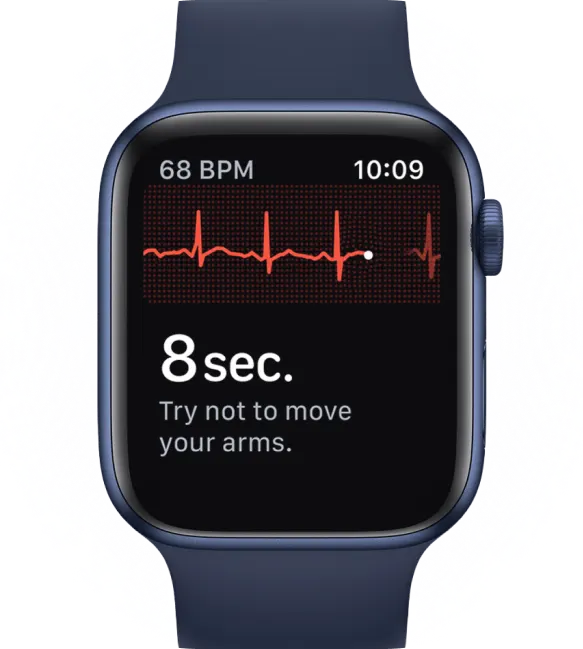
Modern wearables like the Apple Watch, Fitbit, or Samsung watches have put some seriously powerful health tools right on our wrists. These devices can take an electrocardiogram (ECG) whenever you want, giving you a real-time snapshot of your heart’s electrical activity the very moment you feel a palpitation.
This is a huge step forward. You no longer have to struggle to describe a fleeting sensation to your doctor days or even weeks after it happened. Now, you can walk into your appointment with a detailed record of exactly what you felt and when.
Get Answers with On-Demand ECG Interpretation
Capturing an ECG is the first step, but understanding what it means is what really matters. This is where a service like the Qaly app comes in. It connects your wearable's ECG data with an expert human eye, giving you clarity when you need it most.
Instead of waiting days for a doctor’s appointment or trying to make sense of an automated interpretation, Qaly sends your ECG to a certified cardiographic technician who reviews your reading, often within minutes. The service is available 24/7, providing rapid, professional analysis right from your phone.
The real power here is turning a moment of worry into a moment of understanding. Getting immediate, human-verified feedback helps you know if you're dealing with a harmless flutter or an arrhythmia that needs a doctor's attention, which can cut down on anxiety in a big way.
This process lets you track how your heart responds to different factors. You can start to connect the dots between your body's reactions and things like supplements, exercise intensity, hydration levels, and other lifestyle choices.
The flowchart below breaks down when you should be extra cautious and talk to your doctor before starting creatine.
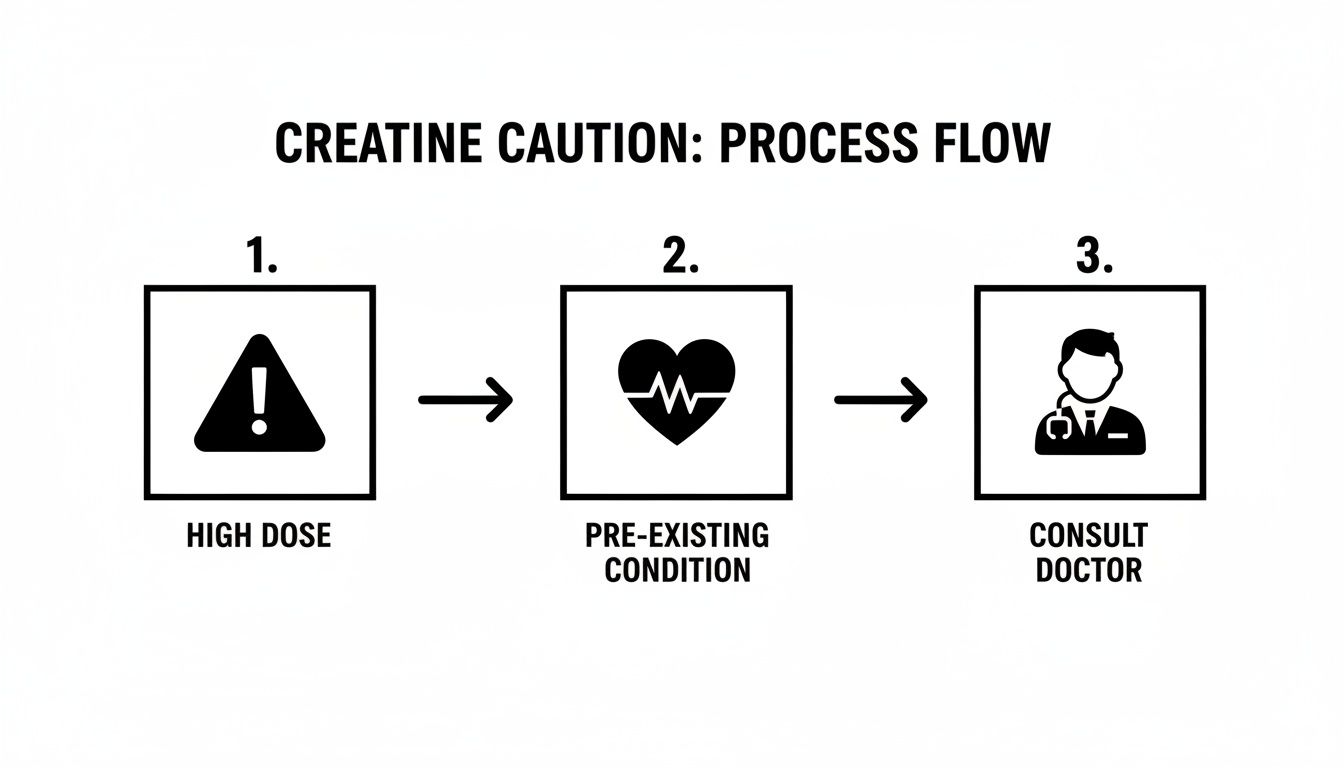
As you can see, if you have any pre-existing health conditions or are thinking about taking high doses, the right move is always to get a doctor's guidance first.
Your Path to Confident Health Management
Using a monitoring service changes the game. You're no longer just a passive patient; you become an active partner in your own health. By logging your palpitations and getting them interpreted, you're essentially building a detailed health diary.
You can then share these clear, organized reports with your doctor, giving them actionable data to work with. It makes your conversations far more productive because your physician can understand your experiences with real precision. If your doctor ever suggests more in-depth tracking, you might want to learn about other options, like a Holter monitor, in our detailed guide.
Ultimately, monitoring your heart puts you back in control. It helps you identify personal triggers for creatine-related heart palpitations and gives you the reassurance of knowing what’s actually going on inside your body.
Frequently Asked Questions About Creatine and Your Heart
Even with a deep dive into the science, you might still have a few personal questions buzzing in your mind. That's completely normal. Let's tackle some of the most common concerns we hear about creatine and heart palpitations.
Can I Take Creatine if I Already Have Benign Palpitations like PVCs?
This is a great question. If you’ve already been diagnosed with benign palpitations, like Premature Ventricular Contractions (PVCs), and you're in good health otherwise, creatine is generally considered safe to use.
The trick is to be extra careful with the known triggers we've talked about. That means making hydration a top priority and definitely not mixing creatine with high doses of stimulants. Since those are common culprits for palpitations, you want to manage them carefully.
Still, it's always smart to have a quick chat with your doctor before adding any new supplement to your routine. This is especially true if you notice your palpitations changing in how they feel or how often they pop up. Using a service like Qaly to track your PVCs can be a huge help here. It gives you real data to show your doctor, making that conversation much more specific and productive.
How Soon After Starting Creatine Might Palpitations Appear?
There really isn't a fixed timeline. Because creatine isn't a direct cause of palpitations, if they do show up, it's usually tied to those other factors we've discussed.
For instance, if you’re suddenly working out harder (and sweating more) or you’ve started a new pre-workout alongside the creatine, you might feel flutters within a few days. The palpitations aren't from the creatine itself, but from the dehydration or stimulants that came along with your new routine.
The best advice is to pay attention to your body and your entire lifestyle when you start. If you feel any new or worrying palpitations, it’s always a good idea to stop taking the supplement for a bit and talk to a healthcare professional. This helps you rule out other causes and gives you peace of mind.
A Sensible Precaution: If you feel a new, persistent, or scary heart flutter, pressing pause on creatine is a logical first step. It's a simple way to isolate one variable and see if the palpitations stop.
While you're on a break from it, focus on getting properly hydrated and maybe even cut out all stimulants. If the flutters disappear, you could consider reintroducing creatine by itself at a lower dose (3-5 grams per day) to see how you feel.
If the palpitations stick around or feel severe, getting medical advice is the most important next step. An on-the-spot ECG from your watch, interpreted by an expert, can be invaluable in these moments. It helps you understand what's happening in your heart right then and there.

Qaly provides expert, human-reviewed analysis of your wearable ECGs in minutes, 24/7. Get peace of mind and share detailed reports with your doctor by trying the Qaly app today.


.png)
.png)