


Key Takeaways

User Profile
Hello Heart Hero. You might be sitting with a hospital handout in one tab, a patient forum in another, and a notes app full of questions like: “Is ablation worth it?” “What does 75% success even mean?” “If my watch still shows odd beats afterward, did it fail?” That mix of hope and doubt is completely understandable.
Ablation can sound simple when someone says it quickly. “They zap the bad signals and fix the rhythm.” But when you start looking up the ablation success rate, the numbers can feel slippery. One place says one thing. Another says something else. Then your own situation seems more complicated than any headline number.
That's where people often feel let down by the healthcare system. You get percentages, but not always context. You hear “good candidate,” but not always what that means for your actual life, your symptoms, and your recovery. You deserve more than a statistic tossed across an exam room.
This guide is built to make the topic feel human again. It treats success as something bigger than a single number on a study chart. It also takes seriously the reality that many people now use wearable ECG tools, symptom logs, and follow-up data to understand what's happening in their own body after the procedure.
A Reassuring Welcome to Your Ablation Journey
If you're considering ablation or recovering from one, you're probably not looking for marketing language. You want honest answers. You want to know what people mean when they talk about success. You want to know what to expect if healing is messy or slower than you hoped.
Ablation success rate sounds like it should be straightforward. It isn't. It's more like asking, “How well does this repair hold up over time, in different homes, under different conditions?” The answer depends on the rhythm problem being treated, how doctors define success, how long they follow patients, and whether repeat procedures are part of the plan.
Why this feels so confusing
A lot of patients assume success means “my heart never acts up again.” That's a natural assumption. But in real life, doctors often measure success in narrower ways, such as whether a certain rhythm comes back during a set follow-up period.
At the same time, your lived experience matters too. If you can walk without getting winded, sleep without feeling your heart race, and stop organizing your day around fear, that matters. Those improvements can be exceptionally meaningful, even if your journey isn't perfect.
Practical rule: Don't judge your result by one number alone. Judge it by symptom relief, rhythm data, and the conversations you have with your clinician over time.
Questions matter as much as percentages
You don't need to become your own cardiologist. But you do need enough clarity to ask better questions. Questions like: What kind of rhythm problem do I have? What would success look like in my case? What would count as a normal part of healing? What happens if symptoms return?
If you want help preparing for that visit, this list of questions to ask your cardiologist can help you walk in with a calmer, more organized plan.
People often feel more steady once they stop chasing one magic number and start looking at the full picture. That shift changes everything. It turns a scary unknown into a series of understandable pieces.
What Does Ablation Success Rate Actually Mean
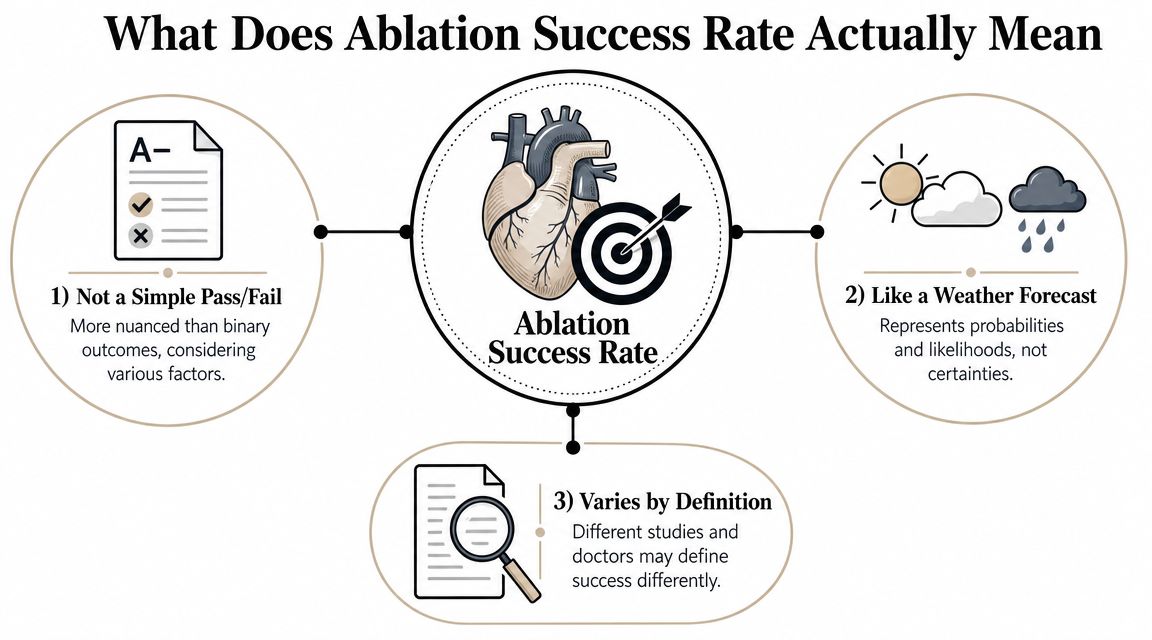
You may hear “success rate” and picture a simple grade, like pass or fail after one procedure. In medicine, the phrase is narrower than that. It usually means the share of people in a study who met a preset study definition after a certain follow-up period.
Your heart's electrical system works a bit like home wiring. One area can keep sending the wrong signal, and that can throw off the whole rhythm. Ablation aims to block or isolate that trouble spot. Whether the result counts as a “success” depends on what the study was tracking, how long patients were followed, and whether rhythm episodes showed up later on monitoring.
Success is a study definition
For atrial fibrillation, doctors and researchers often use standardized reporting rules so results from different centers can be compared more fairly. A Heart Rhythm Society consensus statement on catheter and surgical ablation of AF describes success in terms of freedom from recurrent atrial arrhythmias after a defined follow-up period, often while also noting whether antiarrhythmic drugs were still needed.
That can feel surprisingly technical. A brief symptom does not always count. A rhythm episode may need to last long enough to meet the study rule. Some studies count success only if no rhythm medicine is needed. Others report results both on and off medication.
So if you read that an ablation has a certain success rate, the useful next question is: what counted as success in that study?
What success feels like to a patient can be different
This is the part many people wish someone explained earlier.
A study may focus on documented rhythm recurrence. You may care most about whether you can sleep without jolting awake, exercise without fear, or get through the week without checking your pulse every hour. Those two views are related, but they are not identical.
That is why personal tracking matters after ablation. Looking at your AFib burden over time can be more helpful than reacting to one strange sensation, one smartwatch alert, or one difficult afternoon. Tools like Qaly can help you organize rhythm strips and questions for your doctor, so your follow-up is based on patterns instead of panic.
Ablation success is partly a medical definition and partly a lived experience. Both matter. The clearest picture comes from putting them together over time.
Typical Success Rates for Different Heart Rhythms
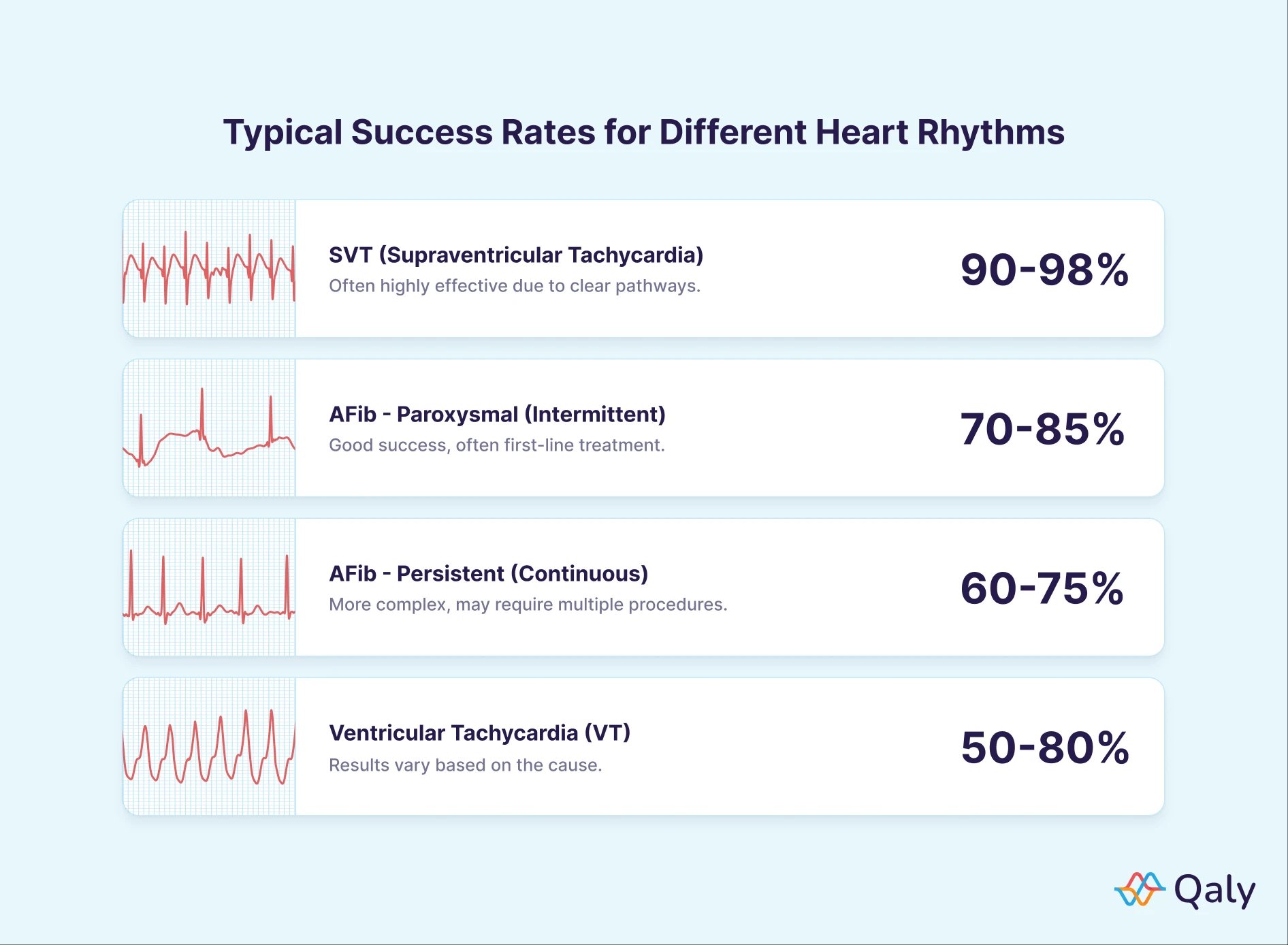
One reason people get frustrated is that they search “ablation success rate” and expect one clean answer. But there isn't one universal number, especially for atrial fibrillation. The rhythm type changes the picture.
Here's the historical pattern that helps make sense of it. In early studies of AF ablation, the majority of centers reported single-procedure success rates of 60% or more for paroxysmal AF and 30% or less for persistent AF. For multiple procedures, the majority reported 70% or more for paroxysmal AF and 50% or more for persistent AF, according to StopAfib.org's review of AF ablation success rates.
Why paroxysmal and persistent AF behave differently
Paroxysmal AF means episodes start and stop on their own. In general, that pattern is easier to treat because the rhythm problem is often less entrenched.
Persistent AF usually means the heart spends longer in the abnormal rhythm and may have undergone more electrical and structural remodeling. That doesn't mean ablation can't help. It means the procedure often has a harder job.
Longer follow-up changes the number
Another layer of complexity is time. A systematic review cited in a peer-reviewed paper reported single-procedure success for paroxysmal AF of 68.6% at 1 year, 61.1% at 3 years, and 62.3% at 5 years. The same paper also described another long-term cohort with 74% freedom from AF in paroxysmal AF versus 42% in persistent AF, which highlights the gap between these AF subtypes.
That's why one-year success can sound more reassuring than five-year follow-up. Both matter. They just answer different questions.
A short visual explainer can make that easier to digest:
The number you hear may already include repeat procedures
Some broad summaries are useful if you keep the context in mind. Harvard Health, as cited in the verified background above, puts overall AF ablation success at around 75%, rising to nearly 90% when a second procedure is performed. Some centers today cite 80% to 85% success for first ablations and 95% for second ablations, while also noting that definitions vary by center and follow-up method.
So if you've been reading about AFib ablation and wondering why one figure sounds far better than another, this is usually the reason. The study may be looking at a different type of AF, a different length of follow-up, or a different rule about whether second procedures count.
The main takeaway is simple. For AF, success has improved over time, but it still depends heavily on the kind of rhythm you have and how the result is measured.
Why You Should Look Beyond Published Success Rates
You read one page that says ablation works well. Then you read another that sounds far less reassuring. That kind of whiplash is common, and it usually does not mean anyone is hiding the truth.
Published success rates are group averages. Your decision is personal.
A study result can be useful in the same way a weather forecast is useful. It tells you what often happens under certain conditions. It does not tell you exactly what your week will feel like, what symptoms matter most to you, or how much peace of mind you will get if your episodes become milder, shorter, or much less frequent.
Three questions to ask every time you see a number
When you come across a published success rate, stop for a moment and ask:
- Success for whom
Was the study focused on paroxysmal AF, persistent AF, or a mixed group? Those groups often have different outcomes. - Measured how
Did success mean no symptoms, no documented episodes, or only no episodes that met a formal study threshold? - Measured for how long
A short follow-up can sound encouraging, while a longer follow-up gives you a better sense of staying power.
These questions help you compare like with like.
“Success” on paper and success in real life are not always the same
Medical papers need strict definitions so researchers can compare results across studies. Real life is messier. One person may call the procedure a success because scary palpitations are gone and daily life feels normal again. Another may only count it as a success if every trace of arrhythmia disappears.
Both views are understandable.
This is why the patient's perspective matters so much. A published number cannot tell you whether you can sleep without fear, exercise with confidence, or stop checking your pulse every few minutes. Those changes are often what success feels like.
Your doctor's results matter more than a headline
The setting matters too. Different hospitals treat different kinds of patients. Different electrophysiologists have different experience, tools, and follow-up routines. A center that sees many straightforward cases may report different results than one that handles more advanced rhythm problems.
So a better question is often, “What do outcomes look like for people like me in your practice?”
That question shifts the conversation from a general average to your unique health strategy.
Use published rates as a map, not a promise
Numbers can guide you. They should not define your expectations by themselves.
The most useful approach is to combine three things. The published evidence, your doctor's experience with patients like you, and your own goals after treatment. If you track symptoms, rhythm alerts, and recovery patterns with your care team, and with tools like Qaly when appropriate, you get a clearer picture of how your own story is unfolding after ablation.
That is often more reassuring than any single percentage.
Personal Factors That Influence Your Ablation Outcome
Group statistics are useful. Your body is still your body.
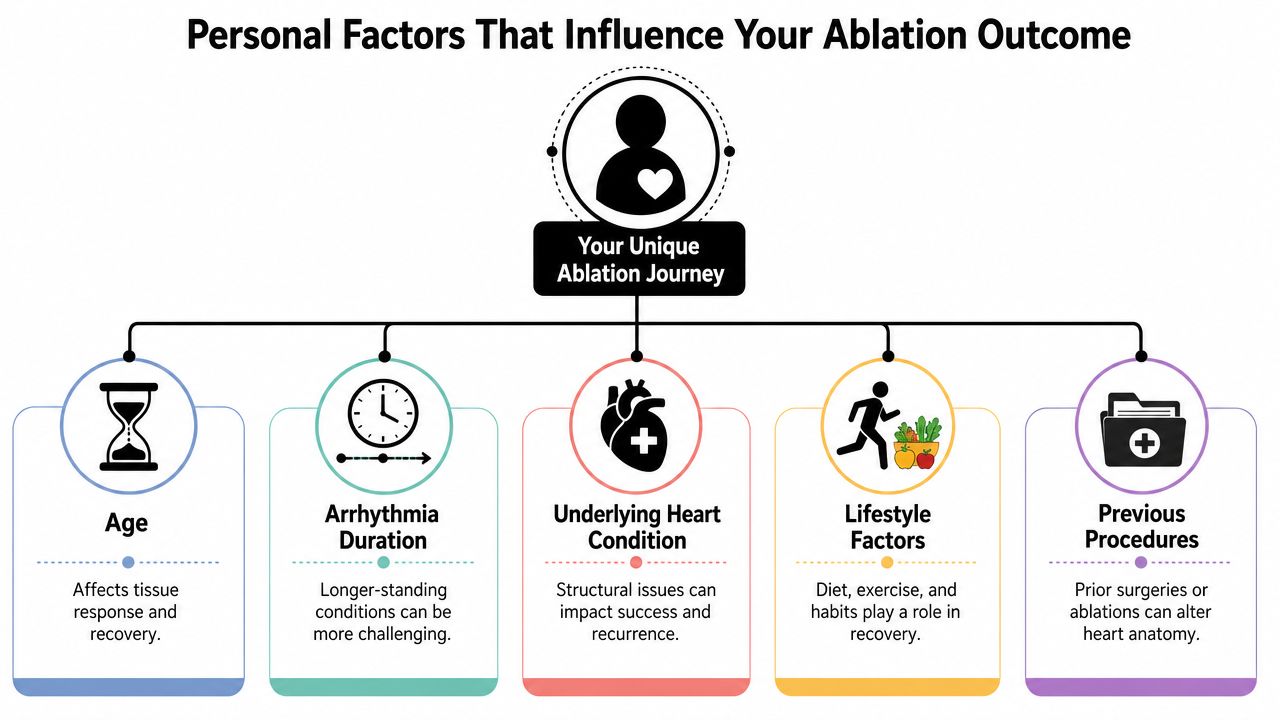
Two people can have the same rhythm diagnosis and very different ablation experiences. One bounces back quickly and stays in normal rhythm. Another needs medication changes, more follow-up, or another procedure. The difference often comes from personal factors that don't show up in a simplified success rate.
The parts of your story that matter
A real-world AF ablation cohort found an overall 2-year sinus-rhythm maintenance rate of 56%, with success correlating significantly with age and standard risk factors, according to this PubMed-indexed cohort study on AF ablation outcomes.
That doesn't mean age or risk factors decide your fate. It means they influence the odds. So do other practical details your doctor will think about, such as how long you've had the arrhythmia, whether your heart has structural changes, whether you've had prior procedures, and whether other health conditions complicate rhythm control.
Here are common examples doctors weigh:
- Age and overall health
Younger, otherwise healthier patients often have less complicated rhythm disease, though that's not a guarantee. - How long the arrhythmia has been present
A rhythm issue that has been around longer can become harder to shut down durably. - Other conditions
Blood pressure issues, sleep-related breathing problems, and heart structure changes can all shape recovery and recurrence.


Your habits still count after the procedure
Patients sometimes hear “the doctor fixed it” and assume the rest is out of their hands. That's rarely true. Sleep, stress, alcohol intake, exercise, medication adherence, and follow-up all affect what happens next.
The idea of your unique health strategy can be helpful. The core idea is simple. Care works better when it fits the individual rather than forcing every patient into the same template.
A grounded mindset: Your ablation outcome is shaped by both the procedure and the environment your heart returns to afterward.
That should feel encouraging, not burdensome. You can't control every variable. But you can bring better information, ask sharper questions, and support your recovery in ways that matter.
The Truth About Repeat Ablations and Complications
A second ablation does not automatically mean the first one “failed.” For many people, especially those with more stubborn AF patterns, treatment works in stages.
Some tissue heals in a way that allows electrical signals to reconnect. Sometimes the first procedure reduces the problem but doesn't fully contain it. In those cases, a repeat procedure can function more like a refinement than a reset.
Repeat procedures are common enough to expect
StopAfib.org notes that recurrent AF after ablation leads to a repeat ablation in approximately 20% to 40% of patients, and a widely cited clinical explanation says 25% to 35% of patients may need a second or third procedure to reach the reported success rate, based on the clinical discussion linked in the verified data.
That can be reassuring. If symptoms return, it doesn't always mean you made a bad decision. It may mean you're in a group for whom rhythm control takes more than one attempt.
The emotional part is often harder than the medical part
Many patients feel discouraged when they hear “we may need to do another one.” They hear defeat. Doctors often hear treatment strategy.
Those are not the same thing.
If you go into ablation believing success only counts if one procedure fixes everything forever, you're more likely to feel blindsided. If you go in knowing that some people need a touch-up, you can respond to recurrence with more perspective and less panic.
Complications are part of the informed-consent conversation, and your electrophysiologist should review your specific risks in detail. What matters here is the frame. A repeat procedure is often part of the long game of getting to a better rhythm, not proof that the first effort was pointless.
Tracking Your Own Success After Your Procedure
After ablation, success isn't only something a study reports. It's something you learn to observe in your own life.
You might notice that climbing stairs feels easier. You may stop waking up with a pounding chest. Or you may still get occasional sensations and wonder whether they're harmless healing noise or true recurrence. In such instances, your own record becomes valuable.
What to track in daily life
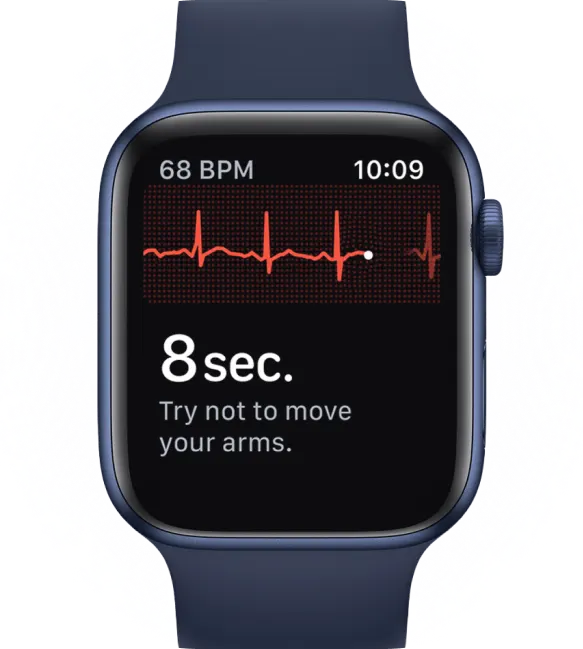
Start simple. Keep notes on symptoms, time of day, what you were doing, and anything that seems to trigger episodes. If you use an Apple Watch, Fitbit, Kardia, Samsung device, Withings device, or another wearable ECG tool, save strips that match symptoms.
That combination matters because symptoms alone can be fuzzy. A rhythm strip adds objective evidence. Over time, patterns become easier to spot.

How technology can support follow-up
Many people benefit from some form of ongoing rhythm review, especially if they feel intermittent palpitations and want clearer information to bring to appointments. Learning about continuous monitoring after rhythm issues can help you decide what level of tracking makes sense for your situation.
If you want another layer of support, Qaly is one option for people using wearable or at-home ECG recordings. It connects those recordings to certified cardiographic technicians who review the strips and provide reports that can be shared with a doctor. Used carefully, tools like this can help patients organize what they're seeing instead of relying on memory during a follow-up visit.
Your personal definition of success matters too
Not every meaningful result fits a study endpoint. Maybe your watch still catches brief odd beats, but your old episodes are far less frequent. Maybe you still need some medication, but your energy is back and your anxiety has dropped. Those outcomes count.
A good post-ablation mindset balances two truths. First, objective data matters. Second, quality of life matters. The strongest follow-up plans respect both.
Bring your doctor a timeline, symptom notes, and any saved wearable ECG strips. That turns “I felt weird last week” into something much more useful.

Monitoring your heart rhythm after ablation? Qaly can help you review ECG recordings and track changes over time.



.png)
.png)