


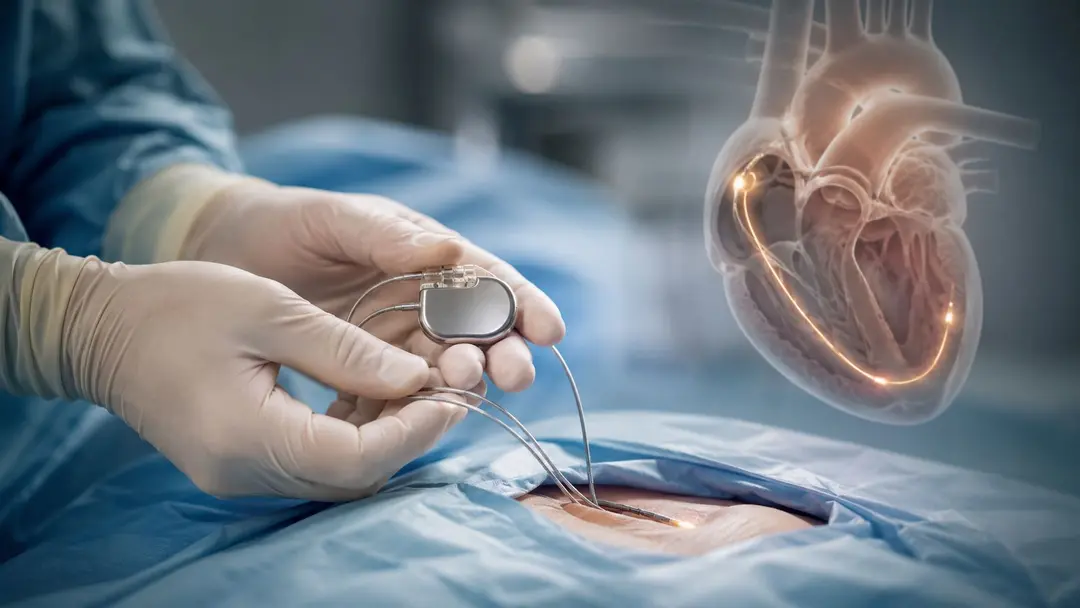


Hello Heart Hero. If you're searching can a pacemaker be removed, you're probably not asking out of curiosity. You may be living with a device that feels constant, confusing, or hard to trust, or you may be trying to help someone who's facing another procedure and wants straight answers.
The short answer is yes, a pacemaker can be removed in some situations, but that phrase hides a lot of important detail. Sometimes doctors remove the generator, the small box under the skin. Sometimes they remove the leads, the wires that reach into the heart. Those are very different procedures, with very different levels of complexity.
If you've seen mixed messages online, that confusion is normal. Public articles often blur together replacement, upgrade, and true extraction, even though they don't mean the same thing at all. This guide separates those pieces so you can talk to a cardiologist or electrophysiologist with a clearer sense of what's being proposed, and why.
If you want a helpful place to start your next appointment, this list of questions to ask your cardiologist can help you organize your thoughts before you make any decision.
You Are Not Alone in Asking This Question
A lot of people ask this after a rough clinic visit, a device alarm, a pocket infection, or the uncomfortable feeling that something is sitting inside their chest. Others are asking because a parent, spouse, or friend has a pacemaker and they're trying to sort out what doctors mean when they say “remove it.” The worry is real, and it deserves a clear answer.
Start with one simple idea, removal is not one thing. A doctor might be talking about taking out the battery box, replacing it with a new one, or doing a more complex extraction of the wires. Those choices carry different risks and different reasons for doing them.
A calm question beats a rushed decision. Ask what exactly is being removed, what's staying in place, and why that plan fits the problem.
You do not need to understand every technical term before you ask for help. You just need enough vocabulary to slow the conversation down and make it specific. That's where a good explanation helps, because it gives you a way to ask, “Do you mean the generator, the leads, or the whole system?”
If you're also trying to understand how the device works in the first place, this overview of heart pacemaker operation can make the next sections easier to follow.
What a Pacemaker Is
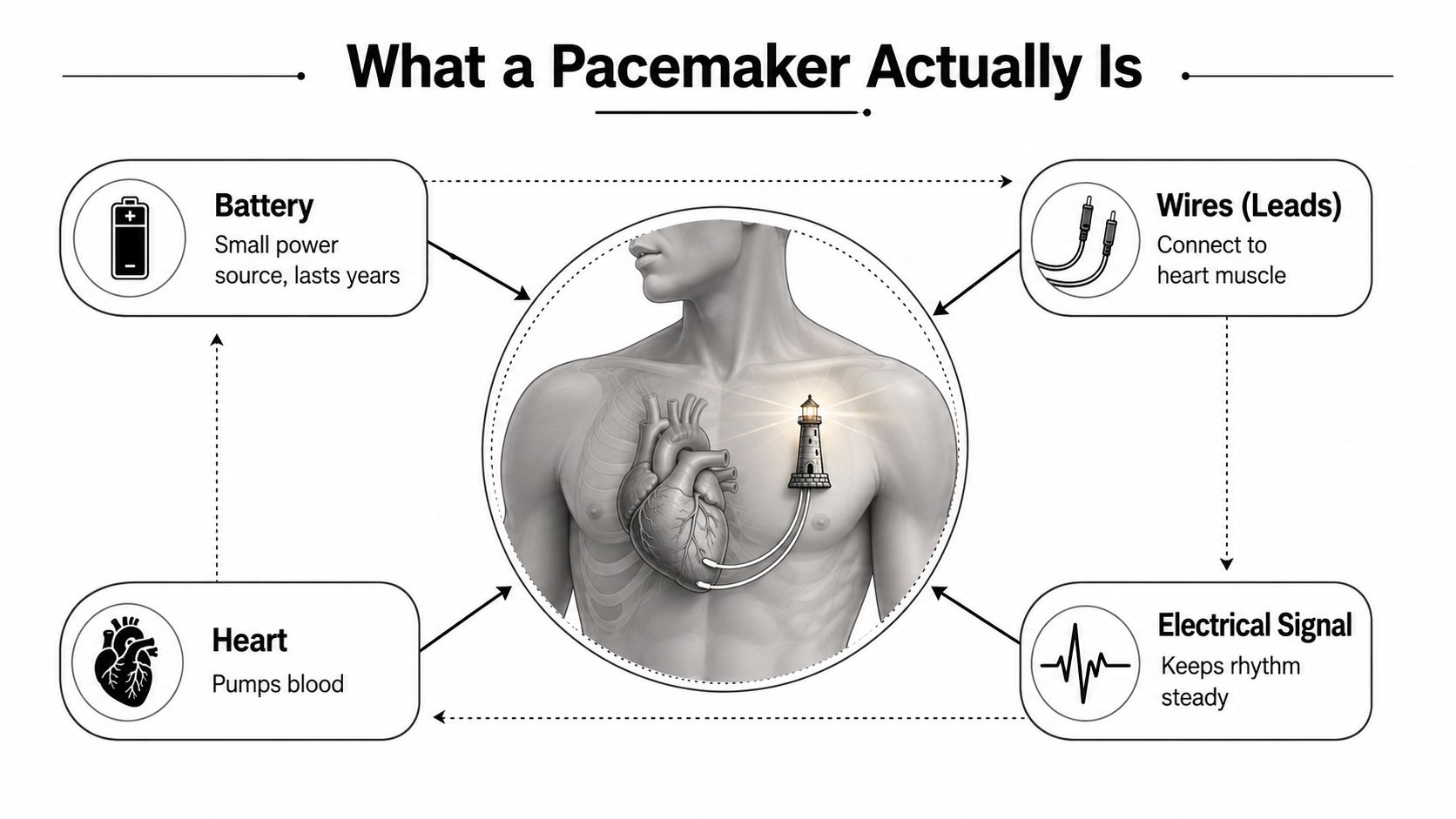
A pacemaker has two main parts: the generator, a small battery-powered box placed just under the skin, usually near the collarbone, and one or more insulated wires called leads. The leads travel through a vein into the heart and carry the electrical pulses that help steady the rhythm.
The generator is the part many people picture first. It senses how the heart is behaving and decides when to fire. The leads do the delivery work, and over time the body can form scar tissue around them, which makes them harder to remove.
That difference matters. A device can sometimes be changed without disturbing the wires. A generator change is like swapping the power source in a system that is already installed, while the leads stay in place if they are still working well.
There is also a different kind of device called a leadless pacemaker. It sits inside the heart itself and does not use the same long wires, so the question of removal changes a lot. If someone says their pacemaker came out, ask which type they had, because the answer is not the same for every device.
For a visual walkthrough of the device itself, this pacemaker anatomy guide is a useful companion.
Two Very Different Procedures Often Called Removal
When people say “removal,” they're often talking about two separate jobs. One is the generator change, where the old battery box comes out and a new one goes in while the leads stay attached. The other is lead extraction, where the wires themselves are removed from the body.
Generator change is the simpler end of the spectrum
A generator change is often the least dramatic version of the story. The doctor opens the pocket under the skin, disconnects the old box, and swaps in a new one. If the leads are in good shape, there's no reason to disturb them.
That's why some people think a pacemaker can be “removed” when what happened was a battery replacement. The device still exists, the leads are still in place, and the heart still has pacing support if it needs it.
Lead extraction is the part people miss
Lead extraction is the harder, more delicate procedure. The wires are often held in place by scar tissue where they pass through veins and into the heart, so they can't just be pulled like a loose cord. Specialists use tools to free them safely, and that's why this work belongs in experienced centers.
Practical rule: if someone says “we're removing the pacemaker,” ask whether they mean the box, the wires, or both.
That distinction is not just semantic. It changes the level of risk, the length of recovery, and the backup planning. A lot of internet content skips that difference, which leaves patients thinking the whole thing is either impossible or simple, and neither is true.
If you want a plain-language explanation of the specialty that handles these decisions, this guide to cardiac electrophysiology is worth reading.
When Doctors Actually Recommend Taking It Out
The clearest reason for removal is infection. When a pacemaker system becomes infected, guideline-based practice calls for complete removal of the generator and all leads, because hardware can keep bacteria hidden in the body even when antibiotics are being used. In that situation, leaving pieces behind can allow the infection to come back.
Sometimes the problem is not infection, but the device or its wires are causing trouble in a different way. Published lead-extraction guidance includes severe chronic pain at the device site, life-threatening rhythm problems linked to retained leads, lead-related clotting problems, vein blockage such as superior vena cava syndrome, interference between leads, and situations where the device gets in the way of cancer treatment or another necessary procedure. Those are narrower reasons, but they're real.
A doctor may also recommend removal if the hardware is malfunctioning or has become part of a larger management problem. The key question is not “Can it come out?” but “Does taking it out solve the problem better than leaving it in place or replacing part of it?”
Why this is usually a problem-solving procedure
Pacemakers are built to stay in place for years, so removal is rarely elective. In practice, doctors are weighing whether the device is helping enough, harming enough, or interfering enough to justify the procedure. That's especially true when the leads have been in the body a long time, because the scar tissue around them changes the balance.
A device that's old or annoying usually isn't enough reason by itself. But infection, dangerous malfunction, blocked veins, or interference with another essential treatment can turn removal into the safer choice.
Get your ECG checked by certified experts within minutes on the Qaly app.


What Actually Happens During a Lead Extraction
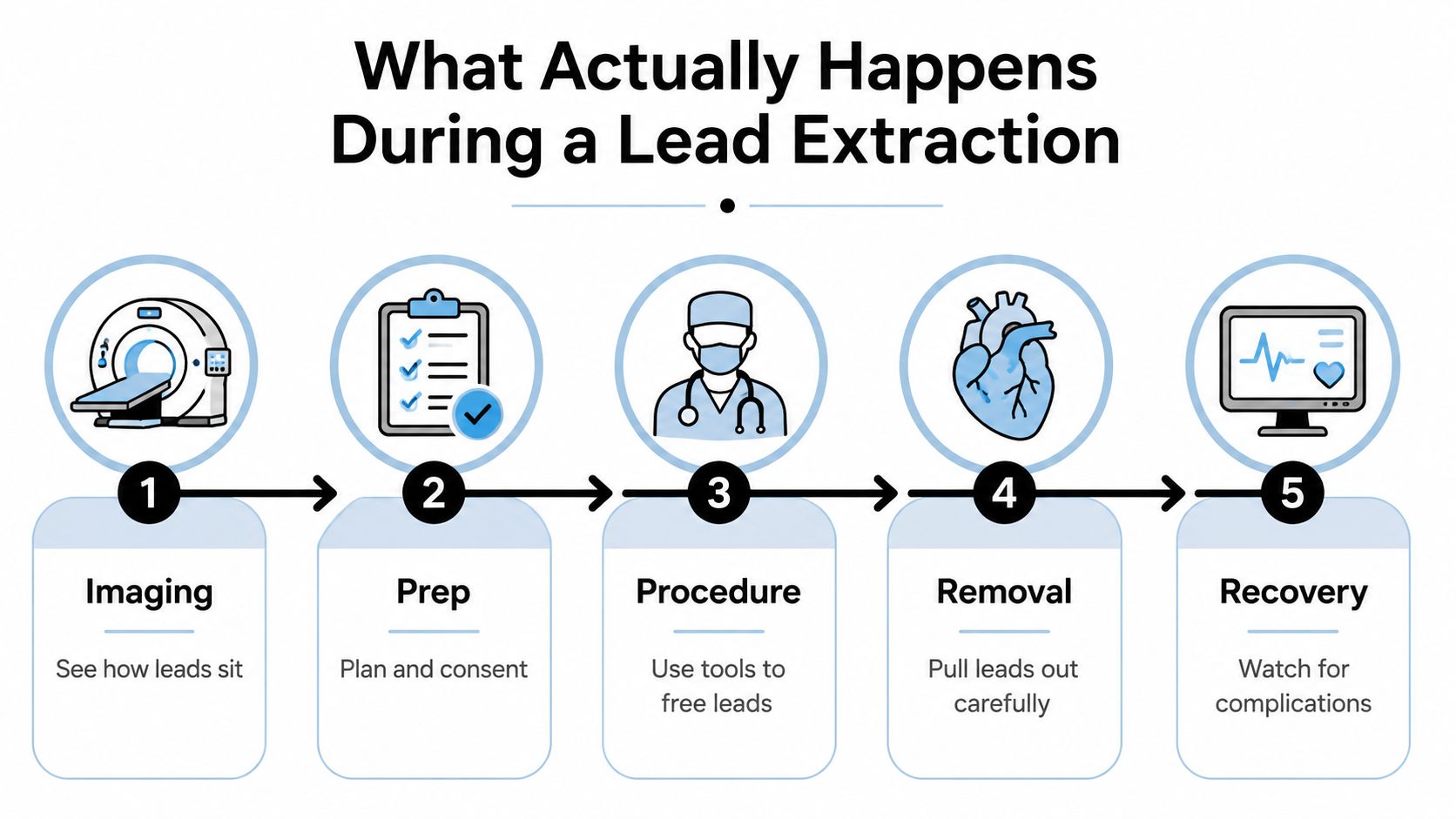
A real extraction starts long before the lead moves. Doctors review imaging, labs, and the device history, because they need to know how the wires sit and how much scar tissue they may face. If you're trying to understand the imaging piece, this plain explanation of fluoroscopy helps make the operating room picture less mysterious.
The procedure is usually done under general anesthesia in a hospital, not in a small office setting. Teams plan for the rare but serious possibility of bleeding or cardiac perforation, which is why expert guidance emphasizes high-volume centers with experienced staff and on-site cardiothoracic surgical backup. The point is simple, if something goes wrong, rescue has to be immediate.
A guided tour of the procedure
The doctor opens the pocket where the generator sits, disconnects the device, and then works on the lead. A sheath is advanced over the wire to break up the scar tissue holding it in place, and specialized tools help free the lead as the team watches closely. Once the wire is out, the pocket is closed and the patient is monitored for bleeding, rhythm problems, or fluid around the heart.
Most patients then stay in the hospital for observation. That doesn't mean something went wrong, it means the team is being careful after a procedure that can't be treated casually.
The detail people often miss is that the operation is about controlling risk, not eliminating it. The doctors are trying to remove a problem while avoiding injury to the heart and blood vessels. That's why the setting, the staff, and the plan matter so much.
Real Risks and What the Numbers Mean
The honest answer is that extraction often works well, but it is not risk-free. In a 20-year single-centre experience, 1,006 leads were removed from 510 patients, and 96% of leads were completely removed, which shows how capable specialized centers can be source. Another cohort reported complete removal in 90.7% of extracted leads, with 2.7% in-hospital mortality in a severely ill population referred for extraction source.
That mortality figure needs context. In that dataset, the people who died were extremely sick, and the deaths were linked to overwhelming sepsis rather than the procedure itself source. The risk reflects both the patient's underlying illness and the extraction procedure itself.
What pushes risk higher
Older leads can be harder to remove because scar tissue has had more time to build up. Abandoned leads from prior devices can also make the job more complicated, and recent coverage described a much higher serious complication rate in patients with abandoned leads than in those without them source. Infection at the time of extraction also raises the stakes, because the patient is already carrying a serious illness.
For leadless pacemakers, removal is a different story, but it still shows the same general pattern. A 2016 analysis reported 94% overall retrieval success, with 100% success when devices had been implanted for less than 6 weeks and 91% success when implanted for 6 weeks or longer source.
Numbers matter, but they do not tell the whole story by themselves. The patient's illness, lead age, and center experience change the meaning of the risk.
Recovery, Follow-Up, and What Comes Next
Recovery depends on which procedure was done. A generator swap is usually much easier, often a same-day or overnight stay with soreness around the pocket for a while. Full lead extraction is more involved, and the hospital stay is usually longer because doctors want to keep an eye on bleeding, rhythm changes, and the pocket site.
If you've had any procedure and want practical support for getting back on your feet, these faster postoperative recovery tips from MedAmerica Rehab Center can be a useful general resource. They're not specific to pacemakers, but the basic idea of pacing your activity, resting well, and following instructions carefully still applies.
What happens if pacing is still needed
Sometimes the old system comes out, but the heart still needs pacing support. In that case, doctors may place a new device, use temporary external pacing, or consider a leadless pacemaker depending on the situation. The long-term plan is not just about removing hardware, it's about making sure the heart still has the support it needs afterward.
Follow-up usually includes close monitoring and sometimes imaging to make sure nothing has shifted. The practical goal is to confirm that the body is healing and that the next pacing strategy is working.
Modern device care is becoming more thoughtful. Instead of treating extraction as a one-time event, teams now think about the full arc of device life, from implantation to revision to replacement or removal.
Questions Readers Ask and How Wearable ECGs Fit In
Yes, removal can still be possible after years, but the question is never only about time. The longer a lead has been inside the body, the more scar tissue can build up around it, so “possible” and “easy” are not the same word. If a device is no longer needed, doctors still look at whether leaving part of the system in place is safer than forcing everything out.
People also ask whether it hurts. During extraction, you're typically under anesthesia, so the procedure itself isn't something you feel in the moment. Afterward, discomfort is more about the pocket, the chest wall, and the healing process.
The practical questions that matter most
- What exactly is being removed? Ask whether the plan is generator change, generator removal, or lead extraction.
- Why is this the best choice? The reason might be infection, pain, malfunction, blockage, or another procedure that needs the hardware gone.
- What happens if I still need pacing? That question should be answered before any procedure is scheduled.
- What should I watch for after I go home? Fever, worsening pain, redness, swelling, or new rhythm symptoms should be taken seriously.
Wearable ECG tools can fit into this picture before and after the procedure, especially if you're tracking palpitations or trying to document a rhythm change from home. Devices like Apple Watch, Fitbit, Kardia, and Samsung watches don't replace your cardiologist, but they can help you catch a symptom while it's happening.
If you use wearables, it can be helpful to have human-reviewed ECG support as you prepare for, or recover from, a device decision. Qaly is one option people use to review wearable ECGs and keep a clearer record for their care team.
If you're facing a pacemaker removal decision, write down the exact questions you want answered, ask whether the plan involves the generator, the leads, or both, and bring your wearable ECG recordings if you have them. Then book time with a qualified electrophysiologist, or use Qaly to organize your ECG evidence before the visit so you can walk in calmer and better prepared.
Tracking rhythm changes? Certified experts review your ECGs within minutes.


