




Hello Heart Hero. If you're here, there's a good chance you've been noticing skipped beats, little chest flutters, dizziness that doesn't make sense, or a feeling that something important was missed the last time you got checked. That uncertainty can wear on you fast, especially when the symptoms come and go and every normal test feels incomplete.
A 48 hour Holter monitor is often the next step people hear about, but the question is usually simpler and more personal, is two days enough for the way your symptoms show up? If you've been bouncing between worry and skepticism, you're not overreacting. You just want a clear answer about what this test can catch, what it can't, and what a normal result really means.
If you want a broader overview of rhythm monitoring first, this guide on cardiac monitoring basics is a helpful companion. If you're already trying to make sense of whether a monitor fits your situation, read slowly and keep your own symptom pattern in mind. That pattern matters more than many are told.
Hello Heart Hero and What to Expect From This Guide
A lot of people arrive at a 48 hour Holter monitor appointment with the same thought, “I hope this finally catches what I'm feeling.” That's a very human feeling. When your heart seems to misbehave without warning, it's hard not to wonder whether anyone is looking at the right thing.
The good news is that this test has a very specific job. It watches your heart's electrical activity while you live your normal life, so the doctor can try to match a symptom with a rhythm. That's different from a quick office ECG, which only gives a short snapshot.
If you've been hunting for a plain-language explanation, you're in the right place. The sections ahead move step by step through what the monitor does, how it's worn, what it can realistically catch, when 48 hours is enough, what a normal result does and doesn't rule out, and the practical questions people ask before and after the test. You can treat it like a calm conversation with someone who has seen a lot of nervous patients and knows the questions that usually stay unspoken.
One useful companion while you read is this overview of heart rhythm monitoring, especially if you're trying to connect the monitor to the bigger picture of symptom tracking. The point here isn't to rush you toward one answer. It's to help you understand whether 48 hours fits your symptoms, or whether you should push for something longer.
What a 48-Hour Holter Monitor Does
A 48-Hour Holter Monitor is a small, wearable ECG recorder that tracks your heart's electrical activity continuously for two full days. It works like a dashcam for the heart. It does not infer what happened later. It records the beat-by-beat electrical trace so a clinician can review the rhythm itself.
What gets attached to you
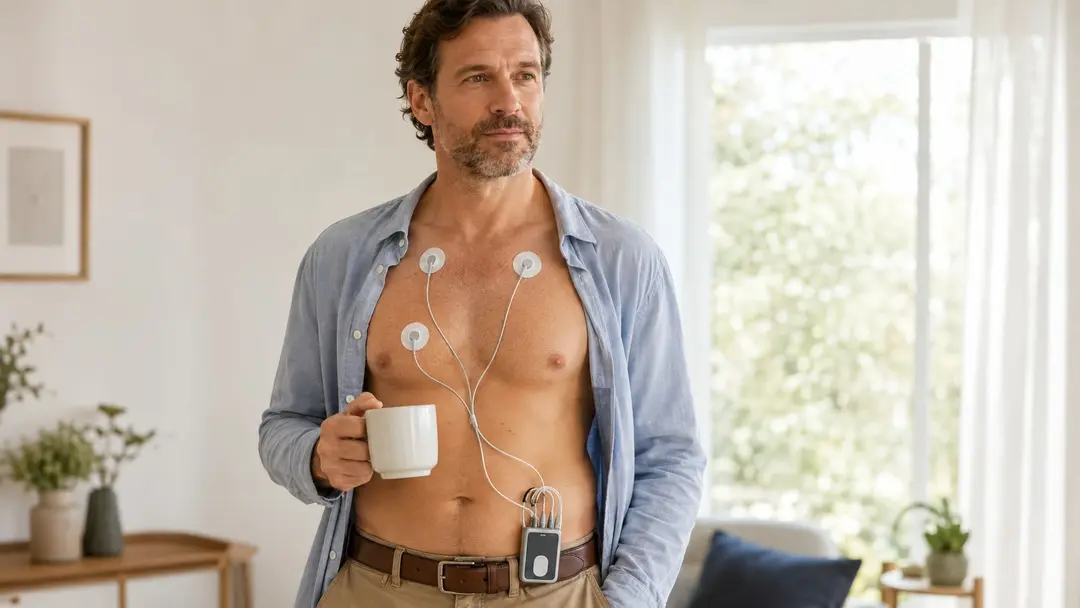
The setup is simple, even if it looks technical at first glance. Sticky electrodes go on the chest, thin leads connect those patches to a small recorder, and the device stores a rhythm strip the whole time you are wearing it. A patient guide for a 48 hour monitor describes that same flow, with electrodes on the chest feeding signals into a small recorder while you go about your day (device instructions).
The two-day window is practical. It gives the heart more time than a brief office ECG, while still staying manageable for everyday life. Standard references describe modern Holter systems as portable recorders that continuously capture cardiac electrical activity for 24 to 48 hours, with some systems extending to 12 to 48 hours across 2 to 3 ECG leads and compact recorders weighing about 190 g in the 2010 Circulation review (NCBI reference).
That middle ground matters when symptoms are intermittent. A two-day recording can include sleep, work, walking around, stress, meals, and the random moments when symptoms usually show up. If the rhythm issue happens during that window, the monitor can catch it. If it does not, the test still gives useful information about timing and next steps.
If you have seen the phrase 48-Hour Holter Monitor online and wondered whether it is basically just a longer ECG, the answer is close. It is longer, continuous, and built to solve a different problem. A quick ECG asks, “What is happening right now?” A Holter asks, “What happens over ordinary life?”
Getting Set Up and Living With the Monitor
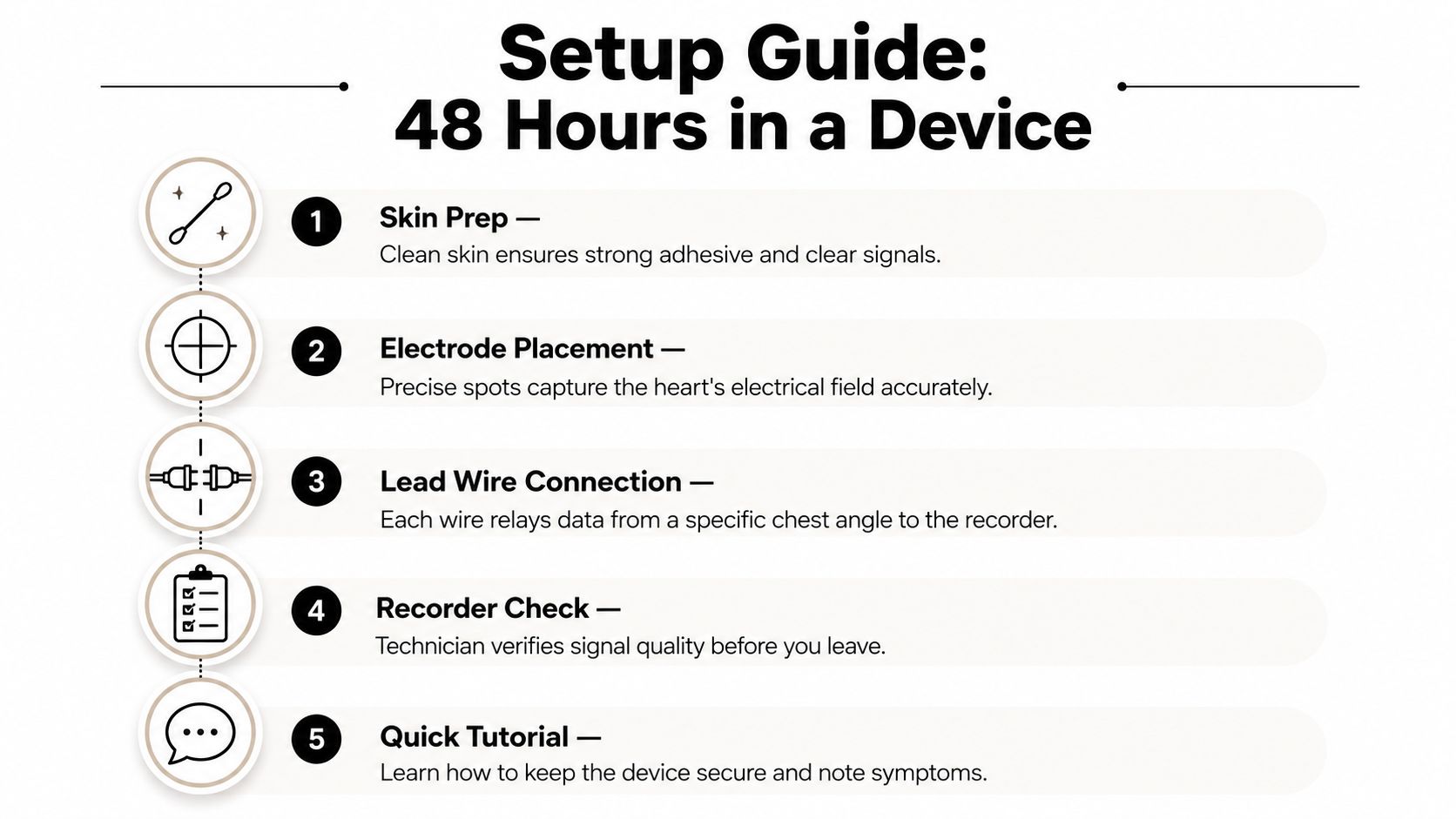
The appointment itself is usually straightforward, but each step has a reason behind it. That's the part people don't always hear. The technician isn't being fussy when they prep your skin or place the leads carefully. They're trying to make sure the recorder gets clean electrical signals instead of static, loosened patches, or gaps.
Why the prep matters
The skin is often wiped before the electrodes go on because clean, dry skin helps the adhesive hold and the signal stay stable. The leads are placed in specific spots so the monitor can read the heart's electrical field from useful angles. The recorder should sit snugly because loose movement can create noise in the tracing.
Practical rule: if the patch starts peeling, the test gets less useful, not because you did anything wrong, but because the signal quality drops.
During the wear period, most guides say to keep the device dry, avoid bathing or swimming, and leave it on day and night unless your care team says otherwise. A Cleveland Clinic guide also notes some practical interference advice, including avoiding standing in front of a working microwave and not sleeping with an electric blanket switched on (Holter instructions).
How to make the diary actually useful
The symptom diary is not busywork. It helps the clinician line up what you felt with what the tracing showed at that exact time. If you get a flutter, note the time. If you feel lightheaded, note the time. If you were climbing stairs, getting out of bed, or lying down when it started, write that down too.
A good way to protect the tracing is to think in small habits. Avoid heavy lotions before the appointment, pat sweat dry if you get warm, and keep the leads from tugging when you dress. Those little things help the monitor stay readable for the full period.
For a practical overview of how monitoring costs are usually discussed in clinics, this resource on Holter monitor cost questions may help you prepare for the conversation. It's the kind of detail people often want to understand before they commit to testing.
What the Test Can and Cannot Catch
You press the symptom-diary button during a sudden flutter, then wonder whether the 48-Hour Holter Monitor will show what happened. Its main job is symptom-rhythm correlation, matching the time you felt something with the heart's electrical pattern at that moment. A normal rhythm during the symptom matters too. It suggests that particular episode may not have come from an arrhythmia and helps narrow the next question.
What it can realistically pick up
The monitor works best for rhythm events that occur during its recording window. It may capture premature atrial contractions, premature ventricular contractions, paroxysmal atrial fibrillation, supraventricular tachycardia, brief bradyarrhythmias, pauses, and temporary ST changes when they happen while you are wearing it. It can also show that your rhythm stayed normal while you felt unwell, which may point the evaluation in another direction.
A symptom diary adds the missing context. Without the time and activity, a tracing can be difficult to match to what you felt.
A Holter answers electrical rhythm questions. It does not by itself assess every cardiac problem, such as structural disease or coronary blockages. A normal recording can therefore be reassuring about the rhythms captured during those hours while still leaving room for other tests if your symptoms or examination suggest them.
What it often misses
The shorter the recording window compared with your symptom pattern, the easier it is to miss the event. Episodes that occur once a week or less may never overlap with the monitor. Earlier monitoring research found that traditional 24 to 48 hour Holter testing can have a limited diagnostic yield, with reported results around 15 to 28%. A review and comparative study also found that a 48-hour Holter identified the rhythm cause in 35% of people with intermittent palpitations, compared with 67% for event recorders.
A missed episode does not mean the monitor failed or that your symptoms were unimportant. It may mean the recording window was shorter than the gap between episodes. Unpredictable fainting, rare racing spells, or symptoms appearing only every few days may need a longer monitoring approach.
The useful question is not whether a Holter is “good” in general. Ask how often your symptom happens. That frequency helps show whether two days gives the test a fair chance to meet the event.
When 48 Hours Is Enough and When It Is Not
The most useful way to think about this test is as a match between symptom frequency and monitor duration. A 48 hour Holter monitor is most sensible when symptoms are daily or close to daily, because the chance of catching the event is much better when it's likely to happen inside the recording window. Expert consensus recommends 24- to 48-hour ambulatory ECG monitoring when daily or reliably reproducible palpitations are expected, because shorter monitoring windows improve symptom-rhythm correlation in that subgroup (expert consensus).
When two days is a reasonable starting point
A 2025 emergency department study of 491 patients found an overall diagnostic yield of 68.2% for ambulatory Holter monitoring, with no significant difference between 24-hour and 48-hour monitoring durations, 66.9% vs 70.7%, p = 0.39 (2025 ED study). That supports a practical idea, if the symptom is already happening often, moving from one day to two may not always change the answer much, but it still gives the clinician more time to link symptoms with rhythm.
This is why 48 hours often works well for near-daily palpitations, exertional symptoms that can be triggered during ordinary activity, and follow-up checks after medication changes or ablation. It gives the doctor a fair sample of your normal routine without jumping straight to a more complex strategy.
When you should push for longer monitoring
If your symptoms are weekly, unpredictable, or frightening enough that you don't want to wait for another short test, longer monitoring deserves a stronger look. The same 2025 study noted that more than one-third of initial arrhythmias in an earlier large single-center experience were recorded only after 48 hours (2025 ED study). Broader monitoring literature also shows that prolonged strategies can capture more events when the first 48 hours are negative.
That's where extended Holter, event recorders, mobile cardiac telemetry, and selected smartphone or wearable ECG devices come in. They're not competing ideas. They're different tools for different symptom frequencies. If the symptom is rare, asking for a longer capture window is often more sensible than repeating the same short test.
If you want to compare those options in plain language, this overview of Holter monitor alternatives is a useful next step. A good question to bring to your prescriber is simple, “How often do you need my symptoms to happen for this monitor to be the right choice?”
Get your ECG checked by certified experts within minutes on the Qaly app.


Reading Your Results and What Comes Next
People often hear “your Holter was normal” and assume that ends the story. It doesn't. A Holter report is really a combination of what the technician processed, what the cardiologist reviewed, and whether the rhythm matched the times you wrote down in your diary. A clean study can mean one of two things, either no meaningful arrhythmia was present during the wear period, or the symptom didn't happen while you were monitored.
How the report is usually interpreted
The technician sorts and checks the recording first. The cardiologist then reviews the tracing for rhythm abnormalities, pauses, fast runs, slow runs, and any time-linked symptoms. If your diary says “fluttering at 8:14 p.m.” and the strip shows normal sinus rhythm, that is still useful information. It tells the clinician the symptom may not be caused by an arrhythmia that day.
If the test does find a cause, the next step can be medication changes, referral for ablation discussion, or more testing depending on what was seen and how you felt. If the study is normal but the symptoms continue, the more logical next step is often longer monitoring or a different device class, not repeating the same short test.
A negative Holter rules out what happened during those two days, not every rhythm problem you could ever have.
There's also a third bucket, urgent findings. If the monitor picks up something serious, the practice may contact you the same day. That's one reason it helps to know where to reach your clinician and to ask when you should expect the report.
What you can request
You can also ask for the actual tracing, not just the summary. That matters if you want a second opinion, if you're collecting records before another appointment, or if you're trying to understand a symptom that still hasn't been fully explained. If you keep having episodes after a normal study, that doesn't mean you're imagining them. It means the monitoring window may have been too short.
For people who want a human-reviewed rhythm option alongside their medical workup, Qaly is one option that accepts Holter recordings and other ECG files for interpretation by certified cardiographic technicians. That kind of review can be helpful when you're trying to compare your own symptom log against the rhythm strip before your next visit.
Common Questions Patients Ask Before and After
The questions that come up most often are usually practical ones. People want to know if they can shower, whether magnets matter, whether the monitor changes driving, and what symptoms are serious enough to skip the routine follow-up path. Those are smart questions, and they deserve clear answers.
The everyday logistics
Most 48 hour monitors need to stay dry, so plan a shower or bath before the hookup and again after the device comes off. Don't submerge the recorder, and don't try to “power through” a wet patch if the electrodes start loosening. Water is one of the easiest ways to ruin a good recording.
Household magnets are a common worry, but modern devices are usually more resilient than people think. Still, it makes sense to avoid MRI rooms and not rest stacked electronics directly on the recorder. If a specific device instruction sheet says something different, follow that sheet.
Driving is another point people ask about. The monitor itself doesn't impair driving, but if you've had fainting or near-syncope, your clinician may give you driving restrictions until they review the cause. Safety comes first there.
When to get urgent help
Some symptoms shouldn't wait for the monitor appointment or a call-back. Get urgent care or call emergency services for chest pain lasting more than a few minutes, sustained rapid palpitations with lightheadedness, sudden severe shortness of breath, fainting, or stroke-like symptoms such as facial droop, arm weakness, or slurred speech. Those symptoms need a real-time medical response, not a diary entry.
If the symptom feels new, severe, or neurologic, treat it as urgent first and diagnostic second.
Sleep position, exercise, work, and travel are usually manageable while wearing the monitor, as long as the device stays attached and dry. If you're traveling with symptoms that worry you, a written plan from your clinician can make the week much easier. For people who like structured follow-up and reminder-based communication, this health care SMS overview is a useful look at how message-based communication is used in care settings.
If you're still wondering whether the test fits your own pattern, the most useful thing you can do before the visit is write down how often the symptoms happen. That one detail often changes the whole decision.
If you've been told to wear a 48 hour Holter monitor, don't just ask whether it's “normal.” Ask whether two days matches your symptom frequency, what a normal result would rule out, and what the next step should be if the fluttering keeps happening. If you want support reviewing the tracing or organizing your symptom notes before your appointment, schedule a visit with your cardiology team and bring your diary, because the most useful answers usually come from matching the strip to the exact moment you felt something.
Still tracking flutters? Certified experts review your ECG within minutes, day or night.


