


Key Takeaways

User Profile
Hello Heart Hero.
You feel a flutter. Then a pause. Then a strange pressure that may be nothing, or may be something you don't want to ignore. A lot of people know this feeling. Your mind starts sorting through possibilities fast: stress, indigestion, poor sleep, anxiety, too much caffeine, or something more serious.
That uncertainty can be harder than the symptom itself.
Many people were taught one simple story about heart trouble: severe chest pain, sudden collapse, obvious emergency. Real life is often messier. Cardiac event symptoms can be subtle, on and off, or hard to describe. They may feel like breathlessness on the stairs, jaw discomfort that seems random, a cold sweat that doesn't fit the moment, or a wave of fatigue that feels out of proportion to your day.
If you've felt dismissed before, you're not imagining that gap. Vague or intermittent symptoms are harder to explain in a short appointment. That's one reason it helps to learn the language of what your body may be signaling.
Welcome to Your Heart Health Journey
A small chest twinge can send your brain in two directions at once. One part says, "Don't overreact." The other says, "What if I miss something important?" Both reactions are human.
People often wait because the symptom isn't dramatic. It comes and goes. It eases when they sit down. It feels more annoying than alarming. But confusing symptoms deserve calm attention, not shame and not panic.
You don't need to prove that a symptom is severe before taking it seriously.
A good starting point is this: your body doesn't always send clear, movie-style warnings. It often sends fragments. A pattern. A sensation that keeps returning. A change in how ordinary activity feels. Learning to notice those details gives you something solid to work with.
That doesn't mean every flutter or ache is a cardiac emergency. It means your experience matters. It means paying attention is wise. And it means understanding cardiac event symptoms can lower fear because uncertainty shrinks when language gets clearer.
Understanding Your Heart's Signals
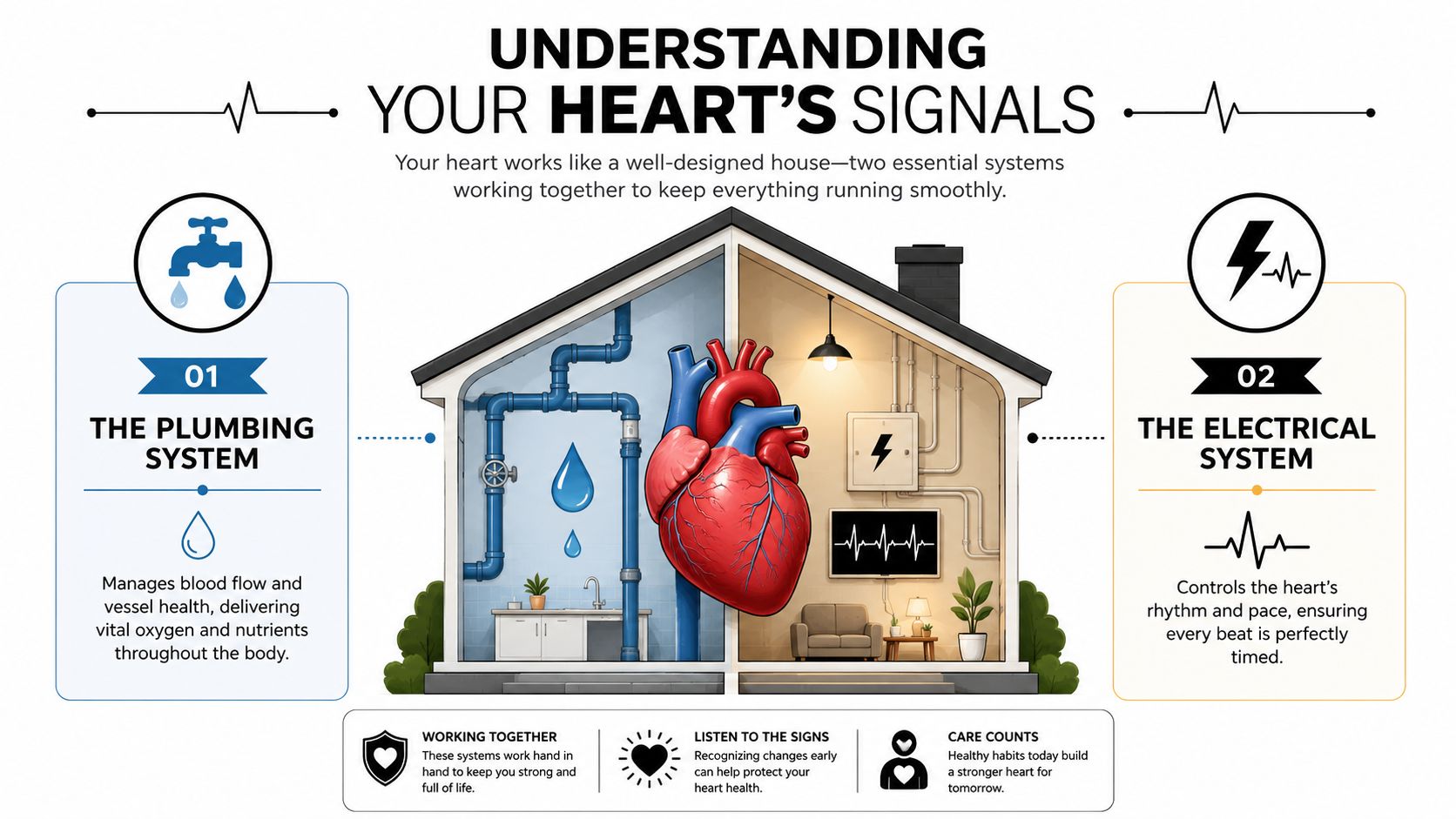
The heart helps to think in two systems. One is plumbing. The other is electricity.
If that sounds simple, good. Simple mental models help when symptoms feel complicated.
The plumbing side of the heart
Your arteries deliver oxygen-rich blood to the heart muscle. When one of those blood vessels becomes blocked, the heart muscle can start to suffer from lack of oxygen. That's a heart attack.
A related issue is angina, which usually means blood flow is reduced rather than fully blocked. People often describe angina as pressure, tightness, heaviness, or discomfort that may show up with exertion or stress and ease with rest. It can be a warning sign that the heart isn't getting what it needs.
A common misunderstanding among many readers is to expect only intense chest pain. But clinical guidance notes that heart attack symptoms can include shortness of breath, nausea or vomiting, cold sweat, lightheadedness, unusual fatigue, and pain that spreads to the jaw, neck, back, arms, or shoulder. In some cases, chest symptoms are mild, intermittent, or absent, as described by Cleveland Clinic's overview of heart attack symptoms.
The electrical side of the heart
Your heart also runs on timing. Tiny electrical signals tell the chambers when to squeeze. If that signal gets disrupted, the rhythm can become too fast, too slow, or irregular. That's an arrhythmia.
Some arrhythmias feel like skipped beats, racing, pounding, or fluttering. Some cause dizziness or a sense that your heart is "acting weird." Others cause few symptoms at all. This is one reason wearables matter. They may catch a rhythm change while it's happening, rather than after the feeling has passed.
At the most dangerous end of the electrical spectrum is cardiac arrest. That's when the heart's electrical system fails so badly that it can no longer pump blood effectively. A heart attack is a circulation problem. Cardiac arrest is a rhythm-and-pumping failure. They aren't the same thing, though one can trigger the other.
If you want a plain-language breakdown of those differences, this explainer on what a cardiac event means can help make the terms less blurry.
Why this distinction matters in daily life
When people say, "I had chest pressure," they may be describing a plumbing problem. When they say, "My heart suddenly raced and then settled," they may be describing an electrical one. Sometimes the overlap is messy. That doesn't mean you're imagining it. It means symptoms need context.
A nearby example is sleep apnea, which can affect how rested you feel and can blur your interpretation of nighttime symptoms. If broken sleep or breathing pauses are part of your picture, looking into non-CPAP solutions for sleep apnea may help you sort out what belongs to sleep disruption and what needs separate cardiac attention.
Recognizing Classic and Atypical Symptoms
The classic image associated with a cardiac event is: pressure or pain in the chest, often described as squeezing, heaviness, or fullness. That still matters. But it isn't the whole story.

A lot of cardiac event symptoms don't announce themselves as "heart symptoms." They show up as things people explain away. Indigestion. A strained shoulder. Being out of shape. Anxiety. A bad night's sleep. That's one reason people delay getting help.
The classic pattern people expect
The traditional warning pattern still includes discomfort in the center or left side of the chest. Public health guidance describes chest discomfort that lasts more than a few minutes or comes and goes. It may feel like pressure, squeezing, fullness, or pain. Shortness of breath can happen too, and it may appear before chest discomfort, according to the CDC's heart attack symptom guide.
Classic symptoms can also radiate. People may feel discomfort moving into the arm, jaw, neck, back, or stomach. The sensation may build gradually rather than hit all at once.
The symptoms people often miss
The less obvious symptom list is where confusion grows. Some people feel:
- Shortness of breath that seems out of proportion to the activity
- Nausea or vomiting that doesn't fit a clear stomach issue
- Cold sweat that appears suddenly
- Lightheadedness or a faint, floaty feeling
- Unusual fatigue that feels different from ordinary tiredness
- Jaw, upper back, neck, shoulder, or arm discomfort without dramatic chest pain
Those symptoms are easy to downplay when they happen one at a time. They become more concerning when they cluster, repeat, or appear with exertion.
A common point of confusion is breathing. People often ask whether they can tell the difference between anxiety, deconditioning, lung issues, and heart-related breathlessness. This guide on what causes shortness of breath is useful when you're trying to put that symptom in context.
Why women and older adults may look different
Women are more likely to have what the CDC calls "other symptoms," including unusual tiredness and nausea or vomiting. The American Heart Association also notes that some women describe upper back pressure that feels like squeezing or like a rope being tied around them. That image matters because it doesn't sound like the classic chest-clutching story many people were taught.
Older adults can also present in less dramatic ways. They may talk about weakness, reduced stamina, breathlessness, or feeling generally unwell rather than naming chest pain first. People with diabetes may have subtler symptom patterns too, which can make self-trust even harder.
Practical rule: If a symptom is new, unexplained, and clearly different from your usual pattern, don't dismiss it just because it doesn't match the movie version of a heart attack.
What skepticism gets right
Some readers are skeptical because they've had symptoms waved off before. That experience can make you second-guess yourself. Skepticism isn't always resistance. Sometimes it's self-protection after feeling unheard.
The answer isn't to assume the worst about every sensation. It's to get more precise. Instead of saying "I felt weird," try identifying the pattern. Was it pressure, burning, tightness, fluttering, breathlessness, nausea, or fatigue? Did it happen at rest or while climbing stairs? Did it spread to the jaw or back? Did it fade and return?
That kind of detail can turn a vague story into a useful clinical one.
Knowing When to Seek Immediate Help
The hardest question isn't usually "What are the symptoms?" It's "At what point do I stop watching and start acting?"
That decision matters because in the United States, someone has a heart attack every 40 seconds, and about half of heart attack deaths occur within one hour of the event, often before reaching a hospital, according to CDC heart attack facts and statistics.
A simple mental checklist
Use this as a decision guide, not a diagnosis tool.
- Check the symptom type
Chest pressure, squeezing, pain that spreads, shortness of breath, cold sweat, nausea, and lightheadedness belong in the high-attention category. - Check whether symptoms combine
One mild symptom can be hard to read. Several symptoms together are more concerning. Chest discomfort plus shortness of breath is different from a brief isolated twinge. - Check duration
Symptoms that last more than a few minutes, or improve and then come back, should not be brushed aside. - Check whether this is new for you
A new pattern deserves more caution than a familiar, fully explained one.
What to do in the moment
If you think you may be having a heart attack, call emergency services immediately. Don't drive yourself. Don't wait to see whether it passes. Don't decide it's "probably stress" if the symptoms fit a concerning pattern.
A lot of people hesitate because they don't want to feel embarrassed if it is a false alarm. That feeling is common. It is still safer to be evaluated than to lose time during a real emergency.
If symptoms are persistent, recurring, or arriving as a cluster, treat that as a reason to escalate.
Questions about aspirin come up often in these moments. The answer depends on the situation and your personal medical history, which is why it's worth reviewing when aspirin is used in a suspected heart attack before an emergency ever happens. It's much easier to think clearly when you aren't making first-time decisions in the middle of fear.
The Challenge of Intermittent and Mild Symptoms
Many people encounter this difficulty. The symptom is real, but it doesn't stay. It doesn't feel dramatic enough for the emergency room. It may even disappear by the time you consider getting checked.
That doesn't make it meaningless.


Why "not bad enough" can be misleading
Authoritative guidance leaves a real gray zone here. Heart attacks can have warning signs hours, days, or weeks in advance, and those warnings may include generalized fatigue, anxiety, and influenza-like symptoms, as described by the American Heart Association's warning signs page. That matters because many people are taught to only look for one dramatic, continuous event.
Mild symptoms can be hard to trust because they overlap with ordinary life. You may feel winded after carrying groceries. You may have nausea on a stressful day. You may wake up tired and blame poor sleep. The problem isn't that these explanations are impossible. The problem is that they can become automatic.
The pattern matters more than the intensity
A brief symptom deserves more attention when it repeats, especially if it follows a pattern.
Consider examples like these:
- The stair test changes: You used to climb one flight without thinking. Now you pause halfway because you feel pressure, breathlessness, or unusual heaviness.
- The discomfort travels: What starts as vague chest or upper body discomfort shows up again in the jaw, neck, shoulder, or back.
- The body sends a cluster: A wave of nausea, sweating, and lightheadedness arrives together, even if the chest sensation is mild.
- Rest doesn't settle the question: The symptom fades, but it keeps coming back over days rather than disappearing for good.
Those are the kinds of details people often forget to mention because each single episode seems too small.
Keep track of what happened, how long it lasted, what you were doing, and what else you felt at the same time.
Why people delay
Delay usually isn't denial in the simple sense. It's often uncertainty mixed with previous experience. Maybe you've been told before that your tests were normal. Maybe you've had anxiety symptoms and now worry no one will take you seriously. Maybe you don't want to spend hours seeking care for something that vanishes by arrival.
Those concerns are understandable. But intermittent cardiac event symptoms can still be clinically important. Fleeting doesn't always mean harmless. Mild doesn't always mean safe.
The most useful mindset is this: treat recurring or unusual symptoms as data, not as a verdict. You don't have to diagnose yourself. You do need to notice the pattern clearly enough to decide when it needs urgent care and when it deserves further monitoring.
Using Wearable Tech for Clarity and Peace of Mind
Intermittent symptoms create a practical problem. By the time you reach care, the flutter, racing, or odd sensation may be gone. That's where wearable devices can help.
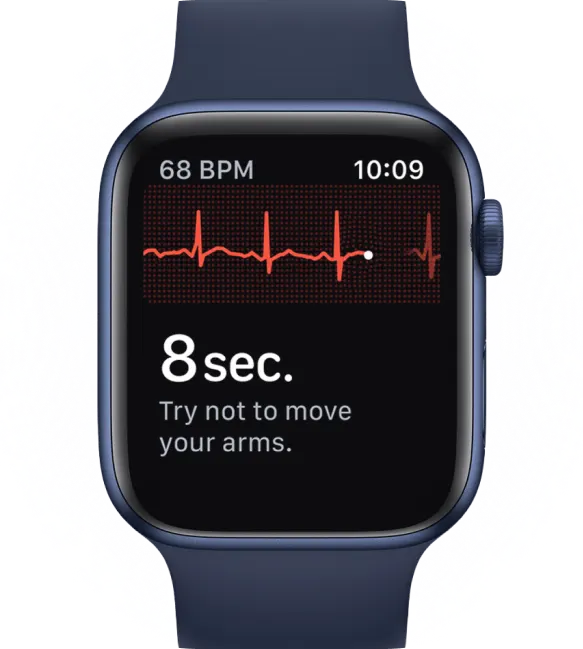
Apple Watch, Fitbit, Kardia, Samsung, and other at-home tools let people capture what their heart rhythm is doing at the moment they feel something unusual. That doesn't replace emergency care for possible heart attack symptoms. It does help when the question is, "What was happening during that episode I couldn't describe well?"
What wearables do well
A wearable ECG can record a single episode in real time. That can be useful for palpitations, skipped beats, racing episodes, or rhythm concerns that come and go. Continuous tracking can also help you spot whether symptoms tend to happen during stress, exercise, poor sleep, or at random times.
If you're trying to understand the broader idea of tracking episodes over time, this guide to continuous monitoring for heart rhythm concerns gives a helpful overview.

What wearables can't do alone
A recording still needs interpretation. A graph on a screen can reassure you, confuse you, or send you searching online for answers that don't fit your exact situation. That's why review matters.
One option people use is Qaly, which reviews wearable and at-home ECG recordings through certified cardiographic technicians and provides interval readings and narrative reports. In practical terms, that can help turn "I felt something weird" into a clearer record you can discuss with a clinician.
Peace of mind comes from context
The value of modern monitoring isn't just the device. It's the combination of timing, symptom awareness, and interpretation. A wearable helps you capture the moment. A careful review helps you understand whether the moment points toward a rhythm issue, a pattern worth discussing, or a reason to seek more urgent care.
For people who feel caught between "it's probably nothing" and "what if I'm missing something," that kind of clarity can make the next step feel less overwhelming.

Caught an ECG during symptoms? Get it reviewed by a cardiac expert and receive a clear, easy-to-understand report with Qaly.



.png)
.png)