


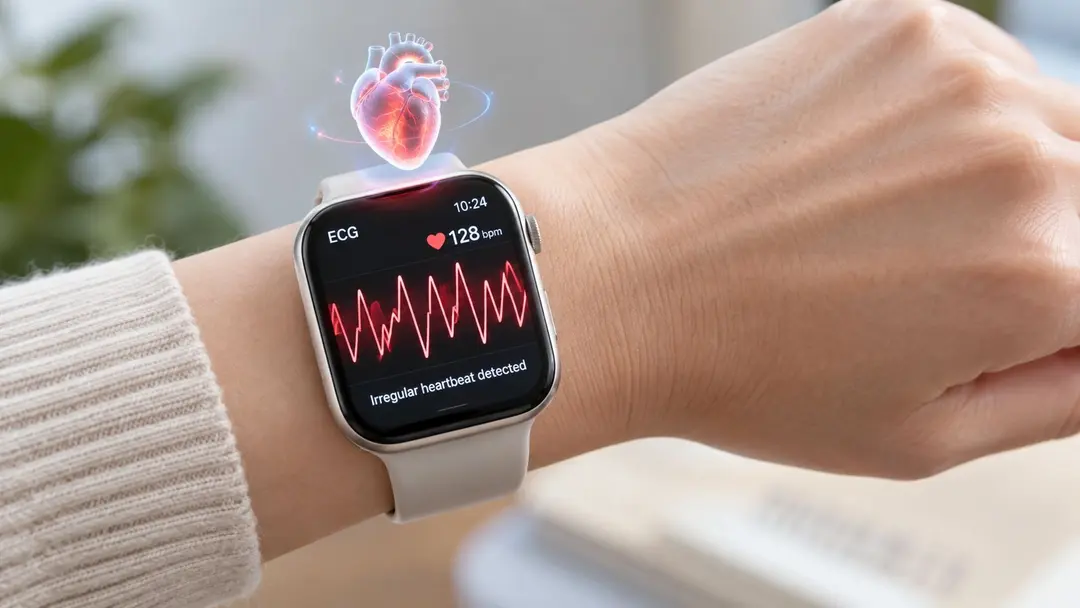


Hello Heart Hero. You're looking at a watch tracing that suddenly looks fast, wide, and uneven, and that can feel like a jolt straight to the stomach. Maybe you felt a thump, a flutter, or a short burst of pounding beats, then snapped a screenshot before the moment passed. If you've already been searching for context, a practical place to start is what raises heart rate with Adderall, especially if medication timing seems tied to the episode.
A wearable strip can't tell you everything, but it can tell you enough to take the rhythm seriously. The goal here is simple, to help you understand what an irregular wide complex tachycardia is, why irregularity changes the diagnosis, and when home monitoring stops being enough.
If you use a one-lead device, the most helpful companion reading is a cardiologist-focused overview of smartwatch ECGs on Qaly's smartwatch ECG guide. Keep that in mind while you read, because this pattern is exactly where a single strip can be useful, and also exactly where it can be misleading.
A Racing Heartbeat Captured on Your Watch
The moment is usually ordinary until it isn't. You check your pulse, open the ECG app, and see a tracing that looks different from your usual rhythm, faster than normal, broader than expected, and uneven enough to make you stop and look twice. That reaction is reasonable, because wide complex tachycardia is one of the higher-stakes ECG patterns in arrhythmia care, and broad categories matter even before anyone names the rhythm (The Cardiology Advisor).
A lot of people go straight to the internet after that first screenshot. Some are worried about anxiety, caffeine, stimulants, or a medication effect, while others are trying to rule out something more serious. If heart rate changes seem linked to a prescription stimulant, the article on what raises heart rate with Adderall can help you think through one possible trigger without jumping to conclusions.
A wearable strip cannot settle the diagnosis by itself, but it can still show whether the rhythm deserves to be watched, logged, or treated as urgent. That is the gap this article fills, with plain language and without pretending a one-lead recording can do the work of a full hospital ECG.
Practical rule: if a wearable strip is fast, wide, and irregular, do not assume it is a harmless SVT until someone has reviewed it carefully.
For people new to smartwatch tracings, a cardiologist-focused overview of how smartwatch ECG interpretation works can make the limits of the device easier to understand. The watch can show rhythm clues clearly, even when it cannot settle the diagnosis on its own.
What Irregular Wide Complex Tachycardia Means
A watch strip can look alarming long before it is fully explainable. Tachycardia means the heart is beating fast, usually above roughly 100 beats per minute. A wide QRS means the lower chambers are taking longer than normal to activate, with QRS ≥120 ms being the practical threshold used in ECG interpretation. For a quick visual on how that width is judged on a wearable tracing, the guide to QRS interval on your watch ECG is a useful companion.
Irregular means the spacing between beats is not steady. One interval may be short, the next longer, then another short again, without a repeating pattern. Put together, irregular wide complex tachycardia describes a rhythm that is fast, broad, and uneven, which immediately points away from a long list of ordinary palpitations and toward a smaller group of higher-risk rhythms.
The key shift is in the pattern itself. Sustained irregular wide QRS tachycardia is described in the literature as almost never ventricular tachycardia in the ordinary monomorphic sense, and the focus turns toward atrial fibrillation with bundle branch block or nonspecific intraventricular conduction block, ventricular preexcitation such as Wolff-Parkinson-White syndrome, or other irregular ventricular rhythms (USP educational PDF).
Working rule: once the rhythm is irregular, the question shifts from “wide equals VT” to “which irregular wide rhythm is present, and does it need urgent attention?”
That distinction matters on a wearable strip. A regular wide rhythm pushes interpretation in one direction, while irregularity opens a different set of possibilities. A one-lead recording may still show the broad pattern clearly, even when it cannot separate every detail needed for a full diagnosis.
The strip can be the first warning sign, not the final answer. It tells you the rhythm is fast and wide-looking, which is enough to take the finding seriously and get it reviewed in the right clinical context.
Get your ECG checked by certified experts within minutes on the Qaly app.


The Three Main Causes Wearable Users Should Know
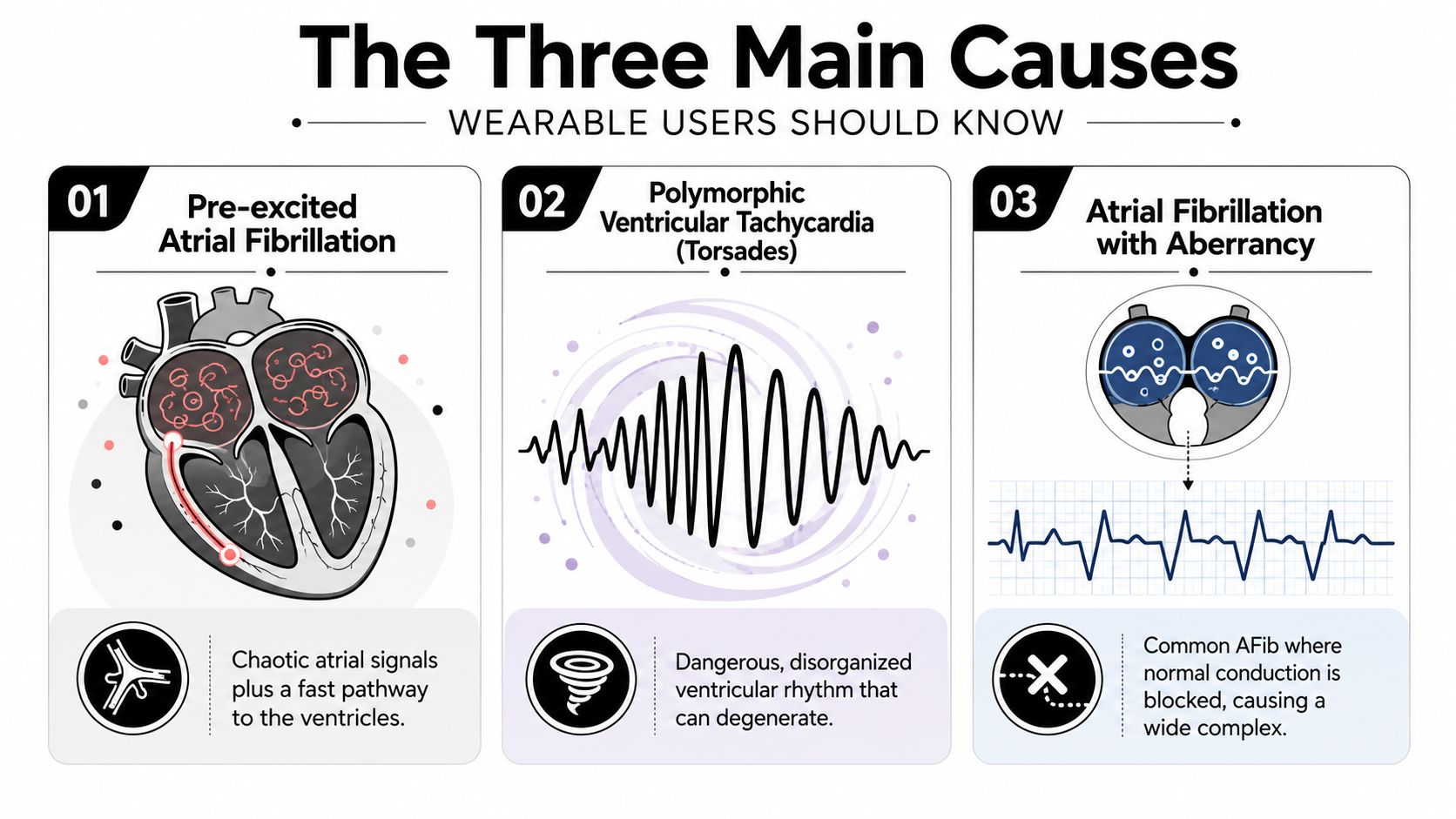
A one-lead watch tracing can make the situation feel more confusing than it is. Once the rhythm is grossly irregular and wide-looking, the list of likely causes becomes short, which is useful when you are staring at a screenshot at home and trying to decide whether this is a pattern to watch or a rhythm that needs urgent review. The main concerns are pre-excited atrial fibrillation, polymorphic ventricular tachycardia, and atrial fibrillation or flutter with aberrancy or variable block (PMC review). That is a much narrower field than the many rhythms that can cause palpitations.
Pre-excited atrial fibrillation
This is the rhythm that often raises the most concern when the heart seems to be racing out of control. The atria fire in a disorganized way, and an accessory pathway gives those impulses a faster route to the ventricles. On a wearable strip, that can look like a storm of uneven, very fast, wide beats. When the ventricular rate exceeds 200 beats per minute, pre-excited atrial fibrillation should be strongly considered (NCBI Bookshelf).
Polymorphic ventricular tachycardia
This is a ventricular rhythm that does not keep one stable shape from beat to beat. On the strip, the complexes may seem to twist or change form, which reflects an unstable lower-chamber rhythm rather than a steady pattern with fixed conduction. It is serious because the problem is not only speed, but also electrical instability in the ventricles.
Atrial fibrillation or flutter with aberrancy
This is the more familiar explanation for many wide, irregular strips. The atria still drive the rhythm, but conduction through the ventricles is slowed or blocked in one branch of the wiring, so the QRS looks wide. The rhythm remains irregular, while the widening comes from delayed conduction rather than from a ventricular rhythm itself.
A useful image review for wearable users is ventricular tachycardia and watch ECGs, because it shows why a watch can raise concern without giving the full answer.
ECG Clues You Can See on a Watch
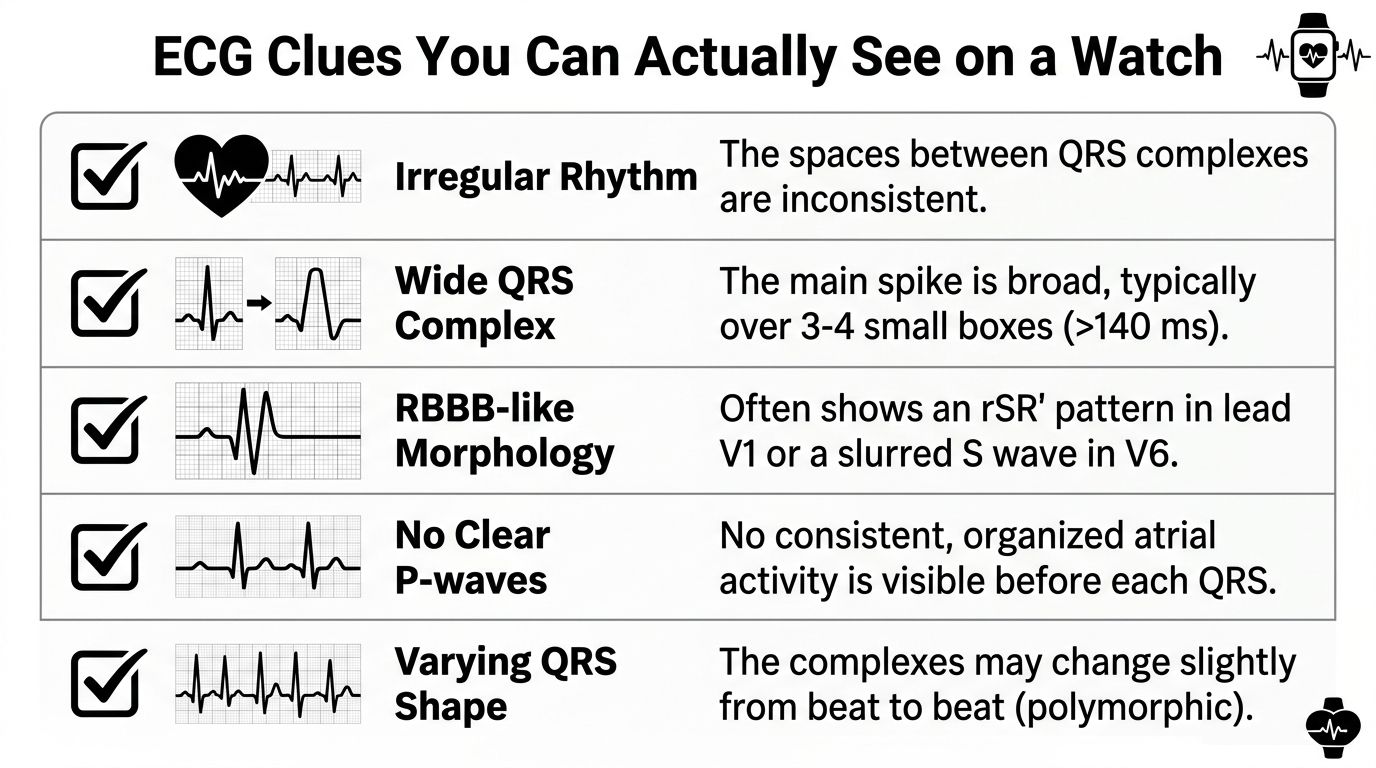
A smartwatch gives you less information than a hospital ECG, but it still gives you useful clues. On a one-lead strip, you can often tell whether the rhythm is irregular, whether the QRS looks wide, and whether the complexes change shape from beat to beat. Those first impressions matter because they help separate a strip that can be saved and reviewed later from one that needs attention now.
What's realistic on a one-lead strip
Some textbook findings need a full 12-lead ECG, and a watch cannot show them well. AV dissociation, precordial concordance, and a precise axis measurement are hard or impossible to assess from a single wearable lead. A clean tracing can still raise or lower suspicion, though, especially if the episode is happening while the recording is taken.
A useful technical anchor is that a normal QRS is under 120 ms, so a wider QRS points to delayed ventricular activation from aberrancy, preexcitation, or ventricular origin (PMC review). On broader ECG interpretation, clinicians also look for no RS complex in any precordial lead, R-to-S interval greater than 100 ms, and QRS duration thresholds that become more suspicious for VT when they exceed 140 ms with RBBB morphology or 160 ms with LBBB morphology (PMC review).
A watch strip is a bit like a hallway glimpse through a partly open door. You cannot see the entire room, but you can still notice whether something is moving too fast, looking irregular, or changing in a way that does not fit a calm, organized rhythm.
What to look for on your own tracing
If you are deciding what to save, start with the pattern you can see, not with a label.
- Irregular spacing: the gaps between beats are uneven, not marching along in a steady pattern.
- Broad complexes: the main spike looks thick or stretched out, not narrow and crisp.
- Shape changes: the complexes may vary from beat to beat, which can happen in polymorphic rhythms.
- Missing clear P waves: you may not see organized atrial activity before each beat.
- Very fast rate: if the rhythm is extremely rapid, especially above 200 beats per minute, concern for pre-excited AF rises.
You do not need every clue to be present for the tracing to matter. A watch can miss P waves, blur the edges of a complex, or make a wide beat look even wider than it really is. That is why a single strip should be treated as a screen, not a final answer.
For a focused walkthrough of wide QRS intervals on consumer devices, R on T ECG is a helpful next read.
What a Wearable ECG Can and Cannot Tell You
A one-lead device can't replace a 12-lead ECG, but it's not useless. It can confirm that the rhythm is fast, that the R-R intervals are irregular, and that the QRS looks wide enough to matter. That alone is often enough to change what happens next, especially if the episode is happening right now and the user is trying to decide whether to wait or seek help.
The trick is to capture useful evidence before the moment passes. Save the rhythm strip, the heart rate shown by the app, and the exact time you felt symptoms. If the episode came with dizziness, chest discomfort, shortness of breath, or a medication change, write that down too, because context can make the strip far more useful than the waveforms alone.
Useful habit: screenshot the strip, then write one sentence about what you felt, what you took, and what happened before the episode started.
Wearable recordings are especially helpful when a human reviewer looks at them in context. Services such as Qaly can add interval measurements and narrative interpretation to consumer ECGs, which gives people a bridge between the raw tracing and what a clinician may want to see later. That matters for users who feel dismissed, because a clean record of the episode is often more persuasive than a verbal description days afterward.
A watch can't answer every question, but it can answer the right first question. Was there an abnormal rhythm at all, and did it happen long enough to capture? If the answer is yes, you've already done the hardest part.
When to Seek Urgent Care Versus When to Monitor
A single watch strip can leave people stuck between two bad choices, waiting too long or rushing for help too quickly. The safest way to sort it out is to focus on how the body is responding, not just on how strange the tracing looks. If the rhythm is paired with fainting, chest pain, severe shortness of breath, or a strong sense that something is seriously wrong, that is not a home-monitoring situation.
Call emergency services now
Seek emergency care if the episode includes any of these features.
- Chest pain: especially if it is new, intense, or spreading.
- Fainting or near-fainting: this suggests the circulation is not tolerating the rhythm.
- Severe shortness of breath: breathing trouble changes the urgency.
- Sustained very fast rate: especially well above 200 beats per minute.
- Impending doom or collapse: trust the symptom, not the app.
A wide, irregular rhythm on a wearable can come and go quickly, but symptoms like these mean the question is no longer about interpretation. The question becomes whether the heart rhythm is affecting blood flow or breathing enough to need immediate treatment.
Contact a clinician soon
A prompt medical review makes sense if the irregular wide-looking rhythm keeps happening, if you have known WPW or structural heart disease, or if symptoms show up during exercise. Repeated events are more informative than a single screenshot, because the pattern across episodes can point toward a specific cause or trigger. A clinician can decide whether the strip needs a full ECG, medication review, or a more formal rhythm workup.
If you are using home support after hours and need someone to assess an episode in person, urgent care for home and hotel may be relevant in some settings, especially when travel feels unsafe.
Log and continue monitoring
Brief, isolated, asymptomatic episodes with a stable surrounding rhythm are different. If the rate is not extreme, symptoms are absent, and the episode ends quickly, it is reasonable to save the tracing and keep watching for recurrence. The goal shifts from dismissal to documentation, capturing enough detail for patterns to emerge.
Be careful with self-treatment guesses. AV nodal blockers can be dangerous in pre-excited atrial fibrillation, so a rhythm that looks irregular and wide should never be assumed safe just because it settled on its own. A watch can record the event, but it cannot choose the right treatment.
Trends, Triggers, and the Bigger Picture Over Time
One tracing can feel frightening, but the pattern across several tracings often says more than a single snapshot. Recurrent uncontrolled irregular wide complex tachycardia has been reported as a cause of tachycardia-mediated cardiomyopathy, meaning repeated episodes can affect heart function if they are missed. That is why the story does not end when the palpitations stop.
Look for reversible triggers
Some irregular wide QRS rhythms are linked to reversible causes. The literature highlights hyperkalemia, sodium-channel blocker toxicity, and severe acidosis as examples that can produce wide complex tachycardia patterns. In everyday life, medication changes, dehydration, vomiting, or a new illness may matter just as much as the rhythm itself.
Wearables help by showing interval trends and how often episodes happen over time. If your device or review service shows repeated episodes on days when a drug dose changed, sleep was poor, or symptoms followed illness, that timeline may help a clinician connect the dots faster. A single snapshot cannot do that job as well.
Bring the pattern, not just the strip
A short note on timing, symptoms, and possible triggers often makes the appointment more useful than a lone PDF. Write down when the episode started, how long it lasted, whether the rhythm looked more irregular or more constant, and whether anything changed beforehand. That gives the clinician a real-world sequence instead of a puzzle with half the pieces missing.
The most useful takeaway is that irregular wide complex tachycardia is not only an emergency pattern, it can also be a monitoring pattern. If it recurs, it deserves follow-up, not just reassurance.
Common Questions About Irregular Wide Complex Rhythms
Does every irregular wide complex rhythm mean WPW? No. Pre-excited AF is important, but the differential also includes AF with aberrancy, polymorphic VT, and other irregular conduction patterns. The rhythm has to be interpreted in context, not guessed from one feature alone.
If the watch looks normal later, does that rule it out? Not really. Many arrhythmias are intermittent, so a normal tracing after the episode only means the episode ended. That's why saving the abnormal strip matters.
How often do episodes need to happen before I should worry? Frequency matters, but symptoms matter more. Recurrent episodes, exercise-related symptoms, or any episode with fainting, chest pain, or severe breathlessness deserves prompt review even if the strip is brief.
Can caffeine, sleep loss, or supplements do this? They can contribute to palpitations or faster rhythms, and some medications or toxins can widen the QRS, but a wearable can't prove the cause on its own. The safe move is to document the timing and let a clinician review the strip if it's wide and irregular.
The hardest part is usually catching the rhythm while it's happening. If you've already done that, you're ahead of the curve, and you've got the one piece of evidence that matters most for the next step.
If your watch has shown a fast, irregular, wide rhythm, don't guess at it alone. Save the strip, note your symptoms and timing, and get it reviewed by a clinician or a human ECG interpretation service as soon as you can, especially if the episode was symptomatic or unusually fast.
Unsure about a fast, wide, irregular ECG? Certified experts review it within minutes.


