


Key Takeaways

User Profile
Hello Heart Hero. You're in a meeting, or sitting in traffic, or finally lying down after a long day. Then it happens. A flutter. A hard thump. A weird pause followed by a stronger beat. Your attention snaps straight to your chest, and your brain fills in the worst-case story before you can catch your breath.
That reaction makes sense. Palpitations feel personal and urgent. They happen inside the part of your body you rely on every second, so even a brief blip can feel very unsettling. If you've tried to explain them to someone and heard “it's probably just stress,” that may have felt dismissive rather than helpful.
You deserve better than vague reassurance.
If you're using a wearable ECG device like an Apple Watch, Fitbit, or Kardia, you already have a tool that can help turn a scary feeling into something more concrete. The goal isn't to self-diagnose. It's to notice patterns, capture what's happening, and bring useful information to a clinician instead of showing up with only a memory of “something felt off.”
_apple.webp)
That Sudden Flutter in Your Chest
It often starts in an ordinary moment.
You're answering an email that already has your shoulders tight. Your phone is buzzing. You haven't had much water. Maybe you had coffee earlier. Then your heart seems to do something strange. Not constant pain. Not always a full racing episode. Just a quick flip, a pound, or a run of beats that feels different enough to make you stop everything.
For many people, the hardest part isn't the sensation itself. It's the uncertainty right after. Was that harmless. Was it anxiety. Was it an arrhythmia. Should you ignore it, or get help right now.
If you've been trying to put words to that feeling, this guide on what heart palpitations can feel like may help you describe it more clearly.
Why this feels so scary
Palpitations are unsettling because they interrupt your sense of control. Your heart is supposed to run in the background, like a good appliance you never have to think about. When you suddenly feel it, your mind locks on.
Then a loop can start:
- You notice one odd beat: Your attention narrows fast.
- You get anxious about it: Your body becomes more alert.
- You scan for every sensation: Normal body signals start feeling louder.
- You worry more: The whole episode feels bigger and more dangerous.
A symptom can be real, uncomfortable, and still be caused or amplified by stress.
That doesn't mean you should brush it off. It means there's a useful middle ground between panic and denial. You can pay attention, gather better information, and make more confident decisions.
Why Stress Makes Your Heart Skip a Beat
Stress affects the heart through the nervous system. A major review in the Journal of the American College of Cardiology found that stress and negative emotions significantly contribute to arrhythmias, including palpitations, through heart-brain interactions that involve catecholamine release and changes in the heart's electrical stability. The same review notes that chronic stress can lead to structural changes in the cardiac nervous system due to persistent sympathetic hyperactivity (review of stress and arrhythmias).
Your body has an alarm system
Think of your nervous system like a home alarm. When it senses danger, it doesn't stop to ask whether the threat is a barking dog, a work deadline, an argument, or a true emergency. It switches into alert mode.
That alert mode releases stress chemicals that prepare you to act quickly. Your heart may beat faster. It may beat harder. Sometimes the timing of the beats feels more noticeable or less smooth.
That's where stress induced palpitations can show up.
Your heart runs on electricity
Your heart isn't just a pump. It's also an electrical system. Signals move through it in an organized sequence, telling different parts of the heart when to squeeze. Most of the time, that rhythm is steady and beautifully coordinated.
Stress can act like someone revving a car engine while it's in park. The engine works. The car isn't broken. But the sudden surge changes how it feels and sounds.
When your body is on high alert, you may notice:
- A skipped feeling: Often this is the sensation of an early beat followed by a stronger one.
- A fluttering feeling: The rhythm may feel shaky or jumpy for a moment.
- A pounding feeling: The beat may be normal in pattern but stronger and more noticeable.
For some people, these episodes happen during obvious tension. For others, they happen later, when the body is still carrying the stress from earlier in the day.
Practical rule: A sensation can come from a stressed nervous system even when you're sitting still.
That's one reason people get confused. They think, “I'm on the couch. I'm not stressed right now.” But the body may still be running on leftover adrenaline from hours before.
If you want a deeper look at that mind-heart connection, this article on whether anxiety can cause arrhythmia gives helpful context.
Is It Just Stress or Something More Serious
This is usually the question underneath every other question.
A wearable can help, but first it helps to know what tends to fit a stress pattern and what deserves urgent medical attention. Stress and anxiety account for 15% to 31% of all palpitation cases, making psychological factors a leading non-cardiac cause. The same analysis notes that in people presenting with palpitations, less than half have underlying heart disease, and among the remainder, about one-third stem from psychological causes like anxiety (FibriCheck on stress versus rhythm conditions).

Clues that lean toward stress
Stress-related palpitations often have a pattern. They may show up during conflict, deadlines, public speaking, poor sleep, or after stimulants like caffeine. They may also come with sweating, shakiness, or a sense of nervous energy.
Common clues include:
- A clear trigger: The episode starts during emotional strain, tension, or overstimulation.
- A short run: The sensation is brief and settles when your body calms down.
- No pain: It feels alarming, but not typically painful.
- A familiar pattern: It happens in situations where you already know your stress runs high.
Clues that need prompt medical attention
Some symptoms shouldn't be filed under “probably stress.” If palpitations come with more serious warning signs, it's important to get medical help promptly.
Seek urgent care if palpitations happen with:
- Chest pain: Especially if it feels intense, new, or concerning.
- Fainting or near-fainting: Losing consciousness changes the picture.
- Severe shortness of breath: Not just mild awareness of breathing, but true distress.
- Prolonged dizziness: Feeling like you may pass out, or struggling to stay steady.
If your gut says, “This is different,” listen to that feeling and get checked.
That's not fear talking. That's good self-protection.
Stress management still matters
Even when stress is the likely trigger, it deserves attention. Ongoing stress can affect blood pressure and overall heart health. Some people also use broader tools to understand how stress may be affecting their cardiovascular system, such as digital stress monitoring for hypertension patients, especially if they're trying to connect symptoms with daily patterns.
The key point is simple. “Likely stress-induced” does not mean “imaginary.” It means your nervous system may be driving real symptoms, and those symptoms are worth understanding.
How Your Watch ECG Can Help You Get Answers
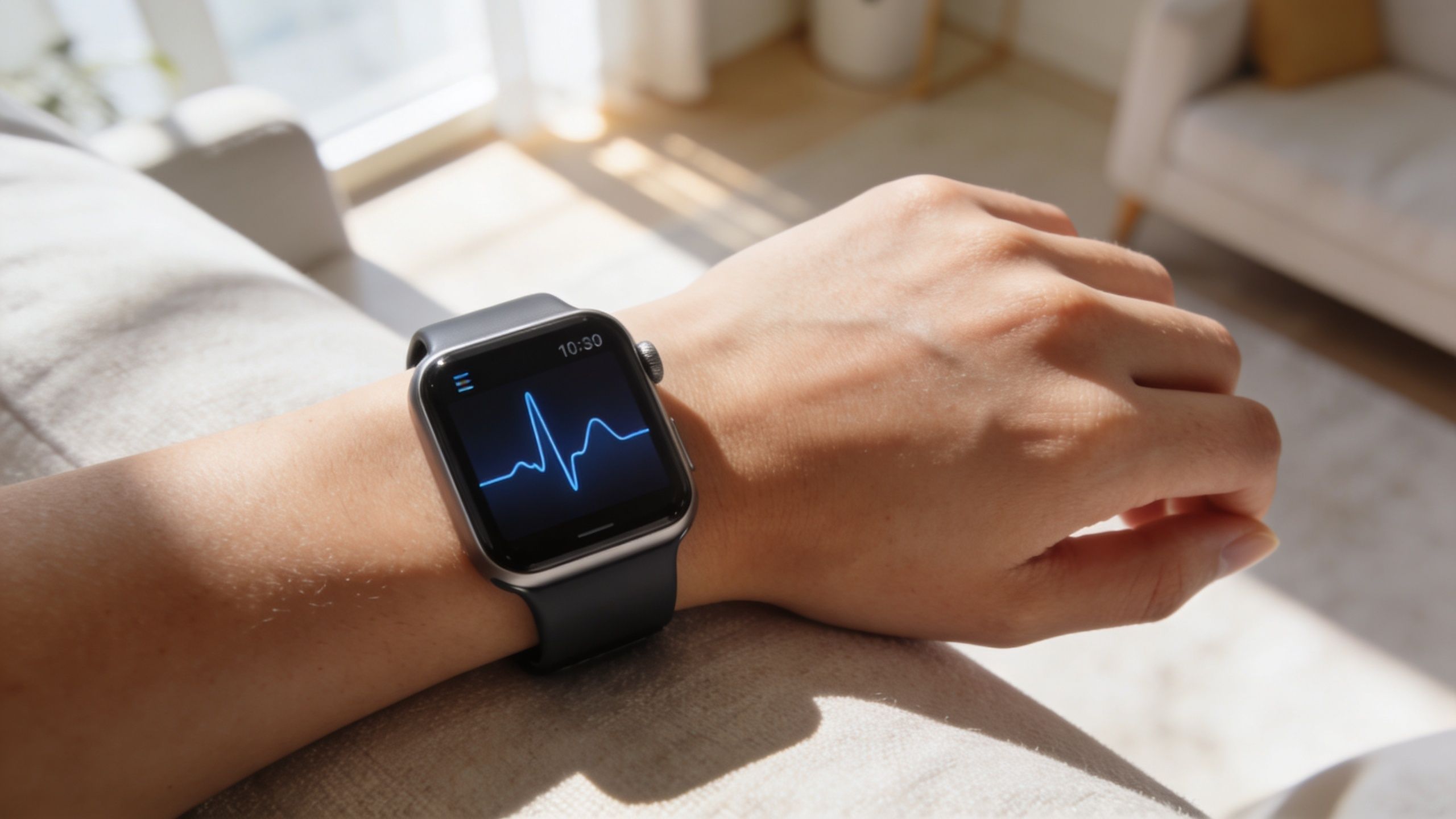
A symptom that happens at home can be hard to explain later. That's where a wearable ECG becomes useful. It gives you something more objective than “my chest felt weird for a few seconds.”
There's a real guidance gap here. Many people don't know how to use wearable ECGs to tell the difference between stress-related events and rhythms that may need follow-up. Guidance from Reddy Cardiology on stress and wearable ECG interpretation highlights that users often feel anxious because they don't know how to understand readings like PR, QRS, and QTc, even though those clues can help distinguish benign stress-related events from rhythms that deserve medical review.
Capture the episode, not just the memory
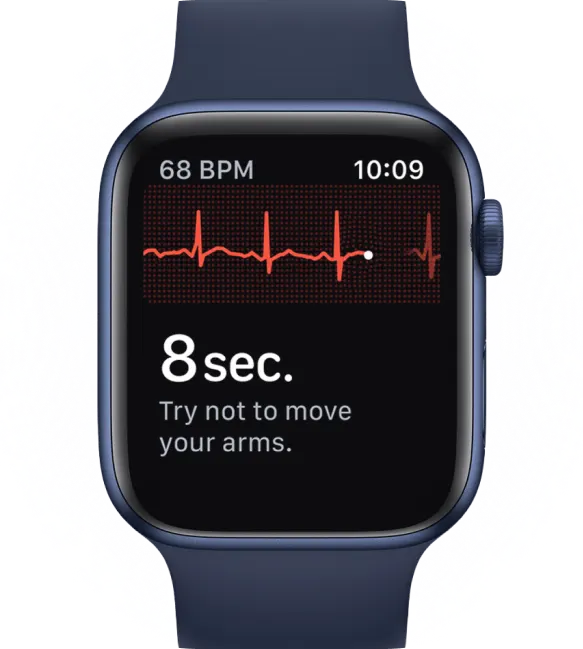
If your device supports ECG, the best time to record is while the palpitation is happening or as close to it as possible after it starts. A reading taken an hour later may look normal, because the event has already passed.
Use this simple approach:
- Pause and sit down if you can
Movement adds noise to the tracing. Rest your arms and try to stay still. - Start the ECG right away
Don't spend time wondering whether this is the “right” moment. If you feel symptoms, record. - Note what was happening
Write down a few words: stressful call, poor sleep, coffee, argument, workout recovery, lying in bed. - Notice your symptoms without dramatizing them
Fluttering, pounding, skipped beat feeling, dizziness, chest pain, shortness of breath. Keep it factual. - Save the tracing
Don't rely on your memory. Keep the ECG strip and any symptom notes together.
What your wearable can and can't do
A single-lead wearable ECG is helpful, but it isn't the same as a full clinic workup. It can capture timing, rhythm, and certain interval clues. It cannot answer every question by itself.
That matters because people often make one of two mistakes:
- They overread a normal-looking tracing and panic over every wiggle.
- They underread an abnormal pattern and assume stress explains everything.
A better approach is to treat the tracing as evidence, not as a final verdict.
What to pay attention to
You don't need to become your own cardiology technician, but it helps to know the basic names.
- PR interval: This reflects how the electrical signal travels from the upper chambers toward the lower chambers.
- QRS duration: This shows how the lower chambers activate.
- QTc interval: This helps describe how the heart's electrical system resets between beats.
Those labels may sound technical, but they are part of the timing story. If your app or review service provides them, they can make a doctor visit far more productive.
A saved ECG strip beats a vague description every time.
If you use an Apple Watch, this guide to an ECG app for Apple Watch can help you understand how people use wearable recordings more effectively.
Practical Ways to Manage and Prevent Palpitations
Once you know stress may be part of the picture, the next step is calming the body in the moment and lowering the chance of repeat episodes later. You don't need a perfect lifestyle overhaul. You need a few reliable tools you'll use.


What to do during an episode
Start with your nervous system. If the episode is stress-related, calming the alarm signal can help shorten the spiral.
Try this in the moment:
- Slow your breathing: Breathe in gently, pause, breathe out longer than you breathed in. The longer exhale tells your body it's safer now.
- Relax your shoulders and jaw: Many people hold tension there without noticing. Releasing it can interrupt the stress loop.
- Sit instead of pacing: Walking in circles can make you more aware of the pounding.
- Avoid repeated pulse checking: Checking once for awareness is fine. Checking every few seconds often fuels more anxiety.
- Take an ECG if your device allows it: A recording can give you something concrete instead of leaving you stuck in guesswork.
What reduces episodes over time
Preventing stress induced palpitations usually means lowering the overall strain on your system. Small habits matter because they reduce how often your body flips into overdrive.
A few high-value changes:
Sleep steadies the system
Poor sleep makes everything feel louder, including heartbeat sensations. If your palpitations tend to hit at night or the next day after bad sleep, that pattern is worth taking seriously.
Caffeine and alcohol can muddy the picture
Some people tolerate them well. Others notice a clear connection between stimulants, dehydration, and palpitations. You don't have to assume they're always the cause, but it helps to track whether they show up before episodes.
Hydration is simple but important
When you're stressed, it's easy to forget water and run on coffee. That combination can leave you feeling shaky and more aware of your heartbeat.
Gentle movement helps
Regular walks, stretching, and light exercise can help discharge stress instead of letting it pile up. You don't need punishing workouts. Consistency matters more.
Helpful reminder: The goal isn't to “never feel your heart again.” The goal is to understand the pattern and reduce the unnecessary alarms.
If fluttering is your main symptom, this guide on how to stop heart fluttering may give you a few more practical ideas.
Keep a trigger log
A short note on your phone can reveal more than you think. Track:
- Time of day: Morning, afternoon, bedtime
- What happened before it: Stress, caffeine, missed meal, poor sleep
- What it felt like: Flutter, pounding, skipped beat, racing
- How long it lasted: Brief, on and off, persistent
- Anything that helped: Breathing, rest, hydration, no clear effect
Patterns reduce fear. When you can say, “This often happens after a tense afternoon and fades when I slow down,” the sensation usually becomes less mysterious.
Partnering With Your Doctor for Lasting Peace of Mind
A medical visit goes better when you bring data, not just distress.
Instead of saying, “My heart felt weird a few times,” you can say, “Here are the ECGs I captured, here's what I felt, and here's what was happening around the time.” That changes the conversation. It gives your clinician something to review, compare, and act on.
What to bring to the appointment
Bring a short, organized summary:
- Your saved ECG strips: Especially recordings taken during symptoms
- A symptom list: Fluttering, pounding, skipped beats, dizziness, breathlessness
- Trigger notes: Stress, caffeine, lack of sleep, alcohol, illness, medications
- Timing patterns: Random, evenings, during meetings, after meals, at rest
This kind of preparation can save time and make you feel less dismissed.
Be a clear partner, not a passive patient
Ask direct questions. What rhythm do you think this is. Do these ECGs look benign. What symptoms would make you want me to seek urgent care. Should I keep tracking this.
You don't need to know everything. You just need enough information to stop feeling lost.

Want a second opinion on a wearable ECG? Qaly offers human review of recordings from Apple Watch, Kardia, Fitbit, Samsung, and more.



.png)
.png)