


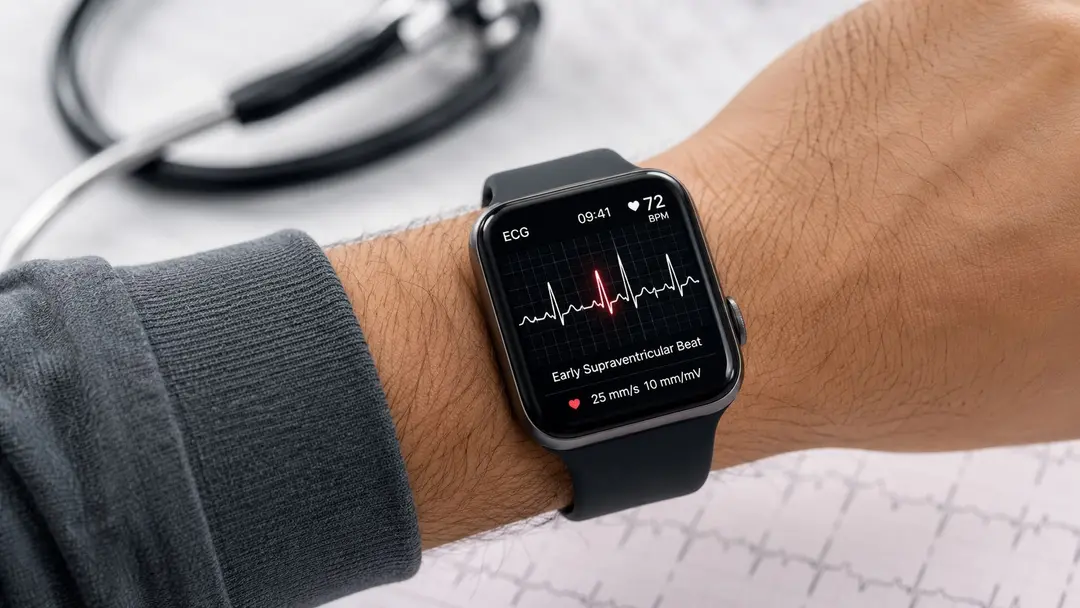


Hello Heart Hero. You're sitting there, phone in one hand and watch on the other, because a tiny flutter just showed up on a strip that used to look boringly normal. That little shift can be unsettling fast. A skipped beat can feel like your body sent you a message in a language you don't speak yet, and the good news is that this one has a clear translation.
Supraventricular ectopic beats are one of the most common reasons a wearable ECG suddenly looks unfamiliar. In plain language, they're early beats that start above the ventricles, usually in the atria or the AV junction, and often they turn out to be a harmless quirk rather than a crisis. A foundational review reports supraventricular premature beats in 10% to 20% of people younger than 20, 30% to 60% of people aged 20 to 60, and 90% of people older than 75, with fewer than 100 per 24 hours in people without evident heart disease (PubMed review). If that number startled you, take a breath. Common doesn't mean meaningless, but it does mean you're not alone.
If the fluttering feeling is making you spiral, the Refresh Psychiatry & Therapy panic attack guide can help separate the physical jolt from the fear that often follows it. And if you've already got a watch tracing in front of you, this heart fluttering guide is a useful companion while you're figuring out what your body is doing.
That Flutter You Just Felt on Your Watch
It usually starts the same way. You're checking a watch ECG after a weird thump in your chest, and the line shows one beat that arrived too early. Your brain jumps to the worst interpretation first, because that's what anxious brains do. A calm read of the rhythm often tells a much simpler story.
Supraventricular ectopic beats are early beats that begin in the upper part of the heart's electrical system. They can feel like a skip, a flip, a thud, or a brief reset. Most of the time, the heartbeat settles right back into place after that one early pulse.
Practical rule: one odd beat is data, not danger. The pattern matters more than the moment.
The phrase sounds technical, but the idea is not. “Supra” means above, “ventricular” points below the atria, and “ectopic” just means out of place. That's why these beats are often discussed alongside other palpitations, yet they don't behave like the more alarming rhythms people usually picture.
A lot of readers also worry that any extra beat means a broken heart. That's usually not the case. The key question is whether the beat is isolated, clustered, or showing up so often that it starts to change the larger rhythm picture.
If the watch strip made your stomach drop, that reaction is real. The rhythm strip may be simple, but the feeling it creates isn't.
For anyone who wants a calmer framework for the next few minutes, it helps to think in layers. First, what is the beat. Second, how does it look on ECG. Third, what tends to trigger it. Fourth, when does it matter. Fifth, how do wearables fit in. Sixth, what should you bring to a clinician conversation if the pattern keeps showing up.
What Supraventricular Ectopic Beats Actually Are
Your heart normally follows one electrical lead, the sinus node, which acts like the body's built-in timekeeper. When that pacemaker fires on schedule, the upper chambers and lower chambers move in a tidy sequence. A supraventricular ectopic beat happens when a different spot fires early, but the impulse still travels through the usual wiring.
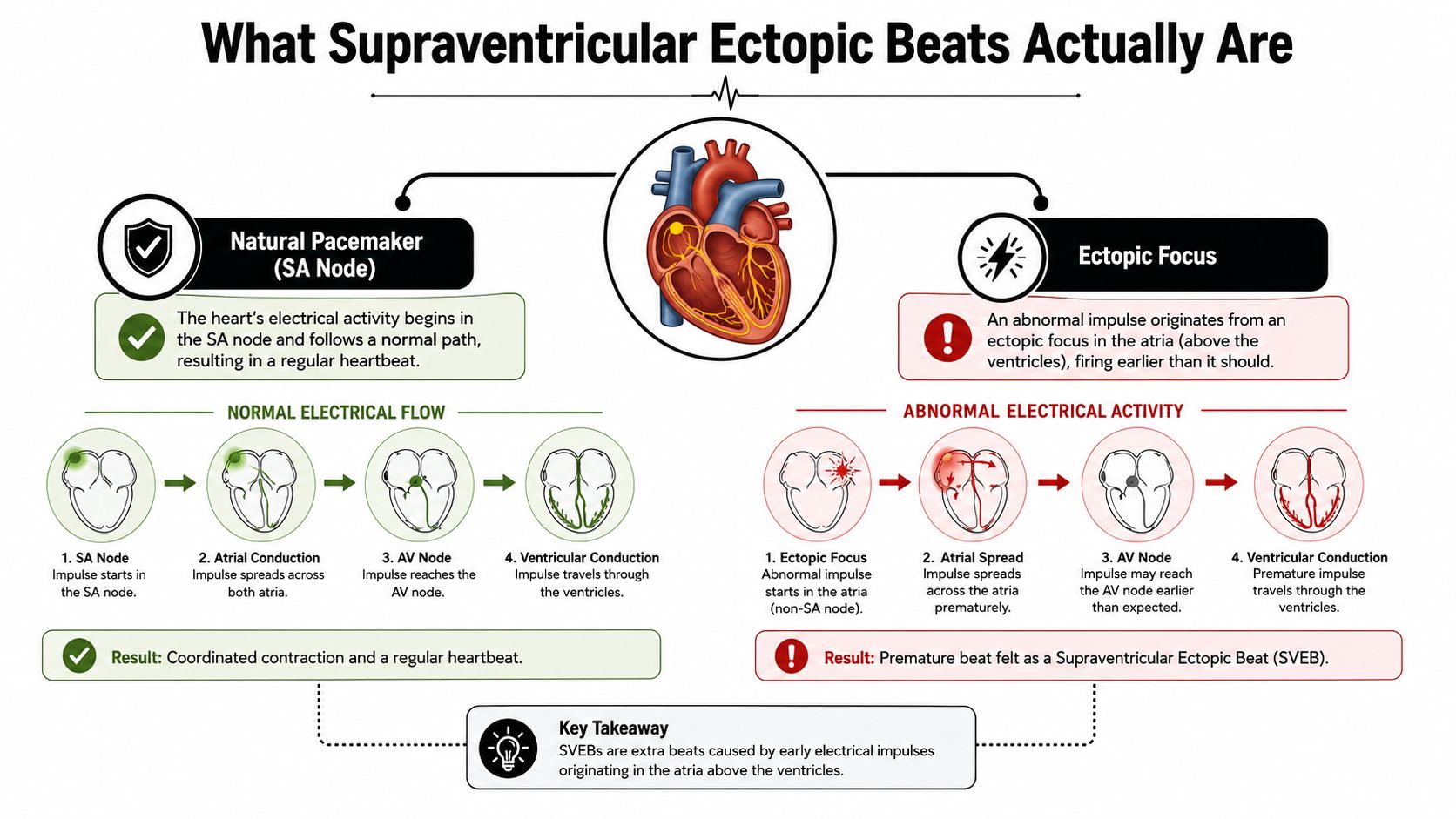
A light switch being flipped from a side room instead of the main hall. The light still comes on through the same house wiring, but it turns on a little early and from the wrong spot. That's why these beats are called ectopic, and why they can feel odd without automatically meaning something dangerous.
The family includes two main players. Premature atrial contractions, or PACs, start in the atria. Junctional premature beats start near the AV junction. Clinicians group them together because both arise above the ventricles, both usually keep the QRS narrow, and both are often benign when they show up on their own.
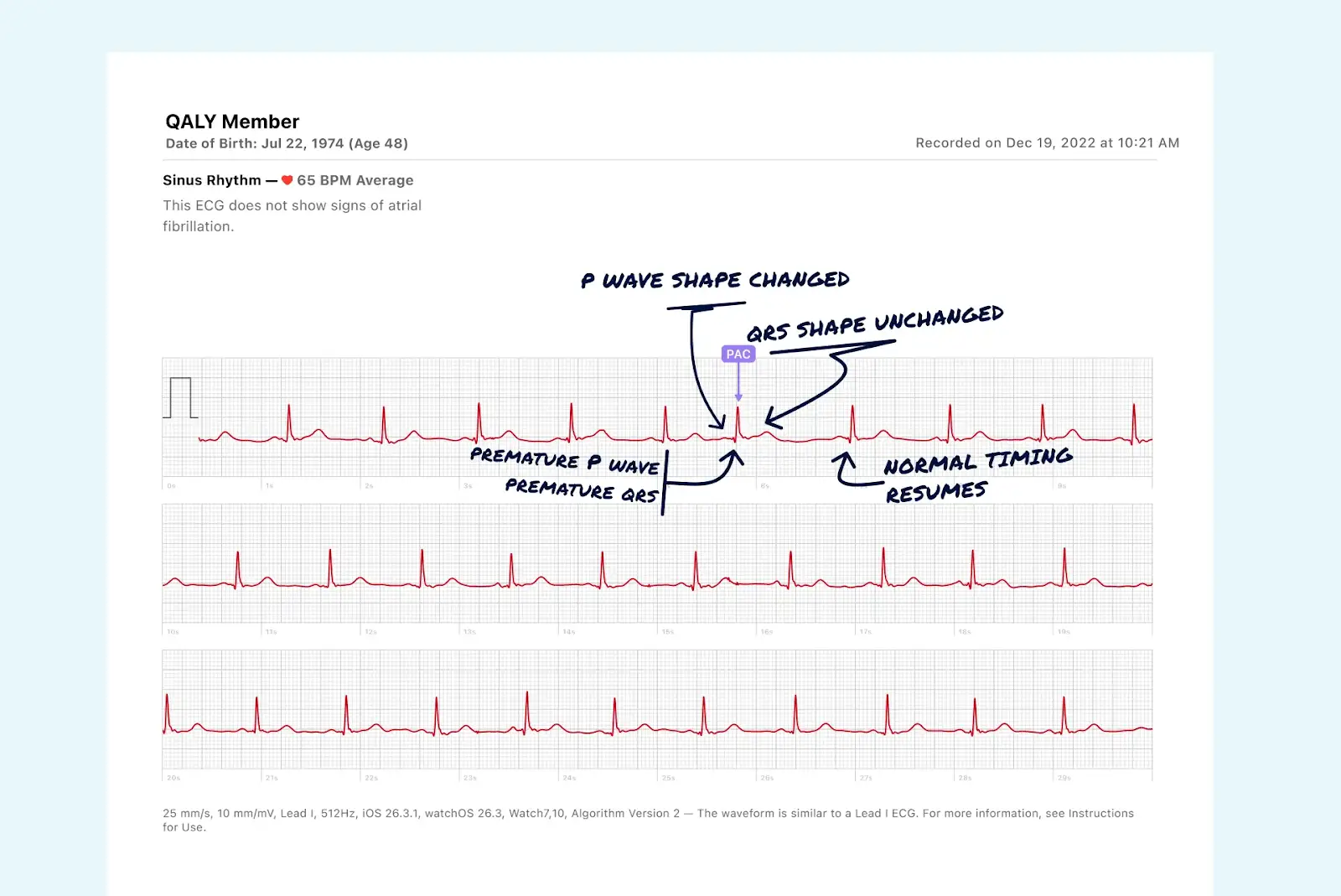
The ECG pattern follows that logic. Merck Manual notes that supraventricular ectopic beats usually appear as a premature atrial or junctional depolarization, with a QRS that's typically narrow and similar to sinus rhythm. If the focus is atrial, the P wave often looks different. If it is junctional, the P wave may be buried in the QRS or appear after it (Merck Manual).
That's the core idea behind the label. The beat is early, but it's still using the normal highway. For a plain-language extension of this pattern, this ectopic beat burden guide is a useful companion if you're trying to connect one beat to the bigger daily pattern.
How They Look on a Wearable ECG
On a watch ECG, the easiest clue is timing. One beat shows up before you expected it, then the rhythm resumes. The QRS is usually still narrow, so the spike doesn't look wildly different from the surrounding beats.
That matters because a lot of readers confuse PACs with PVCs. PVCs usually create a wider, stranger-looking QRS because they start in the ventricles and use a different electrical path. Supraventricular ectopic beats usually don't do that. They borrow the normal conduction system, so the beat can look nearly normal except for its early arrival and the P wave detail around it.
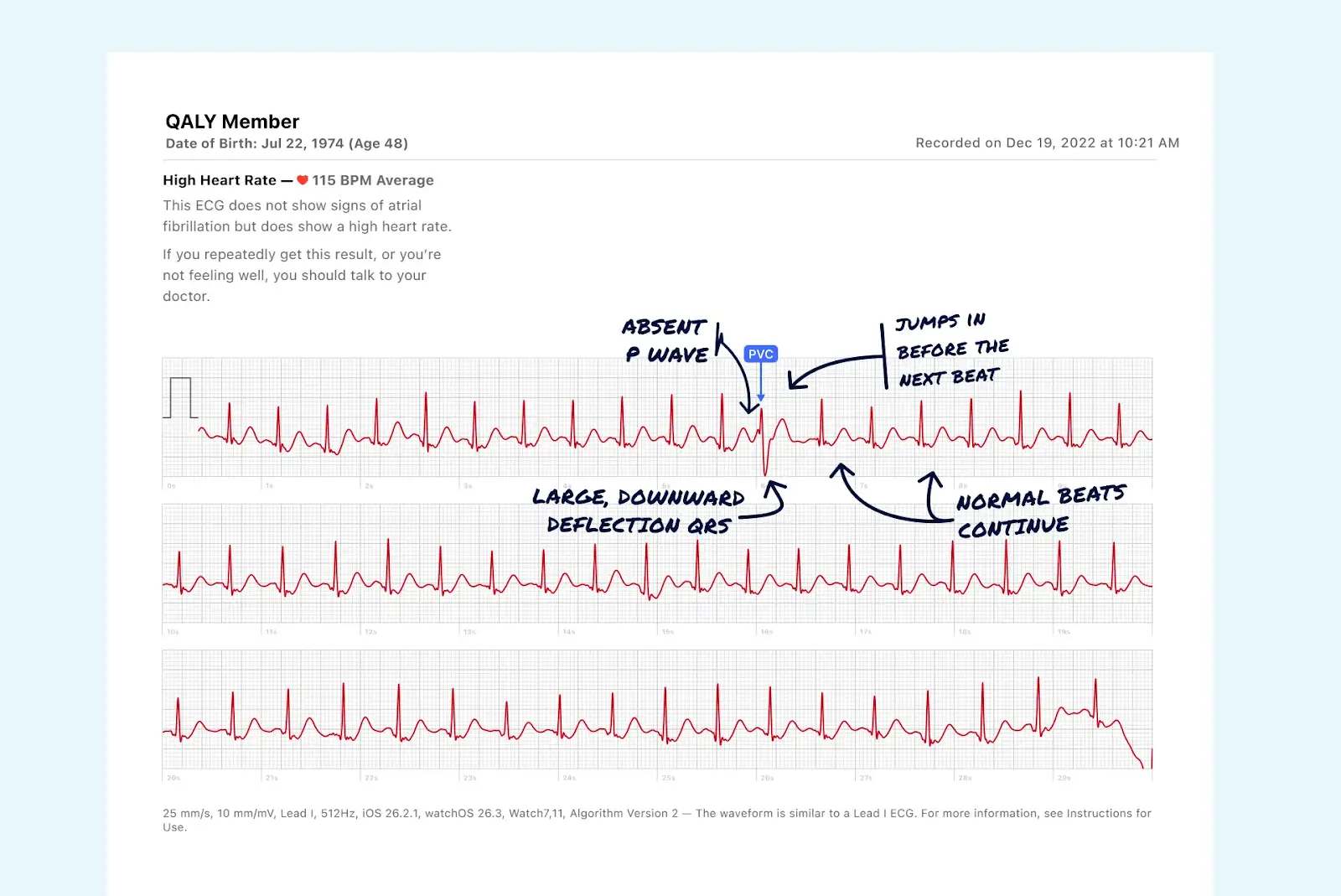
Classic research criteria also describe a coupling interval that is 70% or less of the mean baseline RR interval, a QRS duration under 0.11 seconds unless aberrancy is present, and a noncompensatory pause afterward (research ECG criteria). On a wearable, that pause can feel like the heart briefly resets before picking up the regular rhythm again.
Quick read: early beat, narrow QRS, odd or hidden P wave, brief pause after. That pattern points more toward supraventricular ectopy than a ventricular one.
For a watch-specific visual guide, this smartwatch ECG explainer can help you compare a clean PAC strip with what your own device is showing.
Common Triggers and Underlying Causes
A lot of supraventricular ectopic beats show up because the atria are a little more excitable that day, not because the heart is broken. For many wearable users, the trigger sits in ordinary life, not in a dramatic diagnosis.
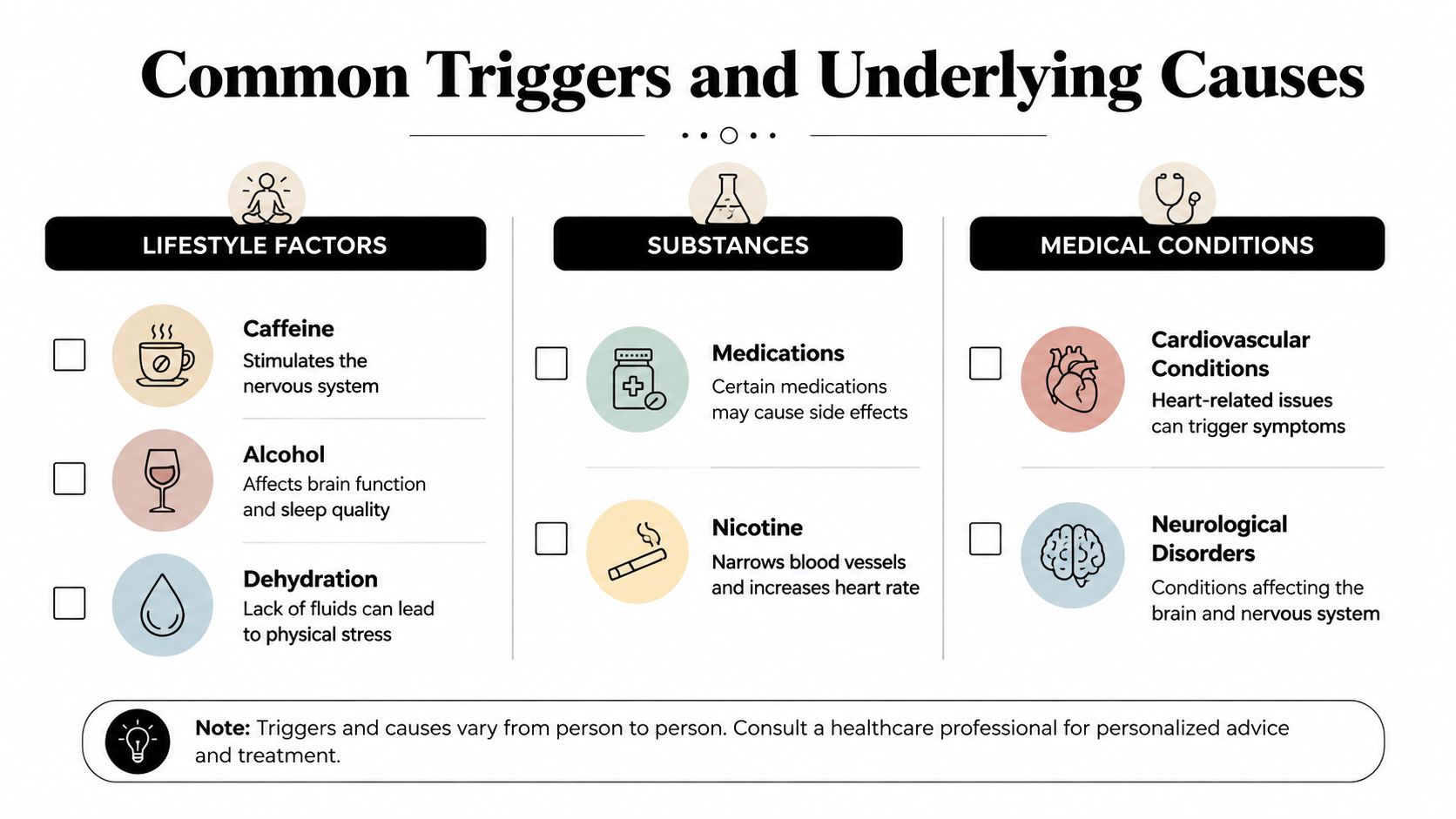
Everyday triggers that often show up first
Caffeine, alcohol, dehydration, poor sleep, and intense exercise can all make the heart feel more irritable. Stress and anxiety do the same thing by turning up the body's internal alarm system. Menstrual cycle shifts can also change how symptoms are perceived, and many people notice their palpitations more during hormonal swings.
The important part is proportion. For individuals checking a watch ECG, one of those day-to-day inputs explains the episode better than a hidden emergency does. That doesn't make the symptom imaginary. It just means the trigger may be familiar once you start tracking it.
If the rhythm changes after a rough night, a hard workout, or a stressful meeting, don't ignore the pattern. Write it down.
Medical contributors still matter, but they're not the first guess
Electrolyte imbalance, thyroid changes, certain medications, and structural heart issues can all contribute too. Those possibilities deserve attention when beats are frequent, persistent, or paired with other symptoms. They're part of the reason clinicians take a pattern seriously instead of treating every flutter as harmless.
A large synthesis cited in a clinical article reported supraventricular ectopy becoming more frequent across childhood and adolescence, reaching about 25% in late adolescence in one set of monitoring data (clinical synthesis). That gradual rise with age matches what many people notice in real life. A watch that barely flagged anything in the past may suddenly start catching more early beats in the late 30s, 40s, and beyond, and that shift can be completely consistent with normal aging.
For readers who want help separating stress from rhythm problems, this stress-induced arrhythmia resource is a practical place to compare symptoms with common triggers.
When Supraventricular Ectopic Beats Matter
A few isolated PACs on a quiet afternoon usually are not the kind of finding that should send you into panic mode. The picture changes when the beats become frequent, come in clusters, or repeat in a recognizable pattern. In research, excessive supraventricular ectopic activity, or ESVEA, is often defined as 30 or more PACs per hour or runs of 20 or more consecutive PACs (ESVEA definition).
That line matters because it shifts the finding from ordinary extra beats into a pattern clinicians watch more closely. A Circulation cohort reported that atrial fibrillation occurred at 37.1 per 1,000 person-years in people with ESVEA versus 9.1 per 1,000 person-years in those without it. The same study linked each increase of 10 supraventricular ectopic complexes per hour with a 27% higher risk of death or stroke and a 50% higher risk of atrial fibrillation (Circulation cohort).
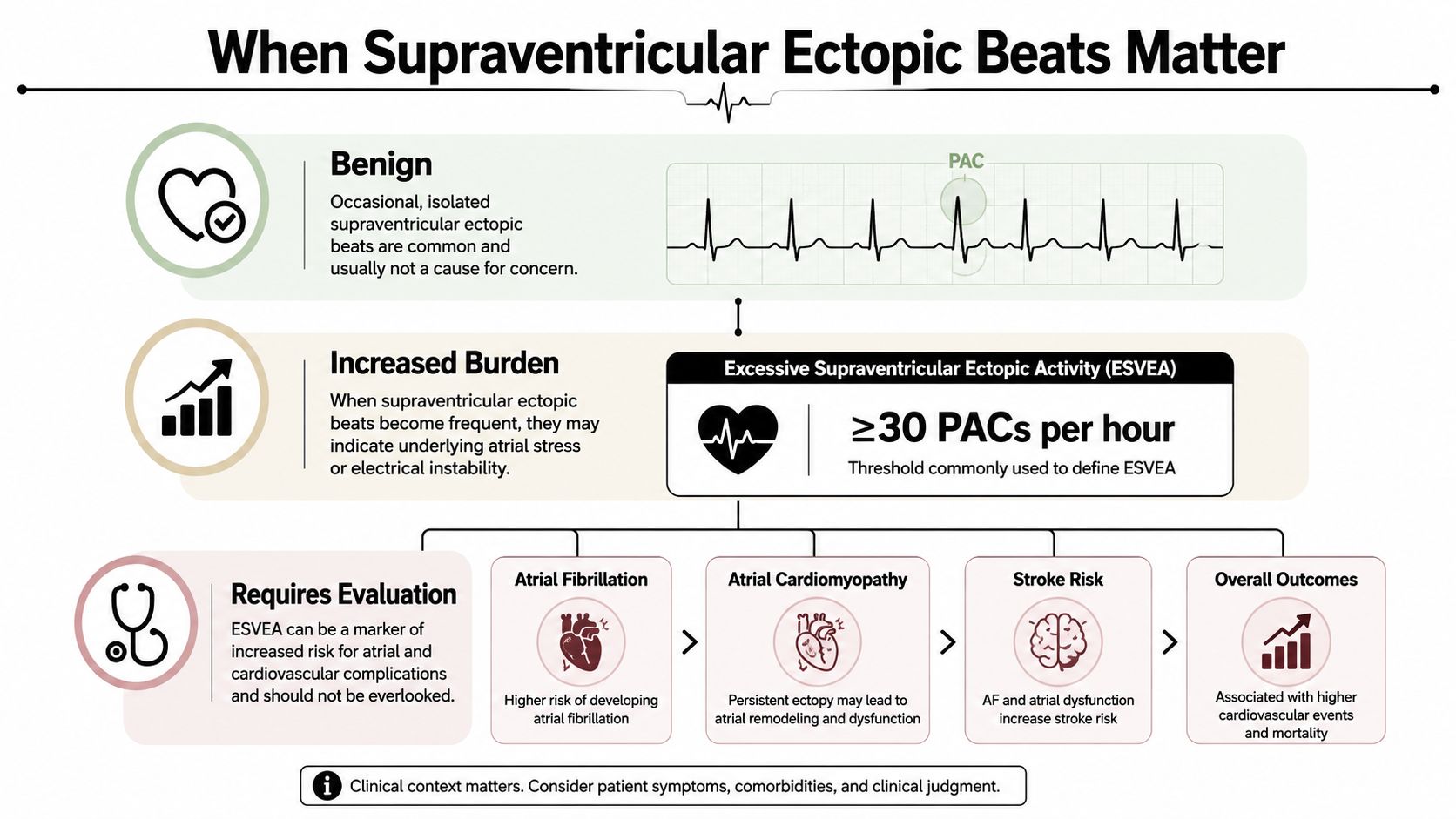
A simple way to think about the decision line
- Occasional and isolated: usually reassuring, especially if you feel otherwise well.
- Frequent or daily: worth paying attention to, especially if the pattern keeps showing up.
- Frequent plus symptoms: worth a clinician conversation, particularly with dizziness, chest discomfort, or breathlessness.
- High burden on a wearable: a reasonable reason to ask about longer AF screening, not just reassurance.
A 2025 postoperative study also found that supraventricular ectopic activity predicted postoperative AF, incident new-onset AF, and worse clinical outcomes, with AF incidence rising as PAC burden worsened. Frequent ectopy starts to look less like a random annoyance and more like a decision signal that may justify closer rhythm follow-up (2025 cohort study).
If you want a place to organize symptoms, ECGs, and notes before a visit, the Family Folder health hub can help keep the paperwork side from becoming its own stressor.
Get your ECG checked by certified experts within minutes on the Qaly app.


Using Wearables and Human-Reviewed ECG Analysis
A smartwatch ECG gives you a short snapshot. It captures a slice of rhythm, which is helpful when the flutter happens during that exact window, but it cannot show the whole day's pattern. A clean strip or two does not erase a real problem, and a messy strip or two does not define one either.
The useful habit is to treat each recording like a clue. Save the beat when the flutter starts, note what was happening right before it, and keep the context with it. Coffee, poor sleep, stress, exercise, and hydration all matter because they help connect the rhythm to real life instead of to vague worry.

Human review adds another layer. Qaly is one option that lets users upload wearable ECGs for technician review, along with narrative feedback and interval readings that are easier to bring into a clinician visit. It does not replace a doctor, but it does turn scattered strips into something more organized and shareable.
Useful habit: do not send one lonely tracing and hope it explains everything. Send the tracing, the time, the trigger, and how you felt.
That matters because frequent supraventricular ectopic activity can be more than a harmless blip. As noted earlier, a 2025 postoperative cohort linked increasing PAC burden with postoperative AF, incident new-onset AF, and worse outcomes. For people whose wearables keep picking up early beats, that is a reason to think about longer AF screening rather than simple reassurance. The wearable does not just say something happened. It helps show whether it is happening again and again.
Putting It All Together Without Losing Sleep
A few supraventricular ectopic beats are usually a normal quirk of a heart that's reacting to age, stress, caffeine, dehydration, or simple electrical variability. Frequent or symptomatic beats are different. They're not a reason to panic, but they are a reason to pay attention.
The hardest part is often psychological, not electrical. One watch alert can make a person feel powerless, especially when the healthcare system has already dismissed palpitations in the past. A better approach is to treat each ectopic beat as data, not danger.
Wearables give you the first piece of that data. Human-reviewed ECG analysis helps turn the strip into a readable pattern. A clinician then decides whether the pattern fits reassurance, follow-up, or extended AF screening.
That shift matters. It changes the watch from a source of random anxiety into a tool for informed self-advocacy. If your watch keeps flagging early beats, bring the rhythm strips, your trigger notes, and your questions to a clinician you trust, and ask what the pattern means for you.
Seeing early beats on your ECG? Certified experts review your ECG within minutes.


