


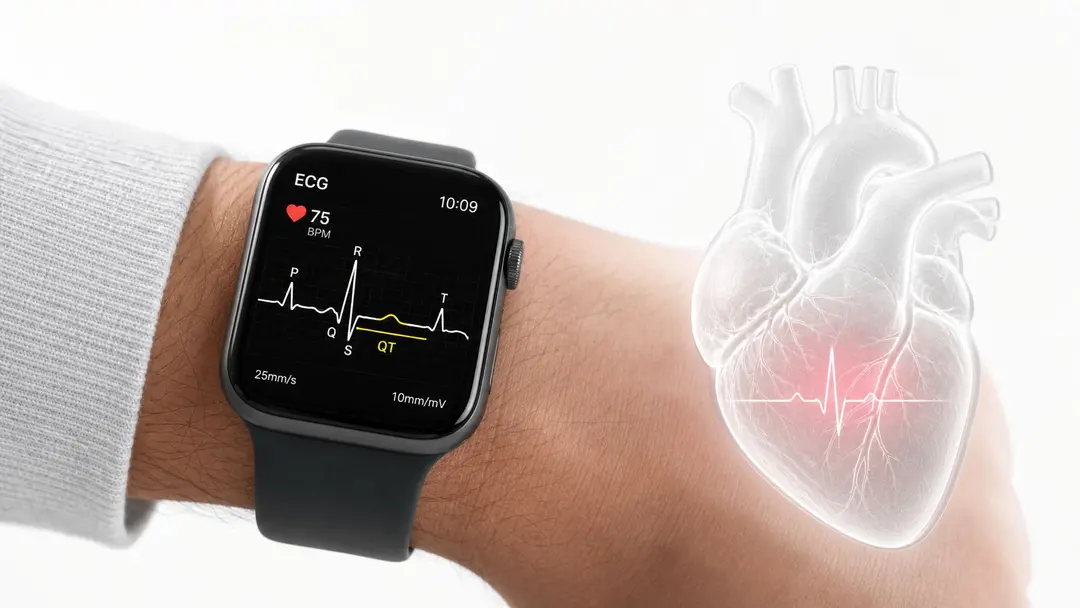


Hello Heart Hero. If your QTc is above about 450 ms in men or 470 ms in women, clinicians usually treat it as prolonged, and readings above 500 ms are widely seen as especially concerning because they raise the risk of dangerous rhythms like torsades de pointes.
That number on your watch can feel abrupt, especially if you were just checking for curiosity, after starting a new medication, or because heart rhythm problems run in your family. QTc is the heart-rate-adjusted time it takes your heart's lower chambers to reset between beats, and that single number matters because it can flag risk before a rhythm turns unstable.
Hello Heart Hero and What This Guide Covers
A strange watch reading can send your mind in two directions at once. One part of you wants to shrug it off, the other part starts searching every symptom and medication you've ever had.
That's a normal reaction. If you're here because your watch showed a QTc number you didn't expect, or because a new prescription made you wonder whether your heart rhythm could change, you're in the right place.
QTc is best thought of like a recovery timer. Your ventricles fire, then they reset, and QTc tells you how long that reset takes after adjusting for heart rate, so the number is more useful than a raw QT reading when the heart is beating faster or slower. It's not a verdict by itself, it's a signal that helps you decide whether to watch closely, ask questions, or get checked.
Practical rule: a QTc reading is most useful when you read it in context, with your symptoms, medications, and the trend over time.
You'll see where QT lives on the ECG tracing, why correction formulas exist, why different websites give different “normal” ranges, and what can push QTc higher or lower. You'll also get a grounded sense of what your watch can tell you, what it can't, and how to track a number without spiraling over one odd reading.
The Anatomy of a Heartbeat and Where QT Hides
A watch ECG is only a tiny strip of line, but it is trying to show the shape of a full heartbeat. The landmarks are the familiar P, QRS, and T waves, and QT runs from the start of the QRS complex to the end of the T wave.
The reset phase inside the beat
The QRS complex is the instant the ventricles contract. The QT interval covers the electrical burst and the quiet recovery that follows, so it reflects how long the lower chambers take to reset before the next beat. In plain language, it is the recharge time.
Squeezing a tube of toothpaste illustrates the idea clearly, the squeeze is depolarization, and the return to shape is repolarization. QT measures that whole recovery window from start to finish.
Any delay in the reset makes the QT interval longer. A faster reset shortens it. The raw number can shift from one moment to the next even in a healthy heart, because heart rate changes the timing.
Why the QT interval is corrected
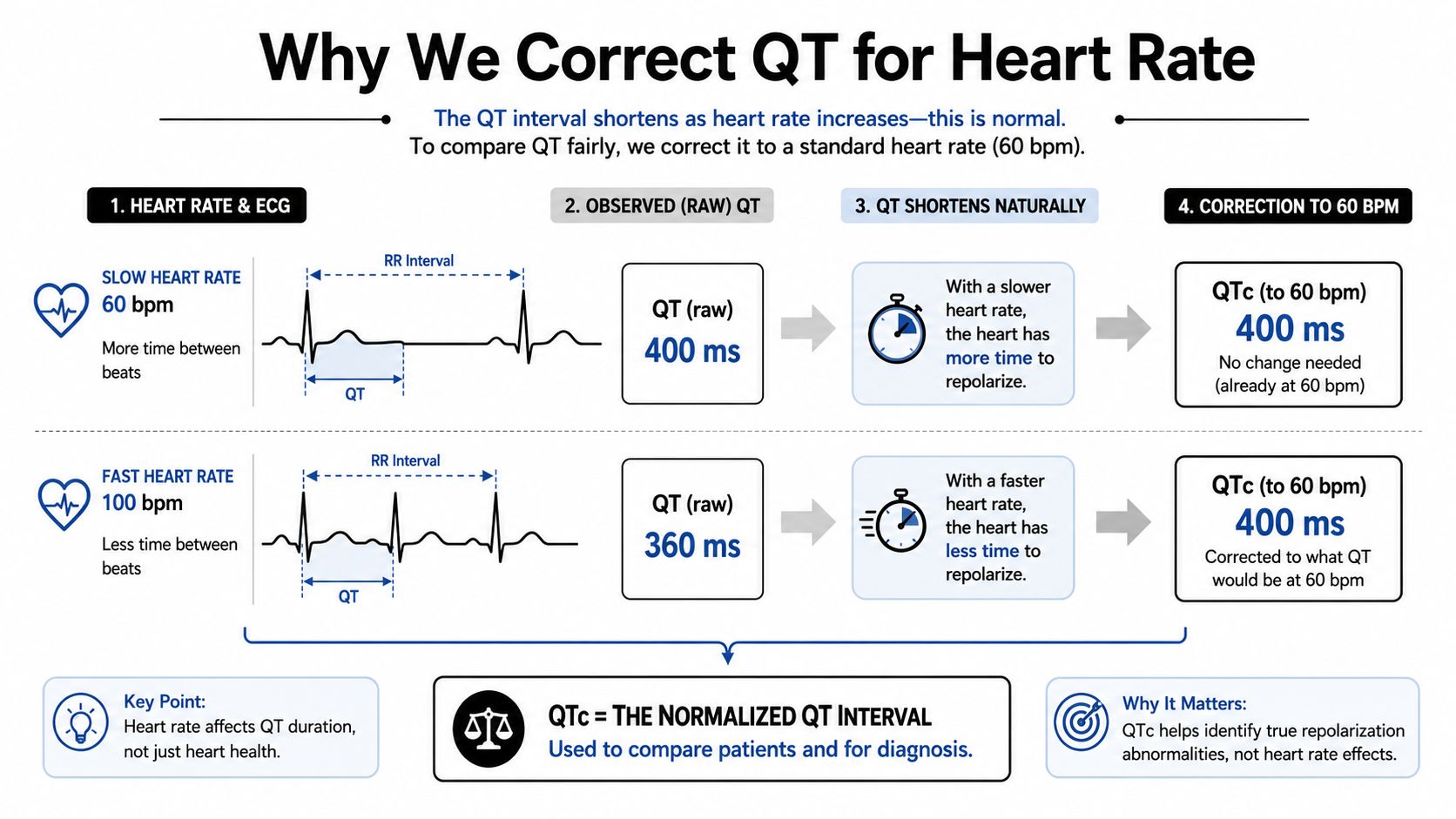
That changing timing is why clinicians use QTc, the corrected QT interval. A raw QT taken during a slow pulse can look longer than the same heart would show during a faster pulse, so the correction tries to put the number onto a common heart-rate footing.
If you can picture the tracing, QT is the full recovery stretch after the QRS spike. QTc is the adjusted version that lets a clinician compare one tracing with another without being misled by a faster or slower pulse.
The simplest way to read it is this. The raw QT shows what happened on that beat, while QTc shows how unusual the recovery really is once heart rate is accounted for. That is why QTc becomes the number people track, not raw QT alone.
If you want to see the measurement steps laid out in a plain way, this guide to calculating QT interval walks through the basics.
Why We Correct QT for Heart Rate
A watch reading can look different just because your pulse changed. That is why QTc matters. The raw QT stretches and shrinks with heart rate, so the corrected value gives you a steadier number to compare across readings.
The logic behind the correction
QTc is the cleaned-up version of that timing. A tracing taken during a slow pulse can look longer than the same heart would look during a faster pulse, so correction helps separate heart-rate effects from the recovery pattern itself.
One common method is Bazett's formula, which adjusts QT using the square root of the preceding RR interval. It is widely used because it is simple and built into many ECG systems. Another option is Fridericia's formula, which many clinicians prefer when the heart rate is far from average because it can behave better at the extremes.
There are other formulas too, including Framingham and Hodges. That is why the same watch ECG and clinic ECG can give slightly different QTc values, even when both are measuring the same heartbeat. The formula used matters as much as the number itself.
If you are comparing a wearable result to a clinical report, check how each one calculated QTc. A small difference does not automatically mean the wearable is wrong. It may be using a different correction method, or measuring from a tracing recorded under different conditions.
For a plain explanation of the measurement steps, How QT interval calculations work in practice shows the process clearly.
What correction actually changes
Correction does not make the heart “more normal.” It makes the comparison cleaner. That matters because QTc is the number clinicians usually use when thinking about medication safety, follow-up, and whether a reading deserves a closer look.
A raw QT is still useful as a snapshot of one beat. QTc gives that snapshot a common frame so you can compare one reading with another without heart rate distorting the picture. That is especially helpful if you are watching a trend on a consumer wearable, because a single off-looking value may just reflect a faster or slower pulse at the time.
In everyday terms, QTc is the standardized lens. Raw QT is the snapshot. If your wearable ECG looks different from a clinic printout, the corrected value is usually the one that carries the most clinical weight.
Normal QTc Ranges and How to Read Them
Many people get stuck, because the internet doesn't agree with itself. One site may say one thing, another site gives a different cutoff, and suddenly a borderline reading feels like a crisis.
Why the ranges don't match perfectly
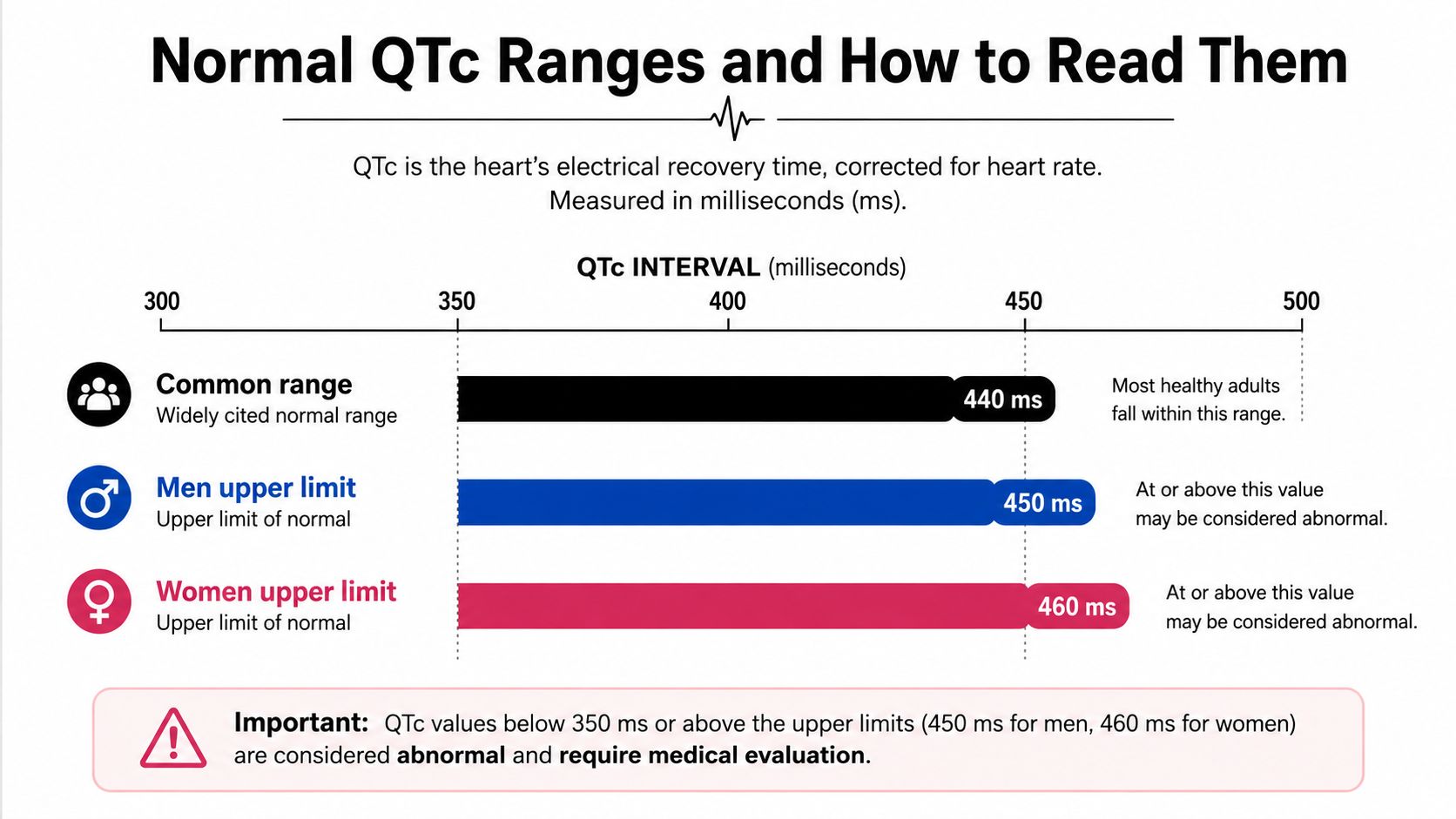
Adult QTc values are commonly described as roughly 350 to 440 ms in some references, while other sources use upper limits around 450 ms in men and 460 ms in women. The European Society of Cardiology also uses a newer diagnostic approach of QTc ≥480 ms, or QTc ≥460 ms in a symptomatic person, in certain contexts as summarized in the QTc reference discussion.
Those differences happen because studies use different populations, different formulas, and different clinical goals. A screening cutoff for a general population won't always match a threshold used when someone already has symptoms or a suspected inherited rhythm disorder.
The best way to read your number is to ask three questions at once. What was the QTc value, what was happening when it was recorded, and were you having symptoms or taking a drug that can affect repolarization?
Helpful frame: a borderline number can mean “watch this,” not “something is definitely wrong.”
How to compare your reading without panicking
If your watch shows a QTc near a cutoff, don't judge it in isolation. A reading that sits just outside one reference range may still fall inside another, and the difference can come from the formula or the device rather than from a sudden change in your heart.
That's why context matters more than a single screenshot. If you were resting, calm, and not on any new medication, a repeat tracing may give a clearer picture. If you were symptomatic, the same number deserves more attention.
The main takeaway is simple. QTc ranges are guides, not verdicts, and the right response depends on the combination of value, symptoms, and clinical history.
What Can Make QTc Too Long or Too Short
A prolonged QTc can show up for reasons people can act on. Sometimes it starts with a medication you just began, sometimes it reflects a body chemistry issue, and sometimes it points to an inherited rhythm tendency that was already there.
Common reasons QTc drifts longer
Many medications can lengthen QTc, including some antibiotics, antidepressants, antiarrhythmics, and antipsychotics. Electrolyte problems such as low potassium or low magnesium can also make the interval longer, and that's one reason clinicians pay attention when people have vomiting, dehydration, or diuretic use.
Other causes include thyroid problems and structural heart disease. If you're reading a long QTc on a watch, the most useful question is often not “Is this a disaster?” but “What changed recently?” A new prescription, a dose increase, or a recent illness can matter.
Long QT syndrome is the inherited side of the picture. It's estimated to affect about 1 in 2,500 to 1 in 10,000 people, and some people only learn about it after an ECG is done for another reason. Short QT syndrome exists too, but it's much rarer and gets far less attention in consumer conversations.
If you want a medication-focused walkthrough, the citalopram week-by-week guide is a useful example of how a common antidepressant can come up in real-world monitoring conversations.
Why the medication question matters
A drug-related QTc change is often a conversation, not a crisis. Many people see a medication name on their list and immediately assume the worst, but the right next step is usually to review timing, symptoms, and whether the reading repeats.
For a broader overview of contributors, the Qaly summary on QT prolongation causes is a practical reference point. It helps connect the number on a watch to the things that can push it upward in daily life.
The important thing is that QTc is sensitive. That sensitivity is useful because it can alert you to a change early, but it also means a single value should never be read like a standalone diagnosis.
Get your ECG checked by certified experts within minutes on the Qaly app.


Symptoms, Risks, and When to Act Fast
A prolonged QTc matters because of the rhythm it can set up. Torsades de pointes can start with sudden dizziness, palpitations, or fainting, and in the worst case it can lead to cardiac arrest.
What risk can feel like in real life
A person might feel fine at breakfast, then get lightheaded while walking across a room. Another person notices pounding or skipped beats after starting a new medicine. If fainting happens during exertion or strong emotion, treat that as a red flag and get urgent medical attention.
A watch reading is most useful here as a pattern, not a verdict. A single prolonged value can be a noisy snapshot, while repeated readings that stay high deserve more respect, especially if symptoms are showing up at the same time.
If the number looks off, the next question is whether it matches the moment. Was there motion, poor skin contact, a fast pulse, or a recent change in medication or illness? If the answer is yes, repeat the reading and look for a trend instead of reacting to one trace alone. If you want a practical example of how consumer ECG review can work, the guide to ECG for Apple Watch shows how a wearable tracing can be checked more carefully before you act on it.
These situations call for fast action:
- Fainting or near-fainting: especially if it happens with exertion, stress, or palpitations.
- Chest pain or sustained palpitations: do not wait for the next scheduled appointment if the rhythm feels stuck or unstable.
- A new medication plus a borderline reading: ask a clinician or pharmacist to review whether the drug can affect QT.
- Any QTc over 500 ms: that level is widely treated as especially high risk for torsades de pointes and other malignant arrhythmias as summarized in the QT interval reference material.
Why the number still deserves respect
In one large general-population study, abnormal QTc prolongation was linked to a 2.5-fold higher risk of sudden cardiac death after adjustment for major risk factors, with an incidence of about 3 sudden cardiac deaths per 1,000 person-years and an attributable risk proportion of 0.6. The same study found an eight-fold increased risk in people below the median age of 68 years, which is why QTc is more than a technical ECG detail.
That does not mean every prolonged reading is dangerous right now. It does mean the number should be taken seriously, especially if it keeps showing up, appears after a medication change, or shows up alongside symptoms. If you are a clinician, technician, or device team trying to build a manufacturable IoT device, that same principle applies to alert design too, because a QTc flag is only useful when it helps people notice a real change without overreacting to noise.
Wearables and Clinical ECGs Compared
A watch can catch something worth attention, but it cannot stand in for the full picture. That middle ground matters because QTc depends heavily on signal quality, and the cleaner the tracing, the more confidence you can place in the number.
What a wearable can do well
Single-lead devices like Apple Watch, Fitbit, Kardia, Samsung, and Withings can show QTc readings and are useful for spotting patterns over time. If a symptom keeps showing up, a wearable gives you a way to capture the moment it happens instead of trying to remember it later. It turns a fleeting episode into something you can compare.
The trade-off is precision. Single-lead tracings are more sensitive to motion and noise, and they can be less reliable than a full 12-lead ECG, especially at very high or very low heart rates. That does not make them useless. It means they work better as a trend tool and an early flag than as the final word.
Where the clinical ECG still wins
A 12-lead ECG remains the gold standard for diagnosis because it gives a fuller view of the heart's electrical activity. That wider view helps clinicians measure intervals with more confidence and see patterns that a watch can miss.
A human-reviewed service can sit between the two. Qaly connects wearable ECGs to certified cardiographic technicians for reviewed interval readings, including QTc, which can help translate a consumer tracing into something more usable before you see a clinician. If you want a practical walkthrough of how watch tracings are used in real life, the article on ECG for Apple Watch is a useful place to start.
If you are building a medical device or any connected health workflow, how to build a manufacturable IoT device shows how much care goes into making sensor data reliable enough to trust.
The simplest rule is this. Use your watch to notice, repeat, and follow trends. Use a clinical ECG to confirm and diagnose.
Your Practical QTc Monitoring Playbook
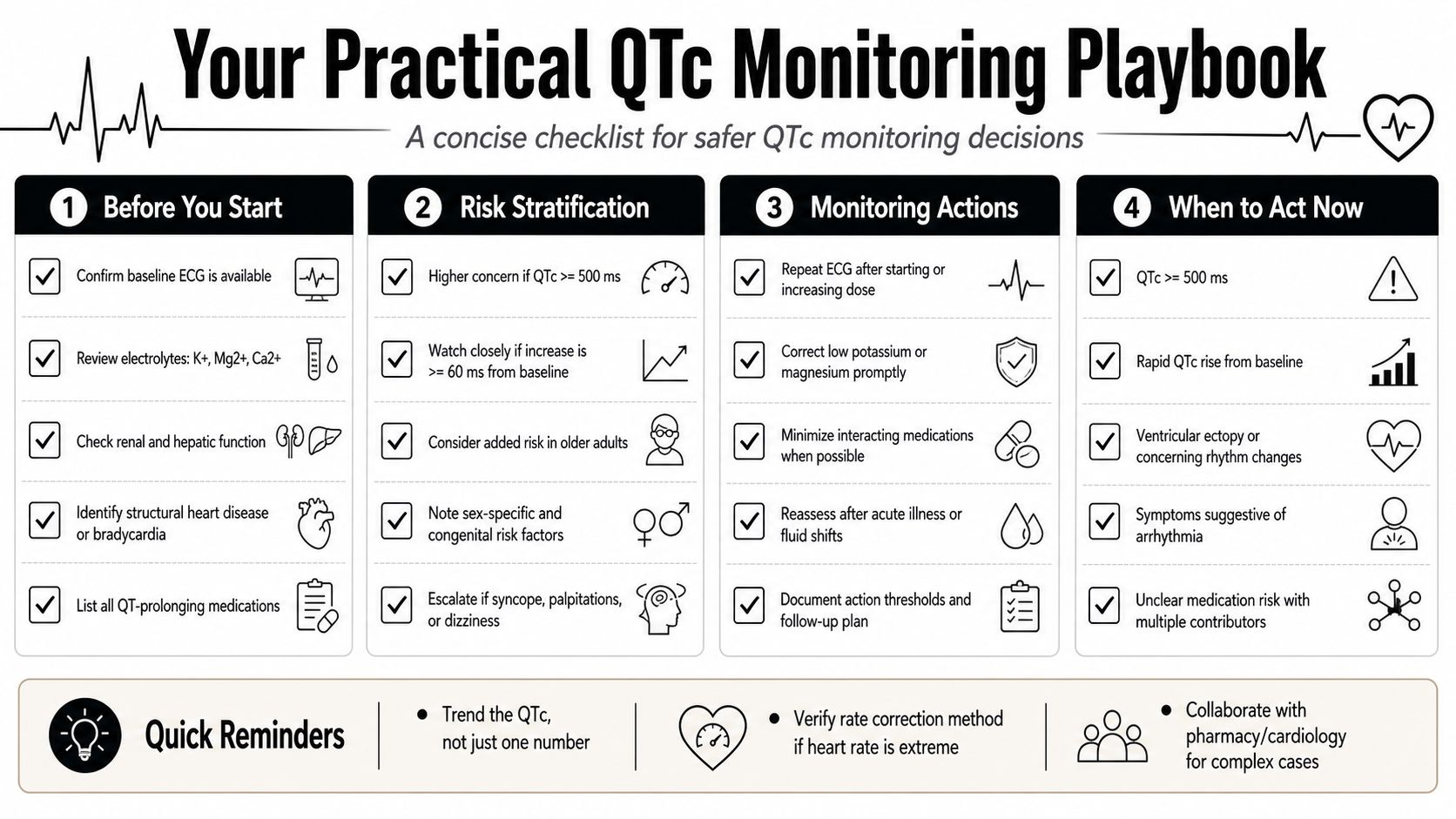
A good QTc routine is calm, repeatable, and boring in the best way. You're trying to reduce noise so the number reflects your heart, not your posture, movement, or stress level.
How to get a cleaner reading
Sit down first and let your arm rest. Keep still while the tracing runs, because motion can blur the signal and make the interval harder to read. If you just had caffeine, wait and repeat later if the number looks odd, since a calm, steady recording is easier to compare over time.
If a reading looks off, repeat it instead of assuming the first one is the truth. Wearables are much more useful when you treat them like a trend tool, not a one-off verdict.
What to track over time
Write down the QTc number, the time of day, what you were doing, and whether you had symptoms. That context turns a random screenshot into a pattern your clinician can use.
If you want a way to organize the data, the free QTc calculator can help you check a corrected value from a tracing before you share it. Services that offer human review can also help bridge the gap between a consumer ECG and a clinic interpretation.
A steady habit beats a single panic
- Record the setting: note rest, symptoms, and any recent medication changes.
- Repeat suspicious tracings: one noisy reading shouldn't outweigh a cleaner second attempt.
- Share trends, not just snapshots: the pattern matters more than one number.
- Ask about new drugs early: don't wait until a long reading becomes a surprise.
QTc is information, not a diagnosis. If you keep your recordings steady and your questions specific, you'll give yourself the best chance of turning a worrying number into a useful conversation.
If your watch keeps showing a borderline or prolonged QTc, don't sit on the uncertainty. Save a few clean tracings, note your symptoms and medications, and bring the pattern to a clinician or a human-reviewed ECG service so you can get a clearer read on what's happening.
Unsure about an ECG? Certified experts review it within minutes, day or night.


